The picks
Best fans for white noise
Every other page here treats fan noise as a problem. On this one it is the product, and that inverts which specification matters.
By Sawyer V. · Published
The short answer
For masking sound you want a fan whose noise is constant, not one that is quiet. The Air King 9145 runs 34 to 37 dBA — a three-decibel spread across its whole range, so it sounds identical whatever you do to it. For a bigger, warmer sound the Lasko Cyclone 2554 at 720 CFM gives you volume to work with. Avoid variable-speed and auto modes entirely: a changing sound wakes people, a steady one does not.
Fan & Frost earns a commission when you buy through our links, at no cost to you. It never changes a ranking, and we say so when the right answer is the cheaper unit or nothing at all. Full disclosure · How we pick.
At a glance
The picks, ranked
Tap any row to jump to the full reasoning. Prices are live from Amazon where we have them, and read “check price” where we don’t — never a number we cannot verify today.
| # | Product | Best for | Price |
|---|---|---|---|
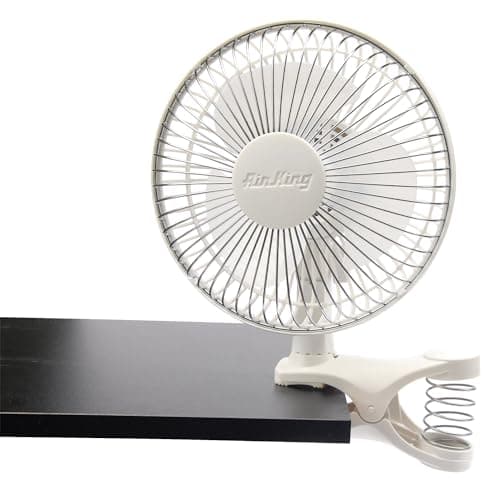
| 1 | Steadiest sound Air King 6" Commercial Grade Clip-On Fan 34 dBA low, 37 dBA high — a three-decibel spread, the narrowest of any fan we hold figures for. | Consistent masking that does not change when you adjust it | |
| 2 |  Most sound to work with Lasko Wind Curve 42" Tower Fan 720 CFM — the most published airflow of any fan here, and airflow is what generates the broadband sound. | Masking a genuinely noisy street, or a shared wall | |
| 3 | 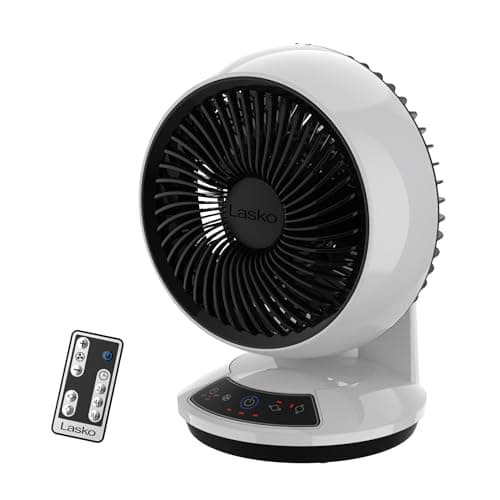 Most adjustable sound level Lasko Whirlwind Tilt 12" Table Fan 39 to 55 dBA published across three speeds — a genuine range to choose from, with a 50-foot throw. | Finding your own level, then leaving it there | |
| — | The features that work against you here Lasko Aria 40" Smart Wi-Fi Tower Fan 31.5 to 48.7 dBA with app control and scheduling — genuinely good, and the wrong shape for sound masking. | Daytime use in a living room, not overnight masking |
Everywhere else on this site, fan noise is a defect to be minimized. If you are here for white noise, it is the feature you are buying — and that inverts which specification you should be reading.
The inversion
Steady beats quiet
Sound masking works because the brain filters constant, featureless sound out of conscious attention within minutes, while raising the level that an intrusive sound must exceed before it registers.
Both halves of that depend on the sound being unchanging. A constant 40 dBA rush is gone from your awareness in five minutes. A sound that varies never fully habituates, because every change is a new event to evaluate.
Which produces a shopping criterion nobody prints on a box: the narrower a fan’s dBA range, the better it masks, almost independently of where in the range it sits.
| Fan | Low | High | Spread |
|---|---|---|---|
| Air King 9145 clip-on | 34 dBA | 37 dBA | 3 dB |
| Lasko Whirlwind A12107 | 39 dBA | 55 dBA | 16 dB |
| Lasko Aria T40733 | 31.5 dBA | 48.7 dBA | 17.2 dB |
| Lasko EcoQuiet T42710 | 23 dBA | 46 dBA | 23 dB |
| Midea Duo portable AC | 43 dBA | — | single figure |
Manufacturer-published figures. There is no certification program for portable fans, so test conditions are not standardized between brands.
The EcoQuiet has the best low-end figure on the site at 23 dBA and is our first recommendation for a quiet bedroom. For masking specifically it is the least suitable fan in that table, because 23 dBA is barely above a quiet room’s own noise floor and there is nothing to mask with.
The other half
Broadband sound, not tonal sound
Level is only part of it. What you want is a broad, featureless rush — energy spread across many frequencies at once. That is what actually masks speech and traffic, because it competes with them across the whole spectrum.
What you do not want is a tone: a hum, a whine, a rhythmic beat. Tonal noise has structure, structure attracts attention, and a fan with a bearing whine is more disruptive at 35 dBA than a clean rush at 45.
Practical implications when choosing:
- Bigger, slower blades sound better than small fast ones. High tip speed concentrates energy at higher frequencies and produces more of a whistle than a rush.
- A clean fan sounds better than a dusty one. Uneven dust loading introduces a per-revolution beat you will hear even when you cannot consciously identify it. Worth doing before you conclude a fan is wrong.
- Avoid oscillation. A sweeping head modulates the sound with a slow period, which is exactly the structure you are trying not to have. More on what oscillation does.
- A worn bearing is a tone. If a fan has developed a whine, it is no longer a masking fan regardless of its rating.
This one is not a DIY job
We are not going to tell you a safe sound level. Whether a given level is appropriate overnight — particularly for a child, and particularly close to a bed — is a question for a pediatrician or an audiologist, not a site that reviews fans.
What we can say is that distance is your main control. Sound falls off sharply with distance, so a fan across the room at a higher setting can produce a lower level at the bed than a quieter fan on the nightstand, while masking better across the whole space.
If the fan is for a nursery, the placement rules there are strict and separate. We cover them properly on the nursery page — nothing on or above the crib, and no cords within reach.
Setup
Placement and settings
Put it between you and the noise. If the disturbance comes from a street, a hallway or a shared wall, the fan belongs on that side. Masking works better close to the source of the intrusion than close to the listener.
Get it off the floor. Carpet and furniture absorb sound, and a fan at floor level loses much of its output before it reaches ear height. A shelf, a chest of drawers or a wall mount all work better.
Aim it away from the bed. You want the sound, not the draft — and a fan blowing on you all night dries eyes and throats. Point it at a wall; the sound fills the room regardless.
Set one speed and disable everything else. No auto mode, no timer that switches it off at 2am, no sleep mode that steps the speed down. Every one of those is a change, and changes are what wake people.
Say the unwelcome thing
Do not buy a fan on a timer or a sleep mode for white noise.
Timers and sleep modes are sold as energy-saving features and they are fine for that. For masking they are actively harmful.
A fan that switches off after four hours removes the mask at exactly the point in the night when sleep is lightest. The sounds it was covering — a road, a boiler, a housemate — are suddenly audible again, and the silence itself is a change.
The running cost argument for a timer does not survive contact with the numbers either. A clip-on fan at 9 to 12 W costs 1.8¢ for a full eight-hour night. There is nothing to save.
Buy a fan you can set once and leave, and if it has a timer, do not use it.
In full
Every pick, and what is wrong with it
Published specifications only, each linked to the page it came from. Where a manufacturer publishes nothing, the row says so — we do not fill blanks in.
1. Steadiest sound
Air King 6" Commercial Grade Clip-On Fan
Air King · model 9145
34 dBA low, 37 dBA high — a three-decibel spread, the narrowest of any fan we hold figures for.
34 dBA to 37 dBA. Three decibels between its quietest and loudest settings, against 23 dBA to 46 on a good tower fan — a 23-decibel spread.
That narrowness is the whole point here. A fan used for masking should sound the same at 2am as it did at 11pm, and the same after somebody nudges the switch. This one effectively cannot change.
9 to 12 W — about 1.8¢ for an eight-hour night. The spring-loaded clip mounts it on a shelf or a headboard rail rather than taking floor space, and it is ETL listed and OSHA compliant, which is a commercial specification on a small product.
Up to 190 CFM and 2.22 lb. Masking, not cooling.
What’s wrong with it
190 CFM from a 6-inch blade is personal airflow, so it masks well but does not do much for a warm room.
Running cost — 9145
| Nameplate power | 9 W – 12 W | manufacturer's published figure |
|---|---|---|
| Energy, 8-hour night | 0.10 kWh | 12 ÷ 1000 × 8 |
| Cost per hour | 0.2¢ | at 18.34¢/kWh |
| Cost per 8-hour night | 1.8¢ | on the highest speed |
| Cost per 30 nights | 53¢ | 2.9 kWh |
| Same month, lowest speed | 40¢ | at 9 W |
Rate: 18.34¢/kWh, the US average residential price for June 2026 (EIA Electric Power Monthly, Table 5.3). Yours will differ — swap it in: (watts ÷ 1000) × hours × your rate.
| Power | 9 W - 12 W (0.1-0.2 A at 120 V) |
|---|---|
| Air delivery | Up to 190 CFM |
| Noise | 34 dBA low, 37 dBA high |
| Speeds | 2 |
| Mounting | Spring-loaded clip, non-marking |
| Dimensions | 10.38 H x 6.25 L x 8.13 W in |
| Weight | 2.22 lb |
| Cord | 6 ft, 3-conductor |
| Listing | ETL listed, OSHA compliant |
| Warranty | 1 year |
Every figure above is from Air King product page, 9145 (via Lasko). Blanks are shown as “not published” rather than filled in.
2. Most sound to work with
Lasko Wind Curve 42" Tower Fan
Lasko · model 2554
720 CFM — the most published airflow of any fan here, and airflow is what generates the broadband sound.
Sound masking works by raising the noise floor until intrusive sounds no longer stand out above it. Against traffic, a shared wall or a household with different schedules, a quiet fan simply does not have enough signal to hide anything.
720 CFM is the highest published airflow on this site, and airflow is what produces the sound — a large volume of air across blades and through a guard is exactly the broadband rushing noise that masks well.
The pedestal format helps too: raising the head to bed height puts the sound source in the same plane as your ears, rather than down at floor level where furniture absorbs it.
Be clear on the gaps. No published dBA and no published wattage. This is the loud option chosen on airflow, not on a measured sound figure.
What’s wrong with it
Lasko publishes no dBA for it, so you are buying the sound unheard, and no wattage either.
Running cost — 2554
| Nameplate power | 37 W – 49 W | manufacturer's published figure |
|---|---|---|
| Energy, 8-hour night | 0.39 kWh | 49 ÷ 1000 × 8 |
| Cost per hour | 0.9¢ | at 18.34¢/kWh |
| Cost per 8-hour night | 7.2¢ | on the highest speed |
| Cost per 30 nights | $2.16 | 11.8 kWh |
| Same month, lowest speed | $1.63 | at 37 W |
Rate: 18.34¢/kWh, the US average residential price for June 2026 (EIA Electric Power Monthly, Table 5.3). Yours will differ — swap it in: (watts ÷ 1000) × hours × your rate.
| Power | 37 W - 49 W (0.4 A at 120 V) |
|---|---|
| Air delivery | 720 CFM |
| Speeds | 3 |
| Height | 42.5 in |
| Footprint | 13 x 13 in |
| Weight | 10.62 lb |
| Timer | 7.5-hour auto-off |
| Noise | Not published |
| Warranty | 1 year |
Every figure above is from Lasko product page, 2554. Blanks are shown as “not published” rather than filled in.
3. Most adjustable sound level
Lasko Whirlwind Tilt 12" Table Fan
Lasko · model A12107
39 to 55 dBA published across three speeds — a genuine range to choose from, with a 50-foot throw.
The opposite design philosophy to the Air King, and useful for the opposite reason. 39 dBA low, 55 dBA high gives you three genuinely different sound levels to pick between.
That matters because masking requirements vary enormously. A quiet suburb needs very little; a room facing a main road needs a lot. A fan with one usable level either fails to mask or is itself the problem.
18 to 32 W — 4.7¢ for a night at full — and a 50-foot air throw from a 12-inch table fan, which is why it can sit across the room rather than beside the bed.
Wall-mountable (hardware not included), which gets it off the nightstand and up where the sound spreads better.
What’s wrong with it
A 16-decibel spread is the opposite of steady, so it only works if you set it once and never touch it.
Running cost — A12107
| Nameplate power | 18 W – 32 W | manufacturer's published figure |
|---|---|---|
| Energy, 8-hour night | 0.26 kWh | 32 ÷ 1000 × 8 |
| Cost per hour | 0.6¢ | at 18.34¢/kWh |
| Cost per 8-hour night | 4.7¢ | on the highest speed |
| Cost per 30 nights | $1.41 | 7.7 kWh |
| Same month, lowest speed | 79¢ | at 18 W |
Rate: 18.34¢/kWh, the US average residential price for June 2026 (EIA Electric Power Monthly, Table 5.3). Yours will differ — swap it in: (watts ÷ 1000) × hours × your rate.
| Power | 18 W - 32 W (0.24-0.5 A at 120 V) |
|---|---|
| Noise | 39 dBA low, 55 dBA high |
| Air distance | 50 ft |
| Speeds | 3 |
| Dimensions | 11.19 H x 11.4 W x 6.2 D in |
| Weight | 2.78 lb |
| Mounting | Wall-mountable (hardware not included) |
| Air delivery (CFM) | Not published |
| Warranty | 1 year |
Every figure above is from Lasko product page, A12107. Blanks are shown as “not published” rather than filled in.
Skip this one
Lasko Aria 40" Smart Wi-Fi Tower Fan
Lasko · model T40733
31.5 to 48.7 dBA with app control and scheduling — genuinely good, and the wrong shape for sound masking.
A good fan being recommended against for one specific use. Its problem is its best feature.
Scheduling, app control and voice assistants mean the fan can change speed while you are asleep. For sound masking that is the worst possible behavior — the brain habituates to a constant sound and stops attending to it, then registers any change as an event.
A fan that steps down at 3am does not gently fade out. It removes the mask, unveiling the sounds it was covering, and the change itself is a stimulus.
31.5 to 48.7 dBA across five speeds. If you buy it, set one speed manually and disable every automation. Its real case is daytime scheduling.
What’s wrong with it
Scheduling and auto modes change the sound during the night, and a change in masking noise is exactly what wakes people.
Running cost — T40733
| Nameplate power | 41 W – 52 W | manufacturer's published figure |
|---|---|---|
| Energy, 8-hour night | 0.42 kWh | 52 ÷ 1000 × 8 |
| Cost per hour | 1.0¢ | at 18.34¢/kWh |
| Cost per 8-hour night | 7.6¢ | on the highest speed |
| Cost per 30 nights | $2.29 | 12.5 kWh |
| Same month, lowest speed | $1.80 | at 41 W |
Rate: 18.34¢/kWh, the US average residential price for June 2026 (EIA Electric Power Monthly, Table 5.3). Yours will differ — swap it in: (watts ÷ 1000) × hours × your rate.
| Power | 41 W - 52 W (0.3-0.44 A at 120 V) |
|---|---|
| Air delivery | 460 CFM |
| Noise | 31.5 dBA low, 48.7 dBA high |
| Speeds | 5 |
| Smart control | Aria for Home app (iOS/Android), Amazon Alexa, Google Assistant |
| Height | 39.58 in |
| Footprint | 11.2 x 11.2 in |
| Weight | 9.5 lb |
| Timer | 9 hours |
| Oscillation | 90 degrees |
| Remote | Not included |
| Warranty | 2 years |
Every figure above is from Lasko product page, T40733. Blanks are shown as “not published” rather than filled in.
We are not linking a buy button for this one. If you want to look at it anyway, it is easy enough to find — but we would rather send you to something that fits your room.
Questions people actually ask
Frequently asked
What makes a good white noise fan?
A constant, broadband sound rather than a quiet one. The narrower a fan's dBA range across its speeds, the better it masks — the Air King 9145 spans just 3 dB from low to high, against 23 dB on a variable-speed tower fan.
Is a quieter fan better for sleep?
For sleeping through, yes. For masking outside noise, no — a 23 dBA fan sits barely above a quiet room's own noise floor and has nothing to mask with. Those are two different goals and they point at different fans.
Should a white noise fan oscillate?
No. A sweeping head modulates the sound with a slow, regular period, and that structure is exactly what prevents the brain habituating to it. Set the fan fixed and aimed at a wall.
Where should I put a fan for white noise?
Between you and the noise source, off the floor, and aimed away from the bed. Masking works better near the intrusion than near the listener, carpet absorbs floor-level sound, and you want the noise rather than the draft.
Why does my fan sound worse than it used to?
Usually dust. Uneven loading on the blades introduces a per-revolution beat — structured sound rather than a clean rush — which is more disruptive than a higher but featureless level. A worn bearing produces a tone and has the same effect. Cleaning a fan.
Should I use a sleep timer with a white noise fan?
No. Switching off partway through the night removes the mask when sleep is lightest, and the change itself is a stimulus. At 9 to 12 watts a small fan costs a fraction of a cent to run all night, so there is nothing to save.
Sources
Where these numbers came from
Read next
Where to go from here
Back to Fans, or read how we pick.