Head to head
Mini-split vs portable air conditioner
The same room, the same heat, and a two-and-a-half-fold difference in what you pay to remove it.
By Sawyer V. · Published
The short answer
The mini-split wins on everything except installation. A certified 9,000 BTU unit files SEER2 32.0 and EER2 18.35; a 14,000 BTU dual-hose portable publishes 9,500 SACC on 1,300 W, about 7.3 BTU per watt-hour. The portable costs $1.91 for an eight-hour night. Buy the portable only when you cannot drill a wall — renting, a listed building, a room you leave next year.
Fan & Frost earns a commission when you buy through our links, at no cost to you. It never changes a ranking, and we say so when the right answer is the cheaper unit or nothing at all. Full disclosure · How we pick.
At a glance
The picks, ranked
Tap any row to jump to the full reasoning. Prices are live from Amazon where we have them, and read “check price” where we don’t — never a number we cannot verify today.
| # | Product | Best for | Price |
|---|---|---|---|
| 1 | The mini-split case Hisense Mini-Split Heat Pump, 9,000 BTU SEER2 32.0, EER2 18.35 and cold-climate certified heating — the most efficient way to cool one room, by a wide margin. | A room you own and intend to keep cooling for years | |
| 2 | The portable case Whynter ARC-14S Dual Hose Portable Air Conditioner 9,500 BTU SACC from 1,300 W with dual hoses — the honest choice when installation is impossible, and expensive to run. | A rental, a temporary room, or any wall you are not allowed to drill |
The numbers
Efficiency, installation and what each costs you
| Mini-split | Dual-hose portable | |
|---|---|---|
| Efficiency | EER2 18.35, SEER2 32.0 | about 7.3 BTU/Wh, our arithmetic |
| Certified? | Yes, ENERGY STAR Most Efficient | No program covers portables |
| Heats as well | Yes, HSPF2 11.80 | Only on heat-mode models |
| Compressor location | Outdoors | In the room |
| Install | Wall penetration, circuit, installer | Hose in a window |
| Moves with you | No | Yes |
| Noise source in the room | Indoor head fan only | Whole machine |
| Water to manage | Drains outside | Tank or hose |
This one is not a DIY job
Why portables lose
The hot half of the machine is in the room
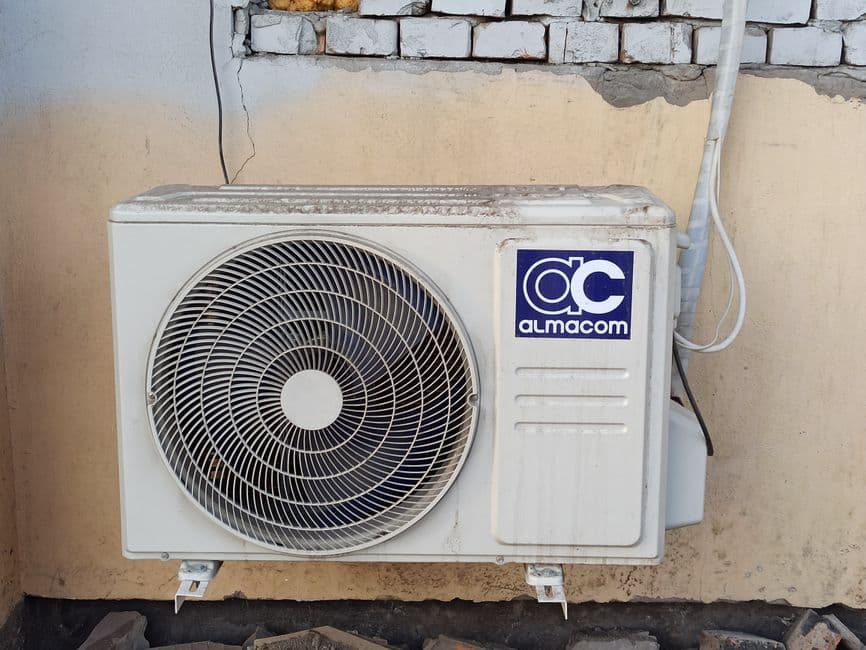
A mini-split condenses refrigerant outdoors, so the heat it removes is rejected into the garden. A portable condenses indoors and then tries to blow that heat out through a flexible hose that sits in the room it is cooling, radiating warmth the whole way.
On top of that, the federal SACC rating exists because portables lose capacity in ways window units do not: duct heat gain and infiltration are both measured into it. That is why a portable marked 14,000 BTU on the box certifies at 9,500 — the arithmetic is in BTU versus SACC.
Cost over a season
What the difference adds up to
Run the portable eight hours a night for ninety nights and you are at $172 of electricity at 18.34¢/kWh. A mini-split doing the same work at two and a half times the efficiency lands nearer a third of that, before its heating season is counted at all.
The gap is what pays back the installation, and it is why the mini-split question is really an ownership question rather than a cooling one — worked through in is a mini-split worth it.
Choose the portable when
Four situations where the portable is correct
- You rent. No landlord is approving a line-set penetration for a tenancy, and the portable leaves with you.
- There is no window a unit can sit in, but there is one a hose can reach. The venting options are in portable air conditioner venting.
- The need is occasional — a few weeks a year, a spare room, a heat wave. Installation economics never arrive.
- The building forbids exterior changes, which covers a lot of apartments, conservation areas and shared freeholds.
If a window is available, the honest third option is a window unit: far cheaper than a mini-split, far more efficient than a portable. That three-way is covered in portable versus window and mini-split versus window.
Say the unwelcome thing
Do not buy a portable for a room you will still be cooling in five years.
The purchase price flatters it and the running cost does not. At roughly 7.3 BTU per watt-hour against 18.35, the portable spends the difference every season, silently, and it does not heat in winter.
If you own the wall, price the mini-split before you buy anything else. SEER2 32.0 with cold-climate heating is a different class of machine. If you genuinely cannot install, buy dual-hose and accept the bill: 9,500 SACC from a dual-hose portable is the honest version of that compromise.
In full
Every pick, and what is wrong with it
Published specifications only, each linked to the page it came from. Where a manufacturer publishes nothing, the row says so — we do not fill blanks in.
1. The mini-split case
Hisense Mini-Split Heat Pump, 9,000 BTU
Hisense · model AO-09U3T25P
SEER2 32.0, EER2 18.35 and cold-climate certified heating — the most efficient way to cool one room, by a wide margin.
A mini-split is a real refrigeration system with the compressor outdoors and a quiet indoor head, connected by a small line set through a three-inch hole. Everything that makes it better follows from that arrangement.
EER2 18.35 means it removes 18.35 BTU of heat per watt-hour at the rating condition. SEER2 32.0 is the seasonal figure, and it is high enough to sit on the ENERGY STAR Most Efficient list. Nothing in the portable category approaches it, because nothing in the portable category can put the hot half of the machine outside.
It also heats. HSPF2 11.80 and a published COP of 2.25 at 5°F mean the same box covers winter, delivering more than two units of heat per unit of electricity in genuinely cold weather — the argument made in full in heat pump versus air conditioner.
What’s wrong with it
It needs a wall penetration, an outdoor unit, a dedicated circuit and a qualified installer — and none of that comes back with you if you move.
Running cost
Hisense does not publish a wattage for the AO-09U3T25P, so we cannot calculate what it costs to run. We are not going to estimate one. If Hisense publishes a nameplate figure, this block will show the arithmetic.
| Cooling capacity | 9,000 BTU/h |
|---|---|
| SEER2 | 32.0 |
| EER2 | 18.35 |
| HSPF2 | 11.80 |
| COP at 5 degrees F | 2.25 |
| Cold climate | Yes |
| Refrigerant | R-454B (GWP 470) |
| ENERGY STAR | Certified, and on the Most Efficient list |
| Noise | Not published in the certified dataset |
Every figure above is from ENERGY STAR Certified Mini-Split Heat Pumps dataset. Blanks are shown as “not published” rather than filled in.
2. The portable case
Whynter ARC-14S Dual Hose Portable Air Conditioner
Whynter · model ARC-14S
9,500 BTU SACC from 1,300 W with dual hoses — the honest choice when installation is impossible, and expensive to run.
A portable keeps the whole machine indoors and pushes heat out through a hose, which is a fundamentally harder way to do the job. The consequence shows in the numbers: 9,500 BTU SACC from 1,300 W is roughly 7.3 BTU per watt-hour, against 18.35 for the mini-split.
In money, an eight-hour night is $1.91 at 18.34¢/kWh and thirty nights is $57. That is the price of not drilling a hole, and for a lot of renters it is worth paying.
Insist on dual hoses. A single-hose unit exhausts room air outdoors and pulls unconditioned replacement air in through every gap in the building, which undoes a meaningful share of the cooling — the structural objection is in single hose versus dual hose.
What’s wrong with it
Two and a half times the electricity per BTU, a hose through a window that defeats the seal, 73 lb to move, and a tank or drain to manage.
Running cost — ARC-14S
| Nameplate power | 1300 W | manufacturer's published figure |
|---|---|---|
| Energy, 8-hour night | 10.40 kWh | 1300 ÷ 1000 × 8 |
| Cost per hour | 24¢ | at 18.34¢/kWh |
| Cost per 8-hour night | $1.91 | on the highest speed |
| Cost per 30 nights | $57 | 312.0 kWh |
Rate: 18.34¢/kWh, the US average residential price for June 2026 (EIA Electric Power Monthly, Table 5.3). Yours will differ — swap it in: (watts ÷ 1000) × hours × your rate.
| Marketing capacity | 14,000 BTU (ASHRAE-128) |
|---|---|
| DOE-rated capacity | 9,500 BTU SACC |
| Hoses | Dual |
| Power | 1,300 W / 11.6 A at 115 V |
| Noise | Under 51 dBA low, under 56 dBA high |
| Dehumidification | 71 pints/day |
| Refrigerant | R-32 |
| Dimensions | 16 W x 19 D x 35.5 H in |
| Weight | 73 lb |
| Manufacturer coverage claim | 500 sq ft |
| Warranty | 1 year unit, 3 years compressor |
Every figure above is from Whynter product page, ARC-14S. Blanks are shown as “not published” rather than filled in.
Questions people actually ask
Frequently asked
Is a mini-split better than a portable air conditioner?
On efficiency, noise, capacity and heating, yes and not narrowly — EER2 18.35 against roughly 7.3 BTU per watt-hour. The portable's only advantage is that it needs no installation, which is decisive if you rent.
How much more does a portable AC cost to run?
Roughly two and a half times as much electricity for the same heat removed. A 1,300 W portable running eight hours a night costs about $1.91 at the national average rate; ninety nights of that is over $170 before a mini-split's winter heating is even considered. Portable running costs.
Can you install a mini-split yourself?
Pre-charged DIY kits exist, but the job involves a wall penetration, a dedicated circuit and refrigerant lines, and getting any of those wrong is expensive. Most people should price professional installation into the comparison from the start. The ownership case.
Do portable air conditioners work as well as mini-splits?
Not in capacity or efficiency. The federal SACC rating already accounts for duct heat gain and infiltration, which is why a portable marked 14,000 BTU certifies at 9,500, while a mini-split's rated capacity is delivered into the room.
What should renters buy instead of a mini-split?
A window unit if a window is usable, because it is far more efficient than a portable and still removable. A dual-hose portable if no window will take a unit. Single-hose portables are the option to avoid where a choice exists. Renter-friendly cooling.
Sources
Where these numbers came from
- ENERGY STAR Certified Air Source Heat Pumps dataset — SEER2 32.0, EER2 18.35, HSPF2 11.80 and COP 2.25 at 5F for the 9,000 BTU mini-split compared here
- Whynter product page, ARC-14S — 14,000 BTU ASHRAE, 9,500 BTU SACC, 1,300 W / 11.6 A, dual hose, 73 lb
- EIA Electric Power Monthly, Table 5.3 — average residential electricity price
Read next
Where to go from here
Back to Air Conditioners, or read how we pick.