Head to head
Ceiling fan vs tower fan
One is dramatically cheaper to run and stirs a whole room. The other costs nothing to install and points at your face. Both facts are decisive for different people.
By Sawyer V. · Published
The short answer
A ceiling fan is far cheaper to run — certified models draw 1.1 to 6.0 W on low against a tower fan’s 2.9 to 52 W — and it stirs the whole room from above. A tower fan needs no installation, can be aimed directly at you, and moves with you between rooms. Decide on one question: can you install an electrical fixture in this room, and will you still be here next year?
Fan & Frost earns a commission when you buy through our links, at no cost to you. It never changes a ranking, and we say so when the right answer is the cheaper unit or nothing at all. Full disclosure · How we pick.
At a glance
The picks, ranked
Tap any row to jump to the full reasoning. Prices are live from Amazon where we have them, and read “check price” where we don’t — never a number we cannot verify today.
| # | Product | Best for | Price |
|---|---|---|---|
| 1 | 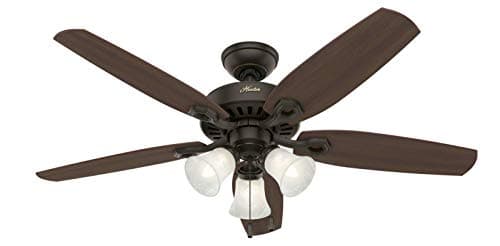 The ceiling case Hunter Vespucci 52" Ceiling Fan 366.7 CFM per watt certified, 13.9 W on high and 1.8 W on low — an order of magnitude below any tower fan. | A room you own, cooled all season for almost nothing | |
| 2 | 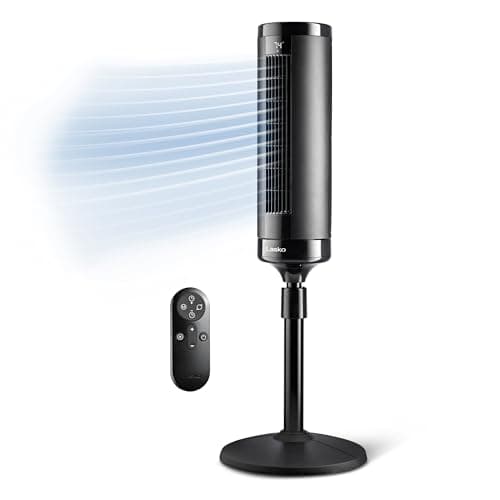 The tower case Lasko EcoQuiet 42" DC Tower Fan 2.9 W on low and 23 dBA — the quietest and cheapest plug-in fan we have figures for, with twelve speeds to tune it. | A rental, a bedroom, or anywhere you want the air aimed at you | |
| 3 | The tower fan that publishes its numbers Lasko Aria 40" Smart Wi-Fi Tower Fan 460 CFM on 41 to 52 W, and 31.5 dBA on low — one of the few tower fans that publishes both airflow and power. | Seeing what a tower fan actually costs in air-per-watt terms | |
| — | 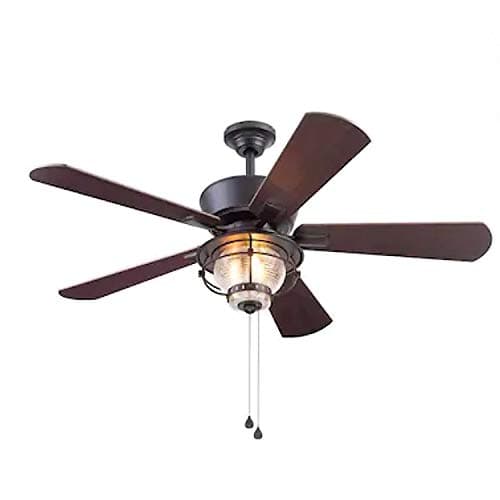 Where the ceiling fan wins outright Harbor Breeze Cando 84" Ceiling Fan 422.2 CFM per watt on 30.6 W. In a big space, no tower fan is in the same conversation. | A large room — where a tower fan cannot compete on any axis |
These two are asked about together constantly, and the honest answer is that they are not really competing on the same axis. One is a fixture that stirs a room; the other is an appliance that aims air at a person.
Side by side
The comparison
| Ceiling fan | Tower fan | |
|---|---|---|
| Power, low | 1.1 – 6.0 W certified | 2.9 – 18 W published |
| Power, high | 10.1 – 31.0 W certified | 19 – 52 W published |
| Airflow figure | Certified CFM per watt | Usually not published at all |
| Coverage | The whole room, from above | Wherever it is pointed |
| Can be aimed at you | No | Yes — the main reason to buy one |
| Installation | Electrical work, fan-rated box | Plug it in |
| Renter-friendly | Rarely permitted | Always |
| Moves with you | No | Yes |
| Floor space | None | About a square foot |
| Works in winter | Yes, reversed and on low | No — a draft makes a cold room worse |
| Noise rating | Not published for ceiling fans | Published in dBA by some brands |
Read this carefully
The efficiency gap is real, and it is not measured the same way
Put the published numbers side by side and the difference looks absurd: a certified ceiling fan at 366.7 CFM per watt against a tower fan at roughly 9.
Before treating that as a fortyfold engineering gap, two qualifications matter.
- Only one of those figures is a certified test result. ENERGY STAR runs a defined test on ceiling fans and publishes CFM per watt. There is no equivalent program for tower fans, so the 460 CFM is a manufacturer claim measured however that manufacturer chose.
- They are doing different work. A ceiling fan moves a large volume slowly across a big disc. A tower fan accelerates a smaller volume to a much higher velocity through a narrow outlet. Aerodynamic drag rises steeply with speed, so fast air is disproportionately expensive — the same physics that makes large ceiling fans more efficient than small ones.
So the fair statement is this: a ceiling fan moves far more air per watt, because moving air slowly over a wide area is cheap and moving it fast through a nozzle is not. The precise multiple is not something the available data supports.
The part you can rely on absolutely is the wattage, because both are published and both are just electricity:
| Setting | Watts | 8 hours |
|---|---|---|
| Hunter Martindale ceiling fan, low | 1.1 W | 0.2¢ |
| Hunter Vespucci ceiling fan, low | 1.8 W | 0.3¢ |
| Lasko EcoQuiet tower, low | 2.9 W | 0.4¢ |
| Hunter Vespucci ceiling fan, high | 13.9 W | 2.0¢ |
| Lasko EcoQuiet tower, high | 19 W | 2.8¢ |
| Harbor Breeze Cando ceiling fan, high | 30.6 W | 4.5¢ |
| Lasko Aria tower, high | 52 W | 7.6¢ |
Ceiling fan wattage from the ENERGY STAR Certified Ceiling Fans dataset; tower fan wattage from Lasko product pages.
Note what that table also shows: a good DC tower fan on low (2.9 W) costs less to run than a ceiling fan on high (13.9 W). The format matters less than the setting, and the cheapest thing in the house is a ceiling fan left on its lowest speed.
This one is not a DIY job
The question that actually decides it. Not efficiency, not airflow — those follow.
“Do I need the air pointed at me, or do I need the room stirred?”
Pointed at you: a desk, a bed, a chair you always sit in, one person who runs hot in a household that does not. That is a tower fan, and no ceiling fan substitutes for it.
The room stirred: several people, a space you move around in, an open-plan area, or a room you want gently circulating overnight with nobody thinking about it. That is a ceiling fan.
And then the practical filter: if you rent, or you may move within a couple of years, the question is settled regardless of the answer.
Both
They work well together
The framing as a versus is slightly false. These are the two cheapest appliances in the house to run, and they solve adjacent problems.
A ceiling fan on low keeps the room evenly mixed for 0.3¢ a night. A tower fan on low adds directed airflow exactly where somebody needs it for another 0.4¢. Together that is under a cent for the evening, and it covers both mechanisms.
It is also the sensible order of purchase for a room you own: put in the ceiling fan for the general case, and add a quiet tower fan if one specific seat still runs warm.
Say the unwelcome thing
Do not buy a ceiling fan for a room you rent.
It requires an electrical fixture, a fan-rated box, and in most tenancies a conversation you will lose. Where it is permitted, you have improved the landlord’s property at your own expense and you cannot take it with you.
The running-cost advantage is real but small in absolute terms. A ceiling fan on low is 0.3¢ a night against 0.4¢ for a good DC tower fan — a difference measured in cents across a whole season.
Buy the tower fan, take it with you, and put the ceiling fan in the first room you own. Our renter-focused advice is here.
In full
Every pick, and what is wrong with it
Published specifications only, each linked to the page it came from. Where a manufacturer publishes nothing, the row says so — we do not fill blanks in.
1. The ceiling case
Hunter Vespucci 52" Ceiling Fan
Hunter · model Vespucci
366.7 CFM per watt certified, 13.9 W on high and 1.8 W on low — an order of magnitude below any tower fan.
1.8 W on low. An eight-hour night costs 0.3¢. On high, 13.9 W is 2.0¢ for the same night.
366.7 CFM per watt is a certified test result, not a manufacturer claim — ENERGY STAR runs a defined test on ceiling fans and publishes the figure. Very few tower fans publish any airflow number at all.
The functional advantage is coverage. Mounted centrally, it sets up a circulation pattern across the whole room rather than a beam pointed one way. Everyone in the room gets some benefit, which a tower fan cannot manage.
What’s wrong with it
It is an electrical installation, it cannot be aimed at you, and it stays behind when you move.
Running cost — Vespucci
| Nameplate power | 1.8 W – 13.9 W | manufacturer's published figure |
|---|---|---|
| Energy, 8-hour night | 0.11 kWh | 13.9 ÷ 1000 × 8 |
| Cost per hour | 0.3¢ | at 18.34¢/kWh |
| Cost per 8-hour night | 2.0¢ | on the highest speed |
| Cost per 30 nights | 61¢ | 3.3 kWh |
| Same month, lowest speed | 7.9¢ | at 1.8 W |
Rate: 18.34¢/kWh, the US average residential price for June 2026 (EIA Electric Power Monthly, Table 5.3). Yours will differ — swap it in: (watts ÷ 1000) × hours × your rate.
| Blade span | 52 in |
|---|---|
| Efficiency | 366.7 CFM per watt |
| Power, high speed | 13.9 W |
| Power, low speed | 1.8 W |
| Standby power | 0.8 W |
| Type | Indoor, fan only (no light kit) |
| Warranty | 3 years, components |
| ENERGY STAR | Certified |
Every figure above is from ENERGY STAR Certified Ceiling Fans dataset. Blanks are shown as “not published” rather than filled in.
2. The tower case
Lasko EcoQuiet 42" DC Tower Fan
Lasko · model T42710
2.9 W on low and 23 dBA — the quietest and cheapest plug-in fan we have figures for, with twelve speeds to tune it.
2.9 W on low — 0.4¢ for an eight-hour night. That is genuinely close to ceiling fan territory, and it comes from a DC motor, which runs efficiently at low speed in a way AC motors do not.
23 dBA on low is the quietest published figure on this site, and twelve speeds means you can find the setting that is just enough rather than choosing between three that are all slightly wrong.
The decisive advantages are not on the spec sheet: no electrician, no landlord conversation, no ceiling, and it comes with you when you move. In a rental that is not a preference, it is the whole answer.
The gap in the data: no published CFM, so its airflow cannot be compared numerically with anything.
What’s wrong with it
19 W on high is seven times its low setting, and Lasko publishes no CFM figure, so there is nothing to compare its airflow against.
Running cost — T42710
| Nameplate power | 2.9 W – 19 W | manufacturer's published figure |
|---|---|---|
| Energy, 8-hour night | 0.15 kWh | 19 ÷ 1000 × 8 |
| Cost per hour | 0.3¢ | at 18.34¢/kWh |
| Cost per 8-hour night | 2.8¢ | on the highest speed |
| Cost per 30 nights | 84¢ | 4.6 kWh |
| Same month, lowest speed | 13¢ | at 2.9 W |
Rate: 18.34¢/kWh, the US average residential price for June 2026 (EIA Electric Power Monthly, Table 5.3). Yours will differ — swap it in: (watts ÷ 1000) × hours × your rate.
| Power | 2.9 W - 19 W (0.06-0.303 A at 120 V) |
|---|---|
| Noise | 23 dBA low, 46 dBA high |
| Speeds | 12 |
| Height | 41.6 in |
| Footprint | 12.8 x 12.8 in |
| Weight | 7.8 lb |
| Timer | 8 hours |
| Air delivery (CFM) | Not published |
| Warranty | 2 years |
Every figure above is from Lasko product page, T42710. Blanks are shown as “not published” rather than filled in.
3. The tower fan that publishes its numbers
Lasko Aria 40" Smart Wi-Fi Tower Fan
Lasko · model T40733
460 CFM on 41 to 52 W, and 31.5 dBA on low — one of the few tower fans that publishes both airflow and power.
Included because it makes the comparison possible. 460 CFM and 41 to 52 W, both published — which most tower fans do not do.
That works out to roughly 9 to 11 CFM per watt. Certified ceiling fans run 242 to 422. The gap is enormous, and the section below explains why it is not quite the like-for-like comparison it appears to be.
Its own case is scheduling. App and voice control mean it can start before you walk into the room, which no basic ceiling fan does. 31.5 dBA on low, 48.7 on high, and about 7.6¢ for an eight-hour day at full power.
What’s wrong with it
460 CFM for 52 W works out around 9 CFM per watt. That is a very different world from a ceiling fan's 366.7.
Running cost — T40733
| Nameplate power | 41 W – 52 W | manufacturer's published figure |
|---|---|---|
| Energy, 8-hour night | 0.42 kWh | 52 ÷ 1000 × 8 |
| Cost per hour | 1.0¢ | at 18.34¢/kWh |
| Cost per 8-hour night | 7.6¢ | on the highest speed |
| Cost per 30 nights | $2.29 | 12.5 kWh |
| Same month, lowest speed | $1.80 | at 41 W |
Rate: 18.34¢/kWh, the US average residential price for June 2026 (EIA Electric Power Monthly, Table 5.3). Yours will differ — swap it in: (watts ÷ 1000) × hours × your rate.
| Power | 41 W - 52 W (0.3-0.44 A at 120 V) |
|---|---|
| Air delivery | 460 CFM |
| Noise | 31.5 dBA low, 48.7 dBA high |
| Speeds | 5 |
| Smart control | Aria for Home app (iOS/Android), Amazon Alexa, Google Assistant |
| Height | 39.58 in |
| Footprint | 11.2 x 11.2 in |
| Weight | 9.5 lb |
| Timer | 9 hours |
| Oscillation | 90 degrees |
| Remote | Not included |
| Warranty | 2 years |
Every figure above is from Lasko product page, T40733. Blanks are shown as “not published” rather than filled in.
Skip this one
Harbor Breeze Cando 84" Ceiling Fan
Harbor Breeze · model 84" Cando
422.2 CFM per watt on 30.6 W. In a big space, no tower fan is in the same conversation.
Listed as a skip because it is not a realistic alternative for most people reading this comparison — but it defines the ceiling of what the format achieves.
422.2 CFM per watt on 30.6 W. For roughly the same power a tower fan uses to move 460 CFM in one direction, this moves an order of magnitude more air across an entire room.
In a large open space that is not a close call. The reason to buy a tower fan is never that it out-performs a ceiling fan — it is that you cannot have one, or that you need the air pointed somewhere specific.
What’s wrong with it
84 inches needs the ceiling height and clearance, and none of it is available to you in a rental.
Running cost — 84" Cando
| Nameplate power | 6 W – 30.6 W | manufacturer's published figure |
|---|---|---|
| Energy, 8-hour night | 0.24 kWh | 30.6 ÷ 1000 × 8 |
| Cost per hour | 0.6¢ | at 18.34¢/kWh |
| Cost per 8-hour night | 4.5¢ | on the highest speed |
| Cost per 30 nights | $1.35 | 7.3 kWh |
| Same month, lowest speed | 26¢ | at 6 W |
Rate: 18.34¢/kWh, the US average residential price for June 2026 (EIA Electric Power Monthly, Table 5.3). Yours will differ — swap it in: (watts ÷ 1000) × hours × your rate.
| Blade span | 84 in |
|---|---|
| Efficiency | 422.2 CFM per watt |
| Power, high speed | 30.6 W |
| Power, low speed | 6.0 W |
| Type | Outdoor ceiling fan |
| ENERGY STAR | Certified |
Every figure above is from ENERGY STAR Certified Ceiling Fans dataset. Blanks are shown as “not published” rather than filled in.
We are not linking a buy button for this one. If you want to look at it anyway, it is easy enough to find — but we would rather send you to something that fits your room.
Questions people actually ask
Frequently asked
Is a ceiling fan or a tower fan more efficient?
A ceiling fan, substantially — certified models draw 1.1 to 6.0 watts on low against 2.9 to 18 for a tower fan, and move far more air for it. Moving a large volume slowly across a wide disc is much cheaper than accelerating a small volume through a narrow outlet.
Can I compare ceiling fan CFM per watt with a tower fan's?
Not directly. ENERGY STAR runs a defined test on ceiling fans and publishes certified CFM per watt; there is no equivalent program for tower fans, so their airflow figures — where published at all — are manufacturer claims measured however the brand chose.
Which is better for a bedroom?
It depends on whether you want the air on you. A tower fan can be aimed at the bed and quiet models publish 23 dBA on low; a ceiling fan circulates the whole room for about half the power but cannot be directed. In a rental the question is settled anyway.
Do tower fans cool a room?
No, and neither do ceiling fans. Both move air across skin, which accelerates evaporative and convective heat loss so you feel cooler. The air temperature does not change, which is why a fan in an empty room achieves nothing.
Can I use a tower fan in winter like a reversed ceiling fan?
No. Winter destratification works by displacing the warm layer at ceiling level, which a floor-standing fan cannot reach. The horizontal airflow a tower fan produces at body height creates exactly the draft that makes a cold room feel colder. Winter fan direction.
Is it worth having both?
Often, yes. A ceiling fan on low keeps the room evenly mixed and a tower fan adds directed airflow where one person needs it. Together they run for under a cent an evening and cover both cooling mechanisms.
Sources
Where these numbers came from
Read next
Where to go from here
Back to Whole-House Airflow, or read how we pick.