Head to head
Inverter vs fixed-speed air conditioners
This used to be a buying decision. On certified equipment it is no longer available as one, and that changes what you should be checking instead.
By Sawyer V. · Published
The short answer
Every certified unit is an inverter now. All 505 US-market certified room air conditioners and all 16,792 certified mini-splits use a variable-speed compressor — not one fixed-speed model holds certification. So the question to ask is not whether a unit is an inverter but what its CEER or EER2 is, because inverters still range from CEER 12.0 to 17.6.
Fan & Frost earns a commission when you buy through our links, at no cost to you. It never changes a ranking, and we say so when the right answer is the cheaper unit or nothing at all. Full disclosure · How we pick.

At a glance
The picks, ranked
Tap any row to jump to the full reasoning. Prices are live from Amazon where we have them, and read “check price” where we don’t — never a number we cannot verify today.
| # | Product | Best for | Price |
|---|---|---|---|
| 1 | What a good inverter achieves Midea Window Heat Pump Air Conditioner, 9,500 BTU CEER 17.6 and 404.8 kWh a year — the highest certified figure of all 505 room air conditioners, at 80% under the federal standard. | One room, both seasons, if you can handle the weight | |
| 2 | 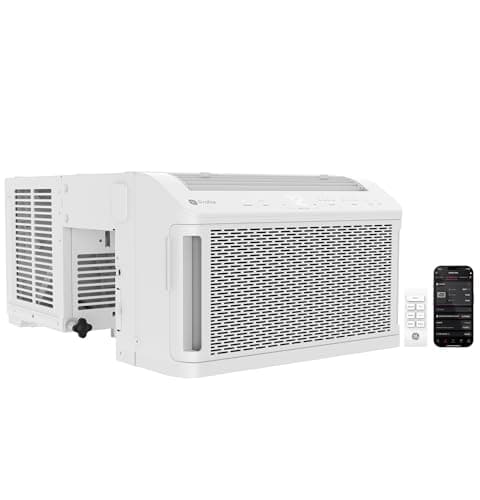 The sensible middle GE Profile ClearView Window Air Conditioner, 8,000 BTU CEER 16 and 375 kWh a year at 46.2 lb — Most Efficient certified without the weight penalty of the leaders. | A normal bedroom, with a normal person lifting it | |
| 3 | 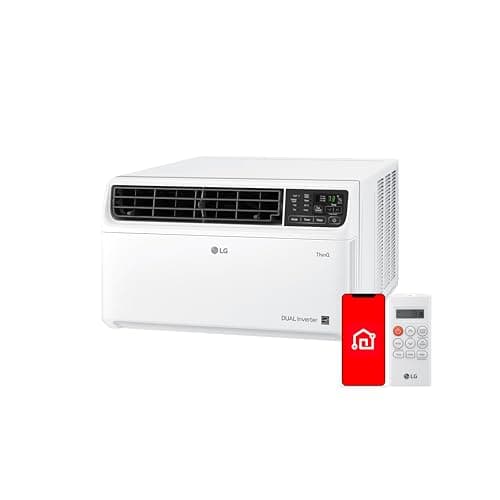 Best small inverter LG Dual Inverter Window Air Conditioner, 6,000 BTU CEER 15.5 and 290.3 kWh a year — the lowest annual consumption of anything we hold certified data for, because it is the smallest. | A small room where the unit will run most of the day | |
| — | 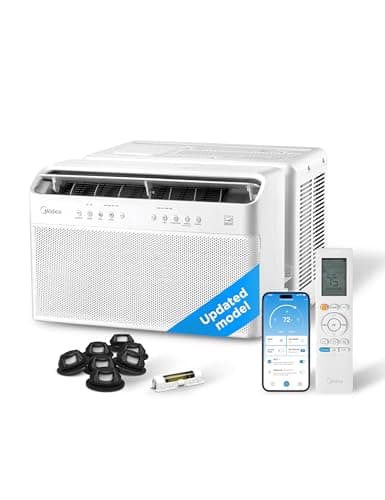 Why 'inverter' is not a spec Midea U-Shaped Window Air Conditioner, 10,000 BTU (V1) A variable-speed inverter at CEER 15 and 500 kWh a year, missing the Most Efficient list — the label is identical to the leader's. | Showing that the label guarantees nothing |
For about a decade, “inverter or not” was a real question with a real answer, and the answer was yes. That period has ended, and most buying advice has not caught up.
The finding
Not one certified fixed-speed unit remains
Pull the ENERGY STAR certified datasets and filter on the compressor field. The result is unambiguous in both categories.
| Category | US records | Variable speed | Fixed speed |
|---|---|---|---|
| Room air conditioners | 505 | 505 | 0 |
| Mini-split heat pumps | 16,792 | 16,792 | 0 |
The mini-split dataset records compressor staging as “continuously variable” on every one of 16,792 US records. The room air conditioner dataset records a variable-speed compressor on every one of 505. There is no single-stage or two-stage certified equipment left in either category.
Fixed-speed units are still sold. They are simply not certified, which means they fall below the efficiency threshold. If a listing does not mention an inverter, that is now a signal in itself.
Mechanism
What the compressor actually does differently
A fixed-speed compressor has two states: on, at full output, and off. It cools the room past your setpoint, stops, lets the room drift back up, and starts again. Each start draws a large inrush current and each stop wastes the cold sitting in the coil.
A variable-speed compressor throttles. Once the room is down it runs at perhaps a quarter of its output continuously, matching the heat coming in. Three things follow, and only the first is about energy:
- Less energy. No repeated inrush, no wasted coil cold, and a compressor at part load is more efficient per BTU than one at full load.
- Steadier temperature. A fixed-speed unit swings either side of the setpoint. An inverter holds much closer to it, which is most of what people mean when they say a unit “feels better”.
- Much better dehumidification. Moisture comes out of the air only while the coil is cold and air is moving over it. A unit that runs long and slow removes far more water than one that blasts and stops — which is most of what comfort actually is.
That third point is the one that gets undersold. It is also why oversizing hurts an inverter almost as much as a fixed-speed unit: a unit too large for the room hits its minimum output and starts cycling anyway, at which point you have paid for a variable-speed compressor and prevented it from varying.
Instead
What to check now that the label is universal
With “inverter” on every box, the useful filters have moved. In order:
- CEER, for a room air conditioner. Certified inverters span 12.0 to 17.6, which is a 47% range inside a single label.
- EER2, for a mini-split — and not SEER2, which is measured differently and cannot be compared to CEER — the comparison people get wrong.
- Annual kWh, within a size class only. A smaller unit always uses less; that is not efficiency.
- Most Efficient status, where it still discriminates. It does on room air conditioners, where 195 of 505 hold it. It does not on mini-splits, where 87.3% do.
- The full model number. The single highest-value check in this whole category, because manufacturers file many near-identical variants at different efficiencies.
This one is not a DIY job
One practical consequence of universal inverters: cutting mains power to schedule a unit is a worse idea than it used to be. A variable-speed machine restarted from cold has to re-establish its operating point, and many return in a default mode rather than yours. Use the unit’s own timer or app — where a smart plug is and is not appropriate.
Old units
Is it worth replacing a working fixed-speed unit?
Usually not on energy grounds alone, and we would rather say so than sell you something.
The federal standard a certified inverter beats by 47% is the standard for new units, not the one your ten-year-old machine was built to. A genuinely old fixed-speed unit is further behind than that, so the saving is real — but it is measured in tens of dollars a year on a single room unit, against the full purchase price.
The better reasons to replace are the ones that are not about the electricity bill: a unit that no longer holds temperature, that is audibly failing, that leaks, or that runs on R-410A and would be expensive to recharge — what the refrigerant transition means for an older machine. If yours is simply not cooling well, check the common causes first.
Say the unwelcome thing
Do not pay extra for the word 'inverter'.
It is on every certified unit in both categories — 505 of 505 room air conditioners and 16,792 of 16,792 mini-splits. A listing that advertises it as a differentiator is advertising the entry requirement.
Worse, the label actively hides a 47% spread. A certified inverter can be CEER 12.0 or CEER 17.6, and both are described the same way in marketing copy.
Check the CEER, check the full model number against the certified dataset, and buy on that. CEER 16 at a weight you can lift is the sensible shape of that decision for most rooms.
In full
Every pick, and what is wrong with it
Published specifications only, each linked to the page it came from. Where a manufacturer publishes nothing, the row says so — we do not fill blanks in.
1. What a good inverter achieves
Midea Window Heat Pump Air Conditioner, 9,500 BTU
Midea · model MAH09B1AGR
CEER 17.6 and 404.8 kWh a year — the highest certified figure of all 505 room air conditioners, at 80% under the federal standard.
The top of the certified field, and a useful upper bound for what variable-speed control is worth when everything else is done well.
CEER 17.6 and 404.8 kWh a year — roughly $74 at 18.34¢/kWh. Against the weakest certified inverter at CEER 12.0, that is a gap of 47% between two units that are both inverters.
Reverse-cycle heating included, which is where variable-speed control earns the most: it lets the machine run long and slow rather than cycling, which matters more in heating than in cooling.
129 lb and a saddle mount that straddles the sill. It needs no bracket, but it is emphatically a two-person install.
What’s wrong with it
129 lb in a window opening, which rules it out of plenty of rooms on its own.
Running cost — MAH09B1AGR
| Annual energy use | 404.8 kWh | ENERGY STAR certified figure |
|---|---|---|
| Annual cost | $74 | 404.8 × 18.34¢/kWh |
| Per cooling month | $19 | spread over a four-month season |
The annual figure is the certified value from the ENERGY STAR Certified Room Air Conditioners dataset, which models a standard cooling season rather than your actual summer. It is more useful than a nameplate wattage here, because a variable-speed compressor spends most of its life well below nameplate.
Rate: 18.34¢/kWh, the US average residential price for June 2026 (EIA Electric Power Monthly, Table 5.3). Yours will differ — swap it in: (watts ÷ 1000) × hours × your rate.
| Cooling capacity | 9,500 BTU/h |
|---|---|
| Heating mode | Yes, reverse cycle |
| CEER | 17.6 |
| Annual energy use | 404.8 kWh/yr |
| vs federal standard | 80% less energy |
| Dimensions | 20.9 H x 25.0 W x 41.2 D in |
| Weight | 129.0 lb |
| Installation | Straddles the windowsill (saddle style) |
| Support bracket | Not required |
| Compressor | Variable speed |
| Refrigerant | R-32 |
| ENERGY STAR | Certified, and on the Most Efficient list |
Every figure above is from ENERGY STAR Certified Room Air Conditioners dataset. Blanks are shown as “not published” rather than filled in.
2. The sensible middle
GE Profile ClearView Window Air Conditioner, 8,000 BTU
GE Profile · model PWJV08W
CEER 16 and 375 kWh a year at 46.2 lb — Most Efficient certified without the weight penalty of the leaders.
More representative of what an inverter is worth in practice than the leader above, because most people will actually install this.
CEER 16 and 375 kWh a year — about $69 at 18.34¢/kWh, and 47% less energy than the federal standard permits.
46.2 lb at 8,000 BTU, with a body that does not straddle the sill. That combination is what makes it liveable.
A support bracket is required even at this weight, which is worth knowing before the delivery arrives — brackets, and when they are not optional.
What’s wrong with it
It still needs a support bracket despite being one of the lighter units.
Running cost — PWJV08W
| Annual energy use | 375 kWh | ENERGY STAR certified figure |
|---|---|---|
| Annual cost | $69 | 375 × 18.34¢/kWh |
| Per cooling month | $17 | spread over a four-month season |
The annual figure is the certified value from the ENERGY STAR Certified Room Air Conditioners dataset, which models a standard cooling season rather than your actual summer. It is more useful than a nameplate wattage here, because a variable-speed compressor spends most of its life well below nameplate.
Rate: 18.34¢/kWh, the US average residential price for June 2026 (EIA Electric Power Monthly, Table 5.3). Yours will differ — swap it in: (watts ÷ 1000) × hours × your rate.
| Cooling capacity | 8,000 BTU/h |
|---|---|
| CEER | 16 |
| Annual energy use | 375 kWh/yr |
| vs federal standard | 47% less energy |
| Dimensions | 12.6 H x 18.6 W x 15.3 D in |
| Weight | 46.2 lb |
| Refrigerant | R-32 |
| Installation | Does not straddle the windowsill |
| Compressor | Variable speed |
| ENERGY STAR | Certified, and on the Most Efficient list |
Every figure above is from ENERGY STAR Certified Room Air Conditioners dataset. Blanks are shown as “not published” rather than filled in.
3. Best small inverter
LG Dual Inverter Window Air Conditioner, 6,000 BTU
LG · model LW6023IVSM
CEER 15.5 and 290.3 kWh a year — the lowest annual consumption of anything we hold certified data for, because it is the smallest.
Long, slow running is the condition under which variable-speed control does the most good, and a correctly sized small unit is exactly that.
290.3 kWh a year, about $53 at 18.34¢/kWh. Note this is a low number because the machine is small, not because it is unusually efficient — its CEER of 15.5 is mid-field.
Most Efficient certified and no bracket required, which at 62.0 lb is welcome.
250 square feet is the coverage claim. Going bigger than you need is how people undo an inverter’s advantage — sizing, properly.
What’s wrong with it
At 62.0 lb it is heavy for 6,000 BTU, and 250 sq ft is its honest limit.
Running cost — LW6023IVSM
| Annual energy use | 290.3 kWh | ENERGY STAR certified figure |
|---|---|---|
| Annual cost | $53 | 290.3 × 18.34¢/kWh |
| Per cooling month | $13 | spread over a four-month season |
The annual figure is the certified value from the ENERGY STAR Certified Room Air Conditioners dataset, which models a standard cooling season rather than your actual summer. It is more useful than a nameplate wattage here, because a variable-speed compressor spends most of its life well below nameplate.
Rate: 18.34¢/kWh, the US average residential price for June 2026 (EIA Electric Power Monthly, Table 5.3). Yours will differ — swap it in: (watts ÷ 1000) × hours × your rate.
| Cooling capacity | 6,000 BTU/h |
|---|---|
| CEER | 15.5 |
| Annual energy use | 290.3 kWh/yr |
| Weight | 62.0 lb |
| Installation | Does not straddle the windowsill |
| Support bracket | Not required |
| Compressor | Variable speed |
| ENERGY STAR | Certified, and on the Most Efficient list |
Every figure above is from ENERGY STAR Certified Room Air Conditioners dataset. Blanks are shown as “not published” rather than filled in.
Skip this one
Midea U-Shaped Window Air Conditioner, 10,000 BTU (V1)
Midea · model MAW10V1QWT
A variable-speed inverter at CEER 15 and 500 kWh a year, missing the Most Efficient list — the label is identical to the leader's.
Not a bad machine, and precisely the point: it is a genuine variable-speed inverter and it is one of the less efficient units in the certified field.
CEER 15 against 17.6 for the leader on this page. Both inverters. Both certified. The annual figures are 500 kWh against 404.8, though the sizes differ.
38% under the federal standard, not 47%, and no Most Efficient badge, in a product family that also contains CEER 16 versions of the same chassis.
Buying “an inverter” in 2026 is like buying “a car with fuel injection”. It narrows nothing — the CEER 16 sibling is the one to get.
What’s wrong with it
Nothing on the box distinguishes it from a CEER 16 unit in the same product family.
Running cost — MAW10V1QWT
| Annual energy use | 500 kWh | ENERGY STAR certified figure |
|---|---|---|
| Annual cost | $92 | 500 × 18.34¢/kWh |
| Per cooling month | $23 | spread over a four-month season |
The annual figure is the certified value from the Midea product page, MAW10V1QWT, with certified figures from the ENERGY STAR Room Air Conditioners dataset, which models a standard cooling season rather than your actual summer. It is more useful than a nameplate wattage here, because a variable-speed compressor spends most of its life well below nameplate.
Rate: 18.34¢/kWh, the US average residential price for June 2026 (EIA Electric Power Monthly, Table 5.3). Yours will differ — swap it in: (watts ÷ 1000) × hours × your rate.
| Cooling capacity | 10,000 BTU/h DOE |
|---|---|
| CEER | 15 |
| Annual energy use | 500 kWh/yr |
| vs federal standard | 38% less energy |
| Coverage claim | Up to 450 sq ft |
| Noise | As low as 32 dBA |
| Smart control | SmartHome app, Apple Watch, voice assistants |
| Dimensions | 13.5 H x 19.2 W x 22.0 D in |
| Weight | 53.1 lb certified / 54.01 lb published |
| Refrigerant | R-32 |
| Installation | U-shape; straddles the window |
| Support bracket | Required |
| Compressor | Variable speed, up to 35% more efficient (manufacturer claim) |
| Warranty | 1 year |
| ENERGY STAR | Certified; NOT on the Most Efficient list |
Every figure above is from Midea product page, MAW10V1QWT, with certified figures from the ENERGY STAR Room Air Conditioners dataset. Blanks are shown as “not published” rather than filled in.
We are not linking a buy button for this one. If you want to look at it anyway, it is easy enough to find — but we would rather send you to something that fits your room.
Questions people actually ask
Frequently asked
Is an inverter air conditioner better than a fixed-speed one?
Yes, but it is no longer a choice you make. All 505 US-market certified room air conditioners and all 16,792 certified mini-splits use a variable-speed compressor. Not one fixed-speed unit holds ENERGY STAR certification in either category.
What does an inverter compressor actually do?
It throttles instead of switching on and off. Once the room is cool it runs continuously at reduced output, which avoids repeated start-up current, holds the temperature steadier, and removes far more humidity because the coil stays cold and air keeps moving over it.
If every unit is an inverter, what should I compare instead?
CEER for a room air conditioner and EER2 for a mini-split. Certified inverters range from CEER 12.0 to 17.6 — a 47% spread inside one label. Also check the full model number, because manufacturers file many near-identical variants at different efficiencies. Reading a spec sheet.
Do inverter air conditioners dehumidify better?
Yes, and it is one of their biggest practical advantages. Moisture is removed only while the coil is cold and air is moving across it, so a unit that runs long and slow pulls out far more water than one that cools hard and shuts off.
Should I replace my old fixed-speed air conditioner?
Not on energy grounds alone — the saving on a single room unit is tens of dollars a year against the full purchase price. Replace it if it no longer holds temperature, is audibly failing, leaks, or uses a refrigerant that would be expensive to recharge.
Can an inverter unit still be inefficient?
Yes. The certified field spans CEER 12.0 to 17.6, all of them inverters. And an inverter oversized for its room hits its minimum output and starts cycling anyway, which removes the advantage you paid for. Sizing, properly.
Sources
Where these numbers came from
- ENERGY STAR Certified Room Air Conditioners dataset — variable-speed compressor field on all 505 US-market records, CEER range and Most Efficient counts
- ENERGY STAR Certified Mini-Split Heat Pumps dataset — compressor staging recorded as continuously variable on all 16,792 US-market records
- EIA Electric Power Monthly, Table 5.3 — average residential electricity price
Read next
Where to go from here
Back to Guides & Calculators, or read how we pick.