Guide and picks
How to clean a window air conditioner
Every certified efficiency number on this site was measured on a clean unit. Yours is not, and the gap between them is the cheapest saving available.
By Sawyer V. · Published
The short answer
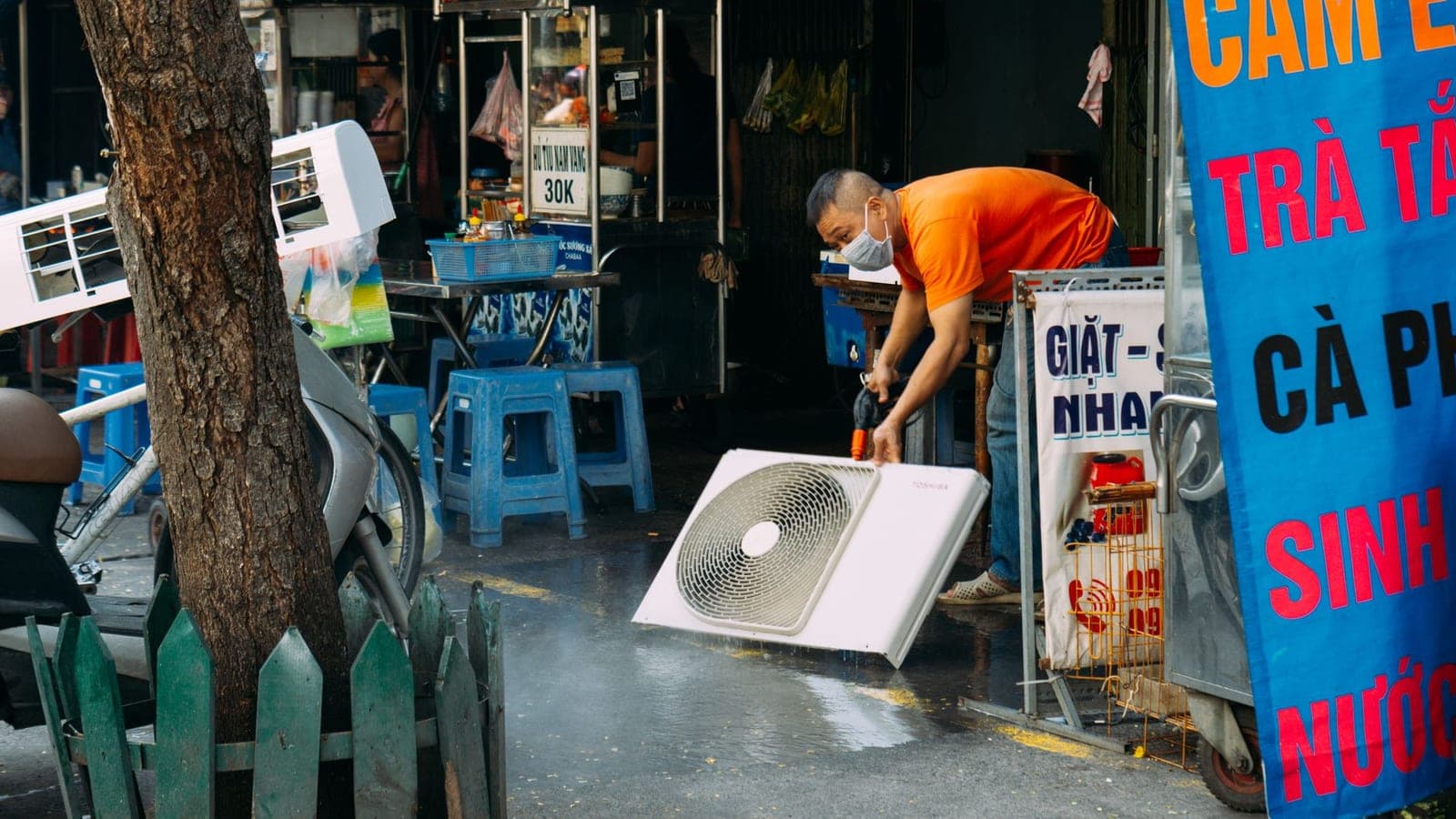
Unplug it, then work through filter, evaporator coil, condenser coil, drain pan. The filter is a two-week job in season; the coils are once a year. A blocked filter starves the evaporator of airflow, which drops capacity and extends run time — and every certified figure here, like the 375 kWh a year for the most efficient 8,000 BTU unit, was measured on a clean machine.
Fan & Frost earns a commission when you buy through our links, at no cost to you. It never changes a ranking, and we say so when the right answer is the cheaper unit or nothing at all. Full disclosure · How we pick.
At a glance
The picks, ranked
Tap any row to jump to the full reasoning. Prices are live from Amazon where we have them, and read “check price” where we don’t — never a number we cannot verify today.
| # | Product | Best for | Price |
|---|---|---|---|
| 1 | 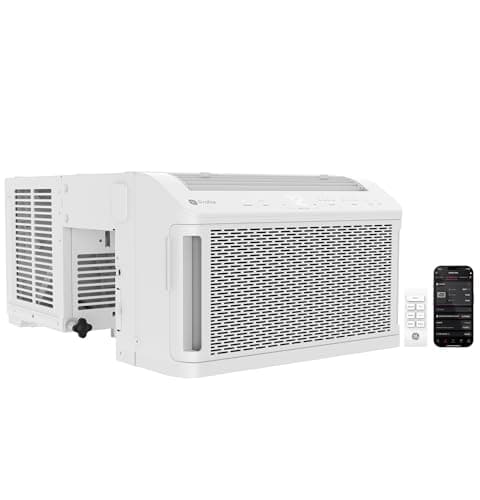 The figure you are protecting GE Profile ClearView Window Air Conditioner, 8,000 BTU CEER 16 and 375 kWh a year — the certified figure, measured under laboratory conditions on a clean machine. | Seeing what a clean, correctly-sized unit actually costs to run | |
| 2 | Easiest to actually service Midea Window Air Conditioner, 6,000 BTU 31.6 lb and 13.3 inches deep at CEER 16 — light enough to lift out and carry to a hose. | A small room where you want maintenance to be trivial | |
| 3 | 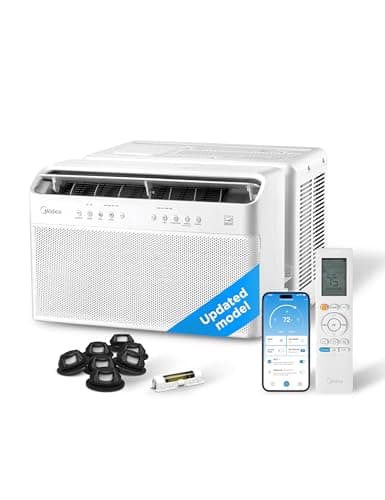 The format that changes the coil job Midea U-Shaped Window Air Conditioner, 8,000 BTU The U-shape puts the compressor and condenser outside a closed window, so the dirty half is genuinely outdoors. | Anyone who dislikes reaching outside to clean a condenser | |
| — | The one where neglect costs most Whynter ARC-14S Dual Hose Portable Air Conditioner 1,300 W and 9,500 BTU SACC, with 71 pints a day of condensate to manage and no certification behind any of it. | Nothing on this page — but it needs the most maintenance |
An air conditioner has one job: move heat from the room air to the outdoor air. It does that across two coils, and everything on this page is about keeping air flowing freely over both of them.
Why it matters
Certified figures assume a clean machine
Every efficiency number on this site — CEER 16, 375 kWh a year, 47% below the federal standard — comes from a laboratory test under controlled conditions on a clean unit.
That makes the numbers excellent for comparing one model against another, which is what they are for. It also means they describe your machine on the day you install it and progressively less well every week after.
Three things degrade, in order of how fast:
- The filter blocks first, within weeks. It starves the evaporator of airflow, so less room air passes over the cold coil per minute, so capacity falls and the unit runs longer for the same result.
- The evaporator coil collects whatever gets past the filter, and it is permanently wet during operation, so it collects biological growth too. Fins clog and airflow drops further.
- The condenser coil faces outdoors and collects pollen, dust, seeds and grass. A fouled condenser cannot reject heat efficiently, which raises head pressure and makes the compressor work harder for every BTU.
None of that is exotic. All of it is airflow, and all of it is recoverable with an hour and a hose.
Schedule
What to do, and how often
| Job | How often | Effort |
|---|---|---|
| Rinse the filter | Every 2–4 weeks in season | Five minutes |
| Clean the evaporator coil | Once a year, before the season | Half an hour |
| Clean the condenser coil | Once a year, or twice if it faces trees | Half an hour |
| Clear the drain pan and path | Once a year, and any time it drips | Ten minutes |
| Wipe the housing and grilles | Whenever you do the filter | Two minutes |
Check your own manual, which takes precedence — filter intervals in particular vary with the filter type.
This one is not a DIY job
Unplug it at the wall before you open anything. Not switched off at the panel — unplugged. There is a fan, a compressor and mains wiring inside, and some units restart automatically after a delay.
Do not touch the fins with anything hard. Coil fins are thin aluminum and they bend if you look at them wrong. Bent fins block the airflow you are trying to restore. A soft brush, a vacuum with a brush head, or water — nothing rigid.
Do not get water into the electrical compartment or the motor. Rinsing coils is normal; hosing the whole machine indiscriminately is not.
Do not attempt anything involving refrigerant. The sealed system is not a user-serviceable part, and in the United States handling refrigerant is legally restricted to certified technicians.
Step by step
The full clean
- Unplug it and remove the front grille. Usually clips or a couple of screws. Take a photo before you start if the assembly looks fiddly.
- Take out the filter and rinse it. Warm water, mild detergent if it needs it, rinse thoroughly and let it dry completely before refitting. A damp filter back in the machine is how you get a smell.
- Vacuum the evaporator coil with a soft brush attachment, working along the fins rather than across them. For anything stubborn, a coil cleaner made for the purpose — not a household spray, which can attack the aluminum.
- Clear the drain pan. The base pan collects condensate and it collects sludge with it. Wipe it out, and check the drain hole or slinger path is clear. A blocked drain is the number one cause of water appearing inside.
- Clean the condenser. This is the outdoor half, and it is the one people never do. If the unit is light enough to remove safely, take it out and rinse the coil from the inside outward so debris leaves the way it came in. If it is not, work through the outdoor grille with a vacuum and a brush.
- Wipe the housing, grilles and louvres, front and back. The intake grille matters as much as the coil.
- Dry everything, reassemble, and check the seal around the unit in the window while you are there.
Do not forget
The seal is part of the maintenance
While the grille is off, look at the installation. Foam gaskets compress and perish, side curtains work loose over a season, and the strip between the two sashes falls out.
Every gap is hot outdoor air entering the room continuously while the unit runs. No certified efficiency figure accounts for that, and it is a larger effect than most cleaning.
Re-check the tilt too. The unit should sit very slightly lower at the outdoor end so condensate drains outside — unless your manual specifies level, as several U-shaped models do. The installation guide covers both.
Say the unwelcome thing
Do not buy a bigger unit because the old one 'stopped keeping up'.
A unit that cooled the room fine two summers ago and struggles now has almost certainly not shrunk. Its airflow has.
A blocked filter and a fouled evaporator reduce capacity gradually enough that you never notice a day-to-day change — you just eventually conclude the machine is undersized. Buying up a capacity band then causes a fresh problem: an oversized unit short-cycles, removes less moisture, and leaves the room cold and clammy.
Clean it properly first. If it still cannot hold the room after a full clean and a seal check, then size the replacement from the room rather than from the unit you are replacing.
In full
Every pick, and what is wrong with it
Published specifications only, each linked to the page it came from. Where a manufacturer publishes nothing, the row says so — we do not fill blanks in.
1. The figure you are protecting
GE Profile ClearView Window Air Conditioner, 8,000 BTU
GE Profile · model PWJV08W
CEER 16 and 375 kWh a year — the certified figure, measured under laboratory conditions on a clean machine.
375 kWh a year, about $69 for a cooling season. CEER 16 is the top of the 8,000 BTU class and it is on the Most Efficient list.
That number is a laboratory result. The test uses a clean filter, a clean coil, and a controlled airflow path. It is a fair basis for comparing units against each other, and it is not a promise about what your unit does in August.
The gap between the two is entirely within your control, and closing it costs nothing but an hour.
At 15.3 inches deep and 46.2 lb it is also among the easier certified units to get out for a proper clean.
What’s wrong with it
Nothing in that certification accounts for a dirty filter, a fouled coil, or a poorly sealed install.
Running cost — PWJV08W
| Annual energy use | 375 kWh | ENERGY STAR certified figure |
|---|---|---|
| Annual cost | $69 | 375 × 18.34¢/kWh |
| Per cooling month | $17 | spread over a four-month season |
The annual figure is the certified value from the ENERGY STAR Certified Room Air Conditioners dataset, which models a standard cooling season rather than your actual summer. It is more useful than a nameplate wattage here, because a variable-speed compressor spends most of its life well below nameplate.
Rate: 18.34¢/kWh, the US average residential price for June 2026 (EIA Electric Power Monthly, Table 5.3). Yours will differ — swap it in: (watts ÷ 1000) × hours × your rate.
| Cooling capacity | 8,000 BTU/h |
|---|---|
| CEER | 16 |
| Annual energy use | 375 kWh/yr |
| vs federal standard | 47% less energy |
| Dimensions | 12.6 H x 18.6 W x 15.3 D in |
| Weight | 46.2 lb |
| Refrigerant | R-32 |
| Installation | Does not straddle the windowsill |
| Compressor | Variable speed |
| ENERGY STAR | Certified, and on the Most Efficient list |
Every figure above is from ENERGY STAR Certified Room Air Conditioners dataset. Blanks are shown as “not published” rather than filled in.
2. Easiest to actually service
Midea Window Air Conditioner, 6,000 BTU
Midea · model MAW06S1KWT-A
31.6 lb and 13.3 inches deep at CEER 16 — light enough to lift out and carry to a hose.
31.6 lb. The lightest certified unit we hold data for, and that changes what cleaning means — you can take it out of the window, carry it outside, and rinse the condenser properly rather than working through a grille in place.
281.3 kWh a year at CEER 16 — about $52 for a season — which is the lowest annual figure in the certified dataset, and 45% below the federal standard.
12.1 H x 16.0 W x 13.3 D inches, no support bracket, R-32, variable speed, Most Efficient listed. A deliberately small machine that is easy to live with.
What’s wrong with it
6,000 BTU covers a small room only, and at 281.3 kWh a year the absolute saving from cleaning is small.
Running cost — MAW06S1KWT-A
| Annual energy use | 281.3 kWh | ENERGY STAR certified figure |
|---|---|---|
| Annual cost | $52 | 281.3 × 18.34¢/kWh |
| Per cooling month | $13 | spread over a four-month season |
The annual figure is the certified value from the ENERGY STAR Certified Room Air Conditioners dataset, which models a standard cooling season rather than your actual summer. It is more useful than a nameplate wattage here, because a variable-speed compressor spends most of its life well below nameplate.
Rate: 18.34¢/kWh, the US average residential price for June 2026 (EIA Electric Power Monthly, Table 5.3). Yours will differ — swap it in: (watts ÷ 1000) × hours × your rate.
| Cooling capacity | 6,000 BTU/h |
|---|---|
| CEER | 16 |
| Annual energy use | 281.3 kWh/yr |
| vs federal standard | 45% less energy |
| Dimensions | 12.1 H x 16.0 W x 13.3 D in |
| Weight | 31.6 lb |
| Installation | Does not straddle the windowsill |
| Support bracket | Not required |
| Compressor | Variable speed |
| Refrigerant | R-32 |
| ENERGY STAR | Certified, and on the Most Efficient list |
Every figure above is from ENERGY STAR Certified Room Air Conditioners dataset. Blanks are shown as “not published” rather than filled in.
3. The format that changes the coil job
Midea U-Shaped Window Air Conditioner, 8,000 BTU
Midea · model MAW08V1QWT-S
The U-shape puts the compressor and condenser outside a closed window, so the dirty half is genuinely outdoors.
Worth knowing on a cleaning page because the architecture changes which surfaces get dirty and how you reach them.
The sash closes through the middle of the unit, so the condenser sits fully outside a shut window. It still needs cleaning — more often, in fact, since it is exposed — but it is genuinely accessible from outside rather than through a grille from within the room.
400 kWh a year at CEER 15, about $73 for a season, with a variable-speed compressor.
53.2 lb and 22 inches deep, so full removal is a planned job. Installation and removal guide.
What’s wrong with it
53.2 lb and 22 inches deep makes removal for cleaning a two-person job, not a casual one.
Running cost — MAW08V1QWT-S
| Annual energy use | 400 kWh | ENERGY STAR certified figure |
|---|---|---|
| Annual cost | $73 | 400 × 18.34¢/kWh |
| Per cooling month | $18 | spread over a four-month season |
The annual figure is the certified value from the ENERGY STAR Certified Room Air Conditioners dataset, which models a standard cooling season rather than your actual summer. It is more useful than a nameplate wattage here, because a variable-speed compressor spends most of its life well below nameplate.
Rate: 18.34¢/kWh, the US average residential price for June 2026 (EIA Electric Power Monthly, Table 5.3). Yours will differ — swap it in: (watts ÷ 1000) × hours × your rate.
| Cooling capacity | 8,000 BTU/h |
|---|---|
| CEER | 15 |
| Annual energy use | 400 kWh/yr |
| vs federal standard | 38% less energy |
| Dimensions | 13.5 H x 19.2 W x 22.0 D in |
| Weight | 53.2 lb |
| Refrigerant | R-32 |
| Installation | U-shape; sash closes through the middle of the unit |
| Compressor | Variable speed |
| ENERGY STAR | Certified |
Every figure above is from ENERGY STAR Certified Room Air Conditioners dataset. Blanks are shown as “not published” rather than filled in.
Skip this one
Whynter ARC-14S Dual Hose Portable Air Conditioner
Whynter · model ARC-14S
1,300 W and 9,500 BTU SACC, with 71 pints a day of condensate to manage and no certification behind any of it.
Included because portable owners arrive at this page and the maintenance burden is genuinely higher.
71 pints a day of dehumidification means a condensate system that has to go somewhere — a tank to empty, a pump, or a drain hose — and that system is where portables grow biological films and start to smell.
The efficiency starting point is also worse. 1,300 W, and a 14,000 BTU headline that is DOE-rated at 9,500 BTU SACC. There is no ENERGY STAR program for portables, so no certified figure exists to degrade from.
If your window can take a unit, the window unit is less to maintain and far less to run.
What’s wrong with it
A portable has the same coils to clean plus a condensate system, and it is already the least efficient format before anything gets dirty.
Running cost — ARC-14S
| Nameplate power | 1300 W | manufacturer's published figure |
|---|---|---|
| Energy, 8-hour night | 10.40 kWh | 1300 ÷ 1000 × 8 |
| Cost per hour | 24¢ | at 18.34¢/kWh |
| Cost per 8-hour night | $1.91 | on the highest speed |
| Cost per 30 nights | $57 | 312.0 kWh |
Rate: 18.34¢/kWh, the US average residential price for June 2026 (EIA Electric Power Monthly, Table 5.3). Yours will differ — swap it in: (watts ÷ 1000) × hours × your rate.
| Marketing capacity | 14,000 BTU (ASHRAE-128) |
|---|---|
| DOE-rated capacity | 9,500 BTU SACC |
| Hoses | Dual |
| Power | 1,300 W / 11.6 A at 115 V |
| Noise | Under 51 dBA low, under 56 dBA high |
| Dehumidification | 71 pints/day |
| Refrigerant | R-32 |
| Dimensions | 16 W x 19 D x 35.5 H in |
| Weight | 73 lb |
| Manufacturer coverage claim | 500 sq ft |
| Warranty | 1 year unit, 3 years compressor |
Every figure above is from Whynter product page, ARC-14S. Blanks are shown as “not published” rather than filled in.
We are not linking a buy button for this one. If you want to look at it anyway, it is easy enough to find — but we would rather send you to something that fits your room.
Questions people actually ask
Frequently asked
How often should you clean a window air conditioner filter?
Every two to four weeks during the cooling season, and check your manual since intervals vary with filter type. The filter blocks fastest of anything on the machine, and a blocked filter starves the evaporator of airflow so capacity falls and run time rises.
Can I hose down a window air conditioner?
You can rinse the coils, ideally with the unit removed and working from the inside outward so debris leaves the way it came in. Do not direct water into the electrical compartment or the fan motor, and never use anything rigid on the fins — they bend easily and bent fins block airflow.
Why does my air conditioner smell?
Usually the evaporator coil and drain pan, which are permanently wet during operation and collect biological growth. A damp filter refitted before it dried is the other common cause. Clean both, and let the filter dry fully before it goes back.
Does cleaning an air conditioner actually save money?
Yes, because every certified efficiency figure was measured on a clean machine under laboratory conditions. Restricted airflow across the evaporator and a fouled condenser both make the compressor work longer and harder for the same cooling.
What is the part people never clean?
The condenser — the outdoor half. It collects pollen, seeds and grass and cannot reject heat efficiently when fouled, which raises compressor load directly. It is also the hardest to reach, which is why lighter units that can be removed are easier to maintain.
Why is water dripping inside from my air conditioner?
Usually a blocked drain path in the base pan, or the unit sitting level or tilted toward the room instead of very slightly toward the outdoors. Clear the pan first, then re-check the tilt against what your manual specifies. Installation and tilt.
Sources
Where these numbers came from
Read next
Where to go from here
Back to Air Conditioners, or read how we pick.