The picks
Whole-house evaporative coolers
The phrase covers two completely different products, and only one of them is something you can buy and plug in.
By Sawyer V. · Published
The short answer
There are two products here. A true whole-house evaporative cooler is a fixed, ducted, roof- or wall-mounted installation — contractor work, not an appliance. What you can buy and plug in is a large portable, and the biggest we hold data for is 5,300 CFM on 430 W. That covers a large open space, not a house of separate rooms, because humidity and airflow do not travel through doorways.
Fan & Frost earns a commission when you buy through our links, at no cost to you. It never changes a ranking, and we say so when the right answer is the cheaper unit or nothing at all. Full disclosure · How we pick.

At a glance
The picks, ranked
Tap any row to jump to the full reasoning. Prices are live from Amazon where we have them, and read “check price” where we don’t — never a number we cannot verify today.
| # | Product | Best for | Price |
|---|---|---|---|
| 1 | 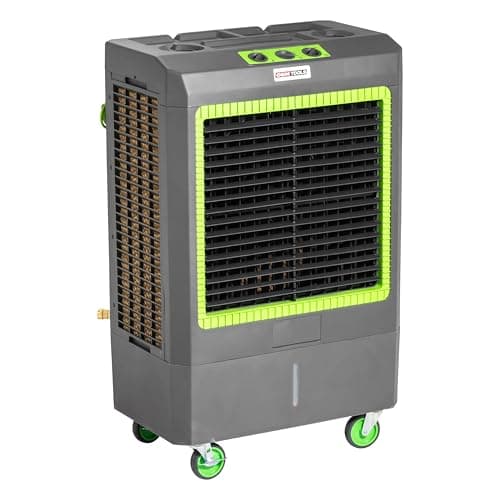 Largest portable Hessaire MC61M Mobile Evaporative Cooler, 5,300 CFM 5,300 CFM on 430 W with a 14.6 gallon reservoir — the most air any portable we hold data for moves. | One large open space — a workshop, a barn, a big covered patio | |
| 2 | Best for an open-plan space Honeywell CO60PM Indoor/Outdoor Evaporative Cooler 2,697 CFM on 220 W with a 15.9 gallon tank, continuous hookup and a 30 ft throw. | A large open floor, or an indoor-outdoor space | |
| 3 | 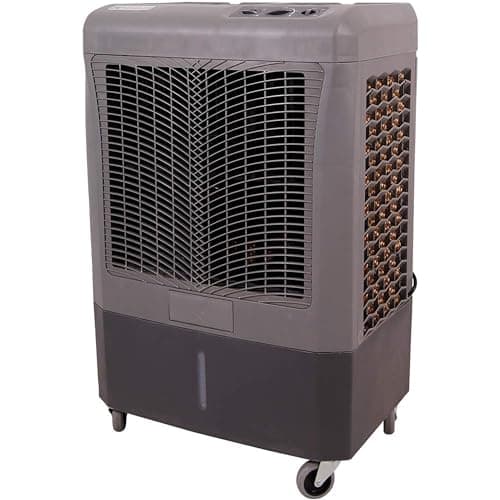 Two of these beats one of anything Hessaire MC37M Mobile Evaporative Cooler 3,100 CFM on 250 W each — and in a house of rooms, two placed units beat one large one. | Two separate spaces, rather than one machine trying to serve both | |
| — | Not a whole-house machine Honeywell CL25AE Indoor Evaporative Cooler 764 CFM on 235 W — a 466 sq ft coverage claim that is one room, not a house. | A single room with a window open |
“Whole-house evaporative cooler” is two different products wearing one phrase, and the difference is the whole of this page.
The two products
Fixed and ducted, or portable and plugged in
A true whole-house evaporative cooler is a fixed unit mounted on a roof, a gable wall or a window opening, ducted into the house and wired in. Air is drawn through wetted pads, cooled, and pushed into the building through ductwork or a central ceiling register. It is the standard air conditioning of the American Southwest.
It is also, unambiguously, an installation: structural mounting, a plumbed water supply with a float valve, a drain, an electrical circuit, and ductwork. Sizing, siting and installation belong to a contractor, and the equipment is not generally an over-the-counter purchase.
A portable evaporative cooler is what you can buy and plug in. The largest we hold data for moves 5,300 CFM on 430 W, and it cools the space it stands in.
We cover the second honestly and point you at a contractor for the first, in the same way we handle whole-home dehumidifiers and whole-house fans.
The limit
Why a portable cannot do a house
This is not about capacity. A 5,300 CFM machine moves more air than most rooms need. It is about where that air goes.
- Cooled air sweeps the space it enters and stops. A doorway is a small opening relative to a room, and air takes the path of least resistance — which is usually straight back to the exhaust window.
- Evaporative cooling does not store. The effect is the moving air; it does not accumulate in a room the way cold air from a compressor does.
- Each room needs its own outlet. The air has to leave, and a room with no open window simply pressurizes.
- Humidity rises as air travels. Air that has already been through one room has picked up moisture and cools less in the next.
Which is why the practical answer to a multi-room house is several correctly placed units, not one large one — or a fixed ducted system that delivers air to each room directly.
The comparison
Airflow per watt across the portable range
| Unit | CFM | Watts | CFM per watt | Tank |
|---|---|---|---|---|
| Hessaire MC61M | 5,300 | 430 | 12.3 | 14.6 gal |
| Hessaire MC37M | 3,100 | 250 | 12.4 | 10.3 gal |
| Honeywell CO60PM | 2,697 | 220 | 12.3 | 15.9 gal |
| Honeywell CL25AE | 764 | 235 | 3.3 | 6.6 gal |
Three of the four land on almost exactly 12.3 CFM per watt, and the small indoor unit manages 3.3. That is close to a fourfold penalty for going small, and it is the clearest argument for buying the larger machine when the space allows.
For context, a whole-house fan on low reaches about 31.9 CFM per watt because it pushes against almost no static pressure — but it moves outdoor air unchanged, rather than cooling it.
Water
At this airflow the tank is not the plan
Evaporative coolers consume water by design, and consumption scales with airflow. A 5,300 CFM unit is evaporating a great deal more than a 764 CFM one.
- Plumb it in. Every large unit here is continuous hookup capable, and a 14.6 gallon reservoir will not last a hot day at full airflow.
- No manufacturer publishes a consumption rate. Tank capacity is always stated; gallons per hour is not — how to measure yours.
- Budget for pads. They are a genuine consumable and a degraded pad quietly takes most of the cooling with it.
- Drain and clean on a schedule. Standing warm water in a large reservoir is a maintenance commitment.
This one is not a DIY job
Fixed whole-house evaporative cooler installation is contractor work. It involves structural mounting on a roof or wall, a plumbed water supply and drain, an electrical circuit, and ductwork into the house. Sizing is done from the building, not from a website.
A roof penetration done badly is a leak that may not appear for a season, and a unit sized wrong either fails to cool or floods the house with humidity.
These systems also require a deliberate exhaust path — usually windows cracked or a dedicated relief vent — and running one with the house sealed does not work.
Climate is the precondition for all of it. Above roughly 60% relative humidity, none of this delivers meaningful cooling at any size.
Say the unwelcome thing
Do not buy one large portable to cool a whole house.
It is the natural reading of the coverage claims and it does not survive contact with a floor plan.
Evaporative cooling is the moving air itself. It sweeps the room it enters and stops at the first closed door, because a doorway is a small opening and air takes the easiest path — usually straight back out of the exhaust window. It does not accumulate the way cold air from a compressor does, and it picks up humidity as it travels, so the second room gets less cooling from wetter air.
Each room also needs its own outlet for displaced air, or it simply pressurizes.
For one large open space, 5,300 CFM on 430 W is the right machine. For a house of rooms, two placed units — 3,100 CFM each — beat one large one, and a genuine whole-house system is a ducted installation.
In full
Every pick, and what is wrong with it
Published specifications only, each linked to the page it came from. Where a manufacturer publishes nothing, the row says so — we do not fill blanks in.
1. Largest portable
Hessaire MC61M Mobile Evaporative Cooler, 5,300 CFM
Hessaire · model MC61M
5,300 CFM on 430 W with a 14.6 gallon reservoir — the most air any portable we hold data for moves.
The top of the portable class, and worth understanding for what it can and cannot reach.
5,300 CFM is roughly 20 air changes an hour in 15,900 cubic feet — a large workshop or a three-bay garage. Genuinely a lot of air.
430 W, about 32¢ for a four-hour session at 18.34¢/kWh, with a 14.6 gallon reservoir and float valve for continuous supply.
The limit is geometry, not capacity. Air from one unit sweeps the space it is in and stops at the first closed door. A house is a set of rooms, and this is one very large fan.
What’s wrong with it
It cools one space. It will not serve a house of separate rooms, whatever the coverage claim says.
Running cost — MC61M
| Nameplate power | 430 W | manufacturer's published figure |
|---|---|---|
| Energy, 8-hour night | 3.44 kWh | 430 ÷ 1000 × 8 |
| Cost per hour | 7.9¢ | at 18.34¢/kWh |
| Cost per 8-hour night | 63¢ | on the highest speed |
| Cost per 30 nights | $19 | 103.2 kWh |
Rate: 18.34¢/kWh, the US average residential price for June 2026 (EIA Electric Power Monthly, Table 5.3). Yours will differ — swap it in: (watts ÷ 1000) × hours × your rate.
| Air delivery | 5,300 CFM |
|---|---|
| Power | 430 W / 4.3 A |
| Water tank | 14.6 gallons, float valve |
| Dimensions | 28 L x 17 W x 46 H in |
| Weight | 57 lb |
| Pads | Replaceable media pads |
| Manufacturer coverage claim | Up to 1,600 sq ft |
Every figure above is from Hessaire product page, 5,300 CFM mobile cooler (MC61M). Blanks are shown as “not published” rather than filled in.
2. Best for an open-plan space
Honeywell CO60PM Indoor/Outdoor Evaporative Cooler
Honeywell · model CO60PM
2,697 CFM on 220 W with a 15.9 gallon tank, continuous hookup and a 30 ft throw.
The most efficient of the large portables on airflow per watt, and the one with the reach to serve an open floor.
2,697 CFM on 220 W is about 12.3 CFM per watt — roughly four times what the small indoor units manage.
30 ft throw with oscillation, which is what determines whether the far end of an open space sees any air at all.
61 to 65 dBA published and a 15.9 gallon tank with continuous hookup. Treat the 1,643 sq ft claim as marketing — run the air-change arithmetic instead.
What’s wrong with it
Its 1,643 sq ft coverage claim is about 12 air changes an hour, which is optimistic indoors.
Running cost — CO60PM
| Nameplate power | 220 W | manufacturer's published figure |
|---|---|---|
| Energy, 8-hour night | 1.76 kWh | 220 ÷ 1000 × 8 |
| Cost per hour | 4.0¢ | at 18.34¢/kWh |
| Cost per 8-hour night | 32¢ | on the highest speed |
| Cost per 30 nights | $9.68 | 52.8 kWh |
Rate: 18.34¢/kWh, the US average residential price for June 2026 (EIA Electric Power Monthly, Table 5.3). Yours will differ — swap it in: (watts ÷ 1000) × hours × your rate.
| Air delivery | 2,697 CFM |
|---|---|
| Power | 220 W |
| Water tank | 15.9 gallons, continuous hookup |
| Air throw | 30 ft |
| Noise | 61-65 dBA |
| Speeds | 3, with oscillation |
| Pads | Triple-sided honeycomb |
| Dimensions | 27.6 W x 18.3 D x 40 H in |
| Weight | 39.2 lb |
| Manufacturer coverage claim | 1,643 sq ft |
| Warranty | 1 year |
Every figure above is from Honeywell Air Comfort product page, CO60PM. Blanks are shown as “not published” rather than filled in.
3. Two of these beats one of anything
Hessaire MC37M Mobile Evaporative Cooler
Hessaire · model MC37M
3,100 CFM on 250 W each — and in a house of rooms, two placed units beat one large one.
The practical answer to “whole house” when the house is not one room: put the air where the people are.
3,100 CFM on 250 W is about 18¢ for four hours. Two of them is 500 W and 6,200 CFM — more air than the single largest unit, placed where it is actually needed.
That matters because evaporative cooling does not propagate. Cooled air sweeps the room it enters and stops at the first door; a neighboring room gets very little.
Continuous hookup capable and a 10.3 gallon tank. The honest cost is doubled maintenance — pads are a consumable on both.
What’s wrong with it
Two machines means two water supplies, two sets of pads and twice the maintenance.
Running cost — MC37M
| Nameplate power | 250 W | manufacturer's published figure |
|---|---|---|
| Energy, 8-hour night | 2.00 kWh | 250 ÷ 1000 × 8 |
| Cost per hour | 4.6¢ | at 18.34¢/kWh |
| Cost per 8-hour night | 37¢ | on the highest speed |
| Cost per 30 nights | $11 | 60.0 kWh |
Rate: 18.34¢/kWh, the US average residential price for June 2026 (EIA Electric Power Monthly, Table 5.3). Yours will differ — swap it in: (watts ÷ 1000) × hours × your rate.
| Air delivery | 3,100 CFM |
|---|---|
| Power | 250 W / 2.4 A |
| Water tank | 10.3 gallons, continuous hookup capable |
| Dimensions | 24 L x 16 W x 38 H in |
| Weight | 40 lb |
| Pads | Industrial-grade cooling pads |
| Coverage claim | Not published on the product page |
Every figure above is from Hessaire product page, MC37M. Blanks are shown as “not published” rather than filled in.
Skip this one
Honeywell CL25AE Indoor Evaporative Cooler
Honeywell · model CL25AE
764 CFM on 235 W — a 466 sq ft coverage claim that is one room, not a house.
Flagged because small indoor coolers get bought on coverage claims that sound house-sized and are not.
764 CFM gives about 20 air changes an hour in 2,290 cubic feet — a room of roughly 285 sq ft at an 8 ft ceiling. The 466 sq ft claim is about 12 air changes.
235 W for 764 CFM is 3.3 CFM per watt, against 12.3 for the large units. The small machines are markedly worse per unit of air.
52 to 60 dBA published and a 33 ft throw. It is a perfectly good single-room unit — in a single room.
What’s wrong with it
3.3 CFM per watt against 12.3 for the large units, and it still needs an open window.
Running cost — CL25AE
| Nameplate power | 235 W | manufacturer's published figure |
|---|---|---|
| Energy, 8-hour night | 1.88 kWh | 235 ÷ 1000 × 8 |
| Cost per hour | 4.3¢ | at 18.34¢/kWh |
| Cost per 8-hour night | 34¢ | on the highest speed |
| Cost per 30 nights | $10 | 56.4 kWh |
Rate: 18.34¢/kWh, the US average residential price for June 2026 (EIA Electric Power Monthly, Table 5.3). Yours will differ — swap it in: (watts ÷ 1000) × hours × your rate.
| Air delivery | 764 CFM |
|---|---|
| Power | 235 W |
| Water tank | 6.6 gallons |
| Air throw | 33 ft |
| Noise | 52-60 dBA |
| Speeds | 3, oscillating louvers |
| Timer | Up to 7.5 hours |
| Dimensions | 18.9 x 14.6 x 33.3 in |
| Weight | 25.4 lb |
| Manufacturer coverage claim | 466 sq ft |
| Warranty | 1 year |
Every figure above is from Honeywell Air Comfort product page, CL25AE. Blanks are shown as “not published” rather than filled in.
We are not linking a buy button for this one. If you want to look at it anyway, it is easy enough to find — but we would rather send you to something that fits your room.
Questions people actually ask
Frequently asked
Can an evaporative cooler cool a whole house?
A fixed, ducted, roof- or wall-mounted system can — that is standard air conditioning across the American Southwest. A portable cannot, whatever the coverage claim says, because cooled air sweeps the room it enters and stops at the first closed door.
What is the biggest portable evaporative cooler?
5,300 CFM on 430 W with a 14.6 gallon reservoir is the largest we hold published data for. That is roughly 20 air changes an hour in 15,900 cubic feet — a large workshop or a three-bay garage, not a house.
Is one big evaporative cooler better than two small ones?
For one open space, yes. For a house of separate rooms, no — two 3,100 CFM units placed where people are deliver 6,200 CFM total, more than the single largest machine, and actually reach both spaces.
Why are small evaporative coolers less efficient?
Markedly so. The large portables all land near 12.3 CFM per watt, while a 764 CFM indoor unit manages 3.3 — close to a fourfold penalty. If the space allows the larger machine, it moves far more air per watt.
Do whole-house evaporative coolers need windows open?
Yes, and that is not optional. These work by replacing the air in the house, so the displaced air needs a deliberate exhaust path — usually windows cracked or a dedicated relief vent. Running one with the house sealed does not work. Setting one up.
How much water does a whole-house evaporative cooler use?
No manufacturer publishes a consumption rate — tank capacity is always stated, gallons per hour is not. At these airflows a 14.6 gallon reservoir will not last a hot day, so plumbing it in is the practical requirement rather than an option. Measuring yours.
Sources
Where these numbers came from
- Hessaire 5,300 CFM mobile cooler (MC61M) product page — 5,300 CFM, 430 W, 14.6 gal, 57 lb
- Hessaire MC37M product page — 3,100 CFM, 250 W, 10.3 gal continuous hookup
- Honeywell CO60PM product page — 2,697 CFM, 220 W, 15.9 gal, 30 ft throw, 61-65 dBA
- Honeywell CL25AE product page — 764 CFM, 235 W, 6.6 gal, 52-60 dBA
- EIA Electric Power Monthly, Table 5.3 — average residential electricity price
Read next
Where to go from here
Back to Evaporative Coolers, or read how we pick.