The picks
The best mini-split air conditioners
The most efficient cooling you can install in a single room, and the number everyone quotes for it is not the number you should compare.
By Sawyer V. · Published
The short answer
The certified leader is SEER2 33.5 and EER2 19.1, with a cold-climate COP of 2.48 at 5°F. But note what the comparison actually shows: EER2 19.1 against CEER 17.6 for the best window unit is a real advantage and not a transformative one. A mini-split earns its cost on installation permanence, quiet and heating, not on a three-times efficiency claim.
Fan & Frost earns a commission when you buy through our links, at no cost to you. It never changes a ranking, and we say so when the right answer is the cheaper unit or nothing at all. Full disclosure · How we pick.

At a glance
The picks, ranked
Tap any row to jump to the full reasoning. Prices are live from Amazon where we have them, and read “check price” where we don’t — never a number we cannot verify today.
| # | Product | Best for | Price |
|---|---|---|---|
| 1 | Best overall Fujitsu Mini-Split Heat Pump, 9,000 BTU SEER2 33.5 and EER2 19.1 — the highest EER2 of any 9,000 to 24,000 BTU unit we hold data for — plus COP 2.48 at 5 degrees F. | One room, in a climate with real winters | |
| 2 | Best lower-GWP refrigerant Mitsubishi Electric Mini-Split Heat Pump, 9,000 BTU SEER2 33.1 and EER2 18.35 on R-454B at GWP 470 — a third of R-410A's warming potential. | A new installation where the refrigerant choice is yours | |
| 3 | Best value tier Hisense Mini-Split Heat Pump, 9,000 BTU SEER2 32.0 and EER2 18.35 — within 4% of the leader on both cooling figures. | A cooling-led installation where winter heating is secondary | |
| — | 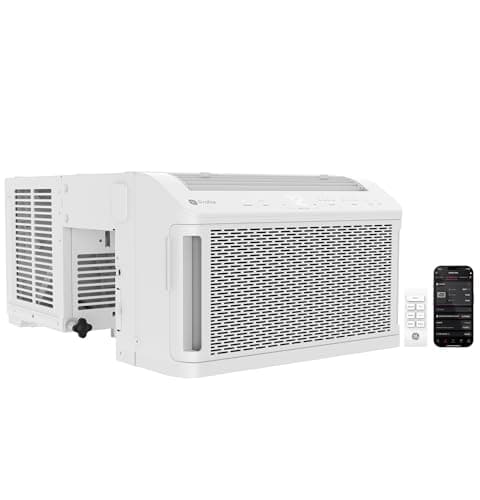 Do this first if you can GE Profile ClearView Window Air Conditioner, 8,000 BTU CEER 16 and 375 kWh a year, installed by you in an afternoon — against a licensed refrigerant job. | A single room with a usable window |
Mini-splits are the most efficient way to cool a single room, and the way that efficiency gets quoted makes the gap look larger than it is.
Method
What we ranked on
The ENERGY STAR Certified Mini-Split Heat Pumps dataset holds 14,328 US records. We filtered to single-zone residential capacities — 9,000 to 24,000 BTU, which is 9,129 records — and ranked on:
- EER2 first, because it is measured at a rating condition and is therefore the only figure comparable to a window unit’s CEER.
- SEER2 second, as the seasonal cooling figure.
- COP at 5°F for anyone in a climate where the heating half matters.
- Refrigerant GWP, as a tie-breaker.
We did not rank on noise, because no mini-split publishes a certified noise figure in this dataset. Indoor units are genuinely quiet — that is one of the category’s real advantages — but every decibel number you see is a manufacturer’s own.
The field
The top of this category is very crowded
| Measure | Median | Best certified |
|---|---|---|
| SEER2 (seasonal cooling) | 21.0 | 35.1 |
| EER2 (rating-condition cooling) | 12.5 | 21.45 |
Two figures worth holding onto. 12,434 of the 14,328 certified units carry the Most Efficient designation — 86.8% of the field. And 12,971 meet the peak-cooling requirement.
A label that 87% of a category carries is not a shortlisting tool. It is a floor. This is the opposite of how selective the same label is elsewhere — 35% of room air conditioners, 15% of ceiling fans, 9% of bathroom fans. In mini-splits you have to compare the numbers directly.
The comparison
EER2 against CEER, not SEER2 against CEER
This is the single most useful thing on the page, and it is where most mini-split marketing quietly cheats.
SEER2 rates a mini-split across a modeled cooling season including a lot of part-load running, where an inverter compressor is at its most efficient. CEER rates a room air conditioner at a single rating condition plus standby. They are different test procedures measuring different things.
Putting SEER2 33.5 next to CEER 17.6 and concluding a mini-split is “almost twice as efficient” compares a seasonal average to a peak-condition rating. It is not a comparison.
EER2 is the mini-split’s rating-condition figure, and it is what belongs beside CEER:
- Best certified mini-split: EER2 19.1 at 9,000 BTU.
- Best certified window unit: CEER 17.6 at 9,500 BTU.
- That is roughly a 9% advantage at comparable conditions.
The seasonal advantage is real and larger than 9%, because an inverter running gently for long periods genuinely beats a unit tested only at full load. But it is not the 90% that the SEER2-versus-CEER framing implies. The full head-to-head.
Heating
The actual reason to buy one
Every unit in this dataset is a heat pump. That is the category’s real argument, and the cooling numbers are almost a side effect.
- COP at 5°F is the figure that matters for heating in a cold climate, and it is published per model. The units here run 2.20 to 2.48 — meaning 2.2 to 2.5 units of heat per unit of electricity at 5°F.
- Cooling efficiency barely predicts heating. Across the certified field the correlation between SEER2 and COP at 5°F is very weak, so a top SEER2 number tells you almost nothing about winter performance. The full analysis.
- HSPF2 is the seasonal heating figure, and it spreads wider than the cooling figures: 11.80 to 14.00 across these three.
- A window unit with heat exists too, and the best reaches CEER 17.6 — the 33 certified reverse-cycle room units. It will not match a mini-split in genuine cold, but it is a fraction of the installation.
This one is not a DIY job
Mini-split installation is licensed work and not negotiable. These systems contain refrigerant under pressure, and charging, evacuating and brazing a line set are regulated activities requiring certification.
A poor installation is the most common reason a mini-split underperforms its published figures: an incorrect charge, a line set that is too long or badly insulated, or an outdoor unit sited where it recirculates its own exhaust will all cost you efficiency you paid for.
“DIY” pre-charged systems exist. They still involve electrical work, a wall penetration, condensate routing and structural mounting, and getting the refrigerant handling wrong voids both the warranty and any efficiency claim.
Sizing should come from a proper load calculation on the space, not from a square-footage rule of thumb.
Practical
What to check before you commit
- Ask for EER2, not just SEER2. Both are published for every certified model. A quote that only mentions SEER2 is quoting the flattering one.
- Ask for COP at 5°F if you have winters. HSPF2 is seasonal and can hide poor cold-weather performance.
- Check the refrigerant. R-410A at GWP 2,088 is still 38% of the certified field. R-454B (470) and R-32 (675) are the modern choices.
- Ignore the Most Efficient badge here. 87% of the field has it, so it does not narrow anything.
- Get the outdoor unit sited properly. Clearance, shade and drainage all matter, and none of it is on the spec sheet.
- Price the window alternative honestly before committing. For one room with a usable window, the efficiency gap at rating conditions is about 9%.
Say the unwelcome thing
Do not compare a mini-split's SEER2 to a window unit's CEER.
It is the standard sales comparison and it is not a comparison at all. SEER2 averages a mini-split across a modeled season including the part-load running an inverter is best at. CEER rates a room unit at one condition plus standby.
Set SEER2 33.5 against CEER 17.6 and a mini-split looks nearly twice as efficient. Set EER2 19.1 against CEER 17.6— the two rating-condition figures — and the advantage is about 9%.
The seasonal advantage is genuine and larger than 9%. The honest case for a mini-split, though, is permanence, indoor quiet, an unblocked window and real winter heating — not a doubled efficiency number.
If those things matter, EER2 19.1 with COP 2.48 at 5 degrees F is the leader. If they do not, 375 kWh a year in a window costs a fraction to install.
In full
Every pick, and what is wrong with it
Published specifications only, each linked to the page it came from. Where a manufacturer publishes nothing, the row says so — we do not fill blanks in.
1. Best overall
Fujitsu Mini-Split Heat Pump, 9,000 BTU
Fujitsu · model AOUH09KTAP1
SEER2 33.5 and EER2 19.1 — the highest EER2 of any 9,000 to 24,000 BTU unit we hold data for — plus COP 2.48 at 5 degrees F.
The efficiency leader on the number that actually compares to a window unit, rather than the one on the marketing.
EER2 19.1 is measured at a single high-load rating condition, the same way CEER is. That makes it the fair comparison, and 19.1 against the best window unit’s CEER 17.6 is about 9% better.
SEER2 33.5 is the seasonal figure, and it is where the real gap lives — it rewards part-load operation that a window unit is not tested for.
COP 2.48 at 5°F and HSPF2 14.00 make it a genuine cold-climate heater, which is the strongest argument for the whole category. R-32 refrigerant at GWP 675.
What’s wrong with it
It is a licensed installation with a line set and an outdoor unit, and no noise figure is certified.
Running cost
Fujitsu does not publish a wattage for the AOUH09KTAP1, so we cannot calculate what it costs to run. We are not going to estimate one. If Fujitsu publishes a nameplate figure, this block will show the arithmetic.
| Cooling capacity | 9,000 BTU/h |
|---|---|
| SEER2 | 33.5 |
| EER2 | 19.1 |
| HSPF2 | 14.00 |
| COP at 5 degrees F | 2.48 |
| Cold climate | Yes |
| Refrigerant | R-32 (GWP 675) |
| ENERGY STAR | Certified, and on the Most Efficient list |
| Noise | Not published in the certified dataset |
Every figure above is from ENERGY STAR Certified Mini-Split Heat Pumps dataset. Blanks are shown as “not published” rather than filled in.
2. Best lower-GWP refrigerant
Mitsubishi Electric Mini-Split Heat Pump, 9,000 BTU
Mitsubishi Electric · model MUZ-FX09NLHZ
SEER2 33.1 and EER2 18.35 on R-454B at GWP 470 — a third of R-410A's warming potential.
Essentially the same efficiency tier with a different refrigerant decision behind it, and that decision is worth making deliberately.
R-454B at GWP 470 against R-32 at 675 and R-410A at 2,088. Across the certified mini-split field the split is roughly 46% R-454B, 38% R-410A and 16% R-32 — which the room air conditioner category has already left behind.
SEER2 33.1, EER2 18.35, HSPF2 13.30, cold-climate certified and on the Most Efficient list.
COP 2.20 at 5°F is a genuine step down from 2.48 — roughly 11% less heat per unit of electricity on the coldest days, which is exactly when it matters.
What’s wrong with it
COP 2.20 at 5 degrees F trails the Fujitsu, and R-454B is mildly flammable (A2L).
Running cost
Mitsubishi Electric does not publish a wattage for the MUZ-FX09NLHZ, so we cannot calculate what it costs to run. We are not going to estimate one. If Mitsubishi Electric publishes a nameplate figure, this block will show the arithmetic.
| Cooling capacity | 9,000 BTU/h |
|---|---|
| SEER2 | 33.1 |
| EER2 | 18.35 |
| HSPF2 | 13.30 |
| COP at 5 degrees F | 2.20 |
| Cold climate | Yes |
| Refrigerant | R-454B (GWP 470) |
| ENERGY STAR | Certified, and on the Most Efficient list |
| Noise | Not published in the certified dataset |
Every figure above is from ENERGY STAR Certified Mini-Split Heat Pumps dataset. Blanks are shown as “not published” rather than filled in.
3. Best value tier
Hisense Mini-Split Heat Pump, 9,000 BTU
Hisense · model AO-09U3T25P
SEER2 32.0 and EER2 18.35 — within 4% of the leader on both cooling figures.
The reminder that the top of this category is crowded. The difference between the best certified cooling figures and the fifteenth-best is small.
EER2 18.35 matches the Mitsubishi exactly and sits 4% behind the Fujitsu. SEER2 32.0 against 33.5 is a 4.5% difference.
Where it separates is heating. HSPF2 11.80 against 14.00 is a 16% gap in seasonal heating efficiency, though its COP 2.25 at 5°F holds up better than that suggests.
R-454B, cold-climate certified, Most Efficient. If you are buying primarily to cool, the cooling figures here are effectively top-tier.
What’s wrong with it
HSPF2 11.80 is well behind the leaders, so it is the weakest of these three as a heater.
Running cost
Hisense does not publish a wattage for the AO-09U3T25P, so we cannot calculate what it costs to run. We are not going to estimate one. If Hisense publishes a nameplate figure, this block will show the arithmetic.
| Cooling capacity | 9,000 BTU/h |
|---|---|
| SEER2 | 32.0 |
| EER2 | 18.35 |
| HSPF2 | 11.80 |
| COP at 5 degrees F | 2.25 |
| Cold climate | Yes |
| Refrigerant | R-454B (GWP 470) |
| ENERGY STAR | Certified, and on the Most Efficient list |
| Noise | Not published in the certified dataset |
Every figure above is from ENERGY STAR Certified Mini-Split Heat Pumps dataset. Blanks are shown as “not published” rather than filled in.
Skip this one
GE Profile ClearView Window Air Conditioner, 8,000 BTU
GE Profile · model PWJV08W
CEER 16 and 375 kWh a year, installed by you in an afternoon — against a licensed refrigerant job.
Marked as a skip on a mini-split page for one reason: a very large share of people pricing a mini-split for a single room have a window that would take a unit.
CEER 16 and 375 kWh a year, about $69 for a season at 18.34¢/kWh. The best mini-split’s EER2 of 19.1 is roughly 9% better on the comparable measure — not a different league.
46.2 lb, no licensed trade, no line set, no outdoor unit. The installed cost difference is very large and the efficiency difference at rating conditions is not.
Where the mini-split genuinely wins: seasonal part-load efficiency, indoor noise, no window occupied, and heating. The comparison in full.
What’s wrong with it
It is in your window all season, it is louder indoors, and it does not heat.
Running cost — PWJV08W
| Annual energy use | 375 kWh | ENERGY STAR certified figure |
|---|---|---|
| Annual cost | $69 | 375 × 18.34¢/kWh |
| Per cooling month | $17 | spread over a four-month season |
The annual figure is the certified value from the ENERGY STAR Certified Room Air Conditioners dataset, which models a standard cooling season rather than your actual summer. It is more useful than a nameplate wattage here, because a variable-speed compressor spends most of its life well below nameplate.
Rate: 18.34¢/kWh, the US average residential price for June 2026 (EIA Electric Power Monthly, Table 5.3). Yours will differ — swap it in: (watts ÷ 1000) × hours × your rate.
| Cooling capacity | 8,000 BTU/h |
|---|---|
| CEER | 16 |
| Annual energy use | 375 kWh/yr |
| vs federal standard | 47% less energy |
| Dimensions | 12.6 H x 18.6 W x 15.3 D in |
| Weight | 46.2 lb |
| Refrigerant | R-32 |
| Installation | Does not straddle the windowsill |
| Compressor | Variable speed |
| ENERGY STAR | Certified, and on the Most Efficient list |
Every figure above is from ENERGY STAR Certified Room Air Conditioners dataset. Blanks are shown as “not published” rather than filled in.
We are not linking a buy button for this one. If you want to look at it anyway, it is easy enough to find — but we would rather send you to something that fits your room.
Questions people actually ask
Frequently asked
What is the most efficient mini-split air conditioner?
On the rating-condition figure, EER2 19.1 with SEER2 33.5 — the highest EER2 of any 9,000 to 24,000 BTU unit we hold data for, with COP 2.48 at 5 degrees F for heating. Across the whole certified field SEER2 reaches 35.1 and EER2 reaches 21.45.
Is a mini-split twice as efficient as a window air conditioner?
No — that claim comes from comparing SEER2 to CEER, which are different test procedures. The fair comparison is EER2 against CEER: 19.1 against 17.6, or about 9%. The seasonal advantage is real and larger, but nowhere near double. The full comparison.
Does the ENERGY STAR Most Efficient label help with mini-splits?
Not really. 12,434 of the 14,328 certified units carry it — 86.8% of the field. A label that most of a category holds is a floor rather than a shortlist, so you have to compare EER2 and COP directly.
Which refrigerant should a new mini-split use?
R-454B at GWP 470 or R-32 at 675, rather than R-410A at 2,088. R-410A is still about 38% of the certified mini-split field, while the room air conditioner category has already converted fully. What GWP means.
Can I install a mini-split myself?
No. Charging, evacuating and brazing a refrigerant line set is licensed work. Pre-charged 'DIY' systems still involve electrical work, a wall penetration, condensate routing and structural mounting, and mishandling the refrigerant voids the warranty and the efficiency claim.
How quiet is a mini-split?
Genuinely quiet indoors — it is one of the category's real advantages — but no mini-split publishes a certified noise figure. Every decibel number you see is the manufacturer's own, measured however they chose.
Sources
Where these numbers came from
- ENERGY STAR Certified Mini-Split Heat Pumps dataset — SEER2, EER2, HSPF2, COP at 5F, capacity, refrigerant and Most Efficient flag across 14,328 US records
- ENERGY STAR Certified Room Air Conditioners dataset — CEER and annual kWh for the comparison case
- EIA Electric Power Monthly, Table 5.3 — average residential electricity price
Read next
Where to go from here
Back to Air Conditioners, or read how we pick.