The picks
Best in-line duct fans
The motor lives in the duct instead of the ceiling. That buys you airflow and quiet at the grille, and costs you about three quarters of your efficiency.
By Sawyer V. · Published
The short answer
For a long or demanding run, the Fantech FG 12XL EC moves 750 CFM through a 12-inch duct — the highest certified in-line airflow we hold data for. For most jobs the FG 10 EC at 460 CFM and 5.2 CFM per watt is the efficiency leader. Expect 4 to 5 CFM per watt from any of them, against 16.7 for a good ceiling-mounted fan, and note that no in-line fan publishes a sone rating at all.
Fan & Frost earns a commission when you buy through our links, at no cost to you. It never changes a ranking, and we say so when the right answer is the cheaper unit or nothing at all. Full disclosure · How we pick.

At a glance
The picks, ranked
Tap any row to jump to the full reasoning. Prices are live from Amazon where we have them, and read “check price” where we don’t — never a number we cannot verify today.
| # | Product | Best for | Price |
|---|---|---|---|
| 1 | Best overall Fantech FG 10 EC In-Line Fan 460 CFM at 5.2 CFM per watt — the highest efficacy of any certified in-line fan we hold data for. | A single long run, or two bathrooms sharing one fan | |
| 2 | Most airflow Fantech FG 12XL EC In-Line Fan 750 CFM — the highest certified in-line airflow in the dataset, at a still-respectable 4.6 CFM per watt. | A workshop, a multi-grille system, or a very long duct run | |
| 3 | Most airflow through the smallest duct S&P TD Silent TD-200S In-Line Fan 460 CFM through an 8-inch duct — the same airflow as the 10-inch Fantech, in a noticeably smaller hole. | Retrofitting real airflow where only 8-inch duct will fit | |
| — | 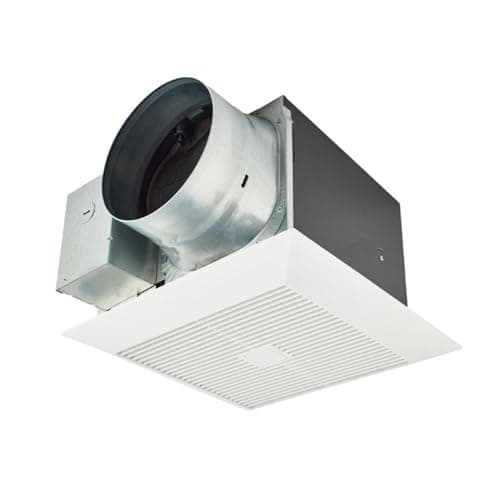 What you give up by going in-line Panasonic WhisperGreen Select FV-0511VK3 Ventilation Fan 16.7 CFM per watt and 0.1 sones. Roughly three times the efficiency of any in-line fan, with a published noise rating. | A normal bathroom — where an in-line fan is the wrong answer |
An in-line fan is not mounted in the room. It sits partway along the duct run, in an attic or a joist bay, with plain grilles at the terminals and nothing mechanical in the ceiling above you.
That single architectural difference is the entire case for and against them.
The case for
Three things it buys you
- The motor noise is not in the room. Sound from a fan mounted twelve feet away in a duct attenuates before it reaches the grille. This is why the category exists.
- Airflow a ceiling fan cannot reach. Certified ceiling-mounted bathroom fans top out around 110 to 155 CFM. In-line fans run to 750 CFM.
- One fan, several grilles. A single in-line unit can serve two bathrooms, or a bathroom and a toilet, through a branched run. A ceiling fan serves the room it is in.
The case against
What it costs you, in numbers
In-line fans are certified under exactly the same ENERGY STAR ventilating fan program as ceiling-mounted ones, tested the same way at 0.25 inches of water gauge. So the comparison is fair, and it is stark.
| Fan | Type | CFM | CFM/W | Sones |
|---|---|---|---|---|
| Panasonic FV-0511VK3 | Ceiling | 110 | 16.7 | 0.1 |
| Ortech ODD-70-1 | Ceiling | 75 | 16.7 | 0.4 |
| Broan-NuTone Premium 150 | Ceiling | 154.4 | 14.2 | 1.4 |
| Fantech FG 10 EC | In-line | 460 | 5.2 | not published |
| Fantech FG 12XL EC | In-line | 750 | 4.6 | not published |
| Fantech FG 8 | In-line | 390 | 4.0 | not published |
| S&P TD-200S | In-line | 460 | 4.0 | not published |
ENERGY STAR Certified Ventilating Fans dataset. All CFM figures at 0.25 inches of water gauge.
Every in-line fan in the dataset sits between 4 and 5.2 CFM per watt. Every ceiling fan on this page sits between 14.2 and 16.7. That is roughly a threefold efficiency gap, and it is consistent enough to treat as a property of the format rather than of any one product.
The reason is duct. An in-line fan spends its entire working life pushing air along a pipe with friction on every surface and losses at every elbow. A ceiling fan pushes into a short run and out. Same test condition, very different real geometry.
The missing number
Nobody publishes sones for in-line fans
This is worth knowing before you buy on a quiet claim. Not one in-line fan in the certified dataset carries a sone rating. The field reads “N/A” across the category.
There is a defensible reason: a sone figure describes the noise a ceiling-mounted fan makes in the room it is installed in. An in-line fan has no fixed relationship to a room — how loud it is at the grille depends on how far along the duct it sits, what the duct is made of, and whether it is isolated from the structure.
But the consequence is unavoidable: any quiet claim on an in-line fan is the manufacturer’s, not a test result. The S&P model here is literally called “TD Silent” and carries no certified acoustic figure at all.
What actually determines noise at the grille is installation: distance from the terminal, flexible connectors at both ends of the fan, insulated or acoustic duct, and not screwing the fan body rigidly to a joist that will transmit vibration through the ceiling.
This one is not a DIY job
An in-line fan is an installation, not a purchase. The fan is the cheap part. Budget for the duct run, the fittings, the exterior termination, the electrical supply at the fan location, and access for future service.
Support it independently and isolate it. Hang the fan from the structure with vibration isolation rather than letting the duct carry its weight, and use flexible connectors at both ends. A rigidly-mounted in-line fan turns the whole ceiling into a soundboard, which defeats the entire reason you bought one.
Leave yourself access. It has bearings and it will need attention eventually. A fan buried in a sealed soffit is a fan you will replace by cutting a hole in something.
Terminate outdoors. Same rule as any exhaust fan — ending a moist duct run in an attic is a building problem.
Sizing
Duct diameter is the decision
Pick the duct first and the fan second, because the duct is what you cannot easily change later.
The S&P versus Fantech comparison above is the clearest evidence of why: the same 460 CFM costs 4.0 CFM per watt through 8-inch duct and 5.2 through 10-inch. Identical airflow, 23% different efficiency, and the only variable is the pipe.
Bigger duct is always more efficient for a given airflow. The limit is what you can physically route. If you have the depth for 10-inch, take it — you will be paying that efficiency difference for as long as the fan runs.
And if the answer is that you have room for 6-inch and one room to serve, that is a ceiling fan job, at three times the efficiency and with a published noise rating.
Say the unwelcome thing
Do not buy an in-line fan to make a normal bathroom quieter.
This is the most common reason people end up here, and it is now the wrong answer. The category exists from an era when ceiling-mounted fans were genuinely loud.
They are not any more. Certified ceiling fans reach 0.1 sones — the floor of the measurement scale — while delivering 16.7 CFM per watt. An in-line fan gives you no certified acoustic figure at all and about a third of the efficiency.
Buy in-line when you need airflow a ceiling fan cannot produce, or when one fan must serve several grilles. For one quiet bathroom, a 0.1-sone ceiling fan is cheaper to buy, cheaper to install, cheaper to run and measurably quiet.
In full
Every pick, and what is wrong with it
Published specifications only, each linked to the page it came from. Where a manufacturer publishes nothing, the row says so — we do not fill blanks in.
1. Best overall
Fantech FG 10 EC In-Line Fan
Fantech · model FG 10 EC
460 CFM at 5.2 CFM per watt — the highest efficacy of any certified in-line fan we hold data for.
5.2 CFM per watt. In a category where 4.0 is typical, that is the efficiency leader — about 30% more air per watt than the 8-inch fans below.
460 CFM at 0.25 inches of water gauge is enough for a genuinely long run, or for one fan serving two grilles. The EC motor is where the efficiency comes from: it varies speed electronically instead of throttling a fixed-speed induction motor.
The honest caveat is the ductwork. 10-inch duct is substantially larger than the 6-inch a bathroom fan uses, and it has to be routed, supported and terminated. That is the real cost of an in-line install, not the fan.
What’s wrong with it
A 10-inch duct is a real commitment, and like every in-line fan it publishes no noise rating.
Running cost
Fantech does not publish a wattage for the FG 10 EC, so we cannot calculate what it costs to run. We are not going to estimate one. If Fantech publishes a nameplate figure, this block will show the arithmetic.
| Air delivery | 460 CFM at 0.25 in w.g. |
|---|---|
| Efficacy | 5.2 CFM per watt |
| Duct size | 10 in diameter |
| Unit type | In-line (single-port), mounted in the duct run |
| Motor | EC (electronically commutated) |
| Noise (sones) | Not published for in-line units |
| ENERGY STAR | Certified |
Every figure above is from ENERGY STAR Certified Ventilating Fans dataset. Blanks are shown as “not published” rather than filled in.
2. Most airflow
Fantech FG 12XL EC In-Line Fan
Fantech · model FG 12XL EC
750 CFM — the highest certified in-line airflow in the dataset, at a still-respectable 4.6 CFM per watt.
750 CFM is the top of the certified in-line field. For scale, a normal bathroom wants 80 to 110 CFM — so this is not a bathroom fan under any reading.
It earns its place where one fan serves several grilles, or where a run is long enough that a smaller fan would arrive at the terminal with nothing left. 4.6 CFM per watt holds up well against the FG 10 EC’s 5.2 given the extra capacity.
12-inch duct is the constraint, and it is a large one. Confirm you have the ceiling or attic depth to route it before anything else.
What’s wrong with it
12-inch duct is a serious installation, and 750 CFM is far more than a single room can use.
Running cost
Fantech does not publish a wattage for the FG 12XL EC, so we cannot calculate what it costs to run. We are not going to estimate one. If Fantech publishes a nameplate figure, this block will show the arithmetic.
| Air delivery | 750 CFM at 0.25 in w.g. |
|---|---|
| Efficacy | 4.6 CFM per watt |
| Duct size | 12 in diameter |
| Unit type | In-line (single-port), mounted in the duct run |
| Motor | EC (electronically commutated) |
| Noise (sones) | Not published for in-line units |
| ENERGY STAR | Certified |
Every figure above is from ENERGY STAR Certified Ventilating Fans dataset. Blanks are shown as “not published” rather than filled in.
3. Most airflow through the smallest duct
S&P TD Silent TD-200S In-Line Fan
S&P · model TD-200S
460 CFM through an 8-inch duct — the same airflow as the 10-inch Fantech, in a noticeably smaller hole.
The interesting comparison on this page. 460 CFM through 8-inch duct, matching the 10-inch Fantech’s airflow through substantially less cross-section.
The physics shows up in the efficiency: 4.0 CFM per watt against 5.2. Pushing the same air through a smaller pipe means higher velocity and more friction, and the motor pays for it — a 23% efficiency penalty for the smaller duct.
That is a trade worth making when the duct route is fixed. An extra couple of inches of duct diameter through an existing structure is frequently the most expensive part of the whole job.
The name is “TD Silent”, and no sone figure is published — which is true of every in-line fan in the dataset.
What’s wrong with it
4.0 CFM per watt is the lowest efficacy of the three, which is the price of forcing that air through less duct.
Running cost
S&P does not publish a wattage for the TD-200S, so we cannot calculate what it costs to run. We are not going to estimate one. If S&P publishes a nameplate figure, this block will show the arithmetic.
| Air delivery | 460 CFM at 0.25 in w.g. |
|---|---|
| Efficacy | 4.0 CFM per watt |
| Duct size | 8 in diameter |
| Unit type | In-line (single-port), mounted in the duct run |
| Noise (sones) | Not published for in-line units |
| ENERGY STAR | Certified |
Every figure above is from ENERGY STAR Certified Ventilating Fans dataset. Blanks are shown as “not published” rather than filled in.
Skip this one
Panasonic WhisperGreen Select FV-0511VK3 Ventilation Fan
Panasonic · model FV-0511VK3
16.7 CFM per watt and 0.1 sones. Roughly three times the efficiency of any in-line fan, with a published noise rating.
Listed here to make the trade explicit, because a lot of people reach for an in-line fan when a ceiling fan would serve them better.
16.7 CFM per watt against 4.0 to 5.2. A ceiling-mounted bathroom fan is roughly three times as efficient as anything in-line, and it publishes a noise rating — 0.1 sones — that no in-line fan does.
In-line fans earn their keep on airflow and on where the motor sits, not on efficiency. If your run is short and one room needs 80 to 110 CFM, buy a ceiling fan and be done.
What’s wrong with it
110 CFM caps what it can serve, and the motor is in the ceiling above you rather than out in the duct run.
Running cost
Panasonic does not publish a wattage for the FV-0511VK3, so we cannot calculate what it costs to run. We are not going to estimate one. If Panasonic publishes a nameplate figure, this block will show the arithmetic.
| Noise | 0.1 sones |
|---|---|
| Air delivery, high | 110 CFM at 0.25 in w.g. |
| Air delivery, medium | 80 CFM |
| Air delivery, low | 50 CFM |
| Efficacy, high | 16.7 CFM per watt |
| Efficacy, medium | 18.4 CFM per watt |
| Efficacy, low | 14.7 CFM per watt |
| Duct size | 6 in diameter |
| Speeds | 3 or more |
| Lighting | None |
| Power | Not published in the certified dataset |
| ENERGY STAR | Certified, and on the Most Efficient list |
Every figure above is from ENERGY STAR Certified Ventilating Fans dataset. Blanks are shown as “not published” rather than filled in.
We are not linking a buy button for this one. If you want to look at it anyway, it is easy enough to find — but we would rather send you to something that fits your room.
Questions people actually ask
Frequently asked
Are in-line duct fans quieter than ceiling fans?
Possibly, but nobody publishes a figure. No in-line fan in the ENERGY STAR certified dataset carries a sone rating — the field reads N/A across the category, so every quiet claim is the manufacturer's. Meanwhile certified ceiling fans reach 0.1 sones, the floor of the scale.
How efficient are in-line duct fans?
Between 4.0 and 5.2 CFM per watt across the certified field, against 14.2 to 16.7 for ceiling-mounted bathroom fans. That roughly threefold gap is a property of the format — an in-line fan spends its life pushing air along a duct.
What size in-line fan do I need?
Choose the duct diameter first, because it is what you cannot change later. Certified data shows the same 460 CFM costs 4.0 CFM per watt through 8-inch duct and 5.2 through 10-inch — identical airflow, 23% different efficiency, and the only variable is the pipe.
Can one in-line fan serve two bathrooms?
Yes, and it is one of the format's genuine advantages. A single unit can feed several grilles through a branched run — something a ceiling-mounted fan cannot do, since it only serves the room it is in.
How do you make an in-line fan quiet?
Installation, not the product. Mount it well back from the terminal, use flexible connectors at both ends, isolate it from the structure rather than screwing it to a joist, and use insulated or acoustic duct. A rigidly mounted fan turns the ceiling into a soundboard.
Is an in-line fan worth it for one bathroom?
Usually not any more. Certified ceiling fans now reach 0.1 sones at 16.7 CFM per watt, so the original reason for going in-line — escaping a loud ceiling fan — has largely gone away. Choose in-line for airflow or multiple grilles instead. Bathroom fans, ranked.
Sources
Where these numbers came from
Read next
Where to go from here
Back to Whole-House Airflow, or read how we pick.