The picks
The best humidity-sensing bathroom fans
The ventilating body that writes the sizing rules says every bathroom should have a control that keeps the fan running 20 minutes after you leave. A humidity sensor is that control, and the certified data says it costs you nothing.
By Sawyer V. · Published
The short answer
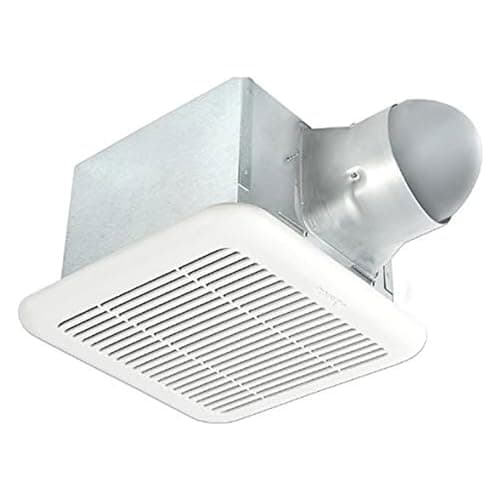
Buy the Delta SIG80-110MH — 110 / 60 / 30 CFM at 0.1 sones and 15.3 CFM per watt, on the ENERGY STAR Most Efficient list, with humidity and motion sensing. The reason to stop agonizing over the sensor: ENERGY STAR certifies this fan at exactly the same efficiency as the non-sensing SIG80-110. What does cost you is the duct — the identical fan falls to 10.5 CFM per watt on a 4-inch duct instead of a 6-inch one.
Fan & Frost earns a commission when you buy through our links, at no cost to you. It never changes a ranking, and we say so when the right answer is the cheaper unit or nothing at all. Full disclosure · How we pick.
At a glance
The picks, ranked
Tap any row to jump to the full reasoning. Prices are live from Amazon where we have them, and read “check price” where we don’t — never a number we cannot verify today.
| # | Product | Best for | Price |
|---|---|---|---|
| 1 | Best overall Delta BreezSignature SIG80-110MH Ventilation Fan 110 / 60 / 30 CFM, 0.1 sones and 15.3 CFM per watt on a 6-inch duct, with humidity and motion sensing. Certified identically to the non-sensing version of the same fan. | Any bathroom you can run a 6-inch duct to — the efficiency leader of the sensing fans, and the only one on the Most Efficient list | |
| 2 | 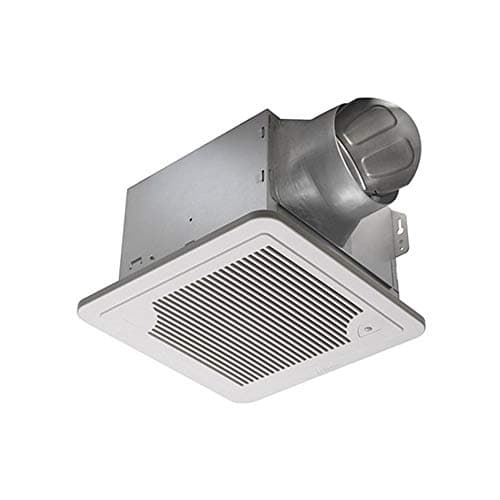 Most air, and the quietest certified Delta BreezSmart SMT130H Ventilation Fan 130 / 70 / 50 CFM at 0.0 to 0.1 sones — the lowest certified noise figure on this page — for 11.4 CFM per watt. | A large bathroom, an enclosed toilet with a bathtub, or any room where the fixture-count sizing rule lands above 110 CFM | |
| 3 | 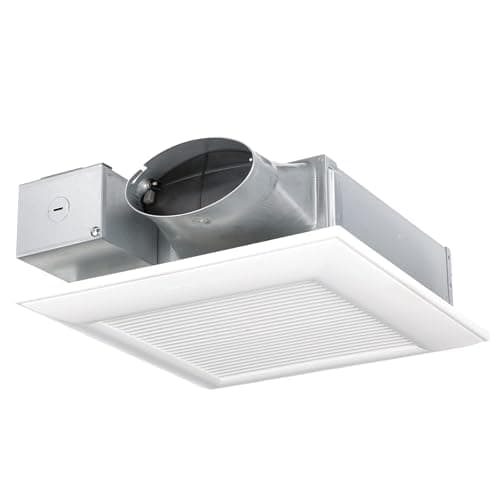 Best for a shallow ceiling or a 4-inch duct Panasonic WhisperValue DC FV-0510VSC1 Ventilation Fan 100 / 80 / 50 CFM on a 4-inch duct at 0.1 to 0.9 sones, and the only fan here that gets more efficient as it slows — 12 CFM per watt on low against 8.2 on high. | A retrofit with almost no cavity depth, or a run that is already 4-inch duct and is going to stay that way | |
| — | 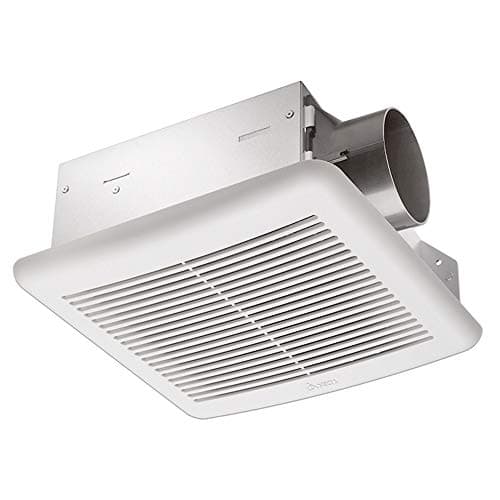 The one to skip Delta BreezSlim SLM70H Ventilation Fan 70 CFM at 5.8 CFM per watt and 2.0 sones on a 3-inch duct. A third the efficiency of the SIG80-110MH and twenty times the noise. | Nothing we would recommend — it is here because it is the cheapest humidity-sensing fan you can buy, and the price is the only argument for it |
A bathroom fan on a wall switch has one failure mode, and it is not mechanical: somebody turns it off on the way out, two minutes after a ten-minute shower, with the mirror still fogged. A humidity sensor fixes exactly that and nothing else.
This matters more in cold weather than in warm. Warm, moist air that meets a cold surface drops its water there — which is why condensation shows up on glass and in cold corners in winter and not in July.
The guidance
Twenty minutes after you leave
The Home Ventilating Institute — the body whose sizing table the whole category uses — publishes this: “A timer or other control that ensures ventilation continues for a minimum of 20 minutes after each use of the bathroom should be installed in each bathroom.”
Read it again as a buying instruction. The recommendation is not a fan; it is a fan plus a control. A humidity sensor is the version of that control that measures the thing you actually care about, rather than counting down from a number somebody guessed at.
The EPA’s moisture guidance arrives at the same place from the other direction: “Run the bathroom fan or open the window when showering”, and keep indoor relative humidity “below 60 percent (ideally between 30 and 50 percent)”. A sensing fan is the only one of these fans that knows whether it has got you there.
The finding
The sensor is free, and the duct is not
The obvious worry about a sensing fan is that the electronics cost you something in airflow or efficiency. The certified data says they do not. ENERGY STAR tests each model number separately, so the sensing and non-sensing builds of the same fan appear as separate records — and they are the same records.
| Model | Sensing | CFM, high | CFM per watt | Sones |
|---|---|---|---|---|
| Delta SIG80-110 | No | 110 | 15.3 | 0.1 |
| Delta SIG80-110MH | Humidity + motion | 110 | 15.3 | 0.1 |
| Delta SMT130 | No | 130 | 11.4 | 0.0 |
| Delta SMT130H | Humidity | 130 | 11.4 | 0.0 - 0.1 |
| Delta SLM70 | No | 70 | 5.8 | 1.9 |
| Delta SLM70H | Humidity | 70 | 5.8 | 2.0 |
ENERGY STAR Certified Ventilating Fans dataset, matched pairs of one model with and without its sensing suffix. Delta figures are the 6-inch duct records except the SLM70 pair, which is certified on 3 inches. The dataset has no sensor field; the suffix is the only record of it.
Three pairs, three identical efficacy figures. Whatever a humidity sensor costs, it is not measured in CFM per watt.
The duct is a different story, and it is the finding worth taking away. ENERGY STAR certifies the SIG80-110MH twice:
- On a 6-inch duct: 15.3 CFM per watt, 0.1 sones.
- On a 4-inch duct: 10.5 CFM per watt, 0.0 to 1.0 sones.
That is a 31 percent efficiency loss and a tenfold noise range, from the same fan, decided entirely by the pipe behind it. If you are choosing between spending money on a sensor and spending it on a bigger duct, the duct is the better purchase — and the sensor is cheap enough that on most of these fans you do not have to choose.
Sizing
How much air the room asks for
The published rule splits at 100 square feet of floor area.
- Under 100 sq ft: 1 CFM per square foot, with a minimum of 50 CFM. A 7-by-9 bathroom is 63 sq ft, so the minimum governs and any fan here clears it.
- Over 100 sq ft: add per fixture — toilet 50, shower 50, bathtub 50, jetted tub 100. A toilet plus a shower plus a tub is 150 CFM, which is more than any fan on this page delivers on its own.
- An enclosed toilet is published as needing its own exhaust fan, not a share of the main one.
- Continuously, instead: 20 CFM running all the time is published as an allowable substitute for an intermittent 50 CFM fan. Every multi-speed fan here has a low speed above that figure.
This one is not a DIY job
Put the fan over the shower or tub if you can. The published guidance is that fans approved for wet locations “should be located over the shower or tub whenever possible” — which is also where a humidity sensor reads the air that actually matters. A sensing fan mounted by the door is measuring the room after the moisture has already spread through it.
The alternative
A sensing switch, if the fan is already there
If you have a decent fan and a bad switch, the fan is not the problem. In-wall humidity-sensing fan controls exist, they replace a single-pole switch, and they turn any dumb fan into a sensing one. The published catches are worth knowing before you buy one: they generally require a neutral wire at the switch box, which older boxes often do not have, and the ones we looked at publish no relative-humidity accuracy figure at all — only an adjustable “sensitivity” with no stated scale.
That is a real asymmetry with the fans on this page, whose airflow, efficacy and noise are all federally certified. If you go the switch route you are buying an unmeasured control for a measured fan. How long the fan actually needs to run covers what you would be setting it to.
Which one
How to choose between them
- You can run 6-inch duct: the SIG80-110MH. Best efficiency, lowest noise, motion as well as humidity, and the only Most Efficient listing here.
- Bathroom over 100 sq ft, or three fixtures: the SMT130H for its 130 CFM, and accept 11.4 CFM per watt.
- Shallow ceiling, or 4-inch duct you cannot change: the Panasonic FV-0510VSC1 for the slim housing — though on efficiency alone the Delta still wins on 4 inches.
- Planning to leave it running: the Panasonic again. It is the only fan here that gets more efficient on low, at 12 CFM per watt.
Say the unwelcome thing
Do not buy a 'module-ready' fan and assume the sensor is in the box.
Several ventilating fans are sold as sensor-compatible rather than sensor-equipped: the housing accepts a plug-in condensation or motion module that is a separate purchase, frequently at a meaningful fraction of the fan’s own price. The listing says “module ready”, which reads like a feature and is actually a shopping list.
Check for a sensing suffix in the model number instead — Delta uses H and MH, Panasonic uses a C on its condensation-sensing builds. The suffix is on the certification record; the marketing copy is not.
In full
Every pick, and what is wrong with it
Published specifications only, each linked to the page it came from. Where a manufacturer publishes nothing, the row says so — we do not fill blanks in.
1. Best overall
Delta BreezSignature SIG80-110MH Ventilation Fan
Delta · model SIG80-110MH
110 / 60 / 30 CFM, 0.1 sones and 15.3 CFM per watt on a 6-inch duct, with humidity and motion sensing. Certified identically to the non-sensing version of the same fan.
110 / 60 / 30 CFM on three or more speeds, at 0.1 sones and 15.3 CFM per watt on a 6-inch duct. That is the highest certified efficacy of any humidity-sensing fan on this page and it carries the ENERGY STAR Most Efficient designation, which none of the other three do.
The MH suffix is the whole point: Delta’s motion-and-humidity build. Motion starts it when you walk in, humidity keeps it running until the room is actually dry rather than until a timer expires. That second half is what the ventilating industry’s own guidance asks for.
Now the number that matters more than the sensor. ENERGY STAR certifies this model twice, once per duct diameter: 15.3 CFM per watt on 6 inches, 10.5 on 4 inches, and the noise range widens from 0.1 sones to 0.0–1.0. Same fan, same motor, same sensor. The duct you can run decides a third of the performance.
Low speed is 30 CFM. That is the figure to look at if you want the fan to simply stay on — the ventilating guidance allows a continuous 20 CFM in place of an intermittent 50, and 30 CFM clears it with margin while drawing a fraction of what high speed does.
No light. If you need one in the same housing, the LED variants and what the lens costs you.
What’s wrong with it
Put it on a 4-inch duct and the certified efficiency drops to 10.5 CFM per watt and the noise range opens to 1.0 sones — a 31 percent efficiency penalty for the duct, not the fan. It also has no light, so a light fixture is a separate job.
Running cost
Delta does not publish a wattage for the SIG80-110MH, so we cannot calculate what it costs to run. We are not going to estimate one. If Delta publishes a nameplate figure, this block will show the arithmetic.
| Noise, on a 6 in duct | 0.1 sones |
|---|---|
| Air delivery, high | 110 CFM at 0.25 in w.g. |
| Air delivery, medium | 60 CFM |
| Air delivery, low | 30 CFM |
| Efficacy, high, on a 6 in duct | 15.3 CFM per watt |
| Efficacy, high, on a 4 in duct | 10.5 CFM per watt |
| Duct size | Certified on both 6 in and 4 in diameter |
| Speeds | 3 or more |
| Lighting | None |
| Sensing | Humidity and motion -- the MH suffix. Not a field in the certified dataset |
| Power | Not published in the certified dataset |
| ENERGY STAR | Certified, and on the Most Efficient list |
Every figure above is from ENERGY STAR Certified Ventilating Fans dataset. Blanks are shown as “not published” rather than filled in.
2. Most air, and the quietest certified
Delta BreezSmart SMT130H Ventilation Fan
Delta · model SMT130H
130 / 70 / 50 CFM at 0.0 to 0.1 sones — the lowest certified noise figure on this page — for 11.4 CFM per watt.
130 / 70 / 50 CFM at 0.0 to 0.1 sones. The bottom of that range is the quietest certified figure on this page, and 0.0 sones in the certified dataset means the measurement rounded below the first decimal — not that the fan is silent.
The reason to want 130 CFM is the published sizing rule. For a bathroom over 100 square feet the recommendation is to add the requirement for each fixture: 50 CFM for the toilet, 50 for the shower, 50 for the bathtub, 100 for a jetted tub. A room with a toilet, a shower and a tub asks for 150 — and a room with two of the three asks for 100, which 110 covers and 80 does not.
11.4 / 10.7 / 9.8 CFM per watt across its three speeds. Against the SIG80-110MH’s 15.3 that is a real gap, and it is the trade this pick asks you to make: more air and less noise, for more electricity per cubic foot moved.
Same finding as every fan here: ENERGY STAR certifies the non-sensing SMT130 at an identical 130 CFM and 11.4 CFM per watt. The H costs nothing in performance.
What’s wrong with it
11.4 CFM per watt against the SIG80-110MH's 15.3, so you pay about a third more electricity per unit of air moved. Its low speed is 50 CFM, which is more than you need for continuous running.
Running cost
Delta does not publish a wattage for the SMT130H, so we cannot calculate what it costs to run. We are not going to estimate one. If Delta publishes a nameplate figure, this block will show the arithmetic.
| Noise | 0.0 - 0.1 sones |
|---|---|
| Air delivery, high | 130 CFM at 0.25 in w.g. |
| Air delivery, medium | 70 CFM |
| Air delivery, low | 50 CFM |
| Efficacy, high | 11.4 CFM per watt |
| Efficacy, medium | 10.7 CFM per watt |
| Efficacy, low | 9.8 CFM per watt |
| Duct size | 6 in diameter |
| Speeds | 3 or more |
| Lighting | None |
| Sensing | Humidity -- the H suffix. Not a field in the certified dataset |
| Power | Not published in the certified dataset |
| ENERGY STAR | Certified |
Every figure above is from ENERGY STAR Certified Ventilating Fans dataset. Blanks are shown as “not published” rather than filled in.
3. Best for a shallow ceiling or a 4-inch duct
Panasonic WhisperValue DC FV-0510VSC1 Ventilation Fan
Panasonic · model FV-0510VSC1
100 / 80 / 50 CFM on a 4-inch duct at 0.1 to 0.9 sones, and the only fan here that gets more efficient as it slows — 12 CFM per watt on low against 8.2 on high.
100 / 80 / 50 CFM at 0.1 to 0.9 sones, certified on a 4-inch duct — which is the entire reason this pick exists. Every other fan here wants 6 inches, and a retrofit in a finished ceiling frequently cannot give it.
It is also the one fan on this page whose efficiency improves as it slows: 8.2 CFM per watt on high, 9.9 on medium, 12 on low. Most fans here go the other way. If your plan is to leave it running at 50 CFM most of the time — well above the 20 CFM continuous allowance — it is the most efficient way on this page to do that.
The honest comparison: put the SIG80-110MH on the same 4-inch duct and it certifies at 10.5 CFM per watt, still ahead of this fan’s 8.2 on high. So this is not the 4-inch efficiency winner either — it is the fan that fits when the cavity is shallow, and that is a different kind of win.
Panasonic’s C-suffix build is the condensation-sensing one. The company also sells a plug-in sensor module for its module-ready fans, which is a second purchase — see the skip card below for why that matters.
What’s wrong with it
8.2 CFM per watt on high is the second-worst figure on this page, and 0.9 sones at the top of its range is nine times the SIG80-110MH's 0.1. You are buying it for the housing, not the numbers.
Running cost
Panasonic does not publish a wattage for the FV-0510VSC1, so we cannot calculate what it costs to run. We are not going to estimate one. If Panasonic publishes a nameplate figure, this block will show the arithmetic.
| Noise | 0.1 - 0.9 sones |
|---|---|
| Air delivery, high | 100 CFM at 0.25 in w.g. |
| Air delivery, medium | 80 CFM |
| Air delivery, low | 50 CFM |
| Efficacy, high | 8.2 CFM per watt |
| Efficacy, medium | 9.9 CFM per watt |
| Efficacy, low | 12 CFM per watt |
| Duct size | 4 in diameter |
| Speeds | 3 or more |
| Lighting | None |
| Sensing | Humidity -- the C suffix on Panasonic's condensation-sensing build. Not a field in the certified dataset |
| Power | Not published in the certified dataset |
| ENERGY STAR | Certified |
Every figure above is from ENERGY STAR Certified Ventilating Fans dataset. Blanks are shown as “not published” rather than filled in.
Skip this one
Delta BreezSlim SLM70H Ventilation Fan
Delta · model SLM70H
70 CFM at 5.8 CFM per watt and 2.0 sones on a 3-inch duct. A third the efficiency of the SIG80-110MH and twenty times the noise.
70 CFM nominal, 58.7 CFM at 0.25 inches water gauge, at 5.8 CFM per watt and 2.0 sones, on a 3-inch duct. Every one of those numbers is the worst on this page.
The arithmetic is unkind. 5.8 against 15.3 CFM per watt means it uses roughly two and a half times the electricity to move the same air as the top pick. And a humidity-sensing fan runs longer than a switched one by design — that is what you are buying — so the efficiency penalty compounds rather than cancels.
Then the noise. The certified figure is 2.0 sones against 0.1 for the Delta and 0.0–0.1 for the BreezSmart. A sensing fan is supposed to stay on unattended for twenty minutes after you leave; at 2.0 sones the household turns it off, and a fan that gets switched off is a fan with no sensor.
It is not a broken machine. On a 3-inch duct in a tiny powder room it will clear moisture. But the gap to the top pick is larger here than in any fan comparison on this site, and it is not a close call.
What’s wrong with it
2.0 sones is loud enough that the sensor becomes the problem rather than the solution: a fan that runs on for 20 minutes after every shower had better be inaudible, and this one is the loudest certified fan on the page by a factor of twenty.
Running cost
Delta does not publish a wattage for the SLM70H, so we cannot calculate what it costs to run. We are not going to estimate one. If Delta publishes a nameplate figure, this block will show the arithmetic.
| Noise | 2.0 sones |
|---|---|
| Air delivery | 70 CFM, 58.7 CFM at 0.25 in w.g. |
| Efficacy | 5.8 CFM per watt |
| Duct size | 3 in diameter |
| Speeds | 1 |
| Lighting | None |
| Sensing | Humidity -- the H suffix. Not a field in the certified dataset |
| Power | Not published in the certified dataset |
| ENERGY STAR | Certified |
Every figure above is from ENERGY STAR Certified Ventilating Fans dataset. Blanks are shown as “not published” rather than filled in.
We are not linking a buy button for this one. If you want to look at it anyway, it is easy enough to find — but we would rather send you to something that fits your room.
Questions people actually ask
Frequently asked
What is the best humidity-sensing bathroom fan?
The Delta BreezSignature SIG80-110MH. It certifies at 110 / 60 / 30 CFM, 0.1 sones and 15.3 CFM per watt on a 6-inch duct, carries humidity and motion sensing, and is the only fan of the four on this page on the ENERGY STAR Most Efficient list.
Does a humidity sensor make a bathroom fan less efficient?
No, and the certified data is unusually clear about it. ENERGY STAR tests each model number separately, and three matched pairs certify identically: SIG80-110 and SIG80-110MH both at 15.3 CFM per watt, SMT130 and SMT130H both at 11.4, SLM70 and SLM70H both at 5.8. The sensor costs nothing measurable.
How long should a humidity-sensing bathroom fan run?
The Home Ventilating Institute publishes that ventilation should continue for a minimum of 20 minutes after each use of the bathroom. A humidity sensor runs to a measured condition instead of a fixed time, which is why the same guidance accepts 'a timer or other control' — the sensor is the other control. Run time, worked out.
Does duct size matter more than the fan?
On these figures, close to it. The same SIG80-110MH is certified at 15.3 CFM per watt and 0.1 sones on a 6-inch duct and 10.5 CFM per watt with a 0.0 to 1.0 sone range on a 4-inch one. That is a 31 percent efficiency difference with no change to the fan at all.
What size bathroom fan do I need?
Under 100 square feet, 1 CFM per square foot with a minimum of 50 CFM. Over 100 square feet, add per fixture: 50 CFM each for a toilet, shower or bathtub and 100 for a jetted tub. An enclosed toilet is published as needing its own fan rather than a share of the main one. Bathroom fans ranked on sones.
Can I add a humidity sensor to the fan I already have?
Yes, with an in-wall humidity-sensing fan control that replaces a single-pole switch. Two published catches: they generally require a neutral wire at the switch box, which older boxes often lack, and the ones we checked publish no relative-humidity accuracy figure — only an adjustable sensitivity with no stated scale.
Is a humidity-sensing fan better than a dehumidifier for a bathroom?
For a bathroom, yes. A fan removes the moist air; a dehumidifier condenses water out of air it keeps in the room, which in a space generating moisture several times a day is the harder job. A dehumidifier is the right machine for a basement or a closed room with no duct to the outside. Fan or dehumidifier.
Sources
Where these numbers came from
- ENERGY STAR Certified Ventilating Fans dataset — certified CFM, sones and CFM per watt for every model number on this page, including the sensing and non-sensing pairs
- Home Ventilating Institute, How much ventilation do I need? — 1 CFM per sq ft with a 50 CFM minimum, per-fixture addition above 100 sq ft, 20 CFM continuous alternative, and the 20-minute post-use run time
- EPA, A Brief Guide to Mold, Moisture and Your Home — keep indoor humidity below 60 percent, ideally 30 to 50 percent; run the bathroom fan or open the window when showering
- ENERGY STAR Most Efficient — the designation the SIG80-110MH carries
Read next
Where to go from here
Back to Whole-House Airflow, or read how we pick.