Guide and picks
Cooling a laundry room
The room feels hot because it is humid, and the humidity has an obvious source that is usually fixable for nothing.
By Sawyer V. · Published
The short answer
A laundry room is usually a humidity problem wearing a heat problem’s clothes. A dryer venting indoors, or a dryer duct with a jammed exterior flap, puts a very large amount of moisture into a small space — and humid air blocks the evaporation your body uses to cool itself. Check the dryer vent first, then extract. A certified ventilating fan removes air at 16.7 CFM per watt and 0.1 sones.
Fan & Frost earns a commission when you buy through our links, at no cost to you. It never changes a ranking, and we say so when the right answer is the cheaper unit or nothing at all. Full disclosure · How we pick.
At a glance
The picks, ranked
Tap any row to jump to the full reasoning. Prices are live from Amazon where we have them, and read “check price” where we don’t — never a number we cannot verify today.
| # | Product | Best for | Price |
|---|---|---|---|
| 1 | 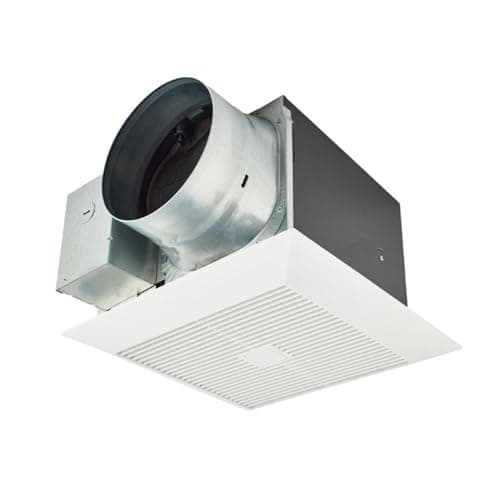 Best extraction Panasonic WhisperGreen Select FV-0511VK3 Ventilation Fan 110 CFM at 0.1 sones and 16.7 CFM per watt — certified, and it removes the air rather than cooling it. | A laundry room that needs the moisture taken out of the building | |
| 2 | For an existing 4-inch duct Ortech ODD-70-1 Ventilation Fan 75 CFM at 16.7 CFM per watt through a 4-inch duct — matching the best 6-inch fan on efficacy. | A retrofit where enlarging the duct is not happening | |
| 3 | 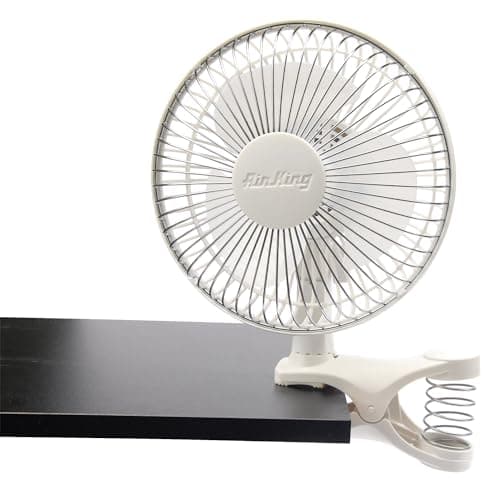 For the person standing in there Air King 6" Commercial Grade Clip-On Fan 9 to 12 W on a clip that mounts to a shelf edge — ETL listed and OSHA compliant. | Airflow while sorting or folding, without using counter space | |
| — | 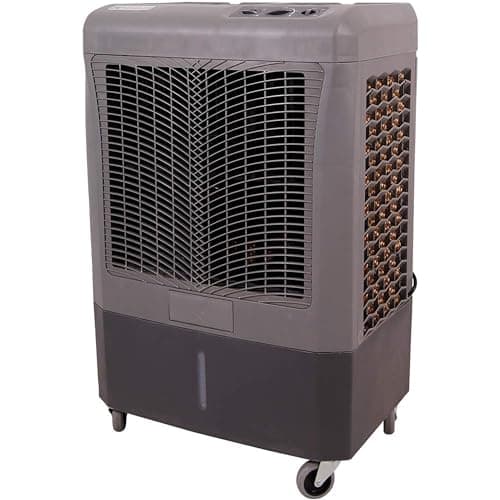 Exactly the wrong machine Hessaire MC37M Mobile Evaporative Cooler 3,100 CFM on 250 W, and it cools by adding water vapor to air that already has too much. | A dry garage or patio — never a laundry room |
A laundry room usually measures cooler than it feels, and that gap is the whole story of the room.
Diagnosis
It is humidity, not heat
Your body sheds heat mainly by evaporating sweat, and evaporation needs air with spare capacity to absorb water. A laundry room is a small space with several large moisture sources, so that capacity gets used up.
The result is a room that reads a comfortable temperature on a thermometer and feels oppressive to stand in. The mechanism in full.
Test it before buying anything. A cheap thermometer-hygrometer left in the room for a day settles which problem you have — and they call for completely different purchases.
The big one
Check where the dryer vents
A tumble dryer removes water from clothes and puts it into the air. Over a load that is a substantial amount of moisture, and where it goes determines whether your laundry room is comfortable.
Three situations, in order of how bad they are:
- Vented indoors. Either a condenser-style unit that releases into the room, or a vented dryer with its duct simply pointed at a wall. Every gram of moisture from every load stays in the building.
- Vented outdoors through a blocked or jammed duct. The worst version, because it looks correct. Lint accumulates in the run and exterior flaps stick shut with paint, debris or nesting — so the moisture backs up into the room while the installation appears fine.
- Vented outdoors through a clear duct. What you want.
Go outside and look at the flap while the dryer runs. It should be open with air moving. That single check resolves more laundry room discomfort than any appliance purchase.
This one is not a DIY job
A blocked dryer duct is a safety matter, not just a comfort one. Lint accumulation in a dryer duct is a recognized fire risk, and a restricted duct also makes the dryer run longer and hotter for every load.
Clean the duct run and the exterior termination on whatever schedule your appliance manual specifies, and check the flap opens freely.
Never vent a dryer into an enclosed space — a loft, a crawl space, a garage — where the moisture has nowhere to go. That is a building problem as well as a comfort one.
If the dryer is gas, venting requirements are a combustion safety matter and belong to your appliance manual and local code.
Then
Extract, do not cool
Once the dryer is venting properly, the remaining moisture comes from washing, from damp clothes, and from anything drying on an airer. Those want extraction.
A ventilating fan takes the air — and the moisture in it — out of the building. That addresses the cause. An air conditioner removes moisture too, but does it by condensing water out of air it is also cooling, which is far more energy-intensive for the same result.
Certified units reach 16.7 CFM per watt at 0.1 sones, which is a fraction of a cent an hour. Run it during and after laundry rather than in bursts.
The certified field, and why it needs cleaning — lint-heavy air loads a blower wheel faster than most rooms.
Also
The rest of the load
- The dryer itself is a heater. Even correctly vented, its cabinet radiates into the room throughout a cycle. Running loads in the morning or evening rather than the afternoon shifts that heat away from the hottest part of the day.
- Dry outdoors where you can. The cheapest dehumidification available, and it removes the heat source entirely.
- Do not dry clothes on an airer in a closed laundry room. Every gram of water in those clothes ends up in the air, and without extraction it stays there.
- Close the door and extract rather than letting damp air migrate into the rest of the house, where it becomes somebody else’s problem — frequently a basement one.
Say the unwelcome thing
Do not put an air conditioner in a laundry room to fix the humidity.
It will work, in the sense that a cold coil condenses moisture. It is an expensive way to address a problem with a free fix upstream.
Dehumidifying by refrigeration is the most energy-intensive part of what an air conditioner does, and in a laundry room it is competing against a source that keeps replenishing every time you run a load.
Meanwhile the actual cause — a dryer venting indoors, or a jammed exterior flap — costs nothing to check and frequently nothing to fix.
Check the vent, then extract. A certified fan at 16.7 CFM per watt takes the moisture out of the building for a fraction of a cent an hour.
In full
Every pick, and what is wrong with it
Published specifications only, each linked to the page it came from. Where a manufacturer publishes nothing, the row says so — we do not fill blanks in.
1. Best extraction
Panasonic WhisperGreen Select FV-0511VK3 Ventilation Fan
Panasonic · model FV-0511VK3
110 CFM at 0.1 sones and 16.7 CFM per watt — certified, and it removes the air rather than cooling it.
The right machine for this room, because the problem is moisture and extraction removes moisture from the building rather than moving it around.
16.7 CFM per watt against a category median of 4.7, and 0.1 sones — the floor of the measurement scale, which matters if the laundry adjoins a living space.
Its middle speed is the efficient one: 18.4 CFM per watt at 80 CFM. That suits continuous low-rate running, which is exactly what a laundry room wants — 71.8% of certified fans are more efficient below full speed.
On the Most Efficient list, which only 80 of 912 certified bathroom and utility fans reach.
What’s wrong with it
It is a ceiling-mounted ducted installation, and it needs a 6-inch duct route to outside.
Running cost
Panasonic does not publish a wattage for the FV-0511VK3, so we cannot calculate what it costs to run. We are not going to estimate one. If Panasonic publishes a nameplate figure, this block will show the arithmetic.
| Noise | 0.1 sones |
|---|---|
| Air delivery, high | 110 CFM at 0.25 in w.g. |
| Air delivery, medium | 80 CFM |
| Air delivery, low | 50 CFM |
| Efficacy, high | 16.7 CFM per watt |
| Efficacy, medium | 18.4 CFM per watt |
| Efficacy, low | 14.7 CFM per watt |
| Duct size | 6 in diameter |
| Speeds | 3 or more |
| Lighting | None |
| Power | Not published in the certified dataset |
| ENERGY STAR | Certified, and on the Most Efficient list |
Every figure above is from ENERGY STAR Certified Ventilating Fans dataset. Blanks are shown as “not published” rather than filled in.
2. For an existing 4-inch duct
Ortech ODD-70-1 Ventilation Fan
Ortech · model ODD-70-1
75 CFM at 16.7 CFM per watt through a 4-inch duct — matching the best 6-inch fan on efficacy.
Many laundry rooms have a 4-inch duct already, and enlarging one through a ceiling and out through a wall or roof is real construction.
16.7 CFM per watt through 4 inches matches the best 6-inch fan on efficiency, which is unusual — smaller ducts normally cost efficiency.
0.4 sones is still below the 0.7 category median, so it is quieter than most of what is sold despite being four times the 0.1-sone units.
One speed, no lighting, on the Most Efficient list. A deliberately plain product with fewer things to go wrong — which suits a room you rarely think about.
What’s wrong with it
0.4 sones is four times the quietest units here, and one fixed speed gives no tuning.
Running cost
Ortech does not publish a wattage for the ODD-70-1, so we cannot calculate what it costs to run. We are not going to estimate one. If Ortech publishes a nameplate figure, this block will show the arithmetic.
| Noise | 0.4 sones |
|---|---|
| Air delivery | 75 CFM at 0.25 in w.g. |
| Efficacy | 16.7 CFM per watt |
| Duct size | 4 in diameter |
| Speeds | 1 |
| Lighting | None |
| Power | Not published in the certified dataset |
| ENERGY STAR | Certified, and on the Most Efficient list |
Every figure above is from ENERGY STAR Certified Ventilating Fans dataset. Blanks are shown as “not published” rather than filled in.
3. For the person standing in there
Air King 6" Commercial Grade Clip-On Fan
Air King · model 9145
9 to 12 W on a clip that mounts to a shelf edge — ETL listed and OSHA compliant.
Extraction handles the room. It does nothing for you standing in front of a warm dryer, and that is a separate and much cheaper problem.
The spring-loaded clip mounts to a shelf edge or a rail rather than taking counter space, which in most laundry rooms is the only flat surface there is.
9 to 12 W — about 0.4¢ for a two-hour session — and 34 to 37 dBA.
Metal guard, commercial construction, which survives a lint-heavy environment better than a plastic domestic fan. Clean it often — lint loads a guard fast.
What’s wrong with it
190 CFM is personal airflow. It does nothing about the humidity, which is the actual problem.
Running cost — 9145
| Nameplate power | 9 W – 12 W | manufacturer's published figure |
|---|---|---|
| Energy, 8-hour night | 0.10 kWh | 12 ÷ 1000 × 8 |
| Cost per hour | 0.2¢ | at 18.34¢/kWh |
| Cost per 8-hour night | 1.8¢ | on the highest speed |
| Cost per 30 nights | 53¢ | 2.9 kWh |
| Same month, lowest speed | 40¢ | at 9 W |
Rate: 18.34¢/kWh, the US average residential price for June 2026 (EIA Electric Power Monthly, Table 5.3). Yours will differ — swap it in: (watts ÷ 1000) × hours × your rate.
| Power | 9 W - 12 W (0.1-0.2 A at 120 V) |
|---|---|
| Air delivery | Up to 190 CFM |
| Noise | 34 dBA low, 37 dBA high |
| Speeds | 2 |
| Mounting | Spring-loaded clip, non-marking |
| Dimensions | 10.38 H x 6.25 L x 8.13 W in |
| Weight | 2.22 lb |
| Cord | 6 ft, 3-conductor |
| Listing | ETL listed, OSHA compliant |
| Warranty | 1 year |
Every figure above is from Air King product page, 9145 (via Lasko). Blanks are shown as “not published” rather than filled in.
Skip this one
Hessaire MC37M Mobile Evaporative Cooler
Hessaire · model MC37M
3,100 CFM on 250 W, and it cools by adding water vapor to air that already has too much.
Worth stating explicitly because evaporative coolers get bought for hot utility spaces, and this is the room where the mismatch is most complete.
It cools by evaporating water into the air. A laundry room already has more moisture than it can shed — which is why it feels bad in the first place.
You would get almost no temperature drop, because humid air cannot absorb much more water, and you would make the underlying problem worse.
It is a good machine. Put it somewhere dry.
What’s wrong with it
A laundry room's problem is humidity. This is a machine whose entire function is adding humidity.
Running cost — MC37M
| Nameplate power | 250 W | manufacturer's published figure |
|---|---|---|
| Energy, 8-hour night | 2.00 kWh | 250 ÷ 1000 × 8 |
| Cost per hour | 4.6¢ | at 18.34¢/kWh |
| Cost per 8-hour night | 37¢ | on the highest speed |
| Cost per 30 nights | $11 | 60.0 kWh |
Rate: 18.34¢/kWh, the US average residential price for June 2026 (EIA Electric Power Monthly, Table 5.3). Yours will differ — swap it in: (watts ÷ 1000) × hours × your rate.
| Air delivery | 3,100 CFM |
|---|---|
| Power | 250 W / 2.4 A |
| Water tank | 10.3 gallons, continuous hookup capable |
| Dimensions | 24 L x 16 W x 38 H in |
| Weight | 40 lb |
| Pads | Industrial-grade cooling pads |
| Coverage claim | Not published on the product page |
Every figure above is from Hessaire product page, MC37M. Blanks are shown as “not published” rather than filled in.
We are not linking a buy button for this one. If you want to look at it anyway, it is easy enough to find — but we would rather send you to something that fits your room.
Questions people actually ask
Frequently asked
Why is my laundry room so hot?
Usually it is humid rather than hot. Washing, damp clothes and especially a dryer put a lot of moisture into a small space, and humid air blocks the evaporation your body uses to cool itself — so the room feels worse than it measures.
Where should a dryer vent to?
Outdoors, through a clear duct with a flap that opens freely. Go outside and look at the flap while the dryer runs — a duct that is blocked or a flap jammed shut looks correct from inside while the moisture backs up into the room.
Is an extract fan better than an air conditioner in a laundry room?
Yes, and by a wide margin. A ventilating fan removes the moisture from the building at 16.7 CFM per watt on the best certified units. An air conditioner condenses it out of air it is also cooling, which is the most energy-intensive thing it does. Certified extract fans.
Can I use an evaporative cooler in a laundry room?
No — it is the most complete mismatch on this site. An evaporative cooler cools by adding water vapor to the air, and a laundry room already has more moisture than it can shed.
Should I dry clothes on an airer indoors?
Not in a closed laundry room. Every gram of water in those clothes ends up in the air, and without extraction it stays there — then migrates into the rest of the house.
Does a blocked dryer duct matter beyond comfort?
Yes. Lint accumulation in a dryer duct is a recognized fire risk, and a restricted duct makes the dryer run longer and hotter every load. Clean the run and the exterior termination on the schedule your appliance manual specifies.
Sources
Where these numbers came from
- ENERGY STAR Certified Ventilating Fans dataset — CFM at 0.25 in w.g., CFM per watt by speed, sones and Most Efficient flag
- Air King 9145 product page — 9-12 W, 190 CFM, 34-37 dBA, ETL listed
- Hessaire MC37M product page — 3,100 CFM, 250 W, 10.3 gal tank
- EIA Electric Power Monthly, Table 5.3 — electricity rate
Read next
Where to go from here
Back to Room Cooling, or read how we pick.