The picks
The best fan brands, judged on what they will tell you
There is no certification program for portable fans, so the only brand signal that survives contact with the evidence is whether a brand prints its own numbers.
By Sawyer V. · Published
The short answer
Air King is the brand to buy — it publishes airflow and wattage on all nine models we can source specs for, decibels on six, and its range runs 15.8 to 29.0 CFM per watt. Lasko publishes airflow on five of nine and tops out at 18.1. Vornado publishes no airflow figure at all. With no certification program for this category, that is the whole signal.
Fan & Frost earns a commission when you buy through our links, at no cost to you. It never changes a ranking, and we say so when the right answer is the cheaper unit or nothing at all. Full disclosure · How we pick.
At a glance
The picks, ranked
Tap any row to jump to the full reasoning. Prices are live from Amazon where we have them, and read “check price” where we don’t — never a number we cannot verify today.
| # | Product | Best for | Price |
|---|---|---|---|
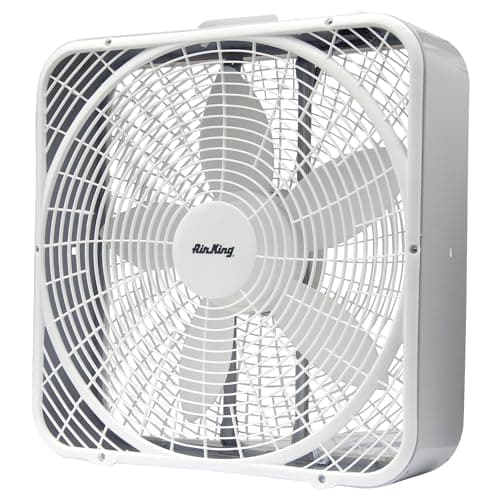
| 1 | Best brand overall Air King 9723 20" Commercial Grade Box Fan The only brand here that publishes airflow and wattage on every model we can source — and the numbers are also the best, from 15.8 to 29.0 CFM per watt. | Anyone who wants to compare two fans before buying rather than after | |
| 2 | The brand you can actually buy tonight Lasko Twin Window Fan with Remote Publishes wattage on eight of nine models but airflow on only five, so most of the range cannot be compared on efficiency at all. | A fan needed today, from a shelf in a shop, at a supermarket price | |
| 3 | 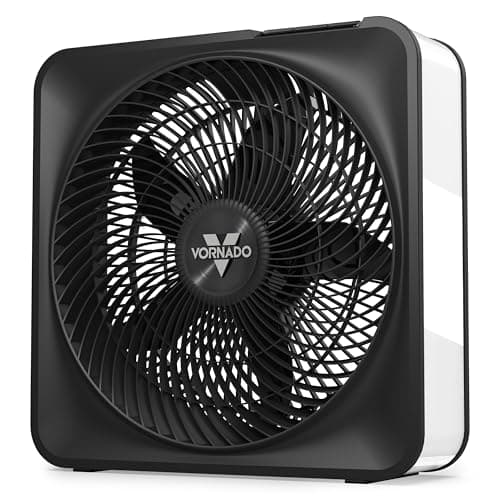 The best-regarded brand with the least published data Vornado Model 80 High-Velocity Box Fan Publishes a wattage but no airflow figure on either model we hold, so no efficiency number exists for this brand at all. | A buyer who trusts the brand and does not intend to compare it with anything | |
| — | 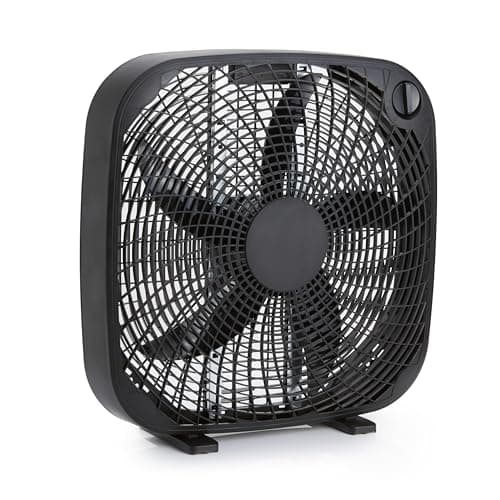 The one to skip Amazon Basics 20" 3-Speed Box Fan 67 W published, no airflow figure, no decibel figure, and no model number worth the name. It is the cheapest fan here and the least knowable. | Nothing you could verify in advance |
Ceiling fans have an ENERGY STAR program, room air conditioners have a certified CEER, and dehumidifiers have an IEF. Portable fans have nothing. There is no federal test procedure, no certified dataset and no third party checking anybody’s arithmetic, which means a brand page about portable fans has exactly one honest basis: what each manufacturer publishes about its own products, and whether it publishes it at all.
The field
What each brand publishes
| Brand | Models | Airflow | Watts | Decibels | Best CFM/W |
|---|---|---|---|---|---|
| Air King | 9 | 9 of 9 | 9 of 9 | 6 of 9 | 29.0 |
| Lasko | 9 | 5 of 9 | 8 of 9 | 3 of 9 | 18.1 |
| Vornado | 2 | 0 of 2 | 1 of 2 | 0 of 2 | Not computable |
| Amazon Basics | 1 | 0 of 1 | 1 of 1 | 0 of 1 | Not computable |
| Comfort Zone | 1 | 0 of 1 | 0 of 1 | 0 of 1 | Not computable |
Counts are across the 22 portable room fans on this site whose manufacturer specifications we have sourced and recorded individually. This is our own set rather than a market census — no complete one exists, because no certifying body collects it.
The pattern is not subtle: one brand publishes everything, one publishes about half, and the rest publish a wattage or nothing. Across those 22 models, 14 carry a manufacturer airflow figure and 19 carry a wattage — and once Air King and Lasko are removed, the remaining three brands account for no computable efficiency figure at all.
This one is not a DIY job
A published wattage without a published airflow is worse than neither. It gives you the cost of running the fan and tells you nothing about what the cost buys, which makes the cheap-to-run fan look like the good one. A 67 W fan that moves 900 CFM is a worse machine than a 105 W fan that moves 2,163, and only one of those two sentences can be checked.
When a brand publishes no CFM, treat the fan as unrated rather than average. There is a reason the manufacturers with the best figures are the ones that print them.
Why
Why there is no certified fan data
ENERGY STAR certifies ceiling fans because a ceiling fan is a fixed appliance tested in free air under a repeatable procedure, and the program has a meaningful efficiency metric to report. A portable fan is a different problem: its output depends on where it sits, what it points at and whether a window is open behind it, so there is no single number that describes it in a room.
That is a fair reason not to certify, and a poor reason not to publish. Air King demonstrates the distinction — it tests its fans at a bench and prints what it measured, per speed, on every model. The figures are manufacturer figures and we report them as such, but they exist, they are specific, and they are consistent across the catalogue.
The practical consequence for a buyer is that brand reputation in this category is almost pure marketing inheritance. The brands people name first are the ones with the largest retail presence, not the ones with the best measured performance, and in two cases the best-known brands are the ones publishing the least.
Efficiency
What the published numbers actually show
Among the fans where both halves of the sum exist, the spread is large. Air King’s nine models run from 15.8 CFM per watt on a 9-inch desk fan to 29.0 on a 30-inch drum fan — and that direction is not an accident. Bigger blades turning slower move more air per watt than small blades turning fast, which is the same physics that makes a ceiling fan the most efficient air mover in a house.
Lasko’s computable models run from 8.8 on a tower fan to 18.1 on the twin window fan above, once the two misting fans are set aside. A tower fan is a tall, narrow column pushing air through a small aperture, and it pays for its shape in efficiency. That is a format difference rather than a brand failing — the box-versus-tower comparison covers it in detail.
Which is the honest caveat on this whole page: a brand’s average is partly a statement about what it chooses to make. Air King sells drum fans and commercial box fans; Lasko sells towers and misting fans for patios. Comparing the two averages compares their catalogues as much as their engineering. The publication record is the cleaner signal, because it is a choice every brand makes freely.
Buying
How to use a brand name when shopping
Check for a CFM figure before anything else. If the manufacturer publishes one, the fan is comparable; if not, you are buying on appearance. This single test eliminates most of the market and costs nothing.
Then divide it by the wattage. CFM per watt is the only efficiency measure available in this category and it is trivial arithmetic. Anything above about 20 is strong for a portable fan; anything below 10 is a tower or a misting fan paying for its format.
Buy by model number, never by brand. Air King’s own range nearly doubles from worst to best, and the same is true of every brand with enough models to show a range. The badge narrows the field; the model number decides it.
Treat a missing decibel figure as normal and a present one as a gift. Nine of these 22 fans publish any noise figure at all, and six of the nine are Air King. If quiet matters more than airflow, start from the models that publish a number rather than from the ones that describe themselves as whisper-quiet.
Say the unwelcome thing
Do not buy a brand on reputation in this category.
Portable fans are the one cooling category on this site with no certification, no dataset and no independent arbiter. That makes brand reputation unusually detached from measured performance, because nothing is measuring it.
The two most recognised names here publish the least: Vornado gives no airflow figure on either model we hold, and Amazon Basics gives a wattage and nothing else. Meanwhile the brand with a full set of published numbers across nine models is a commercial-equipment maker most buyers have never heard of.
Buy the Air King if you want to know what you are getting before it arrives. Buy the Lasko if you need a fan this evening and a published figure on the model you are holding. Either way, read the model number off the box and check it against the manufacturer’s own specification page.
In full
Every pick, and what is wrong with it
Published specifications only, each linked to the page it came from. Where a manufacturer publishes nothing, the row says so — we do not fill blanks in.
1. Best brand overall
Air King 9723 20" Commercial Grade Box Fan
Air King · model 9723
The only brand here that publishes airflow and wattage on every model we can source — and the numbers are also the best, from 15.8 to 29.0 CFM per watt.
2,163 CFM on 105 W for this 20-inch box fan, which is 20.6 CFM per watt by our arithmetic on Air King’s published figures. The figure matters less than the fact that both halves of it are published at all, which is what lets you check our arithmetic and compare it with the next box fan you look at.
Nine models, nine airflow figures, nine wattage figures. That is the finding. Every other brand on this page has at least one model where the airflow is simply absent from the manufacturer’s own specification, and an absent CFM figure makes efficiency uncomputable — not bad, uncomputable.
Six of the nine also carry a published decibel figure, which is close to unheard of outside this brand. Air King prints noise per speed: its 30-inch drum fan is 75 / 71 / 67 dB, and its 6-inch clip-on fan is 34 dBA on low. Whether that is quiet enough is your call, but you get to make it before the box arrives.
The brand’s own range is wide — 15.8 CFM per watt at the bottom, 29.0 at the top — so the badge still does not pick the model for you. It just gives you the numbers to pick with. The 29.0 figure belongs to the drum fans.
What’s wrong with it
Air King's catalogue is commercial and industrial in character: powder-coated steel, rear rotary switches, no remotes and no app. Nothing it makes is a handsome object.
Running cost — 9723
| Nameplate power | 65 W – 105 W | manufacturer's published figure |
|---|---|---|
| Energy, 8-hour night | 0.84 kWh | 105 ÷ 1000 × 8 |
| Cost per hour | 1.9¢ | at 18.34¢/kWh |
| Cost per 8-hour night | 15¢ | on the highest speed |
| Cost per 30 nights | $4.62 | 25.2 kWh |
| Same month, lowest speed | $2.86 | at 65 W |
Rate: 18.34¢/kWh, the US average residential price for June 2026 (EIA Electric Power Monthly, Table 5.3). Yours will differ — swap it in: (watts ÷ 1000) × hours × your rate.
| Air delivery | 2,163 / 1,900 / 1,463 CFM (high / medium / low) |
|---|---|
| Power | 105 / 87 / 65 W (0.94 / 0.72 / 0.56 A) |
| Efficiency | 20.6 CFM per watt on high, 22.5 on low (our arithmetic) |
| Blade speed | 1,220 / 1,075 / 855 RPM |
| Blade | 20 in |
| Speeds | 3 |
| Motor | 1/25 HP, 120 V, 1 phase |
| Dimensions | 21.38 W x 6.38 D x 22.5 H in |
| Weight | 11.4 lb |
| Oscillation | No |
| Noise | Not published |
Every figure above is from Air King commercial box fan product page, model 9723. Blanks are shown as “not published” rather than filled in.
2. The brand you can actually buy tonight
Lasko Twin Window Fan with Remote
Lasko · model W09550
Publishes wattage on eight of nine models but airflow on only five, so most of the range cannot be compared on efficiency at all.
560 CFM on 22 to 31 W for this twin window fan, which works out at 18.1 CFM per watt — the best figure Lasko publishes anywhere in the range, and a genuinely good one. At 18.34¢/kWh a full season of nights costs about $4.09.
The problem is the other four models. Lasko publishes a wattage for almost everything it makes and an airflow figure for a bit over half. Its tower fans and its box fan arrive with watts and no CFM, which means you can price the electricity but not the cooling.
Where Lasko does lead is decibels on its quiet models — 23 dBA on low for one tower, 31.5 for another. Three of nine is still a minority, but it is three more than Vornado, Comfort Zone or Amazon Basics manage between them.
Two of its published airflow figures belong to misting fans, at 3.2 and 3.9 CFM per watt. Those are not comparable to a dry fan — a good part of the wattage is driving a pump, not a blade — and we have left them out of the brand’s range for that reason rather than letting them drag it down.
What’s wrong with it
This particular model has no current Amazon listing of its own, so the buy link runs a tagged search across Lasko's twin window fans rather than landing on one page. Check the model number on whatever it returns.
Running cost — W09550
| Nameplate power | 22 W – 31 W | manufacturer's published figure |
|---|---|---|
| Energy, 8-hour night | 0.25 kWh | 31 ÷ 1000 × 8 |
| Cost per hour | 0.6¢ | at 18.34¢/kWh |
| Cost per 8-hour night | 4.5¢ | on the highest speed |
| Cost per 30 nights | $1.36 | 7.4 kWh |
| Same month, lowest speed | 97¢ | at 22 W |
Rate: 18.34¢/kWh, the US average residential price for June 2026 (EIA Electric Power Monthly, Table 5.3). Yours will differ — swap it in: (watts ÷ 1000) × hours × your rate.
| Power | 22 W - 31 W at 120 V |
|---|---|
| Air delivery | Up to 560 CFM |
| Window fit | 24 - 32 in wide |
| Modes | Intake, exhaust or exchange (independent motors) |
| Thermostat | Adjustable |
| Speeds | 3 |
| Dimensions | 12.9 H x 24.0 W x 4.9 D in |
| Weight | 8.0 lb |
| Warranty | 1 year |
Every figure above is from Lasko product page, W09550. Blanks are shown as “not published” rather than filled in.
3. The best-regarded brand with the least published data
Vornado Model 80 High-Velocity Box Fan
Vornado · model 80
Publishes a wattage but no airflow figure on either model we hold, so no efficiency number exists for this brand at all.
120 W, and no published airflow. Vornado describes its air movement in terms of whole-room circulation and distance rather than cubic feet per minute, which reads well and compares with nothing. We hold two Vornado products and neither carries a CFM figure from the manufacturer.
This is not an accusation of poor performance. Vornado’s vortex circulators have a real engineering argument behind them and a long reputation. It is a statement about what you can verify before you spend: with this brand, nothing about airflow.
For context, 120 W is more than the 105 W Air King box fan above and roughly double the 67 W Amazon Basics. If Vornado’s 20-inch matched Air King’s 2,163 CFM it would land at 18.0 CFM per watt, below the Air King. If it beat it, it would be the best fan on this page. Both sentences are speculation, which is precisely the problem.
The brand does publish a genuinely long warranty, and its Transom window fan carries five years. Where a brand will not give you performance data, warranty length is the next most useful thing it can give you.
What’s wrong with it
Without a CFM figure there is nothing to put beside the 120 W. A fan that draws 120 W might be excellent or might be the worst on this page, and Vornado does not say which.
Running cost — 80
| Nameplate power | 70 W – 120 W | manufacturer's published figure |
|---|---|---|
| Energy, 8-hour night | 0.96 kWh | 120 ÷ 1000 × 8 |
| Cost per hour | 2.2¢ | at 18.34¢/kWh |
| Cost per 8-hour night | 18¢ | on the highest speed |
| Cost per 30 nights | $5.28 | 28.8 kWh |
| Same month, lowest speed | $3.08 | at 70 W |
Rate: 18.34¢/kWh, the US average residential price for June 2026 (EIA Electric Power Monthly, Table 5.3). Yours will differ — swap it in: (watts ÷ 1000) × hours × your rate.
| Power | 120 / 90 / 70 W (three of the five settings published) |
|---|---|
| Speeds | 5 |
| Blade diameter | 16.15 in |
| Supply | 120 V, 60 Hz |
| Dimensions | 19.99 W x 6.41 D x 20.19 H in |
| Weight | 12.96 lb |
| Cord | 6 ft, 2-pin polarized |
| Grille | Removable, for cleaning |
| Air delivery (CFM) | Not published |
| Noise | Not published |
| Warranty | 5 years |
Every figure above is from Vornado product page, Model 80 High-Velocity Box Fan. Blanks are shown as “not published” rather than filled in.
Skip this one
Amazon Basics 20" 3-Speed Box Fan
Amazon Basics · model 20-inch 3-speed box fan
67 W published, no airflow figure, no decibel figure, and no model number worth the name. It is the cheapest fan here and the least knowable.
Listed as a skip not because it is bad — we have no idea whether it is bad, and that is the point — but because it is the clearest example of the pattern this page is about.
67 W is published right in the product title. At 18.34¢/kWh that is about 9.8¢ a night, or $8.85 across a 90-night season. You can work out exactly what it costs you.
What you cannot work out is what you get. No airflow figure is published anywhere, so the 67 W sits on its own. The Air King box fan above draws 105 W and moves a published 2,163 CFM. If the Amazon Basics moves more than 1,380 CFM it is the more efficient of the two; if less, it is worse. Nobody outside Amazon can say.
Buy it if you want a cheap 20-inch box fan tonight and do not care about the comparison. Do not buy it believing you have chosen the efficient option, because that claim cannot be made in either direction. What fans actually cost to run.
What’s wrong with it
A 20-inch box fan with a published wattage and no published CFM is the one combination that tells you the cost and hides the benefit.
Running cost — 20-inch 3-speed box fan
| Nameplate power | 67 W | manufacturer's published figure |
|---|---|---|
| Energy, 8-hour night | 0.54 kWh | 67 ÷ 1000 × 8 |
| Cost per hour | 1.2¢ | at 18.34¢/kWh |
| Cost per 8-hour night | 9.8¢ | on the highest speed |
| Cost per 30 nights | $2.95 | 16.1 kWh |
Rate: 18.34¢/kWh, the US average residential price for June 2026 (EIA Electric Power Monthly, Table 5.3). Yours will differ — swap it in: (watts ÷ 1000) × hours × your rate.
| Power | 67 W (speed not specified) |
|---|---|
| Speeds | 3 |
| Blade | 20 in, 5 blades |
| Dimensions | 20.86 W x 6.8 D x 21.33 H in |
| Handle | Carry handle |
| Air delivery (CFM) | Not published |
| Blade speed | Not published |
| Noise | Not published |
| Warranty | Not published on the listing |
Every figure above is from Amazon Basics product listing, 20-inch 3-speed box fan. Blanks are shown as “not published” rather than filled in.
We are not linking a buy button for this one. If you want to look at it anyway, it is easy enough to find — but we would rather send you to something that fits your room.
Questions people actually ask
Frequently asked
What is the best fan brand?
Air King, on the only evidence available. It publishes an airflow figure and a wattage for all nine models we can source specifications for, decibels for six of them, and its efficiency range of 15.8 to 29.0 CFM per watt is the best we can compute for any brand. No portable fan is certified by anyone, so published manufacturer data is the whole basis.
Is Lasko a good fan brand?
Lasko is the most available brand and publishes a wattage for eight of the nine models we hold, but an airflow figure for only five — so most of its range cannot be compared on efficiency. Its best published figure, 18.1 CFM per watt on a twin window fan, is genuinely good. It also publishes decibels on three quiet models, which most brands never do. Window fans.
Why do fan brands not publish CFM?
Because nothing obliges them to. There is no ENERGY STAR program, no federal test procedure and no certified dataset for portable fans, unlike ceiling fans, room air conditioners and dehumidifiers. A portable fan's real output also depends on placement, which gives manufacturers a defensible reason to avoid a single number — and a convenient one. Reading a spec sheet.
Is Vornado worth the money?
We cannot answer that from published data, which is itself the finding. Neither Vornado product we hold carries a manufacturer airflow figure, so no efficiency number exists for the brand and no comparison with Air King or Lasko is possible. Vornado does publish long warranties, including five years on its Transom window fan.
What is a good CFM per watt for a fan?
Above roughly 20 CFM per watt is strong for a portable fan and the best figure we hold is 29.0, from a 30-inch drum fan. Below 10 usually means a tower fan or a misting fan, both of which pay for their format — a tower pushes air through a narrow aperture, and a misting fan spends part of its wattage on a pump rather than a blade. Drum fans.
Are expensive fan brands quieter?
There is no published evidence either way for most of the market. Only nine of the 22 fans charted here publish any decibel figure, and six of those are from Air King, which is a commercial brand rather than a premium consumer one. A fan described as whisper-quiet with no number attached has told you nothing. How loud is a fan.
Sources
Where these numbers came from
Read next
Where to go from here
Back to Fans, or read how we pick.