Guide and picks
How to cool a room with a box fan
A box fan is the only cheap fan shaped to do two completely different jobs, and which one you get depends entirely on how you place it.
By Sawyer V. · Published
The short answer
Put it in a window facing outward. That turns the fan from an air-stirrer into an air-exchanger, pushing the room’s hot air outside and drawing cooler air in through another opening. Aiming it at yourself is the other valid use — it cools you, not the room. A 20-inch box fan draws about 73 to 102 W.
Fan & Frost earns a commission when you buy through our links, at no cost to you. It never changes a ranking, and we say so when the right answer is the cheaper unit or nothing at all. Full disclosure · How we pick.
At a glance
The picks, ranked
Tap any row to jump to the full reasoning. Prices are live from Amazon where we have them, and read “check price” where we don’t — never a number we cannot verify today.
| # | Product | Best for | Price |
|---|---|---|---|
| 1 | Best for a window Lasko Power Plus 20" Box Fan 73 to 102 W across three speeds with a weather-resistant motor — the detail that matters when the fan lives in an open window. | Exhausting a room's hot air, in a window that is open to weather | |
| 2 | Best purpose-built alternative Lasko Twin Window Fan with Remote Up to 560 published CFM on 22 to 31 W, with independently reversible twin motors so one side draws in while the other exhausts. | A window wide enough for it, where you want air in and out at once | |
| 3 | 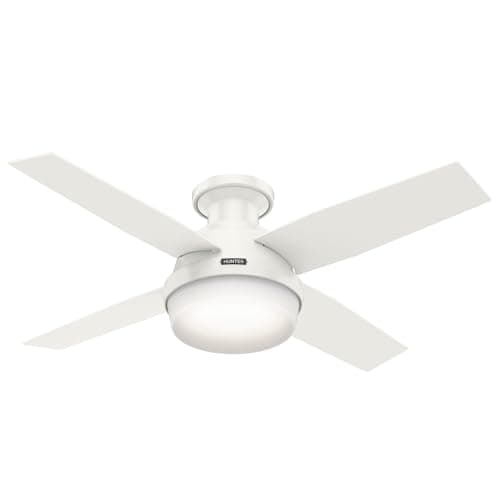 Better if you can fit one Hunter Martindale 44" Ceiling Fan 1.1 W on low at 304.5 CFM per watt — roughly a hundredth of a box fan's draw for comparable comfort. | Permanent air movement in a room you use every day | |
| — | 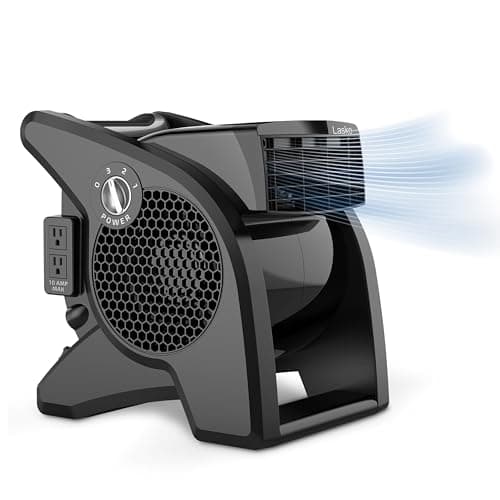 More is not better here Lasko Max Performance 15" Air Mover 160 to 178 W of directed air movement, which is more noise and more electricity for a job a box fan already does. | Drying a floor or a workshop — not cooling a bedroom |
A box fan is a flat square of airflow with no directionality, no oscillation and no cleverness, and that turns out to be its advantage. It is the only cheap fan shaped to sit in a window opening.
The key idea
Moving air and exchanging air are different jobs
Almost all confusion about box fans comes from conflating two things that feel similar and are not.
- Moving air means stirring the air already in the room. It lowers no temperature — it makes a person feel cooler by speeding sweat evaporation, and adds a little heat from the motor.
- Exchanging air means pushing the room’s air out and pulling different air in. If the outdoor air is cooler, this genuinely lowers the room temperature.
A box fan on the floor does the first. A box fan in a window facing out does the second. Same appliance, same wattage, entirely different result — why a fan cools people rather than rooms.
Setup one
The exhaust setup, which is the one that works
This is the arrangement worth knowing, and the direction is counterintuitive enough that most people get it backwards.
- Put the fan in a window, facing outward. It blows the room’s air out of the building.
- Open a second window elsewhere — ideally on the opposite side of the room or the house, and ideally on the shaded side. This is where the replacement air comes from.
- Close everything in between that you do not want involved. The air will take the easiest route, so closing doors forces it through the path you want.
- Block the gaps around the fan with a towel or a board so air is not simply recirculating around the frame.
Facing the fan outward rather than inward matters because a fan pushes air in a focused stream and draws it in from a wide area. Exhausting gives you a wide, gentle intake across the whole opening of the second window. Blowing inward gives you a jet at one wall and dead air everywhere else.
Only do this when it is cooler outside than in. Otherwise you are importing heat with a 100 W fan, which is worse than doing nothing — the night purge.
This one is not a DIY job
Two box fans beat one, and cost the same as one on high. Put one in a window facing out at the hot end of the room and one in a window facing in at the shaded end. You are now driving the exchange from both directions rather than relying on the second window to supply air passively.
Setup two
The other valid use: point it at yourself
If outdoor air is hotter than indoor air — which is most of a summer afternoon — there is no exchange worth making, and the fan reverts to its other job.
Aimed at a person, a box fan is a perfectly good comfort device. It moves a lot of air at low pressure, which is what you want across skin. Put it at floor level aimed slightly upward at seated height, not at head height where it will dry your eyes out.
And switch it off when you leave the room. With nobody there to evaporate, a box fan is a 100 W heater — whether leaving one on is fine.
Cost
What each arrangement costs to run
| Setup | Power | Eight hours |
|---|---|---|
| Ceiling fan on low | 1.1 W | 0.2¢ |
| Twin window fan on high | 31 W | 4.5¢ |
| Box fan on low | 73 W | 11¢ |
| Box fan on high | 102 W | 15¢ |
| Two box fans on high | 204 W | 30¢ |
| Portable air conditioner | 1,300 W | $1.91 |
The useful comparison is not against the air conditioner — a box fan is obviously cheaper. It is against a ceiling fan. A box fan on low draws about 66 times what a certified ceiling fan draws on low, for air movement most people would rate similarly.
Which tells you where a box fan genuinely earns its place: the window exhaust job, which a ceiling fan cannot do at all, and temporary or rented situations where nothing can be installed — fan running costs across the categories.
Mistakes
Four arrangements that do nothing
- A fan in a window facing in, with no other opening. The room pressurizes slightly and the exchange stalls. You have a jet of hot outdoor air and no cross-flow.
- A fan blowing at a closed door. Air has to go somewhere, and a closed door is a wall. It recirculates.
- A fan running in an empty room. No person, no evaporation, no benefit — and the motor adds heat.
- A bowl of ice in front of it. Five pounds of ice holds about 720 BTU, roughly seven minutes of a small air conditioner, once. And if you froze it at home the freezer put more heat into the house than the ice removes — the physics, with numbers.
Safety
A fan in a window is a fan in a security gap
Two practical points that are easy to overlook and awkward to discover later.
The window cannot be secured while the fan is in it, and the fan itself is not a barrier. On a ground floor or an accessible window that is worth a thought before leaving it running overnight.
A window with a fan in it is not an escape route, and the gaps you pack around it are not a child barrier. Keep box fans out of windows in children’s rooms, where a fan on the floor or a ceiling fan is the safer arrangement — fan safety around children and pets.
Say the unwelcome thing
Do not buy a bigger fan to fix a placement problem.
The most common upgrade path here is box fan, then a second box fan, then a high-velocity utility fan — each one louder and hungrier than the last, all doing the same wrong thing more emphatically.
If a room is not cooling, the question is almost never airflow. It is whether you are exchanging air or just stirring it, whether outdoor air is actually cooler, and whether there is a second opening for the replacement air to come through.
Get the placement right first. Then, if you want permanent air movement in a room you use daily, a certified ceiling fan at 1.1 W on low does the comfort job for a fraction of the electricity — and keep the box fan for the window.
In full
Every pick, and what is wrong with it
Published specifications only, each linked to the page it came from. Where a manufacturer publishes nothing, the row says so — we do not fill blanks in.
1. Best for a window
Lasko Power Plus 20" Box Fan
Lasko · model B20801
73 to 102 W across three speeds with a weather-resistant motor — the detail that matters when the fan lives in an open window.
A box fan in a window is partly outdoors. Rain blows in, condensation forms, and most fans are not built for that.
A weather-resistant motor is the specification that separates this from a standard box fan, and it is the reason to choose it for the exhaust job specifically.
73 W on low and 102 W on high, three speeds. Eight hours on high is about 15¢ at 18.34¢/kWh — considerably more than a ceiling fan and a tiny fraction of a compressor.
21.25 by 22.5 by 4.75 inches at 10.1 lb. Note the width: a 22.5-inch fan needs an opening wider than that, and plenty of windows are narrower. No published CFM, which we flag rather than estimate — box fans compared in full.
What’s wrong with it
Lasko publishes no CFM figure, so there is no airflow number to compare against anything.
Running cost — B20801
| Nameplate power | 73 W – 102 W | manufacturer's published figure |
|---|---|---|
| Energy, 8-hour night | 0.82 kWh | 102 ÷ 1000 × 8 |
| Cost per hour | 1.9¢ | at 18.34¢/kWh |
| Cost per 8-hour night | 15¢ | on the highest speed |
| Cost per 30 nights | $4.49 | 24.5 kWh |
| Same month, lowest speed | $3.21 | at 73 W |
Rate: 18.34¢/kWh, the US average residential price for June 2026 (EIA Electric Power Monthly, Table 5.3). Yours will differ — swap it in: (watts ÷ 1000) × hours × your rate.
| Power | 73 W - 102 W (0.6-0.9 A at 120 V) |
|---|---|
| Speeds | 3 |
| Dimensions | 21.25 H x 22.5 x 4.75 in |
| Weight | 10.1 lb |
| Motor | Weather-resistant |
| Air delivery (CFM) | Not published |
| Warranty | 2 years |
Every figure above is from Lasko product page, B20801. Blanks are shown as “not published” rather than filled in.
2. Best purpose-built alternative
Lasko Twin Window Fan with Remote
Lasko · model W09550
Up to 560 published CFM on 22 to 31 W, with independently reversible twin motors so one side draws in while the other exhausts.
The purpose-built version of what people improvise with a box fan, and it solves the single-window problem a box fan cannot.
Two independently reversible motors. Set one to intake and one to exhaust and you get a complete air exchange through one opening — intake, exhaust or exchange, from the same unit.
Up to 560 CFM on 22 to 31 W. That is a published airflow figure, which the box fans here do not have, at roughly a third of the power. Eight hours on high is 4.5¢ at 18.34¢/kWh against 15¢ for a box fan.
An adjustable thermostat and a remote, so it can stop itself once the room is down. The honest limit is fit: it needs a 24 to 32 inch window, wider than the 22.5-inch box fan — window fans compared.
What’s wrong with it
It needs a 24 to 32 inch window, which is wider than a box fan requires.
Running cost — W09550
| Nameplate power | 22 W – 31 W | manufacturer's published figure |
|---|---|---|
| Energy, 8-hour night | 0.25 kWh | 31 ÷ 1000 × 8 |
| Cost per hour | 0.6¢ | at 18.34¢/kWh |
| Cost per 8-hour night | 4.5¢ | on the highest speed |
| Cost per 30 nights | $1.36 | 7.4 kWh |
| Same month, lowest speed | 97¢ | at 22 W |
Rate: 18.34¢/kWh, the US average residential price for June 2026 (EIA Electric Power Monthly, Table 5.3). Yours will differ — swap it in: (watts ÷ 1000) × hours × your rate.
| Power | 22 W - 31 W at 120 V |
|---|---|
| Air delivery | Up to 560 CFM |
| Window fit | 24 - 32 in wide |
| Modes | Intake, exhaust or exchange (independent motors) |
| Thermostat | Adjustable |
| Speeds | 3 |
| Dimensions | 12.9 H x 24.0 W x 4.9 D in |
| Weight | 8.0 lb |
| Warranty | 1 year |
Every figure above is from Lasko product page, W09550. Blanks are shown as “not published” rather than filled in.
3. Better if you can fit one
Hunter Martindale 44" Ceiling Fan
Hunter · model 44in Martindale
1.1 W on low at 304.5 CFM per watt — roughly a hundredth of a box fan's draw for comparable comfort.
Worth stating plainly, because box fans are frequently a long-running workaround for a fan that was never installed.
1.1 W on low against 73 W for a box fan on low. Over an eight-hour night that is 0.2¢ against 11¢ at 18.34¢/kWh.
304.5 CFM per watt, certified, Most Efficient at a 44-inch span, with 0.4 W standby. Box fans have no certification program at all, so nothing about them is third-party measured.
It does a different job. A ceiling fan moves air within a room; it exchanges nothing. For the exhaust trick you still need something in the window — the two are complements, not alternatives.
What’s wrong with it
It needs a fan-rated ceiling box and it does no air exchange at all.
Running cost — 44in Martindale
| Nameplate power | 1.1 W – 10.1 W | manufacturer's published figure |
|---|---|---|
| Energy, 8-hour night | 0.08 kWh | 10.1 ÷ 1000 × 8 |
| Cost per hour | 0.2¢ | at 18.34¢/kWh |
| Cost per 8-hour night | 1.5¢ | on the highest speed |
| Cost per 30 nights | 44¢ | 2.4 kWh |
| Same month, lowest speed | 4.8¢ | at 1.1 W |
Rate: 18.34¢/kWh, the US average residential price for June 2026 (EIA Electric Power Monthly, Table 5.3). Yours will differ — swap it in: (watts ÷ 1000) × hours × your rate.
| Blade span | 44 in |
|---|---|
| Efficiency | 304.5 CFM per watt |
| Power, high speed | 10.1 W |
| Power, low speed | 1.1 W |
| Standby power | 0.4 W |
| Type | Indoor, fan only |
| Warranty | 3 years, components |
| ENERGY STAR | Certified |
Every figure above is from ENERGY STAR Certified Ceiling Fans dataset. Blanks are shown as “not published” rather than filled in.
Skip this one
Lasko Max Performance 15" Air Mover
Lasko · model U15720
160 to 178 W of directed air movement, which is more noise and more electricity for a job a box fan already does.
Flagged because “the box fan is not enough” leads people to buy more airflow, when the usual problem is placement rather than power.
160 to 178 W against 73 to 102 for a box fan. Eight hours on high is 26¢ at 18.34¢/kWh, and a utility air mover makes noise proportionate to that.
Two accessory outlets, a 9.5 ft cord and a pivoting head — all built for a job site, none of it useful in a bedroom.
No published CFM here either, so you cannot even confirm that the extra power buys extra air. Before upgrading, try the placements below — they cost nothing — where to put a fan.
What’s wrong with it
It is loud, it draws nearly double, and Lasko publishes no CFM for it either.
Running cost — U15720
| Nameplate power | 160 W – 178 W | manufacturer's published figure |
|---|---|---|
| Energy, 8-hour night | 1.42 kWh | 178 ÷ 1000 × 8 |
| Cost per hour | 3.3¢ | at 18.34¢/kWh |
| Cost per 8-hour night | 26¢ | on the highest speed |
| Cost per 30 nights | $7.83 | 42.7 kWh |
| Same month, lowest speed | $7.04 | at 160 W |
Rate: 18.34¢/kWh, the US average residential price for June 2026 (EIA Electric Power Monthly, Table 5.3). Yours will differ — swap it in: (watts ÷ 1000) × hours × your rate.
| Power | 160 W - 178 W (1.35-1.53 A at 120 V) |
|---|---|
| Speeds | 3 |
| Dimensions | 14.5 H x 14.0 D x 11.5 W in |
| Weight | 12.55 lb |
| Extras | Two 120 V accessory outlets, 9.5 ft cord, pivoting head |
| Air delivery (CFM) | Not published |
| Warranty | 1 year |
Every figure above is from Lasko product page, U15720. Blanks are shown as “not published” rather than filled in.
We are not linking a buy button for this one. If you want to look at it anyway, it is easy enough to find — but we would rather send you to something that fits your room.
Questions people actually ask
Frequently asked
Should a box fan face in or out of the window?
Out, in almost every case. Facing out, it exhausts the room's hot air and draws cooler replacement air in gently across a second opening. Facing in, it produces a jet of outdoor air at one wall and dead air everywhere else.
Does a box fan actually cool a room?
Only when it is exchanging air with cooler outdoor air. On the floor it stirs the air already there, which cools people by speeding sweat evaporation but lowers no temperature — and adds a little heat from the motor. How a fan cools you.
How much electricity does a box fan use?
A 20-inch box fan draws about 73 W on low and 102 W on high — roughly 15¢ for an eight-hour night. A certified ceiling fan on low draws 1.1 W, about 0.2¢ over the same period. Fan running costs.
Is it better to use two box fans?
Yes, if you have two windows. Put one facing out at the hot end and one facing in at the shaded end, which drives the exchange from both directions rather than relying on the second window to supply air passively.
When should I not use a box fan in a window?
When it is hotter outside than in — you are then importing heat with a 100 W fan, which is worse than doing nothing. Also avoid it in a child's room, where the window cannot be secured and the fan is not a barrier. Fan safety.
Does putting ice in front of a box fan work?
Briefly, and less than you would think. Five pounds of ice holds about 720 BTU — roughly seven minutes of a small air conditioner, once. And if you froze it at home, the freezer put more heat into the house than the ice removes. The physics.
Sources
Where these numbers came from
- Lasko product page, B20801 — 73 to 102 W, three speeds, weather-resistant motor, 10.1 lb, no published CFM
- Lasko product page, W09550 — up to 560 CFM, 22 to 31 W, adjustable thermostat, remote, 24 to 32 in window fit
- Lasko product page, U15720 — 160 to 178 W across three speeds
- ENERGY STAR Certified Ceiling Fans dataset — certified low-speed wattage, CFM per watt and standby power for the ceiling fan cited
- Whynter ARC-14S product page — 1,300 W, used for the comparison
- EIA Electric Power Monthly, Table 5.3 — average residential electricity price
Read next
Where to go from here
Back to Fans, or read how we pick.