The picks
The best air conditioners for a 15-amp circuit
Old wiring, a shared bedroom circuit or a single kitchen spur all cap what you can buy. The cap is higher than most people think.
By Sawyer V. · Published
The short answer
Everything through 12,000 BTU fits, with room to spare. A 15-amp circuit carries 12 amps continuously, about 1,380 W at 115 V. A certified 8,000 BTU unit at CEER 15 runs near 4.6 A, and even 12,000 BTU lands around 7.5 A. The constraint is rarely the air conditioner — it is what else is already on the circuit.
Fan & Frost earns a commission when you buy through our links, at no cost to you. It never changes a ranking, and we say so when the right answer is the cheaper unit or nothing at all. Full disclosure · How we pick.
At a glance
The picks, ranked
Tap any row to jump to the full reasoning. Prices are live from Amazon where we have them, and read “check price” where we don’t — never a number we cannot verify today.
| # | Product | Best for | Price |
|---|---|---|---|
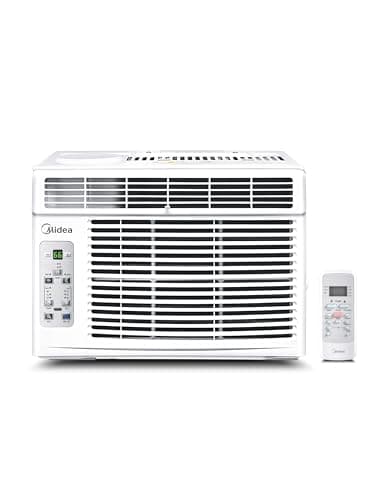
| 1 | Safest on a shared circuit Midea Window Air Conditioner, 5,000 BTU 5,000 BTU at CEER 14.4 works out near 2.9 A running — the smallest load that still removes real heat. | A bedroom circuit that also carries lighting, a TV and chargers | |
| 2 | 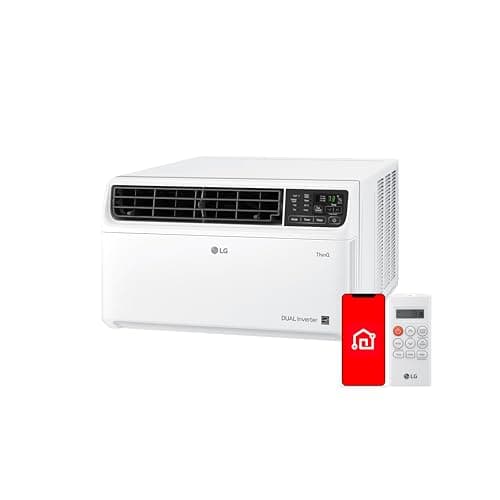 Best on a marginal circuit LG Dual Inverter Window Air Conditioner, 6,000 BTU A dual-inverter 6,000 BTU at 290.3 certified kWh — it ramps up instead of slamming on, which is what marginal circuits object to. | A circuit that trips at start-up rather than during running | |
| 3 | 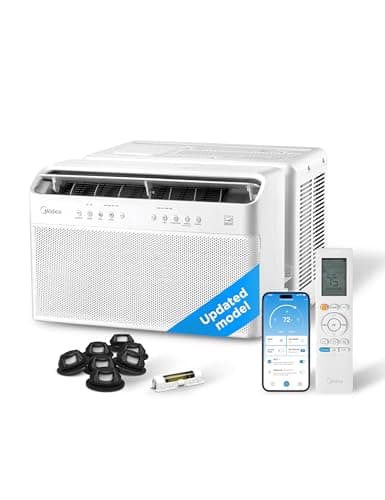 Most cooling that still fits comfortably Midea U-Shaped Window Air Conditioner, 8,000 BTU 8,000 BTU at CEER 15 works out near 4.6 A — the sweet spot between capacity and headroom. | A living room or main bedroom on a circuit you can keep clear | |
| — | 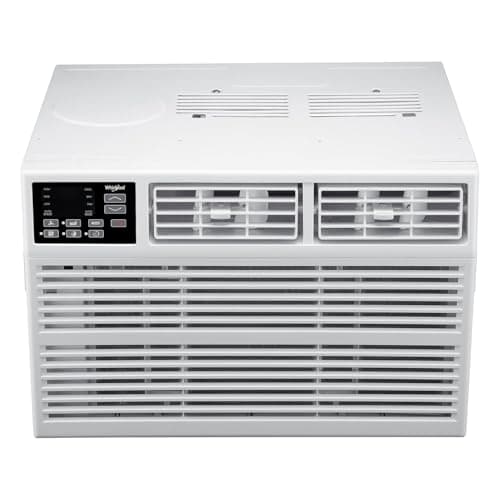 The one to skip on 15 amps Whirlpool Window Air Conditioner, 24,000 BTU 24,000 BTU at CEER 12.7 works out near 16.4 A — over the continuous limit of a 15-amp circuit before anything else is plugged in. | A dedicated circuit, which is exactly what this page does not have |
The budget
What 15 amps really gives you
US practice loads a circuit to no more than 80% of its rating for a continuous load, and an air conditioner on a hot afternoon is the definition of one. So:
- 15-amp circuit: 12 A continuous, about 1,380 W at 115 V.
- 20-amp circuit: 16 A continuous, about 1,840 W.
The full arithmetic, including start-up surge and plug types, is in will my circuit handle this air conditioner. This page applies it to actual certified units.
| Unit | Capacity | Running watts | Amps at 115 V | On a 15-amp circuit |
|---|---|---|---|---|
| Midea 5,000 BTU | 5,000 | 347 W | 3.0 A | Comfortable |
| LG 6,000 BTU inverter | 6,000 | about 400 W | 3.5 A | Comfortable |
| Midea U-shaped 8,000 BTU | 8,000 | 533 W | 4.6 A | Fine with headroom |
| 12,000 BTU at CEER 14 | 12,000 | 857 W | 7.5 A | Only on its own circuit |
| Whirlpool 24,000 BTU | 24,000 | 1,890 W | 16.4 A | No — dedicated circuit |
This one is not a DIY job
Check this first
Find out what shares the circuit
- Switch off one breaker and walk the rooms with a lamp or a phone charger. Everything that dies shares the budget.
- List the motor and heat loads on it: a space heater, a hair dryer, a microwave, a vacuum. Those are the ones that matter.
- Add the air conditioner’s amps from the table above and check the total stays under 12.
- Never use an extension cord or a power strip. Every manufacturer prohibits it, and the failure mode is a melted plug rather than a tripped breaker.
If nothing fits
When the circuit really is the limit
If the room needs more than 12,000 BTU and the wiring cannot take it, the options in order are: have an electrician add a dedicated circuit; cool a smaller area and close a door; or step outside the room-unit category entirely with a mini-split, which gets its own circuit as part of installation.
Cheap ways to reduce the load before spending anything: shade the windows, which is worth real BTU in a west-facing room, and move air with a fan so a higher set point feels the same — both covered in how to lower your cooling bill.
Say the unwelcome thing
Do not buy capacity you cannot power.
A unit that trips the breaker every afternoon gets returned, and a unit on an adapter or an extension cord is a fire risk rather than an inconvenience. Oversizing is already the most common mistake in this category; on old wiring it is also the most expensive.
Size the room, then check the circuit, then buy the smaller of the two answers. 8,000 BTU at about 4.6 amps is the most cooling most shared circuits should carry.
In full
Every pick, and what is wrong with it
Published specifications only, each linked to the page it came from. Where a manufacturer publishes nothing, the row says so — we do not fill blanks in.
1. Safest on a shared circuit
Midea Window Air Conditioner, 5,000 BTU
Midea · model MAW05R1VWWT-T
5,000 BTU at CEER 14.4 works out near 2.9 A running — the smallest load that still removes real heat.
Our arithmetic on the certified figures: 5,000 BTU divided by CEER 14.4 is about 347 W, or 3.0 A at 115 V. Against a 12-amp continuous budget that leaves nine amps for everything else on the circuit.
It is also the cheapest unit here to run, certified at 260.4 kWh a year, about $48 a season at 18.34¢/kWh.
Buy this one when the circuit is genuinely busy — an older apartment where one breaker covers two rooms, for instance — or when the room is small enough not to need more.
What’s wrong with it
5,000 BTU covers about 150 sq ft, so in a larger room it will run continuously and still not reach the set point.
Running cost — MAW05R1VWWT-T
| Annual energy use | 260.4 kWh | ENERGY STAR certified figure |
|---|---|---|
| Annual cost | $48 | 260.4 × 18.34¢/kWh |
| Per cooling month | $12 | spread over a four-month season |
The annual figure is the certified value from the ENERGY STAR Certified Room Air Conditioners dataset, which models a standard cooling season rather than your actual summer. It is more useful than a nameplate wattage here, because a variable-speed compressor spends most of its life well below nameplate.
Rate: 18.34¢/kWh, the US average residential price for June 2026 (EIA Electric Power Monthly, Table 5.3). Yours will differ — swap it in: (watts ÷ 1000) × hours × your rate.
| Cooling capacity | 5,000 BTU/h |
|---|---|
| CEER | 14.4 |
| Annual energy use | 260.4 kWh/yr |
| vs federal standard | 31% less energy |
| Dimensions | 12.1 H x 16.0 W x 13.3 D in |
| Weight | 30.2 lb |
| Installation | Does not straddle the windowsill |
| Support bracket | Not required |
| Compressor | Variable speed |
| Refrigerant | R-32 |
| ENERGY STAR | Certified (not on the Most Efficient list) |
Every figure above is from ENERGY STAR Certified Room Air Conditioners dataset. Blanks are shown as “not published” rather than filled in.
2. Best on a marginal circuit
LG Dual Inverter Window Air Conditioner, 6,000 BTU
LG · model LW6023IVSM
A dual-inverter 6,000 BTU at 290.3 certified kWh — it ramps up instead of slamming on, which is what marginal circuits object to.
The current that trips breakers is usually not the running current. A fixed-speed compressor draws several times its running amps for a fraction of a second at start-up, and on a loaded circuit that surge is the moment the breaker goes.
An inverter compressor ramps rather than starts, so the surge is far smaller. Running current is modest too: 6,000 BTU at this efficiency sits near 3.5 A, and the certified annual figure is 290.3 kWh, about $53 a season.
If your current unit trips the breaker only when it kicks in, this is the specification that fixes it — see inverter versus fixed speed.
What’s wrong with it
More expensive than a fixed-speed unit of the same size, and 6,000 BTU is an awkward middle capacity for some rooms.
Running cost — LW6023IVSM
| Annual energy use | 290.3 kWh | ENERGY STAR certified figure |
|---|---|---|
| Annual cost | $53 | 290.3 × 18.34¢/kWh |
| Per cooling month | $13 | spread over a four-month season |
The annual figure is the certified value from the ENERGY STAR Certified Room Air Conditioners dataset, which models a standard cooling season rather than your actual summer. It is more useful than a nameplate wattage here, because a variable-speed compressor spends most of its life well below nameplate.
Rate: 18.34¢/kWh, the US average residential price for June 2026 (EIA Electric Power Monthly, Table 5.3). Yours will differ — swap it in: (watts ÷ 1000) × hours × your rate.
| Cooling capacity | 6,000 BTU/h |
|---|---|
| CEER | 15.5 |
| Annual energy use | 290.3 kWh/yr |
| Weight | 62.0 lb |
| Installation | Does not straddle the windowsill |
| Support bracket | Not required |
| Compressor | Variable speed |
| ENERGY STAR | Certified, and on the Most Efficient list |
Every figure above is from ENERGY STAR Certified Room Air Conditioners dataset. Blanks are shown as “not published” rather than filled in.
3. Most cooling that still fits comfortably
Midea U-Shaped Window Air Conditioner, 8,000 BTU
Midea · model MAW08V1QWT-S
8,000 BTU at CEER 15 works out near 4.6 A — the sweet spot between capacity and headroom.
8,000 BTU divided by CEER 15 is about 533 W, or 4.6 A at 115 V. That is well inside the 12-amp continuous limit and leaves headroom for lighting and electronics on the same circuit.
Certified at 400 kWh a year, roughly $73 a season, and the U-shaped chassis means the sash closes through the unit — the format comparison is in U-shaped versus standard.
For most rooms people actually want cooled, this is the largest unit worth putting on a shared 15-amp circuit.
What’s wrong with it
The U-shaped chassis needs a deep sill and the right window geometry, and it is heavier to lift into place than a conventional unit.
Running cost — MAW08V1QWT-S
| Annual energy use | 400 kWh | ENERGY STAR certified figure |
|---|---|---|
| Annual cost | $73 | 400 × 18.34¢/kWh |
| Per cooling month | $18 | spread over a four-month season |
The annual figure is the certified value from the ENERGY STAR Certified Room Air Conditioners dataset, which models a standard cooling season rather than your actual summer. It is more useful than a nameplate wattage here, because a variable-speed compressor spends most of its life well below nameplate.
Rate: 18.34¢/kWh, the US average residential price for June 2026 (EIA Electric Power Monthly, Table 5.3). Yours will differ — swap it in: (watts ÷ 1000) × hours × your rate.
| Cooling capacity | 8,000 BTU/h |
|---|---|
| CEER | 15 |
| Annual energy use | 400 kWh/yr |
| vs federal standard | 38% less energy |
| Dimensions | 13.5 H x 19.2 W x 22.0 D in |
| Weight | 53.2 lb |
| Refrigerant | R-32 |
| Installation | U-shape; sash closes through the middle of the unit |
| Compressor | Variable speed |
| ENERGY STAR | Certified |
Every figure above is from ENERGY STAR Certified Room Air Conditioners dataset. Blanks are shown as “not published” rather than filled in.
Skip this one
Whirlpool Window Air Conditioner, 24,000 BTU
Whirlpool · model WHAW-241IN
24,000 BTU at CEER 12.7 works out near 16.4 A — over the continuous limit of a 15-amp circuit before anything else is plugged in.
Included to mark the boundary. 24,000 BTU at CEER 12.7 is about 1,890 W, which is 16.4 A at 115 V — above the 12-amp continuous budget of a 15-amp circuit and above the 16-amp budget of a 20-amp one.
A unit this size needs its own circuit, and often its own voltage: large room units are commonly 208/230 V, which is a separate breaker and an electrician either way.
Its certified consumption tells the same story from the other end: 1,417.3 kWh a year, about $260 a season, against 400 for the 8,000 BTU unit above.
What’s wrong with it
Needs a dedicated circuit and possibly 230 V; putting it on a shared 15-amp circuit is a tripped breaker at best.
Running cost — WHAW-241IN
| Annual energy use | 1417.3 kWh | ENERGY STAR certified figure |
|---|---|---|
| Annual cost | $260 | 1417.3 × 18.34¢/kWh |
| Per cooling month | $65 | spread over a four-month season |
The annual figure is the certified value from the ENERGY STAR Certified Room Air Conditioners dataset, which models a standard cooling season rather than your actual summer. It is more useful than a nameplate wattage here, because a variable-speed compressor spends most of its life well below nameplate.
Rate: 18.34¢/kWh, the US average residential price for June 2026 (EIA Electric Power Monthly, Table 5.3). Yours will differ — swap it in: (watts ÷ 1000) × hours × your rate.
| Cooling capacity | 24,000 BTU/h |
|---|---|
| CEER | 12.7 |
| Annual energy use | 1,417.3 kWh/yr |
| vs federal standard | 35% less energy |
| Dimensions | 20.7 H x 30.0 W x 28.8 D in |
| Weight | 115.7 lb |
| Refrigerant | R-32 |
| Installation | Straddles the window; support bracket territory |
| ENERGY STAR | Certified |
Every figure above is from ENERGY STAR Certified Room Air Conditioners dataset. Blanks are shown as “not published” rather than filled in.
We are not linking a buy button for this one. If you want to look at it anyway, it is easy enough to find — but we would rather send you to something that fits your room.
Questions people actually ask
Frequently asked
What size air conditioner can a 15-amp circuit run?
Comfortably up to 12,000 BTU if nothing significant shares the circuit, and up to about 8,000 BTU on a normal shared bedroom circuit. The working limit is 12 amps continuous, which is roughly 1,380 watts at 115 volts.
How many amps does an 8,000 BTU air conditioner use?
About 4.6 amps running, from certified figures: 8,000 BTU divided by CEER 15 is 533 watts, divided by 115 volts. Start-up draw is briefly higher on fixed-speed units, which is what trips loaded circuits.
Does an air conditioner need a dedicated circuit?
Manufacturers specify one for anything sizeable, and above 12,000 BTU the arithmetic effectively requires it. Below that a shared circuit works provided the other loads are small and the continuous total stays under 12 amps. The full arithmetic.
Why does my air conditioner trip the breaker when it starts?
A fixed-speed compressor draws several times its running current for a moment at start-up. On a circuit already near its limit, that surge is what trips it — an inverter model ramps up instead and largely avoids the problem.
Can I use an extension cord if the socket is across the room?
No. Cord resistance causes a voltage drop, the motor compensates by drawing more current, and the cord and plug heat up. Every manufacturer prohibits it. Use a different socket on a suitable circuit instead.
Sources
Where these numbers came from
- ENERGY STAR Certified Room Air Conditioners dataset — capacity, CEER and annual kWh for every unit on this page; the amps figures are our arithmetic on those values at 115 V
- 10 CFR Part 430, Subpart B, Appendix CC — the federal test procedure defining CEER for room air conditioners
- EIA Electric Power Monthly, Table 5.3 — average residential electricity price
Read next
Where to go from here
Back to Air Conditioners, or read how we pick.