Guide and picks
What a dehumidifier costs to run
This is one of the few appliances where you do not have to estimate: the annual figure is published, tested and free to look up.
By Sawyer V. · Published
The short answer
Certified dehumidifiers run from 117 kWh a year for a 9-pint cupboard unit to 842 kWh for a whole-home machine — $21 to $154 at 18.34¢/kWh. A typical room unit is 283 kWh and a basement unit 471 to 530 kWh. The figure is a standardized estimate, and a machine fighting a real water source will exceed it.
Fan & Frost earns a commission when you buy through our links, at no cost to you. It never changes a ranking, and we say so when the right answer is the cheaper unit or nothing at all. Full disclosure · How we pick.
At a glance
The picks, ranked
Tap any row to jump to the full reasoning. Prices are live from Amazon where we have them, and read “check price” where we don’t — never a number we cannot verify today.
| # | Product | Best for | Price |
|---|---|---|---|
| 1 | Cheapest per pint Vellgoo Taurus Pro Dehumidifier, 45 pints/day 2.24 L/kWh at 444 kWh a year — the most water removed per kilowatt-hour of any certified portable. | A basement where the machine runs for months | |
| 2 | Lowest annual cost for a room Vissani Dehumidifier, 27 pints/day 283 kWh a year — the lowest of any room-sized certified unit we hold data for. | A bedroom, study or flat | |
| 3 | Cheapest per unit of water Santa Fe Whole-Home Dehumidifier, 128 pints/day 3.26 L/kWh at 127.51 pints a day — 46% more water per kilowatt-hour than any portable. | A whole house or a large permanently damp basement | |
| — | 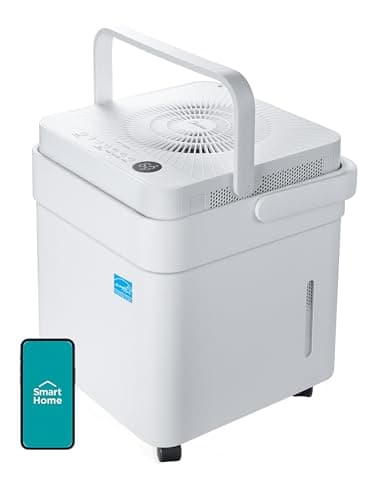 The false economy Midea Dehumidifier, 20 pints/day 249 kWh a year — cheaper than a 25-pint unit, and it removes 18% less water to get there. | Nothing, against the alternatives |
Dehumidifiers are one of the easiest appliances to cost honestly, because the annual energy figure is tested and published for every certified model.
The table
Sixteen certified units, costed
Every figure below is the published annual energy consumption from the certification program, multiplied by the current rate of 18.34¢/kWh. Nothing else.
| Unit | Pints/day | IEF | kWh/yr | A year |
|---|---|---|---|---|
| BLACK+DECKER BDT08TW | 9.20 | 1.73 | 117 | $21 |
| Midea MAD20S1QWT | 20.16 | 1.70 | 249 | $46 |
| AeroNova ADC018 | 24.50 | 2.05 | 257 | $47 |
| Vissani VAD25S1AWTS | 26.87 | 2.01 | 283 | $52 |
| TCL T25DC9R | 24.84 | 1.85 | 283 | $52 |
| Honeywell TPFIT32AWK | 32.46 | 2.01 | 343 | $63 |
| Frigidaire FHDD3534Y1 | 35.85 | 2.01 | 379 | $70 |
| Vellgoo Taurus Pro | 45.00 | 2.24 | 444 | $81 |
| Waykar CTH150D | 49.43 | 2.20 | 471 | $86 |
| Vissani VAD50PS1BWTS | 49.95 | 2.01 | 512 | $94 |
| Midea MDUDMB-50 | 49.67 | 2.08 | 515 | $94 |
| Midea MAD50PS1BWT-C | 49.95 | 2.01 | 520 | $95 |
| Aprilaire E080 (whole-home) | 65.00 | 2.35 | 632 | $116 |
| Santa Fe 4047300 (whole-home) | 127.51 | 3.26 | 842 | $154 |
The whole portable category sits between $21 and $95 a year, which is a narrower range than most people expect for an appliance that runs for months.
What drives it
Capacity first, efficiency second
Two levers set the bill, and they are not equally powerful.
Capacity dominates. Moving from a 27-pint unit to a 50-pint one is $43 a year — roughly doubling the cost. That is the single biggest decision.
Efficiency is the tie-breaker within a size. At 45 to 50 pints, the spread from 2.24 L/kWh down to 2.01 is $14 a year. Real, repeating, and invisible on any retail listing.
Which gives a clear order of operations: get the size right first, because the wrong size costs more than the wrong IEF; then take the highest IEF available in that size. How to size it.
The caveat
Why your bill may be higher
The certified annual figure is a standardized estimate, produced under defined test conditions and a defined usage assumption. That is exactly what makes it comparable between units, and exactly why it will not match your meter.
- It assumes a standard amount of running. A basement unit fighting groundwater runs far more than the test assumes, and your cost scales with your hours.
- It assumes standard conditions. A colder space reduces water removal and can trigger defrost cycles, both of which worsen real-world efficiency.
- A blocked filter raises it. Less airflow across the coil means less water per unit of electricity.
- An undersized unit raises it a lot. Running at 100% duty and never reaching setpoint is the most expensive way to own one of these.
- Your rate is the biggest variable. Ours is 18.34¢/kWh; take the kWh figure and multiply by your own. That is the whole calculation.
Against the alternatives
Where a dehumidifier sits
- A certified 6,000 BTU air conditioner: 281.3 kWh a year — $52, within 1% of a room dehumidifier. Which one you need.
- A certified bathroom extract fan: 16.7 CFM per watt. A fraction of a cent an hour, and it removes moisture from the building instead of condensing it back. Frequently the cheaper fix for a bathroom or laundry problem.
- A ceiling fan on low: 1.1 W. It removes no moisture at all, but it restores the sweat evaporation humid air blocks — which is sometimes the actual complaint.
Everything on this site, ranked by watts.
This one is not a DIY job
A dehumidifier running constantly against a building problem is the most expensive outcome in this category. If the space never dries, water is entering faster than the machine can remove it.
Grading, drainage, downspout discharge, foundation sealing, a failed slab barrier or a leaking pipe are the fixes, and they are contractor work. No amount of appliance capacity substitutes.
Health effects of damp and mold are a matter for a medical professional. We can tell you what these machines remove and what they cost to run.
Say the unwelcome thing
Do not pick a dehumidifier on annual kWh alone.
It looks like the right filter and it rewards exactly the wrong machine.
The lowest annual figures in the certified field belong to the smallest units, not the most efficient ones. A 20-pint unit at 249 kWh looks cheaper than a 25-pint unit at 283 — but it removes 18% less water and runs at 1.70 L/kWh, the floor of the entire dataset.
Worse, in a room that needed the larger capacity, the small unit runs at 100% duty indefinitely and uses more over a season than the right-sized machine would have.
Size it to the room first, then take the best IEF in that size: 283 kWh for a room or 444 kWh at 2.24 L/kWh for a basement.
In full
Every pick, and what is wrong with it
Published specifications only, each linked to the page it came from. Where a manufacturer publishes nothing, the row says so — we do not fill blanks in.
1. Cheapest per pint
Vellgoo Taurus Pro Dehumidifier, 45 pints/day
Vellgoo · model TAURUS PRO-RCS50(Y)-N4-3-25
2.24 L/kWh at 444 kWh a year — the most water removed per kilowatt-hour of any certified portable.
When the machine runs continuously, efficiency is the whole bill. This is the best figure the certified field offers.
2.24 L/kWh against a portable median of 2.01, at 444 kWh a year — about $81 at 18.34¢/kWh.
Against the mainstream 50-pint units at 515 to 530 kWh, that is $16 a year for effectively the same water removed.
45.00 pints a day and Most Efficient certified. The saving repeats every year the machine is in service.
What’s wrong with it
It is an online-native brand, and 444 kWh is still a real annual cost.
Running cost — TAURUS PRO-RCS50(Y)-N4-3-25
| Annual energy use | 444 kWh | ENERGY STAR certified figure |
|---|---|---|
| Annual cost | $81 | 444 × 18.34¢/kWh |
| Per cooling month | $20 | spread over a four-month season |
The annual figure is the certified value from the ENERGY STAR Certified Dehumidifiers dataset, which models a standard cooling season rather than your actual summer. It is more useful than a nameplate wattage here, because a variable-speed compressor spends most of its life well below nameplate.
Rate: 18.34¢/kWh, the US average residential price for June 2026 (EIA Electric Power Monthly, Table 5.3). Yours will differ — swap it in: (watts ÷ 1000) × hours × your rate.
| Water removal | 45.00 pints/day (DOE Appendix X1) |
|---|---|
| Efficiency (IEF) | 2.24 L/kWh |
| Annual energy use | 444 kWh/yr |
| Refrigerant | HFC-32 (GWP 675) |
| Connected | No |
| Noise | Not published in the certified dataset |
| ENERGY STAR | Certified, and on the Most Efficient list |
Every figure above is from ENERGY STAR Certified Dehumidifiers dataset. Blanks are shown as “not published” rather than filled in.
2. Lowest annual cost for a room
Vissani Dehumidifier, 27 pints/day
Vissani · model VAD25S1AWTS
283 kWh a year — the lowest of any room-sized certified unit we hold data for.
The cheapest way to dry a room, and it gets there by being correctly small rather than by being clever.
283 kWh a year, about $52 at 18.34¢/kWh — roughly half a 50-pint unit.
26.87 pints a day at 2.01 L/kWh, the category median.
The lesson the table below makes plain: at these sizes capacity drives the bill far more than efficiency does. Choosing the right size saves more than choosing the best IEF within a size.
What’s wrong with it
2.01 L/kWh is exactly median, so this is small rather than efficient.
Running cost — VAD25S1AWTS
| Annual energy use | 283 kWh | ENERGY STAR certified figure |
|---|---|---|
| Annual cost | $52 | 283 × 18.34¢/kWh |
| Per cooling month | $13 | spread over a four-month season |
The annual figure is the certified value from the ENERGY STAR Certified Dehumidifiers dataset, which models a standard cooling season rather than your actual summer. It is more useful than a nameplate wattage here, because a variable-speed compressor spends most of its life well below nameplate.
Rate: 18.34¢/kWh, the US average residential price for June 2026 (EIA Electric Power Monthly, Table 5.3). Yours will differ — swap it in: (watts ÷ 1000) × hours × your rate.
| Water removal | 26.87 pints/day (DOE Appendix X1) |
|---|---|
| Efficiency (IEF) | 2.01 L/kWh |
| Annual energy use | 283 kWh/yr |
| Refrigerant | HFC-32 (GWP 675) |
| Connected | No |
| Noise | Not published in the certified dataset |
| ENERGY STAR | Certified |
Every figure above is from ENERGY STAR Certified Dehumidifiers dataset. Blanks are shown as “not published” rather than filled in.
3. Cheapest per unit of water
Santa Fe Whole-Home Dehumidifier, 128 pints/day
Santa Fe · model 4047300
3.26 L/kWh at 127.51 pints a day — 46% more water per kilowatt-hour than any portable.
The highest running cost on this page and the lowest cost per pint, which is the distinction that matters when comparing classes.
842 kWh a year is about $154 at 18.34¢/kWh — more than any portable here.
It removes 127.51 pints a day, roughly two and a half times a 50-pint portable, at 3.26 L/kWhagainst a portable maximum of 2.24.
The arithmetic that follows: two 50-pint portables cost $189 a year for 99 pints a day. This costs $154 for 128. When the step up pays.
What’s wrong with it
842 kWh a year in absolute terms, and it is a contractor installation.
Running cost — 4047300
| Annual energy use | 842 kWh | ENERGY STAR certified figure |
|---|---|---|
| Annual cost | $154 | 842 × 18.34¢/kWh |
| Per cooling month | $39 | spread over a four-month season |
The annual figure is the certified value from the ENERGY STAR Certified Dehumidifiers dataset, which models a standard cooling season rather than your actual summer. It is more useful than a nameplate wattage here, because a variable-speed compressor spends most of its life well below nameplate.
Rate: 18.34¢/kWh, the US average residential price for June 2026 (EIA Electric Power Monthly, Table 5.3). Yours will differ — swap it in: (watts ÷ 1000) × hours × your rate.
| Water removal | 127.51 pints/day (DOE Appendix X1) |
|---|---|
| Efficiency (IEF) | 3.26 L/kWh |
| Annual energy use | 842 kWh/yr |
| Unit type | Whole-home (ducted or free-standing install) |
| Noise | Not published in the certified dataset |
| ENERGY STAR | Certified, and on the Most Efficient list |
Every figure above is from ENERGY STAR Certified Dehumidifiers dataset. Blanks are shown as “not published” rather than filled in.
Skip this one
Midea Dehumidifier, 20 pints/day
Midea · model MAD20S1QWT
249 kWh a year — cheaper than a 25-pint unit, and it removes 18% less water to get there.
Included because “lowest annual kWh” is a tempting filter and a poor one on its own.
249 kWh a year looks good next to 283 — about $6.24 a year cheaper at 18.34¢/kWh.
But it removes 20.16 pints a day against 26.87, and its 1.70 L/kWh is the lowest efficiency of any certified dehumidifier at any capacity.
So you are not saving money on the same job. You are buying a smaller job, less efficiently — and in a room that needed the larger capacity, an undersized unit runs continuously and costs more over a season than the bigger one would have.
What’s wrong with it
1.70 L/kWh is the floor of the entire certified dataset, portable or whole-home.
Running cost — MAD20S1QWT
| Annual energy use | 249 kWh | ENERGY STAR certified figure |
|---|---|---|
| Annual cost | $46 | 249 × 18.34¢/kWh |
| Per cooling month | $11 | spread over a four-month season |
The annual figure is the certified value from the ENERGY STAR Certified Dehumidifiers dataset, which models a standard cooling season rather than your actual summer. It is more useful than a nameplate wattage here, because a variable-speed compressor spends most of its life well below nameplate.
Rate: 18.34¢/kWh, the US average residential price for June 2026 (EIA Electric Power Monthly, Table 5.3). Yours will differ — swap it in: (watts ÷ 1000) × hours × your rate.
| Water removal | 20.16 pints/day (DOE Appendix X1) |
|---|---|
| Efficiency (IEF) | 1.70 L/kWh |
| Annual energy use | 249 kWh/yr |
| Refrigerant | HFC-32 (GWP 675) |
| Connected | No |
| Noise | Not published in the certified dataset |
| ENERGY STAR | Certified |
Every figure above is from ENERGY STAR Certified Dehumidifiers dataset. Blanks are shown as “not published” rather than filled in.
We are not linking a buy button for this one. If you want to look at it anyway, it is easy enough to find — but we would rather send you to something that fits your room.
Questions people actually ask
Frequently asked
How much does a dehumidifier cost to run?
Certified units run 117 kWh a year for a 9-pint cupboard unit to 842 kWh for a whole-home machine — $21 to $154 at 18.34¢/kWh. A typical room unit is 283 kWh and a basement unit 471 to 530.
Is the certified annual figure what I will actually pay?
No — it is a standardized estimate under defined test conditions and a defined usage assumption. That is what makes it comparable between units. A basement machine fighting groundwater runs far more than the test assumes.
What makes the biggest difference to running cost?
Capacity, by a wide margin. Moving from a 27-pint unit to a 50-pint one is about $43 a year. Efficiency is the tie-breaker within a size — the 45 to 50 pint spread is $14 a year.
Is it cheaper to run a dehumidifier or an air conditioner?
Almost identical at small sizes — 283 kWh a year for a certified 27-pint dehumidifier against 281.3 for a certified 6,000 BTU air conditioner. Choose on which problem you actually have, not on cost. Which machine you need.
Why is my dehumidifier using more than the rating says?
Most likely it is running more hours than the test assumes — a continuous water source does that. A blocked filter, a cold space triggering defrost cycles, and an undersized unit running at 100% duty all push real consumption above the published figure.
Is a cheaper-to-run dehumidifier always better?
No. The lowest annual figures belong to the smallest units, not the most efficient ones. A 20-pint unit at 249 kWh removes 18% less water than a 25-pint unit at 283 and runs at 1.70 L/kWh — the lowest efficiency in the certified field.
Sources
Where these numbers came from
Read next
Where to go from here
Back to Dehumidifiers, or read how we pick.