The picks
Best wall-mounted fans
Getting a fan off the floor fixes three problems at once. It is worth knowing which fourth one it does not fix.
By Sawyer V. · Published
The short answer
Wall mounting solves floor space, tip-over and reach in one move — genuinely useful in a workshop, a garage, a small kitchen or a room with small children. It does not solve the cord unless you add a socket. The Lasko A12107 is wall-mountable at 18 to 32 W and 39 to 55 dBA, though hardware is not included. For a permanent overhead solution, a ceiling fan runs on 1.1 W with no cord at all.
Fan & Frost earns a commission when you buy through our links, at no cost to you. It never changes a ranking, and we say so when the right answer is the cheaper unit or nothing at all. Full disclosure · How we pick.
At a glance
The picks, ranked
Tap any row to jump to the full reasoning. Prices are live from Amazon where we have them, and read “check price” where we don’t — never a number we cannot verify today.
| # | Product | Best for | Price |
|---|---|---|---|
| 1 | 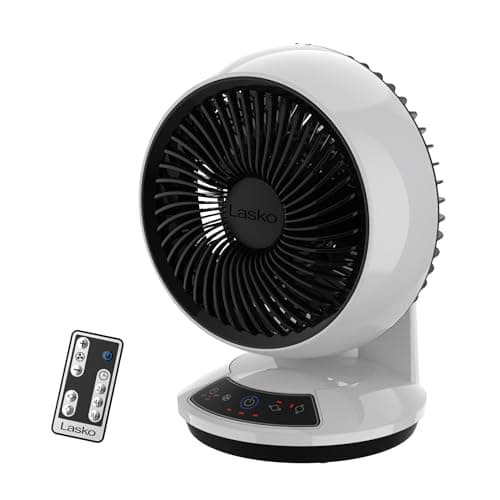 The wall-mountable pick Lasko Whirlwind Tilt 12" Table Fan Wall-mountable at 18 to 32 W with a 50-foot air throw and published 39 to 55 dBA. | A workshop, kitchen or small room where floor space is scarce | |
| 2 | 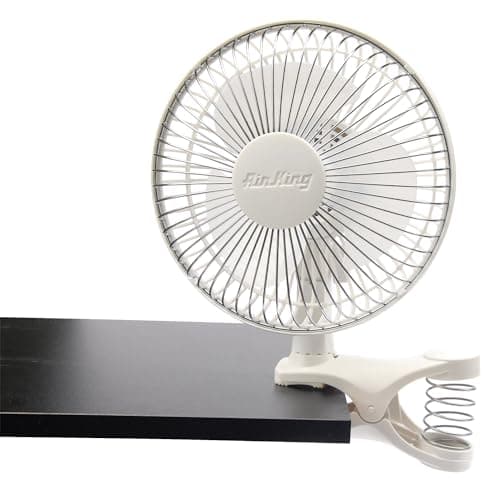 Clamps where a bracket will not go Air King 6" Commercial Grade Clip-On Fan A spring-loaded non-marking clip at 9 to 12 W and 34 to 37 dBA, ETL listed and OSHA compliant. | A shelf edge, a post or a rail — anywhere without a drillable wall | |
| 3 | 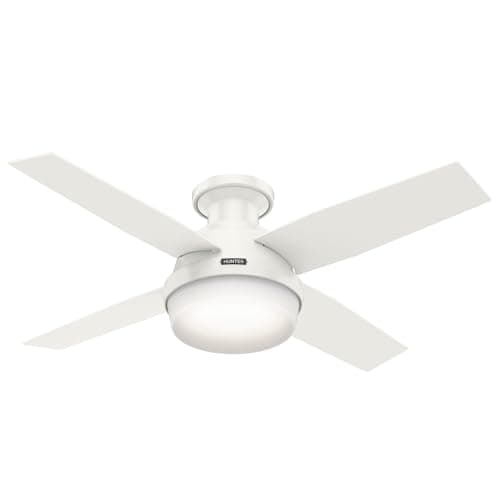 The permanent overhead answer Hunter Martindale 44" Ceiling Fan 1.1 W on low at 304.5 CFM per watt, certified — no floor space, no cord, nothing reachable. | A room you own, where you want the fan gone entirely | |
| — | 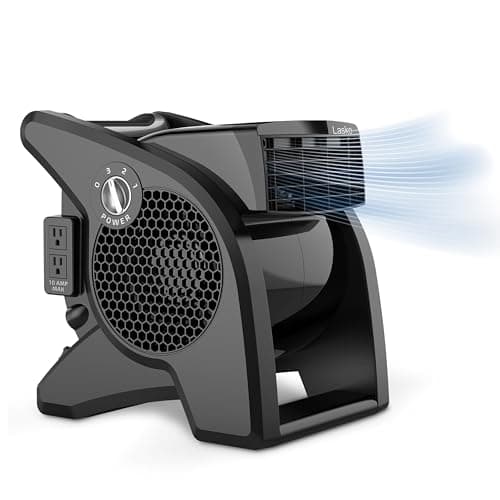 What a shop wall fan usually is Lasko Max Performance 15" Air Mover 160 to 178 W with a pivoting head — the output people want from a wall fan, at the power it costs. | A workshop, on a bench rather than a wall |
Wall mounting is a placement decision rather than a fan type, and it solves a specific set of problems particularly well.
What it solves
Three problems at once
- Floor space. A pedestal fan occupies about a square foot permanently. In a small kitchen, a workshop with a bench, or a nursery, that is space you do not have.
- Tip-over. A tall fan on a small base goes over when pushed, pulled or leaned on. A wall-mounted fan cannot.
- Reach. Height improves throw. A fan at floor level hits furniture legs and rug edges within a few feet; the same fan at seven feet has a clear run across the room. This is why the 50-foot throw figure matters more on a wall than on a table.
There is a fourth benefit worth naming in a home with small children: nothing at reachable height. That covers the guard, the controls and the fan body all at once.
What it does not
The cord is still there
This is the part people discover after mounting the fan.
A wall-mounted fan still needs power, and unless there is a socket at mounting height, you now have a cord running down the wall — which is more visible than a cord behind a sofa, and in a room with small children is arguably worse than a cord on the floor because it is a hanging thing at eye level.
Three ways round it, in order of effort:
- Mount near an existing high socket if there is one, and keep the run short.
- Use a cord cover or trunking down the wall. Cheap, effective, and it removes the hanging-loop problem.
- Have a socket installed at mounting height — which, once you are paying an electrician, invites the question of whether a ceiling fan is the better use of that visit.
This one is not a DIY job
Match the fixing to the wall. A fan is a vibrating load, not a static one, and the fixings that hold a picture will not hold it indefinitely.
Into studs or masonry, with the right anchors for the substrate. Plasterboard alone is not adequate for a fan of any weight unless you are using a rated cavity fixing and the fan is genuinely light.
Check the manufacturer states wall mounting. Many fans have a hole in the base that is not a mounting point. A fan designed to be wall-mounted says so and specifies the method.
Hardware is frequently not included — the wall-mountable pick on this page states exactly that. Budget for a bracket suited to your wall.
Mount high enough to clear heads, and aim it across rather than down onto a fixed position.
The data gap
No certification, and thin publishing
Worth stating plainly: there is no ENERGY STAR program for portable or wall-mounted fans, so nothing in this category is independently tested.
Publishing is also patchy. Of the fans here, the wall-mountable Lasko states watts, air throw and dBA but no CFM; the Air King states watts, CFM and dBA; the air mover states watts only.
The contrast with ceiling fans is stark — certified CFM per watt, wattage at two speeds, span and warranty for all 1,398 US records.
So if published, verifiable performance data matters to you, that is a genuine argument for the overhead format over the wall one.
Where it fits
Rooms where wall mounting wins
Workshops and garages — bench space is the scarcest thing there, and a fan aimed from a wall keeps it clear. The workshop case.
Small kitchens — worktop is contested, and a fan aimed at the cook rather than the hob is the right arrangement. Why not at the hob.
Home gyms — floor space is the point of the room, and a fan aimed across it from height covers more of it. The gym case.
Nurseries and children’s rooms — with the cord properly managed, getting the fan out of reach is a genuine benefit. The nursery rules.
Say the unwelcome thing
Do not wall-mount a fan that is not designed for it.
Improvising a bracket for a floor fan is a common workshop move and a bad one.
A fan is a vibrating, rotating load. Fixings that hold static weight fine will work loose over months of continuous vibration, and the failure is a heavy object falling from height.
Many fans also have a base designed to sit flat and dissipate motor heat downward. Mounted vertically, the airflow path through the housing changes, which is not something the manufacturer has tested.
Buy a fan that states wall mounting and specifies the method, or use a proper clamp mount on a suitable edge. If you want something permanent and overhead, a ceiling fan is the engineered answer at 1.1 W and a certified 304.5 CFM per watt.
In full
Every pick, and what is wrong with it
Published specifications only, each linked to the page it came from. Where a manufacturer publishes nothing, the row says so — we do not fill blanks in.
1. The wall-mountable pick
Lasko Whirlwind Tilt 12" Table Fan
Lasko · model A12107
Wall-mountable at 18 to 32 W with a 50-foot air throw and published 39 to 55 dBA.
Wall-mountable is stated by the manufacturer, and it is the reason this is the pick — most domestic fans are not.
50-foot air throw from a 12-inch fan is the specification that makes wall mounting work. Mounted high on one wall, it needs to reach across the room rather than just past the nearest surface.
18 to 32 W — about 4.7¢ for an eight-hour day at full — and 2.78 lb, which is light enough that the mounting is not a structural problem.
39 to 55 dBA published across three speeds. Note the hardware is not included, so budget for a bracket suited to your wall type.
What’s wrong with it
Mounting hardware is not included, and a 16-decibel spread means the quiet figure applies to one setting only.
Running cost — A12107
| Nameplate power | 18 W – 32 W | manufacturer's published figure |
|---|---|---|
| Energy, 8-hour night | 0.26 kWh | 32 ÷ 1000 × 8 |
| Cost per hour | 0.6¢ | at 18.34¢/kWh |
| Cost per 8-hour night | 4.7¢ | on the highest speed |
| Cost per 30 nights | $1.41 | 7.7 kWh |
| Same month, lowest speed | 79¢ | at 18 W |
Rate: 18.34¢/kWh, the US average residential price for June 2026 (EIA Electric Power Monthly, Table 5.3). Yours will differ — swap it in: (watts ÷ 1000) × hours × your rate.
| Power | 18 W - 32 W (0.24-0.5 A at 120 V) |
|---|---|
| Noise | 39 dBA low, 55 dBA high |
| Air distance | 50 ft |
| Speeds | 3 |
| Dimensions | 11.19 H x 11.4 W x 6.2 D in |
| Weight | 2.78 lb |
| Mounting | Wall-mountable (hardware not included) |
| Air delivery (CFM) | Not published |
| Warranty | 1 year |
Every figure above is from Lasko product page, A12107. Blanks are shown as “not published” rather than filled in.
2. Clamps where a bracket will not go
Air King 6" Commercial Grade Clip-On Fan
Air King · model 9145
A spring-loaded non-marking clip at 9 to 12 W and 34 to 37 dBA, ETL listed and OSHA compliant.
The practical alternative when drilling is not an option — a rental, a masonry wall you would rather not touch, or a temporary setup.
The spring-loaded non-marking clip takes a shelf edge, a post, a bench lip or a rail, which covers most of what a wall mount would have done.
9 to 12 W — 1.8¢ for an eight-hour day — and 34 to 37 dBA, a three-decibel spread that keeps the sound constant whatever speed you use.
ETL listed and OSHA compliant with a metal guard. Keep it away from anywhere a child could pull it down — the placement rules.
What’s wrong with it
A clip is not a wall mount — it depends on a suitable edge, and it can be pulled down.
Running cost — 9145
| Nameplate power | 9 W – 12 W | manufacturer's published figure |
|---|---|---|
| Energy, 8-hour night | 0.10 kWh | 12 ÷ 1000 × 8 |
| Cost per hour | 0.2¢ | at 18.34¢/kWh |
| Cost per 8-hour night | 1.8¢ | on the highest speed |
| Cost per 30 nights | 53¢ | 2.9 kWh |
| Same month, lowest speed | 40¢ | at 9 W |
Rate: 18.34¢/kWh, the US average residential price for June 2026 (EIA Electric Power Monthly, Table 5.3). Yours will differ — swap it in: (watts ÷ 1000) × hours × your rate.
| Power | 9 W - 12 W (0.1-0.2 A at 120 V) |
|---|---|
| Air delivery | Up to 190 CFM |
| Noise | 34 dBA low, 37 dBA high |
| Speeds | 2 |
| Mounting | Spring-loaded clip, non-marking |
| Dimensions | 10.38 H x 6.25 L x 8.13 W in |
| Weight | 2.22 lb |
| Cord | 6 ft, 3-conductor |
| Listing | ETL listed, OSHA compliant |
| Warranty | 1 year |
Every figure above is from Air King product page, 9145 (via Lasko). Blanks are shown as “not published” rather than filled in.
3. The permanent overhead answer
Hunter Martindale 44" Ceiling Fan
Hunter · model 44in Martindale
1.1 W on low at 304.5 CFM per watt, certified — no floor space, no cord, nothing reachable.
If the reason for wall mounting is getting the fan out of the way, a ceiling fan does it more completely — no cord, no bracket, and it covers the whole room rather than one direction.
1.1 W on low is 0.2¢ for a twelve-hour run, against 18 to 32 W for the wall-mountable fan.
304.5 CFM per watt is a certified figure, which no portable fan on this page can offer — there is no certification program for them.
The trade is aim. A wall fan points where you need it; a ceiling fan circulates. The comparison.
What’s wrong with it
It is an electrical installation and cannot be aimed at a specific spot the way a wall fan can.
Running cost — 44in Martindale
| Nameplate power | 1.1 W – 10.1 W | manufacturer's published figure |
|---|---|---|
| Energy, 8-hour night | 0.08 kWh | 10.1 ÷ 1000 × 8 |
| Cost per hour | 0.2¢ | at 18.34¢/kWh |
| Cost per 8-hour night | 1.5¢ | on the highest speed |
| Cost per 30 nights | 44¢ | 2.4 kWh |
| Same month, lowest speed | 4.8¢ | at 1.1 W |
Rate: 18.34¢/kWh, the US average residential price for June 2026 (EIA Electric Power Monthly, Table 5.3). Yours will differ — swap it in: (watts ÷ 1000) × hours × your rate.
| Blade span | 44 in |
|---|---|
| Efficiency | 304.5 CFM per watt |
| Power, high speed | 10.1 W |
| Power, low speed | 1.1 W |
| Standby power | 0.4 W |
| Type | Indoor, fan only |
| Warranty | 3 years, components |
| ENERGY STAR | Certified |
Every figure above is from ENERGY STAR Certified Ceiling Fans dataset. Blanks are shown as “not published” rather than filled in.
Skip this one
Lasko Max Performance 15" Air Mover
Lasko · model U15720
160 to 178 W with a pivoting head — the output people want from a wall fan, at the power it costs.
Included because people shopping for a wall fan in a workshop are usually picturing this level of output, and it is worth seeing what it costs.
160 to 178 W — about 26¢ for an eight-hour day, against 4.7¢ for the wall-mountable Lasko.
The pivoting head does much of what wall mounting would: aiming air upward or across a space from a fixed position. And two 120 V accessory outlets suit a bench.
It is not designed to be wall-mounted, and improvising a bracket for a 12.55 lb fan with a vibrating motor is not a good idea. The high-velocity comparison.
What’s wrong with it
Not wall-mountable as supplied, and 178 W is roughly six times the wall-mountable pick above.
Running cost — U15720
| Nameplate power | 160 W – 178 W | manufacturer's published figure |
|---|---|---|
| Energy, 8-hour night | 1.42 kWh | 178 ÷ 1000 × 8 |
| Cost per hour | 3.3¢ | at 18.34¢/kWh |
| Cost per 8-hour night | 26¢ | on the highest speed |
| Cost per 30 nights | $7.83 | 42.7 kWh |
| Same month, lowest speed | $7.04 | at 160 W |
Rate: 18.34¢/kWh, the US average residential price for June 2026 (EIA Electric Power Monthly, Table 5.3). Yours will differ — swap it in: (watts ÷ 1000) × hours × your rate.
| Power | 160 W - 178 W (1.35-1.53 A at 120 V) |
|---|---|
| Speeds | 3 |
| Dimensions | 14.5 H x 14.0 D x 11.5 W in |
| Weight | 12.55 lb |
| Extras | Two 120 V accessory outlets, 9.5 ft cord, pivoting head |
| Air delivery (CFM) | Not published |
| Warranty | 1 year |
Every figure above is from Lasko product page, U15720. Blanks are shown as “not published” rather than filled in.
We are not linking a buy button for this one. If you want to look at it anyway, it is easy enough to find — but we would rather send you to something that fits your room.
Questions people actually ask
Frequently asked
What is the best wall-mounted fan?
Of the fans we hold published data for, the Lasko A12107 is the one the manufacturer states is wall-mountable — 18 to 32 W, a 50-foot air throw and 39 to 55 dBA. Mounting hardware is not included.
Can I wall-mount any fan?
No. A fan is a vibrating rotating load, and fixings that hold static weight work loose over months. Many fans also have bases designed to sit flat and shed motor heat downward. Buy one that states wall mounting and specifies the method.
Does wall mounting solve the cord problem?
No, and this catches people out. Unless there is a socket at mounting height you now have a cord running down the wall — more visible than one behind furniture, and a hanging loop at eye level in a room with children.
Are wall-mounted fans more effective?
Height improves throw, which is a real advantage. A fan at floor level hits furniture legs within a few feet, where the same fan at seven feet has a clear run — which is why a 50-foot throw figure matters more on a wall than on a table.
Is a wall fan or a ceiling fan better?
A ceiling fan is more complete — no floor space, no cord, nothing reachable, and certified performance data. A wall fan wins when you need the air aimed at a specific place, like a workbench or a piece of gym equipment. Overhead vs directional.
Are wall-mounted fans certified for efficiency?
No. There is no ENERGY STAR program for portable or wall-mounted fans, so nothing in the category is independently tested and publishing is patchy — some state watts and dBA but no airflow, others only watts.
Sources
Where these numbers came from
- Lasko A12107 Whirlwind product page — wall-mountable (hardware not included), 18-32 W, 39-55 dBA, 50 ft air distance
- Air King 9145 product page — spring-loaded non-marking clip, 9-12 W, 190 CFM, 34-37 dBA
- ENERGY STAR Certified Ceiling Fans dataset — certified CFM per watt and wattage
- EIA Electric Power Monthly, Table 5.3 — electricity rate
Read next
Where to go from here
Back to Fans, or read how we pick.