The picks
The best attic fans, and whether you need one
This is the only category here where we spend more words on whether to buy at all than on which one to buy, and the published data is the reason.
By Sawyer V. · Published
The short answer
Attic fans are the least documented category on this site. None is ENERGY STAR certified — the program has no attic fan type — most publish no wattage at all, and the ones that file a sone rating file 0.0, which is a placeholder rather than a measurement. Before buying, check whether passive ridge and soffit venting solves it for nothing, and whether the attic floor is properly insulated.
Fan & Frost earns a commission when you buy through our links, at no cost to you. It never changes a ranking, and we say so when the right answer is the cheaper unit or nothing at all. Full disclosure · How we pick.
At a glance
The picks, ranked
Tap any row to jump to the full reasoning. Prices are live from Amazon where we have them, and read “check price” where we don’t — never a number we cannot verify today.
| # | Product | Best for | Price |
|---|---|---|---|
| 1 | Best documented option Broan 353 Gable-Mount Powered Attic Ventilator 760 / 1,020 CFM gable-mounted with a built-in adjustable thermostat — and it publishes more than most of the category. | A gable-vented attic where passive venting is genuinely inadequate | |
| 2 | 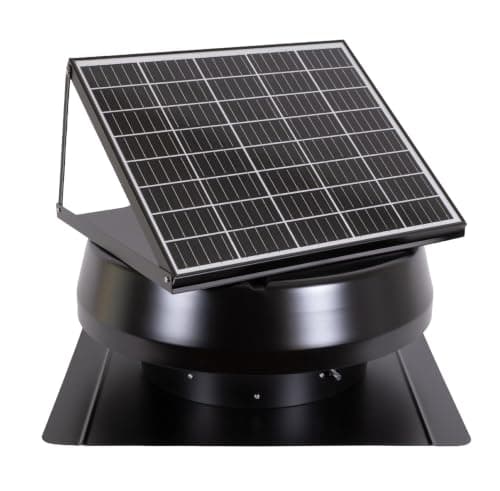 Best without wiring iLIVING 14" Solar Roof Attic Exhaust Fan 1,150 CFM on a 40 W solar panel, brushless IP68 motor, 15-year warranty and a 50 to 122 degree F thermostat. | An attic with no circuit run to it, in a sunny location | |
| 3 | 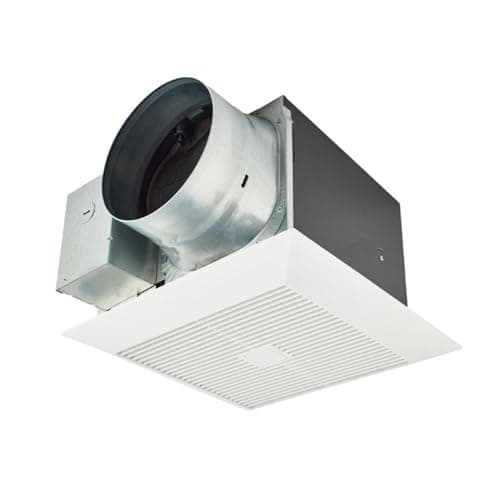 What certified data looks like Panasonic WhisperGreen Select FV-0511VK3 Ventilation Fan 110 CFM at 0.1 sones and 16.7 CFM per watt — everything the attic fan category does not publish. | Removing moisture from the rooms below, which is often the real problem | |
| — | The machine people confuse this with QuietCool Stealth Pro X Whole House Fan, 4,280 CFM 4,280 CFM into the attic, pulling air out of your house — a completely different job from an attic fan. | Cooling the living space — not the attic |
We normally open a roundup by ranking things. This category needs a different opening, because the data you would rank on largely does not exist.
The gap
What this category does not publish
The ENERGY STAR Certified Ventilating Fans dataset holds 1,140 records across four types: 973 bathroom and utility fans, 92 range hoods, 73 single-port in-line fans and 2 multi-port in-line fans.
There is no attic fan type. Not an empty category — no category. Powered attic ventilators are not covered by the program at all.
Which leaves this, from the manufacturer pages we could verify:
| Specification | Attic fans | Certified bathroom fans |
|---|---|---|
| Airflow (CFM) | Manufacturer claim | Tested at 0.25 in w.g. |
| Power (watts) | Frequently not published | Derived from tested efficacy |
| Efficacy (CFM/W) | Not published | Published per speed |
| Noise | Filed as 0.0 sones, a placeholder | Tested sones, 0.1 upward |
| Coverage (sq ft) | Manufacturer claim | Not claimed |
| Independent certification | None exists | 1,140 certified records |
The 0.0 sones entry deserves a note. It appears on several attic ventilator pages, and it is the same filing artifact we found in the certified range hood data, where 8 of 91 units are filed at 0.0 sones. Zero sones is not a quiet machine; it is an empty field rendered as a number. Treat it as “not reported”.
Before you buy
Three things that come first
A hot attic is usually a symptom, and two of its common causes are cheaper to fix than a fan is to run.
- Is the attic floor properly insulated? The attic being hot only matters because that heat reaches the rooms below. Insulation at the ceiling plane is what stops it, and it costs nothing to run forever. A fan is a continuing expense that treats the symptom.
- Is the passive venting adequate? Soffit vents at the eaves and a ridge vent at the top drive a continuous convective flow with no electricity at all. Blocked soffit vents — frequently buried under insulation — are one of the most common causes of a hot attic, and clearing them is free.
- Is moisture arriving from below? A bathroom fan ducted into the attic instead of outdoors, or a dryer venting into it, puts a large amount of water where it should not be. That is a source problem, and an attic fan will run against it indefinitely.
If all three check out and the attic still runs very hot, a powered ventilator has a case. If they do not, it is treating a symptom at a running cost you cannot even calculate.
The controversy
Why this category is genuinely contested
We would be misrepresenting the field if we presented powered attic ventilators as settled good practice. They are not, and the objections are worth stating plainly.
- They can depressurize the attic and, where the ceiling plane is leaky, pull conditioned air out of the living space below — which means your air conditioner is now feeding the attic fan. The leakier the ceiling, the worse this gets.
- They can pull from the wrong place. If passive venting is insufficient, a powered fan takes its make-up air from wherever it can, and that includes the house.
- The energy trade is unclear, and it cannot be modeled honestly when the fan does not publish its wattage.
- Combustion safety. Depressurising a space connected to an atmospherically vented appliance is a hazard.
None of that makes them useless. It does mean the ceiling plane needs to be sealed and insulated, and the passive venting adequate, before a powered fan is a sensible addition rather than a problem.
This one is not a DIY job
Attic fan installation is roof work and pressure work, and both have real consequences. A roof-mounted unit is a penetration in your weatherproofing; a gable unit changes the pressure regime of the space.
Combustion safety first. If the attic or the house contains an atmospherically vented gas appliance, water heater or fireplace, depressurisation can backdraft combustion gases. That needs professional assessment before anything is installed.
Do not block soffit vents while adding insulation. Baffles exist for exactly this reason, and a blocked soffit is a common cause of both hot attics and moisture problems.
Roof penetrations, flashing and electrical work in an attic all belong to qualified trades. A leak introduced by a badly flashed fan costs far more than the fan.
Say the unwelcome thing
Do not buy an attic fan before checking the soffit vents and the insulation.
A hot attic is a symptom. The two cheapest causes are almost always worth eliminating first, and both are free or close to it.
Blocked soffit vents — usually buried under insulation pushed into the eaves — stop the convective flow that ventilates an attic with no electricity at all. Clearing them and fitting baffles frequently fixes the problem outright.
Insufficient ceiling insulation is why the attic temperature reaches you in the first place. Fixing that stops the heat transfer permanently; a fan reduces the attic temperature a bit, forever, for a running cost most of these will not even state.
If both check out, the honest options are a thermostat-controlled gable unit or, with no wiring and a much longer warranty, a solar fan at 1,150 CFM.
In full
Every pick, and what is wrong with it
Published specifications only, each linked to the page it came from. Where a manufacturer publishes nothing, the row says so — we do not fill blanks in.
1. Best documented option
Broan 353 Gable-Mount Powered Attic Ventilator
Broan · model 353
760 / 1,020 CFM gable-mounted with a built-in adjustable thermostat — and it publishes more than most of the category.
Recommended with more caveats than any product on this site, and it is still the best-documented current option we could verify.
760 / 1,020 CFM from a 4-blade steel fan at 1,030 RPM, in a 15 inch by 8 inch gable housing with a built-in adjustable thermostat so it runs on temperature rather than continuously.
No watts are published. The page states 120 VAC and nothing else, which means the running cost cannot be calculated honestly — on a machine that may run for hours every hot afternoon.
Shaded-pole motor and a 1-year warranty. Shaded pole is the least efficient common motor type, and one year is short for something mounted in a roof. The filed 0.0 sones is a data placeholder, not silence.
What’s wrong with it
No wattage published, a 1-year warranty, a shaded-pole motor, and a 0.0 sone filing that is not a rating.
Running cost
Broan does not publish a wattage for the 353, so we cannot calculate what it costs to run. We are not going to estimate one. If Broan publishes a nameplate figure, this block will show the arithmetic.
| Air delivery | 760 / 1,020 CFM |
|---|---|
| Mount | Gable |
| Motor | Shaded pole, 1,030 RPM |
| Blade | 4-blade steel |
| Housing | 15 in diameter x 8 in |
| Thermostat | Built-in, adjustable |
| Power | 120 VAC; watts not published |
| Noise | Filed as 0 sones, which is a placeholder rather than a rating |
| Warranty | 1 year |
| ENERGY STAR | No program exists for attic ventilators |
Every figure above is from Broan-NuTone product page, model 353. Blanks are shown as “not published” rather than filled in.
2. Best without wiring
iLIVING 14" Solar Roof Attic Exhaust Fan
iLIVING · model ILG8SF301
1,150 CFM on a 40 W solar panel, brushless IP68 motor, 15-year warranty and a 50 to 122 degree F thermostat.
More airflow than the mains unit above, no electrician, and a warranty fifteen times longer.
1,150 CFM from a 14 inch fan driven by a 40 W adjustable-tilt solar panel. Nothing on your electricity bill, because the panel is the supply.
Brushless motor, IP68 rated, with a 15-year warranty — against a shaded-pole motor and one year on the mains unit. That is a substantial difference in expected service life.
Adjustable thermostat, 50 to 122°F, 32 lb, and 23.5 by 23.5 by 10.5 inches. The obvious limit is that output tracks sunlight — which is more of an advantage than it sounds.
What’s wrong with it
It only runs when the sun is on the panel, and the CFM figure is unverified like everything here.
Running cost
iLIVING does not publish a wattage for the ILG8SF301, so we cannot calculate what it costs to run. We are not going to estimate one. If iLIVING publishes a nameplate figure, this block will show the arithmetic.
| Air delivery | 1,150 CFM |
|---|---|
| Fan diameter | 14 in |
| Solar panel | 40 W, adjustable tilt |
| Motor | Brushless, IP68 rated |
| Thermostat | Adjustable, 50 - 122 degrees F |
| Coverage claim | Up to 2,900 sq ft |
| Dimensions | 23.5 x 23.5 x 10.5 in |
| Weight | 32 lb |
| Warranty | 15 years |
| Noise | Not published |
| ENERGY STAR | No program exists for attic ventilators |
Every figure above is from iLiving USA product page, ILG8SF301. Blanks are shown as “not published” rather than filled in.
3. What certified data looks like
Panasonic WhisperGreen Select FV-0511VK3 Ventilation Fan
Panasonic · model FV-0511VK3
110 CFM at 0.1 sones and 16.7 CFM per watt — everything the attic fan category does not publish.
Included as a deliberate contrast, because it shows exactly what is missing above.
16.7 CFM per watt, 0.1 sones, tested. Airflow, efficacy at three speeds and an acoustic rating, all under a federal certification program, for every one of 973 units in its class.
Most Efficient certified — a designation only 80 of 912 certified fans reach.
It is also frequently the machine people actually need. A lot of attic moisture arrives from the rooms below through missing or failed extraction, and fixing that at the source costs a fraction of a cent an hour.
What’s wrong with it
It ventilates a bathroom, not an attic. Different machine, different job.
Running cost
Panasonic does not publish a wattage for the FV-0511VK3, so we cannot calculate what it costs to run. We are not going to estimate one. If Panasonic publishes a nameplate figure, this block will show the arithmetic.
| Noise | 0.1 sones |
|---|---|
| Air delivery, high | 110 CFM at 0.25 in w.g. |
| Air delivery, medium | 80 CFM |
| Air delivery, low | 50 CFM |
| Efficacy, high | 16.7 CFM per watt |
| Efficacy, medium | 18.4 CFM per watt |
| Efficacy, low | 14.7 CFM per watt |
| Duct size | 6 in diameter |
| Speeds | 3 or more |
| Lighting | None |
| Power | Not published in the certified dataset |
| ENERGY STAR | Certified, and on the Most Efficient list |
Every figure above is from ENERGY STAR Certified Ventilating Fans dataset. Blanks are shown as “not published” rather than filled in.
Skip this one
QuietCool Stealth Pro X Whole House Fan, 4,280 CFM
QuietCool · model QC STL PRO-4.8X
4,280 CFM into the attic, pulling air out of your house — a completely different job from an attic fan.
Marked skip because it is the wrong purchase for anyone searching for an attic fan — and the two get confused constantly.
An attic fan exhausts the attic to outdoors. It never touches the air in your living space, and its purpose is to reduce attic temperature and moisture.
A whole-house fan pulls air out of your living space and pushes it into the attic, drawing cool outdoor air in through open windows. Its purpose is to cool you.
2,361 CFM on 73.9 W on low — 11¢ for a night — and it needs open windows to work at all. The two machines compared properly.
What’s wrong with it
It is not an attic fan and will not substitute for one. Buying the wrong one of these is a common error.
Running cost — QC STL PRO-4.8X
| Nameplate power | 73.9 W – 408 W | manufacturer's published figure |
|---|---|---|
| Energy, 8-hour night | 3.26 kWh | 408 ÷ 1000 × 8 |
| Cost per hour | 7.5¢ | at 18.34¢/kWh |
| Cost per 8-hour night | 60¢ | on the highest speed |
| Cost per 30 nights | $18 | 97.9 kWh |
| Same month, lowest speed | $3.25 | at 73.9 W |
Rate: 18.34¢/kWh, the US average residential price for June 2026 (EIA Electric Power Monthly, Table 5.3). Yours will differ — swap it in: (watts ÷ 1000) × hours × your rate.
| Air delivery, high | 4,280 CFM |
|---|---|
| Air delivery, medium | 3,500 CFM |
| Air delivery, low | 2,361 CFM |
| Power, high | 408 W |
| Power, medium | 225 W |
| Power, low | 73.9 W |
| Coverage claim | 1,427 - 2,140 sq ft |
| Motor | ECM |
| Warranty | 15 years |
| Noise | Not published as sones or dBA |
| ENERGY STAR | No program exists for whole-house fans |
Every figure above is from QuietCool Stealth Pro X specification sheet, QC STL PRO-4.8. Blanks are shown as “not published” rather than filled in.
We are not linking a buy button for this one. If you want to look at it anyway, it is easy enough to find — but we would rather send you to something that fits your room.
Questions people actually ask
Frequently asked
Are attic fans ENERGY STAR certified?
No. The certified ventilating fans dataset holds 1,140 records across bathroom and utility fans, range hoods and in-line fans, and has no attic fan type at all. Every airflow and coverage figure in this category is a manufacturer claim.
How many watts does an attic fan use?
Most do not say. The best-documented current mains unit we could verify publishes 120 VAC and no wattage, which means its running cost cannot be calculated. That is a real problem for a machine that may run for hours every hot afternoon.
Do attic fans actually work?
It is genuinely contested. They can depressurize the attic and, where the ceiling plane is leaky, pull conditioned air out of the house below — so your air conditioner ends up feeding the attic fan. They make more sense once the ceiling is sealed and insulated and passive venting is adequate.
What should I do before buying an attic fan?
Three checks. Is the attic floor properly insulated? Are the soffit vents clear, or buried under insulation? Is moisture arriving from below through a bathroom fan or dryer ducted into the attic? Each of those is cheaper to fix than a fan is to run.
Why do attic fans show 0.0 sones?
It is a filing placeholder, not a measurement — the same artifact that appears on 8 of 91 certified range hoods. Zero sones is not a silent machine; it is an empty field rendered as a number. Treat it as 'not reported'. The same artifact, in certified data.
Is an attic fan the same as a whole-house fan?
No, and confusing them is a common and expensive mistake. An attic fan exhausts the attic to outdoors and never touches your living space. A whole-house fan pulls air out of your living space into the attic, drawing cool outdoor air in through open windows. The two compared.
Sources
Where these numbers came from
- Broan-NuTone product page, model 353 — 760/1,020 CFM, gable mount, shaded pole motor, thermostat, 1-year warranty
- iLiving USA product page, ILG8SF301 — 1,150 CFM, 40 W solar panel, brushless IP68 motor, 15-year warranty
- ENERGY STAR Certified Ventilating Fans dataset — the four certified unit types, none of which is an attic fan
- EIA Electric Power Monthly, Table 5.3 — average residential electricity price
Read next
Where to go from here
Back to Whole-House Airflow, or read how we pick.