The picks
The best portable air conditioners with heat
One machine for both seasons is a genuinely good idea. The catch is that portable heating is the most expensive kind there is.
By Sawyer V. · Published
The short answer
A dual-hose portable with heat is the right answer when you have no usable window and no wall — a real constraint. Expect 9,200 BTU SACC cooling, 13,000 BTU heating and 1,300 W cooling / 1,000 W heating. But if a window or sleeve exists, a reverse-cycle window unit at 404.8 kWh a year does both seasons for a fraction of the running cost.
Fan & Frost earns a commission when you buy through our links, at no cost to you. It never changes a ranking, and we say so when the right answer is the cheaper unit or nothing at all. Full disclosure · How we pick.
At a glance
The picks, ranked
Tap any row to jump to the full reasoning. Prices are live from Amazon where we have them, and read “check price” where we don’t — never a number we cannot verify today.
| # | Product | Best for | Price |
|---|---|---|---|
| 1 | Best overall Whynter ARC-14SH Dual Hose Portable Air Conditioner and Heater 9,200 BTU SACC cooling and 13,000 BTU heating, dual hose, with 1,300 W and 1,000 W published. | A room with no usable window opening and no wall sleeve | |
| 2 | Do this instead if you have a window Midea Window Heat Pump Air Conditioner, 9,500 BTU CEER 17.6 and 404.8 kWh a year with reverse-cycle heating — the highest CEER of any certified room unit. | Any room with a sash window that will take a saddle unit | |
| 3 | 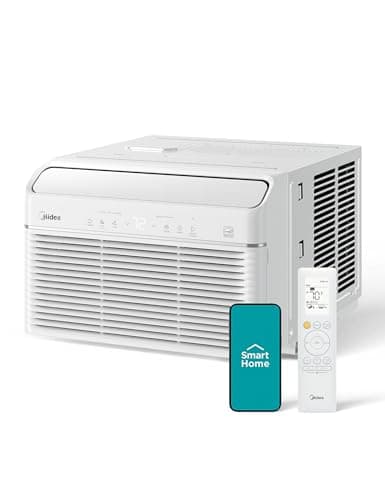 Best conventional window heat pump Midea Window Air Conditioner with Heat, 8,000 BTU 8,000 BTU reverse-cycle at CEER 15.1 and 397.4 kWh a year — 54% below the federal standard. | A standard sash window where a saddle unit will not fit | |
| — | The cooling-only sibling Whynter ARC-14S Dual Hose Portable Air Conditioner 9,500 BTU SACC and 1,300 W, dual hose — slightly more cooling, no heat mode, and no real saving. | A room that genuinely has no heating requirement |
A portable that heats as well as cools solves a real problem for a specific room, and it is worth being precise about what the heating actually is.
The mechanism
Heat pump or resistance heater?
This distinction decides the running cost, and it is frequently not made clear on the box.
- A heat pump reverses the refrigeration cycle. It moves heat from outdoors into the room, so one unit of electricity delivers more than one unit of heat. That is why the certified window heat pumps reach CEER 17.6 while heating.
- A resistance heater converts electricity to heat directly. One unit in, one unit out, no better and no worse than a fan heater or an electric radiator.
On a portable, you are reading manufacturer figures rather than certified ones. Whynter publishes 13,000 BTU of heat against a 1,000 W heating draw — a ratio only a heat pump could reach, from a page that also lists the same 11.6 A for heating and cooling. We would not build a claim about its efficiency on figures that do not reconcile. What is reliable is the draw itself: 1,000 W is the number that lands on your bill.
For comparison, a proper heat pump delivers 2.2 to 2.9 units of heat per unit of electricity even at 5°F.
The cost
Portable heating is the expensive kind
| Option | Published figure | Cost | Basis |
|---|---|---|---|
| Portable, cooling | 1,300 W | $1.91 | one 8-hour night |
| Portable, heating | 1,000 W | $1.47 | one 8-hour night |
| Portable, a month of nights | 1,300 W | $57 | 30 nights |
| Window heat pump, 9,500 BTU | 404.8 kWh/yr | $74 | a whole season |
| Window heat pump, 8,000 BTU | 397.4 kWh/yr | $73 | a whole season |
Read the basis column, because it is doing the work. A certified window heat pump’s entire cooling season is about $74. A 1,300 W portable costs $57 for one month of nights.
That is not quite like-for-like — the certified annual figure assumes a standard usage pattern rather than continuous running — but the order of magnitude is right, and it is why every page on this site recommends a fixed unit wherever one will fit.
The gap
No certification covers portables
Window and through-the-wall units are covered by a program that publishes tested CEER and modeled annual kWh for every model. You can look any of them up and cost it exactly.
Portables are not in that program. There is no certified list, no tested efficiency figure and no annual energy estimate for any portable air conditioner — heating or not.
What that means here:
- No independent heating efficiency figure exists. No HSPF2, no COP, nothing comparable to the certified heat pumps.
- Running cost is reconstructed from wattage, which this manufacturer publishes and many do not.
- The dBA figure is uncertified, measured however the brand chose.
- SACC is the honest capacity — 9,200 BTU here against 14,000 on the box. What SACC measures.
When it is right
The genuine case for one
We recommend against portables often enough that it is worth being clear when one is correct.
- A casement or sliding window. No certified room air conditioner is recorded as casement-capable, so a window unit is not an option at all.
- A lease that forbids window units. Common, and a portable with a vent kit is frequently permitted where a window unit is not.
- No exterior wall for a sleeve and no window worth using.
- A room you need to move it between, which is the one advantage a fixed unit cannot match.
- A space that needs both seasons and where installing two fixed appliances is not practical.
Outside those, the fixed alternatives are a different order of running cost.
This one is not a DIY job
At 1,300 W and 11.6 A, the electrical supply is not a formality. Room air conditioner manuals typically require a dedicated grounded outlet and explicitly forbid extension cords, adapters and external timers. A heat mode drawing 1,000 W on a shared circuit is a real load.
Never vent the exhaust into the room being conditioned, into a chimney, or into an unventilated loft or crawl space.
Heating appliances near furnishings have clearance requirements. Read the manual for this specific unit rather than treating it as an air conditioner that also warms.
Condensate handling changes between modes on some units. Check what yours expects before leaving it running unattended.
Say the unwelcome thing
Do not buy a portable with heat if a window or sleeve is available.
The convenience is real and the running cost difference is not marginal.
A certified reverse-cycle window unit covers an entire season for about $74 at 18.34¢/kWh, at CEER 17.6 — the highest of any certified room air conditioner. A 1,300 W portable costs roughly $57 for a single month of overnight running.
The window unit also publishes a tested efficiency figure and a modeled annual energy estimate. The portable category has no certification program at all, so nothing about its efficiency is independently verified.
If the opening genuinely rules out a fixed unit, then 9,200 BTU SACC with 13,000 BTU of heat is the right choice and dual hose is non-negotiable. Otherwise 404.8 kWh for both seasons.
In full
Every pick, and what is wrong with it
Published specifications only, each linked to the page it came from. Where a manufacturer publishes nothing, the row says so — we do not fill blanks in.
1. Best overall
Whynter ARC-14SH Dual Hose Portable Air Conditioner and Heater
Whynter · model ARC-14SH
9,200 BTU SACC cooling and 13,000 BTU heating, dual hose, with 1,300 W and 1,000 W published.
The best-documented machine in a category that documents very little, and it earns the pick partly on that.
Dual hose is the specification to insist on. A single-hose unit exhausts room air outdoors and pulls unfiltered replacement air in through every gap — the structural objection.
9,200 BTU SACC against 14,000 on the box — a 34% haircut, which is normal for the category. Heating is 13,000 BTU.
1,300 W cooling, 1,000 W heating. That is about $1.91 for an eight-hour night cooling and $1.47 heating — and it publishes both figures, which many portables do not. 71 pints a day of dehumidification, R-32, 85 lb.
What’s wrong with it
1,300 W is a very large draw, and 85 lb on castors is not really portable.
Running cost — ARC-14SH
| Nameplate power | 1300 W | manufacturer's published figure |
|---|---|---|
| Energy, 8-hour night | 10.40 kWh | 1300 ÷ 1000 × 8 |
| Cost per hour | 24¢ | at 18.34¢/kWh |
| Cost per 8-hour night | $1.91 | on the highest speed |
| Cost per 30 nights | $57 | 312.0 kWh |
Rate: 18.34¢/kWh, the US average residential price for June 2026 (EIA Electric Power Monthly, Table 5.3). Yours will differ — swap it in: (watts ÷ 1000) × hours × your rate.
| Marketing capacity | 14,000 BTU (ASHRAE-128) |
|---|---|
| DOE-rated capacity | 9,200 BTU SACC |
| Heating capacity | 13,000 BTU/h (ASHRAE-128) |
| Hoses | Dual |
| Power, cooling | 1,300 W / 11.6 A at 115 V |
| Power, heating | 1,000 W / 11.6 A at 115 V |
| Dehumidification | 71 pints/day |
| Thermostat range | 61 - 89 degrees F cooling, 61 - 77 heating |
| Refrigerant | R-32 |
| Dimensions | 16 W x 19 D x 35.5 H in |
| Weight | 85 lb |
| Manufacturer coverage claim | 500 sq ft |
| ENERGY STAR | No program exists for portable air conditioners |
Every figure above is from Whynter product page, ARC-14SH. Blanks are shown as “not published” rather than filled in.
2. Do this instead if you have a window
Midea Window Heat Pump Air Conditioner, 9,500 BTU
Midea · model MAH09B1AGR
CEER 17.6 and 404.8 kWh a year with reverse-cycle heating — the highest CEER of any certified room unit.
The honest comparison, and it is not close on running cost.
404.8 kWh for an entire season is about $74 at 18.34¢/kWh. A 1,300 W portable running eight hours a night reaches that in roughly nine nights.
CEER 17.6 is the highest of any certified room air conditioner, and it belongs to a heat pump — adding heating costs nothing in cooling efficiency.
Reverse cycle, so it moves heat rather than generating it, which is the entire reason the running cost is different. No support bracket required despite 129 lb, because the saddle design bears on the sill.
What’s wrong with it
129 lb over a saddle mount, and the window has to be the right shape.
Running cost — MAH09B1AGR
| Annual energy use | 404.8 kWh | ENERGY STAR certified figure |
|---|---|---|
| Annual cost | $74 | 404.8 × 18.34¢/kWh |
| Per cooling month | $19 | spread over a four-month season |
The annual figure is the certified value from the ENERGY STAR Certified Room Air Conditioners dataset, which models a standard cooling season rather than your actual summer. It is more useful than a nameplate wattage here, because a variable-speed compressor spends most of its life well below nameplate.
Rate: 18.34¢/kWh, the US average residential price for June 2026 (EIA Electric Power Monthly, Table 5.3). Yours will differ — swap it in: (watts ÷ 1000) × hours × your rate.
| Cooling capacity | 9,500 BTU/h |
|---|---|
| Heating mode | Yes, reverse cycle |
| CEER | 17.6 |
| Annual energy use | 404.8 kWh/yr |
| vs federal standard | 80% less energy |
| Dimensions | 20.9 H x 25.0 W x 41.2 D in |
| Weight | 129.0 lb |
| Installation | Straddles the windowsill (saddle style) |
| Support bracket | Not required |
| Compressor | Variable speed |
| Refrigerant | R-32 |
| ENERGY STAR | Certified, and on the Most Efficient list |
Every figure above is from ENERGY STAR Certified Room Air Conditioners dataset. Blanks are shown as “not published” rather than filled in.
3. Best conventional window heat pump
Midea Window Air Conditioner with Heat, 8,000 BTU
Midea · model MAW08HV1KWT-A
8,000 BTU reverse-cycle at CEER 15.1 and 397.4 kWh a year — 54% below the federal standard.
The conventional-format alternative, and the largest efficiency margin against the federal standard in the certified set we hold.
397.4 kWh a year, about $73 at 18.34¢/kWh, at CEER 15.1 and on the Most Efficient list.
54% below the federal standard — the strongest margin of any unit we hold data for.
56.0 lb, no support bracket required, variable speed, R-32. The 33 certified reverse-cycle room units.
What’s wrong with it
It does not straddle the sill, so installation depends on your window and possibly a bracket.
Running cost — MAW08HV1KWT-A
| Annual energy use | 397.4 kWh | ENERGY STAR certified figure |
|---|---|---|
| Annual cost | $73 | 397.4 × 18.34¢/kWh |
| Per cooling month | $18 | spread over a four-month season |
The annual figure is the certified value from the ENERGY STAR Certified Room Air Conditioners dataset, which models a standard cooling season rather than your actual summer. It is more useful than a nameplate wattage here, because a variable-speed compressor spends most of its life well below nameplate.
Rate: 18.34¢/kWh, the US average residential price for June 2026 (EIA Electric Power Monthly, Table 5.3). Yours will differ — swap it in: (watts ÷ 1000) × hours × your rate.
| Cooling capacity | 8,000 BTU/h |
|---|---|
| Heating mode | Yes, reverse cycle |
| CEER | 15.1 |
| Annual energy use | 397.4 kWh/yr |
| vs federal standard | 54% less energy |
| Dimensions | 13.9 H x 19.4 W x 22.2 D in |
| Weight | 56.0 lb |
| Installation | Does not straddle the windowsill |
| Support bracket | Not required |
| Compressor | Variable speed |
| Refrigerant | R-32 |
| ENERGY STAR | Certified, and on the Most Efficient list |
Every figure above is from ENERGY STAR Certified Room Air Conditioners dataset. Blanks are shown as “not published” rather than filled in.
Skip this one
Whynter ARC-14S Dual Hose Portable Air Conditioner
Whynter · model ARC-14S
9,500 BTU SACC and 1,300 W, dual hose — slightly more cooling, no heat mode, and no real saving.
Included to make the trade explicit, because the cooling-only version looks like the sensible economy and usually is not.
9,500 BTU SACC against 9,200 for the heat model — marginally more cooling, from the same published 1,300 W draw.
Both publish 71 pints a day of dehumidification, so there is nothing to separate them there either. What you are really choosing is whether the heat mode is worth having.
The heat mode is the whole argument for the combo. If the room is somewhere you might work in November, the version without it is a false economy — you will end up plugging in a separate heater, which is the same electricity through a worse machine.
What’s wrong with it
If there is any chance you will want heat, the combo unit is the better buy.
Running cost — ARC-14S
| Nameplate power | 1300 W | manufacturer's published figure |
|---|---|---|
| Energy, 8-hour night | 10.40 kWh | 1300 ÷ 1000 × 8 |
| Cost per hour | 24¢ | at 18.34¢/kWh |
| Cost per 8-hour night | $1.91 | on the highest speed |
| Cost per 30 nights | $57 | 312.0 kWh |
Rate: 18.34¢/kWh, the US average residential price for June 2026 (EIA Electric Power Monthly, Table 5.3). Yours will differ — swap it in: (watts ÷ 1000) × hours × your rate.
| Marketing capacity | 14,000 BTU (ASHRAE-128) |
|---|---|
| DOE-rated capacity | 9,500 BTU SACC |
| Hoses | Dual |
| Power | 1,300 W / 11.6 A at 115 V |
| Noise | Under 51 dBA low, under 56 dBA high |
| Dehumidification | 71 pints/day |
| Refrigerant | R-32 |
| Dimensions | 16 W x 19 D x 35.5 H in |
| Weight | 73 lb |
| Manufacturer coverage claim | 500 sq ft |
| Warranty | 1 year unit, 3 years compressor |
Every figure above is from Whynter product page, ARC-14S. Blanks are shown as “not published” rather than filled in.
We are not linking a buy button for this one. If you want to look at it anyway, it is easy enough to find — but we would rather send you to something that fits your room.
Questions people actually ask
Frequently asked
Do portable air conditioners with heat work well?
They work, and they are expensive to run. Expect 9,200 BTU SACC cooling, 13,000 BTU heating and 1,300 W / 1,000 W draw — about the same electricity as an electric heater, in a machine that also cools. The case for one is a room with no usable window or wall.
Is a portable AC with heat a heat pump or an electric heater?
It varies by model and is often unclear on the box. A heat pump moves heat and delivers more than one unit of heat per unit of electricity; a resistance heater converts one to one. The unit here publishes 13,000 BTU of heat against a 1,000 W heating draw, but the same page lists identical amps for heating and cooling, so we do not treat that ratio as a measured efficiency.
How much does a portable AC with heat cost to run?
About $1.91 for an eight-hour night cooling and $1.47 heating at 18.34¢/kWh, or roughly $57 for a month of overnight running. A certified window heat pump covers a whole season for about $74.
Are portable air conditioners with heat ENERGY STAR certified?
No — there is no ENERGY STAR program for portable air conditioners at all. No certified list, no tested efficiency figure, no annual energy estimate and no heating efficiency figure comparable to HSPF2 or COP.
Should I get single or dual hose?
Dual, always. A single-hose unit exhausts room air outdoors and pulls unfiltered replacement air in through every gap in the building. A dual-hose unit seals the condenser loop off from the room so indoor pressure stays neutral. The full comparison.
When is a portable with heat the right choice?
A casement or sliding window (no certified unit is casement-capable), a lease that forbids window units, no exterior wall for a sleeve, a room you need to move the machine between, or a space needing both seasons where two fixed appliances are impractical.
Sources
Where these numbers came from
- Whynter ARC-14SH product page — 14,000 BTU / 9,200 SACC, 13,000 BTU heating, 1,300 W cooling / 1,000 W heating, 71 pints/day, dual hose
- Whynter ARC-14S product page — 9,500 BTU SACC, 1,300 W, 71 pints/day
- ENERGY STAR Certified Room Air Conditioners dataset — CEER, annual kWh and heating mode flag for the certified comparison
- EIA Electric Power Monthly, Table 5.3 — average residential electricity price
Read next
Where to go from here
Back to Air Conditioners, or read how we pick.