Guide and picks
Cooling during a power outage
The most useful cooling in an outage is the cold your house already has, and most of the mistakes people make are in losing it.
By Sawyer V. · Published
The short answer
Keep what you already have first — close the house, close the blinds, stop opening the fridge. Then move air on battery: a certified tool-platform fan runs up to 16 hours on one pack, and 400 to 2,300 CFM is available without mains power. Do not try to run an air conditioner — and never run a generator indoors or in a garage.
Fan & Frost earns a commission when you buy through our links, at no cost to you. It never changes a ranking, and we say so when the right answer is the cheaper unit or nothing at all. Full disclosure · How we pick.

At a glance
The picks, ranked
Tap any row to jump to the full reasoning. Prices are live from Amazon where we have them, and read “check price” where we don’t — never a number we cannot verify today.
| # | Product | Best for | Price |
|---|---|---|---|
| 1 | 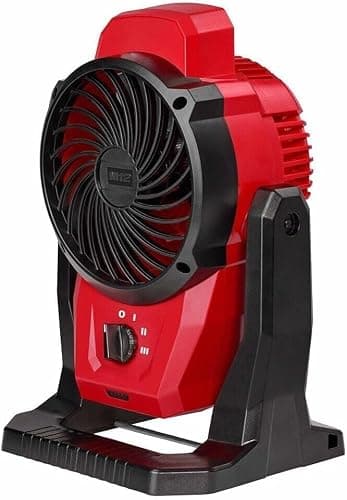 Longest runtime Milwaukee M12 Mounting Fan Up to 16 hours on a single M12 XC 6.0 battery, with magnets and a clamp so it mounts anywhere. | One person, one room, for a whole day | |
| 2 | 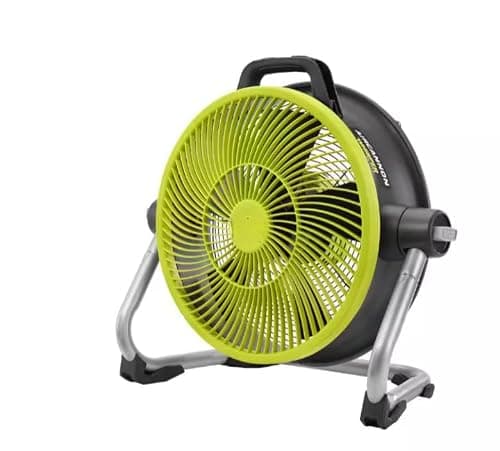 Most airflow Ryobi ONE+ 18V Hybrid Whisper Series 14" Air Cannon Fan 2,300 CFM on high from an 18V battery, with a barrel-plug AC adapter for when the power returns. | Moving air through a room, or exhausting a hot upstairs | |
| 3 | 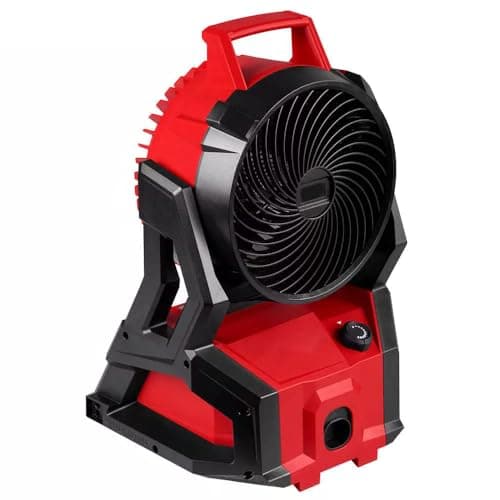 Best balance Milwaukee M18 Brushless PACKOUT Fan 850 CFM with over 3 hours on high or 6.5 hours at 75% speed, plus an integrated AC plug. | Real airflow with a published runtime, and mains when it returns | |
| — | What you cannot run Whynter ARC-14S Dual Hose Portable Air Conditioner 1,300 W and 11.6 A. A portable generator that can start this is a different class of machine from the one in most garages. | Mains power — not an outage |
In an outage the useful question is not what to run. It is what you already have, and how fast you are losing it.
First
The house is the battery
A conditioned house holds a substantial amount of cool in its structure, its furnishings and its air. Everything below is about spending that slowly.
- Close the blinds and curtains immediately, on every window the sun reaches. Solar gain is the largest heat input in most houses and it costs nothing to block — shading is the only cooling with no running cost.
- Close the house up if it is hotter outside than in. Every door opened is a partial air exchange.
- Retreat to one room, low down. A basement or ground floor room on the shaded side will hold its temperature far longer than the whole house will.
- Stop opening the fridge and freezer. Partly to keep the food, partly because every opening dumps cold into the kitchen and pulls warm air in.
- Turn off everything that makes heat. In an outage that is mostly automatic, but battery devices, gas appliances and candles all count.
- Open up at night if outdoor air is cooler, then close again at dawn. This is the night purge done by hand.
None of that needs electricity, and together it matters more than any battery appliance you own.
Then
Move air, on a battery
A fan does not lower temperature. It makes a person feel several degrees cooler by speeding the evaporation of sweat — which in an outage is exactly the right trade, because it works on you rather than on a whole house you cannot afford to condition.
| Fan | Airflow | Published runtime | Mains option |
|---|---|---|---|
| Milwaukee M12 mounting fan | Up to 400 CFM | Up to 16 h on XC 6.0 | No |
| Milwaukee M18 PACKOUT fan | 850 CFM | 3 h+ high, 6.5 h at 75% | Yes, integrated |
| Ryobi ONE+ 18V Whisper 14 in | 2,300 CFM high | Not published | Yes, adapter |
Note the trade running through that table: airflow and runtime are the same budget. 400 CFM for 16 hours, 850 CFM for 3, and the 2,300 CFM unit does not publish a figure at all.
The M18 makes it explicit — over 3 hours on high, 6.5 hours at 75% speed. Dropping one notch roughly doubles the time. In an outage, run everything slower than feels satisfying.
If you already own a cordless tool platform, buying the fan that matches it is by far the cheapest route into this, because the expensive part is the batteries and you have them. The battery fan category in full.
Do not
Three things not to try
- Do not plan to run an air conditioner. A portable draws 1,300 W running and considerably more to start. A generator sized to the nameplate frequently cannot start a compressor at all.
- Do not freeze water for the ice trick. Setting aside that the freezer is off, a home freezer is a refrigeration cycle with both coils indoors — making ice heats the house. Ice you already have is fair game.
- Do not open the whole house during the day when it is hotter outside. It feels like doing something and it spends your remaining cool immediately.
This one is not a DIY job
Never run a generator indoors, in a garage, in a crawl space, or near an open window or door. Portable generators produce carbon monoxide, which is colorless, odorless and lethal, and generator CO poisoning kills people in every major outage.
Generators must run outdoors, well away from the building and away from any opening. An attached garage with the door open is not outdoors. Working CO alarms are essential.
Backfeeding a generator into house wiring without a properly installed transfer switch is illegal in most places and can electrocute utility workers. Generator connection is an electrician’s job.
Heat illness is a medical emergency. This page is about equipment. If someone is unwell in the heat — confusion, not sweating, a very high temperature — that is a call to emergency services, not a cooling problem. Infants, the elderly and people with chronic conditions are at much higher risk, and the correct action in a long outage is frequently to relocate to a cooling center.
Preparing
What to have before it happens
- A battery fan on a platform you already own. The batteries are the expensive part, and a fan that shares your drill packs is a small addition.
- Charged packs. A 16-hour fan on a flat battery is a paperweight. Keep at least one charged in season.
- Working CO alarms, especially if you own a generator. Test them.
- Know your cooling center. Many areas open them during heat events, and for a long outage that is the right answer rather than a heroic effort at home.
- Shading you can deploy fast. Blinds and curtains that actually close, on the windows that matter — the afternoon sun side first.
- A plan for the people at risk in your household before the forecast, not during the outage.
Say the unwelcome thing
Do not buy a generator to run your air conditioner.
It is the instinctive purchase after a summer outage and it is the one most likely to disappoint, and to hurt somebody.
A portable air conditioner draws 1,300 W running and substantially more to start, because compressor inrush current far exceeds the nameplate. A generator sized to the running figure frequently will not start it, and a window unit is the same problem in a different box.
More seriously, generators kill people in outages. They produce carbon monoxide — colorless, odorless, lethal — and an attached garage with the door open is not outdoors. Backfeeding house wiring without a transfer switch can electrocute utility workers.
Close the house, retreat to one cool room, and move air on a battery: up to 16 hours on one pack or 850 CFM with a published runtime. For a long outage in real heat, a cooling center beats all of it.
In full
Every pick, and what is wrong with it
Published specifications only, each linked to the page it came from. Where a manufacturer publishes nothing, the row says so — we do not fill blanks in.
1. Longest runtime
Milwaukee M12 Mounting Fan
Milwaukee · model 0820-20
Up to 16 hours on a single M12 XC 6.0 battery, with magnets and a clamp so it mounts anywhere.
The right shape of answer for an outage, because runtime is the specification that matters when nothing is recharging.
Up to 16 hours on an M12 XC 6.0 battery. That is a full day and night of air movement from one pack, which no other fan here approaches.
Up to 400 CFM and 14 MPH air speed — personal airflow rather than room airflow, which is the honest framing for battery cooling.
Magnets, a 2-inch spring clamp, keyholes and pass-throughs at 4.41 lb, so it mounts to a bed frame, a shelf or a door. Battery only, with no mains option — which in an outage is not the limitation it sounds.
What’s wrong with it
400 CFM is personal airflow, and it is battery only — no AC option at all.
Running cost
Milwaukee does not publish a wattage for the 0820-20, so we cannot calculate what it costs to run. We are not going to estimate one. If Milwaukee publishes a nameplate figure, this block will show the arithmetic.
| Air delivery | Up to 400 CFM |
|---|---|
| Air speed | Up to 14 MPH |
| Run time | Up to 16 hours on an M12 XC 6.0 battery |
| Speeds | 3 (high, medium, low) |
| Power source | M12 battery only, no AC option |
| Weight | 4.41 lb |
| Mounting | Magnets, 2 in spring-loaded clamp, keyholes, pass-through holes |
| Noise | Not published |
| Warranty | 1 year |
Every figure above is from Milwaukee Tool product page, 0820-20. Blanks are shown as “not published” rather than filled in.
2. Most airflow
Ryobi ONE+ 18V Hybrid Whisper Series 14" Air Cannon Fan
Ryobi · model PCL813B
2,300 CFM on high from an 18V battery, with a barrel-plug AC adapter for when the power returns.
The largest battery airflow here, and the one that can actually move air through a space rather than at a person.
2,300 CFM on high from a 14-inch fan, with three speeds and a 225-degree pivoting head.
18V battery or a barrel-plug AC adapter, so it earns its keep the rest of the year rather than sitting in a cupboard.
Runtime is not published, which is a real gap on a product bought for outages. Expect far less than the 16-hour figure above — airflow and runtime trade directly, and this moves nearly six times the air.
What’s wrong with it
Runtime is not published, and 2,300 CFM will drain a battery far faster than 400 CFM does.
Running cost
Ryobi does not publish a wattage for the PCL813B, so we cannot calculate what it costs to run. We are not going to estimate one. If Ryobi publishes a nameplate figure, this block will show the arithmetic.
| Air delivery | 2,300 CFM on high |
|---|---|
| Fan size | 14 in |
| Speeds | 3 (high, medium, low) |
| Power source | 18V ONE+ battery or barrel-plug AC adapter |
| Pivoting head | 225 degrees |
| Run time | Not published |
| Weight | Not published |
| Noise | Not published (marketed as over 55% quieter) |
| Warranty | Not published on the product page |
Every figure above is from Ryobi Tools product page, PCL813B. Blanks are shown as “not published” rather than filled in.
3. Best balance
Milwaukee M18 Brushless PACKOUT Fan
Milwaukee · model 0818-20
850 CFM with over 3 hours on high or 6.5 hours at 75% speed, plus an integrated AC plug.
The only battery fan here that publishes runtime at more than one speed, which makes it the easiest to plan around.
Over 3 hours on high and 6.5 hours at 75% speed on an M18 REDLITHIUM XC5.0 battery. Dropping one notch roughly doubles the runtime — the same relationship that makes low speed three times more efficient on a whole-house fan.
850 CFM and up to 20.5 MPH, with a variable-speed dial rather than fixed steps, so you can trade airflow for hours precisely.
Integrated AC plug and a 300-degree head. Neither weight nor noise is published, which we note rather than fill in.
What’s wrong with it
Over 3 hours on high is a fraction of the 16-hour unit, and it is the heaviest option.
Running cost
Milwaukee does not publish a wattage for the 0818-20, so we cannot calculate what it costs to run. We are not going to estimate one. If Milwaukee publishes a nameplate figure, this block will show the arithmetic.
| Air delivery | 850 CFM |
|---|---|
| Air speed | Up to 20.5 MPH |
| Blade size | 7 in |
| Run time, high | Over 3 hours on an M18 REDLITHIUM XC5.0 battery |
| Run time, 75% speed | 6.5 hours on the same battery |
| Power source | M18 battery or integrated AC plug |
| Head rotation | 300 degrees |
| Speeds | Variable-speed dial |
| Weight | Not published |
| Noise | Not published |
| Warranty | 1 year |
Every figure above is from Milwaukee Tool product page, 0818-20. Blanks are shown as “not published” rather than filled in.
Skip this one
Whynter ARC-14S Dual Hose Portable Air Conditioner
Whynter · model ARC-14S
1,300 W and 11.6 A. A portable generator that can start this is a different class of machine from the one in most garages.
Included to set expectations, because “can I run my air conditioner off a generator” is the first question people ask.
1,300 W running, 11.6 A at 115 V. That is the steady figure. A compressor’s starting current is substantially higher, and a generator sized to the running number frequently cannot start it at all.
For scale, that one appliance draws about $1.91 worth of electricity in an eight-hour night at 18.34¢/kWh — and a battery fan draws a rounding error against it.
If you have a properly sized, professionally installed standby generator with a transfer switch, this is a different conversation. A portable in the garage is not that.
What’s wrong with it
Compressor starting current far exceeds running current, so the nameplate understates what a generator needs.
Running cost — ARC-14S
| Nameplate power | 1300 W | manufacturer's published figure |
|---|---|---|
| Energy, 8-hour night | 10.40 kWh | 1300 ÷ 1000 × 8 |
| Cost per hour | 24¢ | at 18.34¢/kWh |
| Cost per 8-hour night | $1.91 | on the highest speed |
| Cost per 30 nights | $57 | 312.0 kWh |
Rate: 18.34¢/kWh, the US average residential price for June 2026 (EIA Electric Power Monthly, Table 5.3). Yours will differ — swap it in: (watts ÷ 1000) × hours × your rate.
| Marketing capacity | 14,000 BTU (ASHRAE-128) |
|---|---|
| DOE-rated capacity | 9,500 BTU SACC |
| Hoses | Dual |
| Power | 1,300 W / 11.6 A at 115 V |
| Noise | Under 51 dBA low, under 56 dBA high |
| Dehumidification | 71 pints/day |
| Refrigerant | R-32 |
| Dimensions | 16 W x 19 D x 35.5 H in |
| Weight | 73 lb |
| Manufacturer coverage claim | 500 sq ft |
| Warranty | 1 year unit, 3 years compressor |
Every figure above is from Whynter product page, ARC-14S. Blanks are shown as “not published” rather than filled in.
We are not linking a buy button for this one. If you want to look at it anyway, it is easy enough to find — but we would rather send you to something that fits your room.
Questions people actually ask
Frequently asked
How do you stay cool in a power outage?
Keep what you already have first — close the blinds, close the house if it is hotter outside, retreat to one low, shaded room, and stop opening the fridge. Then move air on a battery fan, which works on you rather than on a house you cannot condition.
How long does a battery fan run?
It depends entirely on airflow. A 400 CFM mounting fan runs up to 16 hours on one pack; an 850 CFM fan publishes over 3 hours on high and 6.5 at 75% speed. Airflow and runtime are the same budget, so run everything slower than feels satisfying. Battery fans compared.
Can I run an air conditioner off a generator?
Not easily with a portable generator. A portable AC draws 1,300 W running and substantially more to start, because compressor inrush far exceeds the nameplate — a generator sized to the running figure frequently cannot start it at all.
Is it safe to run a generator in the garage?
No. Portable generators produce carbon monoxide — colorless, odorless and lethal — and an attached garage with the door open is not outdoors. They must run well away from the building and away from any opening, with working CO alarms inside.
Should I open the windows during a daytime outage?
Only if it is cooler outside than in. Opening up during the hot part of the day feels like doing something and spends your remaining cool immediately. Open at night when the outdoor air is genuinely cooler, then close again at dawn. The night purge.
Does ice in front of a fan help in an outage?
Ice you already have is fair game — the freezer is off anyway and there is no alternative. Do not freeze water for it in normal conditions, because a home freezer has both coils indoors and making ice heats the house. The physics.
Sources
Where these numbers came from
- Milwaukee M12 mounting fan product page — up to 400 CFM, up to 16 h on M12 XC 6.0, 4.41 lb
- Milwaukee M18 PACKOUT fan product page — 850 CFM, 20.5 MPH, 3 h+ high and 6.5 h at 75% on XC5.0, integrated AC plug
- Ryobi ONE+ 18V Hybrid Whisper Series 14 in fan product page — 2,300 CFM high, 3 speeds, AC adapter
- Whynter ARC-14S product page — 1,300 W / 11.6 A at 115 V
- EIA Electric Power Monthly, Table 5.3 — average residential electricity price
Read next
Where to go from here
Back to Guides & Calculators, or read how we pick.