The picks
The best whole-house dehumidifiers
A ducted machine is a different class of appliance from the box in the corner, and the certified data says so precisely.
By Sawyer V. · Published
The short answer
The whole-home class begins where the portable class ends. Certified portables cap at 50 pints a day and 2.24 L/kWh; the 24 certified whole-home units run 52 to 172 pints at 2.22 to 3.26 L/kWh. Buy one when you need to dry more than one room from a single location, duct it, and drain it to a permanent point.
Fan & Frost earns a commission when you buy through our links, at no cost to you. It never changes a ranking, and we say so when the right answer is the cheaper unit or nothing at all. Full disclosure · How we pick.
At a glance
The picks, ranked
Tap any row to jump to the full reasoning. Prices are live from Amazon where we have them, and read “check price” where we don’t — never a number we cannot verify today.
| # | Product | Best for | Price |
|---|---|---|---|
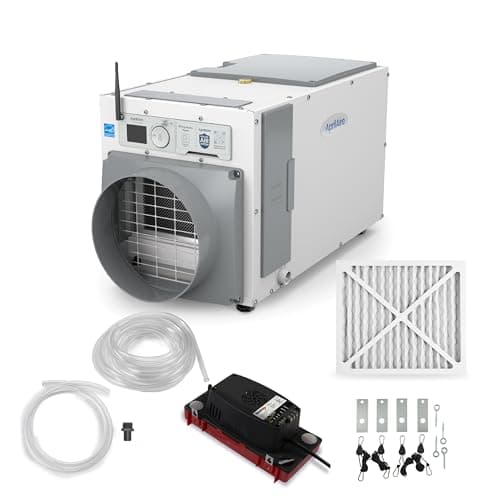
| 1 | Best overall AprilAire E080W Wi-Fi Whole-House Dehumidifier 65 certified pints a day at 2.35 L/kWh and 632 kWh a year, ENERGY STAR Most Efficient, with 10-inch duct collars and a direct drain. | A basement or a sealed crawl space in a house you intend to keep | |
| 2 | 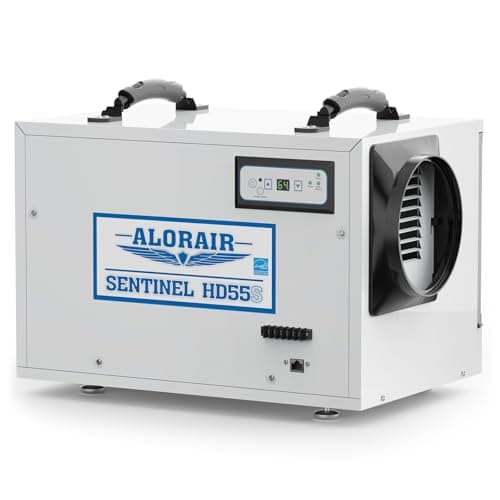 Best for a crawl space AlorAir Sentinel HD55S Crawl Space Dehumidifier 120 pints a day at saturation, 55 at AHAM, ductable both ends, 19 inches wide and 13 tall — it fits where a tall portable cannot. | A sealed crawl space or a basement where the unit can live out of sight | |
| 3 | 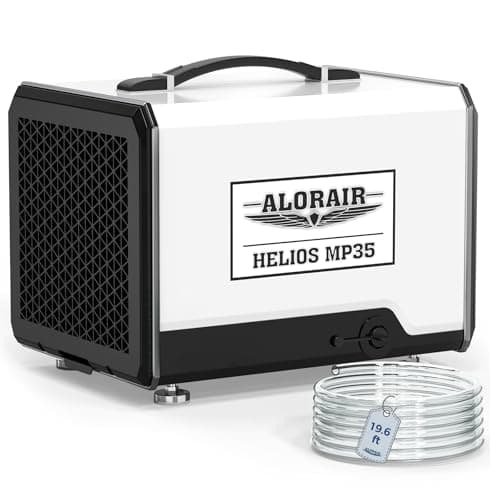 Best with a built-in pump AlorAir Helios MP35 Crawl Space Dehumidifier with Pump 70 pints a day at saturation for 1,000 square feet, with a condensate pump so the water can go up and out rather than down. | A crawl space with no gravity drain below the unit | |
| — | The one to skip for a whole house Vissani Dehumidifier with Built-in Pump, 50 pints/day 49.95 certified pints a day at 2.01 L/kWh with a built-in pump — a good machine that cannot do what a ducted unit does. | One room, not a house — and it is excellent at that |
The field
Twenty-four machines, and what separates them
The ENERGY STAR certified dehumidifier dataset holds 550 records. Only 24 are whole-home units; the other 526 are portables. That is the entire federally measured field, and it is small enough to summarize honestly.
| Class | Records | Capacity, Appendix X1 | IEF range | Median IEF |
|---|---|---|---|---|
| Whole-home | 24 | 52.1 - 172.1 pints/day | 2.22 - 3.26 L/kWh | 2.30 |
| Portable | 526 | up to 50.0 pints/day | 1.70 - 2.24 L/kWh | 2.01 |
Read the two rows together and the case for the class is one sentence: the worst certified whole-home unit is more efficient than all but a handful of portables, and it removes more water. The best of them, a Santa Fe at 3.26 L/kWh, is 62% more efficient than the median portable.
The brands in the certified list are Carrier, Healthy Climate, AprilAire, Honeywell Home, MOISWELL and Santa Fe. Nine of the 24 records carry the Most Efficient 2025 flag; the Honeywell Home and MOISWELL entries sit at the bottom of the range at 2.22 to 2.25 L/kWh.
This one is not a DIY job
Ratings
Why the same machine has two capacities
AprilAire sells the E080 as an 80-pint dehumidifier. The certified dataset lists it at 65 pints a day. Both are true, and the difference is the test condition: the federal Appendix X1 procedure rates at a cooler, drier condition than the saturation and AHAM figures manufacturers prefer to print.
The rule that follows is simple and it saves money: compare certified numbers with certified numbers, and never a saturation figure with an Appendix X1 figure. A “120 pint” crawl space unit and a “65 pint” certified unit may be within a few pints of each other in your house. The same trap appears at the portable end, where the sizing guide explains why yesterday’s 70-pint units are today’s 50-pint ones.
Installation
What ducting actually requires
- A location that can drain. Gravity to a floor drain, sump or standpipe, or a unit with a pump. Plan this before anything else; it decides where the machine goes. The options are in continuous drainage.
- Duct runs at the size the unit specifies. The E080 uses 10-inch collars. Undersized duct throttles airflow and the machine dries less than its rating, quietly.
- A decision about integration. Free-standing in the space it serves, ducted supply only, or tied into the HVAC return. Tying into a furnace return is the tidiest and the one most likely to need a professional.
- A sealed envelope. A whole-home unit dehumidifying a vented crawl space is drying the outdoors. Seal and insulate first, or the machine runs continuously and never wins.
- A power circuit that suits it. These are permanent appliances with cords, not something to run on an extension lead.
Running cost
The certified annual figures
Certified whole-home units publish annual kWh, so the arithmetic is published rather than estimated. The AprilAire E080 is certified at 632 kWh a year — $116 at 18.34¢/kWh. Across the certified whole-home field the annual figures run from about 419 kWh to 2,808 kWh, which is $77 to $515 a year, and the spread tracks capacity rather than inefficiency.
Against a portable at 512 kWh — $94 — the ducted machine costs more to run because it is doing more work, in more of the house. Cost per pint removed is the fair comparison, and that is what IEF measures; the method is in what a dehumidifier costs to run.
Say the unwelcome thing
Do not buy a whole-house dehumidifier for one damp room.
The ducted class exists to serve more space than one machine can reach by standing in it. If the problem is a single basement room, a certified portable with a pump does the same job for a quarter of the money and no ductwork.
Buy ducted when the humidity problem is the house, not the room — multiple levels, a sealed crawl space feeding the floor above, or a whole basement you cannot get air to circulate through. 65 certified pints at 2.35 L/kWh is the efficient way to do that. For one room, a basement portable is the honest answer.
In full
Every pick, and what is wrong with it
Published specifications only, each linked to the page it came from. Where a manufacturer publishes nothing, the row says so — we do not fill blanks in.
1. Best overall
AprilAire E080W Wi-Fi Whole-House Dehumidifier
AprilAire · model E080W
65 certified pints a day at 2.35 L/kWh and 632 kWh a year, ENERGY STAR Most Efficient, with 10-inch duct collars and a direct drain.
AprilAire markets this as an 80-pint machine. The federal Appendix X1 test rates it at 65 pints a day, and that is the number to compare against anything else — the same unit, the same machine, two different conditions. The certified row also gives you what the marketing does not: 2.35 L/kWh and 632 kWh a year, about $116 of electricity annually at 18.34¢/kWh.
That 2.35 puts it in the top group of the certified field and earns the ENERGY STAR Most Efficient 2025 designation, which only nine of the 24 whole-home records hold.
Practically, it is built to disappear. Ten-inch inlet and outlet collars and a backdraft damper mean it can be ducted into supply and return rather than sitting in the room; there is no tray to empty, only a barbed drain fitting; the MERV 8 filter is washable; and the controller is on the unit with Wi-Fi if you want it elsewhere. Coverage is published at up to 4,400 square feet.
One caution on the numbers: AprilAire does not publish a wattage or an airflow figure on the product page, so the running cost here comes from the certified annual kWh rather than from watts times hours.
What’s wrong with it
It is the price of several portables, it needs ducting and a drain, and the product page publishes neither airflow nor wattage.
Running cost — E080W
| Annual energy use | 632 kWh | ENERGY STAR certified figure |
|---|---|---|
| Annual cost | $116 | 632 × 18.34¢/kWh |
| Per cooling month | $29 | spread over a four-month season |
The annual figure is the certified value from the AprilAire product page, E080 — capacity, coverage, ducting, filter and dimensions; certified figures from the ENERGY STAR dehumidifier dataset, which models a standard cooling season rather than your actual summer. It is more useful than a nameplate wattage here, because a variable-speed compressor spends most of its life well below nameplate.
Rate: 18.34¢/kWh, the US average residential price for June 2026 (EIA Electric Power Monthly, Table 5.3). Yours will differ — swap it in: (watts ÷ 1000) × hours × your rate.
| Water removal | 65 pints/day (DOE Appendix X1); AprilAire markets it as 80 |
|---|---|
| Efficiency (IEF) | 2.35 L/kWh |
| Annual energy use | 632 kWh/yr |
| Coverage | Up to 4,400 sq ft |
| Ducting | 10 in inlet and outlet collars, backdraft damper |
| Drain | Direct drain, barbed fitting; no tray |
| Filter | MERV 8, washable, 13.5 x 12 in |
| Refrigerant | R-32 |
| Dimensions | 26 D x 14 W x 15 H in |
| Control | Wi-Fi, onboard digital display |
| ENERGY STAR | Certified, Most Efficient 2025 |
| Power | Not published on the product page |
Every figure above is from AprilAire product page, E080 — capacity, coverage, ducting, filter and dimensions; certified figures from the ENERGY STAR dehumidifier dataset. Blanks are shown as “not published” rather than filled in.
2. Best for a crawl space
AlorAir Sentinel HD55S Crawl Space Dehumidifier
AlorAir · model Sentinel HD55S
120 pints a day at saturation, 55 at AHAM, ductable both ends, 19 inches wide and 13 tall — it fits where a tall portable cannot.
The Sentinel is the shape of the problem it solves: 19.2 wide by 12.2 deep by 13.3 inches high, which slides into a crawl space a portable cannot enter, and it can be ducted at both ends so the air it dries is distributed rather than dumped.
The capacity figures need reading carefully. 120 pints a day is at saturation — a manufacturer condition of high temperature and near-total humidity — and 55 pints is the AHAM figure. Neither is the DOE Appendix X1 number that certified units publish, because AlorAir does not appear in the ENERGY STAR certified dataset at all. There is no IEF, no annual kWh and no wattage on the product page.
What you are buying is coverage to 1,300 square feet, gravity drainage, a six-year warranty, and a form factor that suits the job. What you are giving up is the ability to compare it with anything else on efficiency.
What’s wrong with it
Not federally certified, so no IEF, no annual kWh and no published wattage — and its headline capacity is a saturation figure, not the federal one.
Running cost
AlorAir does not publish a wattage for the Sentinel HD55S, so we cannot calculate what it costs to run. We are not going to estimate one. If AlorAir publishes a nameplate figure, this block will show the arithmetic.
| Water removal | 120 pints/day at saturation, 55 pints/day at AHAM |
|---|---|
| Coverage | Up to 1,300 sq ft |
| Drain | Gravity drain hose |
| Ducting | Ductable inlet and outlet |
| Dimensions | 19.2 W x 12.2 D x 13.3 H in |
| Warranty | 6 years limited |
| ENERGY STAR | Not in the certified dehumidifier dataset |
| Efficiency (IEF) | Not published |
| Power | Not published on the product page |
Every figure above is from AlorAir product page, Sentinel HD55S (white). Blanks are shown as “not published” rather than filled in.
3. Best with a built-in pump
AlorAir Helios MP35 Crawl Space Dehumidifier with Pump
AlorAir · model Helios MP35
70 pints a day at saturation for 1,000 square feet, with a condensate pump so the water can go up and out rather than down.
Gravity drainage assumes somewhere lower than the machine to drain to. In a crawl space, and in plenty of basements, there is not. A built-in pump removes that constraint, pushing condensate up to a sink, a standpipe or outside.
It is the smaller machine of the pair — 70 pints at saturation and coverage to 1,000 square feet — which suits a single crawl space rather than a whole basement level. The same certification caveat applies: no federal record, no IEF, no published wattage, and a six-year warranty doing the reassurance work instead.
If your space does have a floor drain or a sump below the unit, save the money and the extra failure point and buy a gravity model. Pumps are the part that fails first in every category that has them.
What’s wrong with it
A pump is one more thing to fail, coverage is only 1,000 sq ft, and like the Sentinel it publishes no certified efficiency figure.
Running cost
AlorAir does not publish a wattage for the Helios MP35, so we cannot calculate what it costs to run. We are not going to estimate one. If AlorAir publishes a nameplate figure, this block will show the arithmetic.
| Water removal | 70 pints/day at saturation |
|---|---|
| Coverage | Up to 1,000 sq ft |
| Drain | Built-in condensate pump |
| Dimensions | 20.5 x 15.4 x 14.7 in |
| Warranty | 6 years limited |
| ENERGY STAR | Not in the certified dehumidifier dataset |
| Efficiency (IEF) | Not published |
| Power | Not published on the product page |
Every figure above is from AlorAir product page, Helios MP35. Blanks are shown as “not published” rather than filled in.
Skip this one
Vissani Dehumidifier with Built-in Pump, 50 pints/day
Vissani · model VAD50PS1BWTS
49.95 certified pints a day at 2.01 L/kWh with a built-in pump — a good machine that cannot do what a ducted unit does.
This is the unit people actually buy when they search for a whole-house dehumidifier, and on its own terms it is a good one: certified at 49.95 pints a day on the federal test, 2.01 L/kWh, 512 kWh a year, with a pump so it can drain upward.
It is not a whole-house machine, for two structural reasons. It cannot be ducted, so it dries the room it is standing in and relies on air finding its own way from everywhere else. And it caps at 50 pints, because that is where certified portable capacity ends — against 65 to 172 for the ducted class.
Buy it for a basement you spend time in, where you can empty or plumb it and where one open space is the whole problem. Do not buy it expecting it to serve three floors, and do not buy two of them instead of one ducted unit: that is two machines, two drains and two sets of noise in occupied rooms.
What’s wrong with it
No ducting, and 50 pints a day is the ceiling for the entire certified portable class — it cannot serve more than the space it stands in.
Running cost — VAD50PS1BWTS
| Annual energy use | 512 kWh | ENERGY STAR certified figure |
|---|---|---|
| Annual cost | $94 | 512 × 18.34¢/kWh |
| Per cooling month | $23 | spread over a four-month season |
The annual figure is the certified value from the ENERGY STAR Certified Dehumidifiers dataset, which models a standard cooling season rather than your actual summer. It is more useful than a nameplate wattage here, because a variable-speed compressor spends most of its life well below nameplate.
Rate: 18.34¢/kWh, the US average residential price for June 2026 (EIA Electric Power Monthly, Table 5.3). Yours will differ — swap it in: (watts ÷ 1000) × hours × your rate.
| Water removal | 49.95 pints/day (DOE Appendix X1) |
|---|---|
| Efficiency (IEF) | 2.01 L/kWh |
| Annual energy use | 512 kWh/yr |
| Drainage | Built-in pump, plus gravity hose and tank |
| Refrigerant | HFC-32 (GWP 675) |
| Connected | No |
| Noise | Not published in the certified dataset |
| ENERGY STAR | Certified |
Every figure above is from ENERGY STAR Certified Dehumidifiers dataset. Blanks are shown as “not published” rather than filled in.
We are not linking a buy button for this one. If you want to look at it anyway, it is easy enough to find — but we would rather send you to something that fits your room.
Questions people actually ask
Frequently asked
Are whole-house dehumidifiers worth it?
When the problem is more than one room. Certified whole-home units remove 52 to 172 pints a day against a 50-pint ceiling for portables, and run at 2.22 to 3.26 L/kWh against a portable median of 2.01 — more water removed per kilowatt-hour, distributed by duct.
How many whole-house dehumidifiers are ENERGY STAR certified?
Twenty-four records in the current certified dataset, against 526 portables. The brands represented are Carrier, Healthy Climate, AprilAire, Honeywell Home, MOISWELL and Santa Fe, and nine of the 24 carry the Most Efficient 2025 designation.
Why is the same dehumidifier sold as 80 pints and certified at 65?
Different test conditions. Manufacturers often quote saturation or AHAM figures; the federal Appendix X1 procedure rates at a cooler, drier condition. Compare certified numbers only with other certified numbers. Sizing without the marketing numbers.
Does a whole-house dehumidifier have to be ducted?
No. Most can run free-standing in the space they serve, ducted on the supply side only, or tied into an HVAC return. Ducting is what lets one machine serve rooms it is not standing in, which is the reason to buy the class at all.
Can I use two portable dehumidifiers instead?
You can, and it is usually the wrong trade: two machines, two drains, two lots of noise in occupied rooms, and a combined certified capacity still below a mid-size ducted unit. One ducted machine in an unoccupied space is quieter and more efficient.
Sources
Where these numbers came from
- ENERGY STAR Certified Dehumidifiers dataset — 550 records analyzed: 24 whole-home units at 52.1 to 172.1 pints/day and 2.22 to 3.26 L/kWh, against 526 portables capped at 50.0 pints/day and 1.70 to 2.24 L/kWh
- AprilAire product page, E080 — 80-pint marketing capacity, coverage to 4,400 sq ft, 10 in duct collars, backdraft damper, MERV 8 washable filter, direct drain, dimensions
- AlorAir product page, Sentinel HD55S — 120 pints/day at saturation and 55 at AHAM, 1,300 sq ft, gravity drain, dimensions, six-year warranty
- AlorAir product page, Helios MP35 — 70 pints/day at saturation, 1,000 sq ft, built-in pump, dimensions
- EIA Electric Power Monthly, Table 5.3 — average residential electricity price
Read next
Where to go from here
Back to Dehumidifiers, or read how we pick.