The picks
The best PTAC units for a garage conversion, in-law suite or ADU
A converted garage, an in-law suite, a studio over a detached garage: one room that needs its own heating and cooling, with no ductwork reaching it and no outdoor unit anywhere. The hotel-room box solves it, and it is the one air conditioner class with no federal efficiency program at all.
By Sawyer V. · Published
The short answer
For a room up to roughly 450 sq ft, the Klimaire PTHP 12,000 BTU is the pick: a heat pump with automatic electric backup, R-32, and the wall sleeve, grille and drain kit in the box. It fits the standard 42 x 16 inch opening. No PTAC from any brand is ENERGY STAR certified, so nothing here carries a certified efficiency figure.
Fan & Frost earns a commission when you buy through our links, at no cost to you. It never changes a ranking, and we say so when the right answer is the cheaper unit or nothing at all. Full disclosure · How we pick.
At a glance
The picks, ranked
Tap any row to jump to the full reasoning. Prices are live from Amazon where we have them, and read “check price” where we don’t — never a number we cannot verify today.
| # | Product | Best for | Price |
|---|---|---|---|
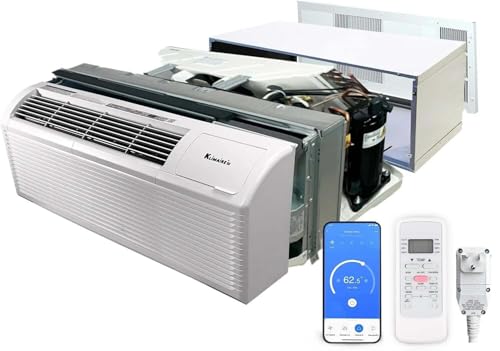
| 1 | Best overall Klimaire PTHP Packaged Terminal Heat Pump, 12,000 BTU A 12,000 BTU heat pump with automatic electric backup, R-32 refrigerant, and the wall sleeve, grille and drain kit supplied. Klimaire is also the only buyable brand here that publishes a model number per capacity. | The common case — a converted garage, an in-law suite or an ADU of roughly 400 to 450 sq ft, where you are cutting a new opening and need the sleeve as well as the unit | |
| 2 | 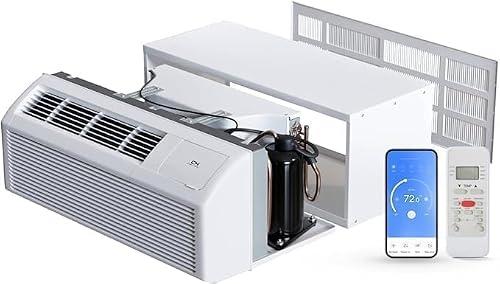 The other complete kit Cooper & Hunter PTAC with Heat Pump, 12,000 BTU 12,000 BTU, heat pump, 3.5 kW electric heater, R-32, with the wall sleeve and grille included and a wireless smart kit built in. | The same room as the Klimaire, when that one is out of stock or the price has moved — same capacity, same class, also supplied with the sleeve and grille | |
| 3 | 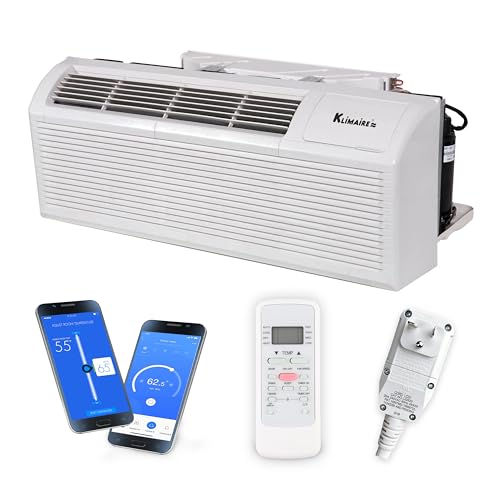 Best for a small room, and the efficient end Klimaire PTHP Packaged Terminal Heat Pump, 9,000 BTU 9,000 BTU, heat pump with electric backup, 3.5 kW heater on a 20 A circuit, R-32. The smallest PTAC in the Klimaire range, and the one to buy if the room genuinely is small. | A single bedroom, a studio or an office conversion up to roughly 350 sq ft — and the capacity that Amana's published data says is the most efficient in the class | |
| 4 | 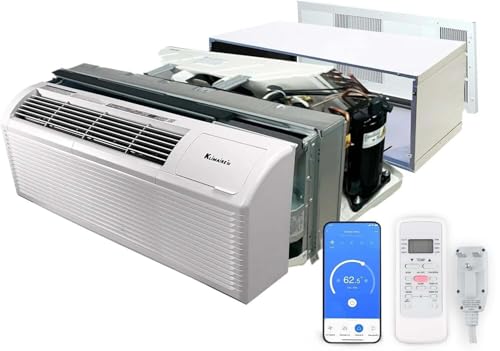 Biggest, and the one that changes the circuit Klimaire PTHP Packaged Terminal Heat Pump, 15,000 BTU with 5 kW Heater 15,000 BTU with a 5 kW electric heater, sleeve and grille included. The extra heat is the point, and it comes with a different electrical requirement rather than a bigger one. | A large open-plan conversion, a poorly insulated garage or a room with a lot of west-facing glass — and only where a 30-amp circuit already exists or is being run | |
| 5 | The only one that publishes its numbers Amana PTH123J Packaged Terminal Heat Pump, 12,000 BTU 12,000 BTU at EER 11.5, 11,000 BTU of heat-pump output at a COP of 3.3, on R-32. The only PTAC on this page with an efficiency figure of any kind attached to it. | Anyone buying through an HVAC contractor or a hotel supplier rather than online — this is what the specification sheet looks like when a PTAC maker is willing to print one | Not sold on Amazon. Amana sells through its own dealers. |
| — | The one to skip Amana PTC123J Packaged Terminal Air Conditioner, Electric Heat Only The same 12,000 BTU chassis as the PTH above, with electric resistance heat instead of a heat pump. Amana publishes no heating capacity for it and no COP, because there is nothing to publish. | A room that already has heat from somewhere else — at which point you are buying a cooling-only box with an emergency element, and should know that is what it is | Not sold on Amazon. Amana sells through its own dealers. |
There is a room this page is for, and it is increasingly common: a garage converted into a studio, an in-law suite behind the kitchen, an accessory dwelling unit over a detached garage. It has its own door, its own occupants and no ductwork from the main house. It needs heating in January and cooling in July, and there is nowhere sensible to put an outdoor unit.
The answer the hotel industry settled on fifty years ago is the PTAC: a packaged terminal air conditioner. One self-contained chassis slides into a steel sleeve through the wall. Half of it is indoors, half is outdoors, and it both heats and cools with nothing else attached.
The finding
There is no ENERGY STAR program for PTACs. At all.
This site ranks room air conditioners on certified figures, because the ENERGY STAR Certified Room Air Conditioners dataset publishes CEER and annual kilowatt-hours for every certified model. We queried it again for this page.
It holds 608 records, in exactly two types: Window and Through the Wall. There is no PTAC type, and not one of the 48 certified brands is a PTAC maker. No Amana, no Klimaire, no Cooper & Hunter, no Gree PTAC line. A search of all 608 records for “PTAC” or “packaged terminal” returns zero rows.
So the method that works everywhere else on this site is unavailable here. There is no certified efficiency figure for any PTAC you can buy, and anybody quoting one is quoting the manufacturer.
Who publishes what
One maker publishes efficiency, and you cannot buy it online
| Unit | Cooling | EER | COP | Heater | Sleeve included |
|---|---|---|---|---|---|
| Amana PTH093J | 9,000 BTU | 12.4 | 3.6 | Not published | No — dealer only |
| Amana PTH123J | 12,000 BTU | 11.5 | 3.3 | Not published | No — dealer only |
| Amana PTH153J | 14,600 BTU | 10.4 | 3.1 | Not published | No — dealer only |
| Amana PTC123J | 11,900 BTU | 11.4 | None — resistance | Not published | No — dealer only |
| Klimaire PTHP 9k | 9,000 BTU | Not published | Not published | 3.5 kW / 20 A | No |
| Klimaire PTHP 12k | 12,000 BTU | Not published | Not published | 3 or 3.5 kW | Yes |
| Klimaire PTHP 15k | 15,000 BTU | Not published | Not published | 5 kW / 30 A | Yes |
| Cooper & Hunter 12k | 12,000 BTU | Not published | Not published | 3.5 kW | Yes |
Amana figures from its own per-model pages, at 230 V. Klimaire figures from its KC-3 series page and the product listings. Cooper & Hunter from the listing, because cooperandhunter.us returns HTTP 403. None of these units is ENERGY STAR certified, because the program does not cover the class.
Read the EER and COP columns down and the shape of this market is obvious. The brand that prints its numbers is the one sold through HVAC contractors and hotel suppliers. The brands on the retail shelf print heater kilowatts, amps, refrigerant and sleeve size — all useful, none of it efficiency.
That is not a reason to avoid them. It is a reason to buy on the figures that are published, and to stop pretending the missing ones can be inferred.
Criteria
What to compare instead, in this order
- Does the sleeve come with it? The sleeve is the structural steel box in the wall. On a new opening, a unit supplied with sleeve, grille and drain kit removes both a cost and a sizing mistake. Two of the four buyable units here include one; two do not.
- Heat pump, or element only? A PTAC heat pump heats at a published COP of around 3.3 where Amana has measured it, with resistance backup for the cold end. A PTAC with element-only heat runs at 1.0 forever. Both are sold at similar prices.
- How many kilowatts, and therefore which circuit? 3.5 kW is a 20-amp circuit; 5 kW is a 30-amp circuit. That is not a preference, it is a different piece of electrical work.
- Is the opening 42 x 16 inches? It almost always is, and that is the quiet strength of this class — a PTAC drops into another brand’s twenty-year-old hole.
- Capacity last, and smaller than you think. Amana’s own ladder shows efficiency falling as capacity rises. Size the room, do not round up.
The arithmetic
What the heating actually costs
Because nobody publishes a seasonal figure for this class, the only honest running-cost statement is the one that comes from physics rather than from a brochure.
Electric resistance heat delivers 3,412 BTU per kilowatt-hour. That is a definition, not a performance claim. At 18.34¢/kWh a kilowatt-hour costs 18¢, so resistance heat costs about 18¢ per 3,412 BTU from any brand, in any box, in any year.
A heat pump moves heat rather than making it. At Amana’s published COP of 3.3 the same kilowatt-hour delivers roughly 11,260 BTU — about a third of the cost for the same warmth, while the outdoor temperature allows it. When it does not, the backup element takes over and you are back to 1.0.
Running the elements themselves: at 18.34¢/kWh, a 3.5 kW element costs 64¢ an hour flat out and a 5 kW element 92¢. Those are the numbers to put against a winter month, not the purchase price difference. Where household energy actually goes.
This one is not a DIY job
If there is already a wall unit in the room, you are probably in the wrong class. A PTAC needs a 42-inch opening. The ordinary through-the-wall air conditioner takes a sleeve of roughly 24-1/2 to 27 inches, which is what most American homes have in a wall. Putting a PTAC into one means cutting the hole nearly twice as wide. Through-the-wall units that also heat, on certified figures, and the cooling-only wall units.
The alternative
Price a mini-split before you cut anything
For a self-contained room with no ductwork, the PTAC’s real competitor is a single-zone mini-split, and the comparison is not close on paper:
- The hole. A PTAC needs a 42 x 16 inch structural opening and a sleeve. A mini-split needs a three-inch penetration for the line set.
- The data. The certified mini-split dataset publishes SEER2, HSPF2, heating capacity at 47 F, 17 F and 5 F, and a coefficient of performance at 5 F, for every one of 18,036 records. PTACs have none of that.
- The install. A PTAC is a carpentry job plus a circuit. A mini-split is a refrigerant job, which usually means a contractor.
- Where the PTAC wins. There is no outdoor unit to site, nothing on an exterior wall to look at or protect, and the whole thing can be swapped in twenty minutes when it eventually dies. In a rental or a short-term let, that last point is the entire argument.
Cold-climate mini-splits, on certified output at 5 degrees, and what one costs to run.
Install
Four measurements, before anything is bought
- The opening: 42 inches wide by 16 inches high. If you are replacing an existing PTAC, measure the sleeve you have rather than trusting the class standard.
- The wall depth. Amana’s standard sleeve is 14-1/8 inches deep and it sells extra-deep versions for thicker walls. A chassis in too shallow a sleeve will not drain correctly.
- The circuit: 20 A for 3.5 kW, 30 A for 5 kW, at 208–230 V. This is an electrician’s job and it should be priced before the unit is.
- The drain. PTACs are designed to slinger-sling condensate onto the outdoor coil and evaporate most of it, but a drain kit still matters on a humid site. The Klimaire units include one. Where air conditioner water goes.
Say the unwelcome thing
Do not buy a PTAC for a bedroom inside the main house.
Two reasons, and the first is the hole. A 42-inch structural opening through an exterior wall of a finished house is a serious piece of carpentry for a single room, and it is not reversible in any cheap way.
The second is noise. A PTAC puts the compressor inside the room, a few feet from a bed, and not one unit on this page publishes a decibel or sone figure — not the retail brands and not Amana. For a bedroom in a house with ductwork or an existing wall sleeve, start with the quiet air conditioners that do publish a noise figure. The PTAC earns its place where the room is effectively a separate dwelling.
In full
Every pick, and what is wrong with it
Published specifications only, each linked to the page it came from. Where a manufacturer publishes nothing, the row says so — we do not fill blanks in.
1. Best overall
Klimaire PTHP Packaged Terminal Heat Pump, 12,000 BTU
Klimaire · model PTHP12H352-KC-3 (KC-3 series)
A 12,000 BTU heat pump with automatic electric backup, R-32 refrigerant, and the wall sleeve, grille and drain kit supplied. Klimaire is also the only buyable brand here that publishes a model number per capacity.
12,000 BTU of cooling, heat-pump heating with a built-in electric resistance backup that engages automatically, R-32 refrigerant, 208–230 V. Klimaire’s own words for the backup behaviour are worth quoting, because this is the detail that separates a PTAC heat pump from a PTAC with a heating element: it “automatically engages built-in electric resistance backup heat when additional heating is required”.
The wall sleeve, the rear grille and the drain kit are all in the box. On a new opening that matters more than it sounds. The sleeve is the structural steel box the chassis slides into; buying it separately is both an extra cost and an extra chance to order the wrong one.
It fits most standard 42 x 16 inch wall openings, which is Klimaire’s claim and the single most useful compatibility fact in this category — it means a PTAC from one maker drops into another maker’s old hole. What cutting a wall opening involves.
Control is unusually flexible for the money: the on-unit digital panel, the included wireless remote, or standard 24 V thermostat wiring, with Wi-Fi as an option. The 24 V option is the one that makes it usable in a real dwelling rather than a hotel room — it lets a normal wall thermostat run it.
What’s wrong with it
No EER and no COP is published for any Klimaire PTAC, so its efficiency cannot be compared with anything — not even with its own 9,000 BTU sibling. The listing says a 3 kW heater while Klimaire's own series table says 3.5 kW at 20 A for this capacity, and nothing reconciles the two.
Running cost
Klimaire does not publish a wattage for the PTHP12H352-KC-3 (KC-3 series), so we cannot calculate what it costs to run. We are not going to estimate one. If Klimaire publishes a nameplate figure, this block will show the arithmetic.
| Cooling capacity | 12,000 BTU/h |
|---|---|
| Heating | Heat pump, with built-in electric resistance backup that engages automatically |
| Electric heater | 3 kW on the listing; Klimaire's KC-3 series table gives 3.5 kW at 20 A for the 12,000 BTU model. The two disagree |
| Voltage | 208 - 230 V |
| Refrigerant | R-32 |
| Wall opening | Fits most standard 42 x 16 in openings |
| In the box | Wall sleeve, grille, drain kit, wireless remote |
| Control | On-unit digital panel, wireless remote, or standard 24 V thermostat wiring. Wi-Fi optional |
| EER | Not published |
| COP | Not published |
| Noise | Not published |
Every figure above is from Klimaire PTHP-KC-3 series page plus the product listing — R-32, 208-230 V, heat pump with automatic electric backup, fits most standard 42 x 16 in wall openings, 24 V thermostat compatible; the series table lists PTHP12H352-KC-3 at 3.5 kW / 20 A while the listing says 3 kW. Klimaire publishes no EER or COP for any PTAC model. Blanks are shown as “not published” rather than filled in.
2. The other complete kit
Cooper & Hunter PTAC with Heat Pump, 12,000 BTU
Cooper & Hunter · model Not stated on the listing (12,000 BTU / 1 ton PTAC)
12,000 BTU, heat pump, 3.5 kW electric heater, R-32, with the wall sleeve and grille included and a wireless smart kit built in.
12,000 BTU (1 ton), heat pump, 3.5 kW electric heater, R-32, with the wall sleeve and grille included and a power cord fitted. On the figures the listing gives, this is the same machine as the Klimaire in a different shell.
The wireless smart kit is built in rather than optional, which is the one specification where it is ahead of the Klimaire at this capacity — Klimaire sells Wi-Fi as an option on the KC-3 series.
Cooper & Hunter’s 15,000 BTU listing publishes a chassis size of 42 x 21 x 16 inches, which is the clearest confirmation anywhere in this category that the 42-inch width is the class standard rather than one brand’s choice.
What is missing is the maker. cooperandhunter.us returns 403 to automated access, so there is no specification page behind any of this, no amp figure, and no warranty term. For a 1,000-dollar appliance that is a real gap, and it is why this sits second rather than first. How we pick.
What’s wrong with it
Cooper & Hunter's US site returns HTTP 403 to automated access, so every figure here comes from the listing and nothing could be verified against a manufacturer page — no voltage, no amps, no warranty term, and no model number anywhere on the listing.
Running cost
Cooper & Hunter does not publish a wattage for the Not stated on the listing (12,000 BTU / 1 ton PTAC), so we cannot calculate what it costs to run. We are not going to estimate one. If Cooper & Hunter publishes a nameplate figure, this block will show the arithmetic.
| Cooling capacity | 12,000 BTU/h (1 ton) |
|---|---|
| Heating | Heat pump |
| Electric heater | 3.5 kW |
| Refrigerant | R-32 |
| In the box | Wall sleeve, grille, power cord, wireless smart kit |
| Chassis | 42 x 21 x 16 in (W x D x H) on the 15,000 BTU sibling's listing |
| Voltage | Not published on the listing |
| Amps | Not published on the listing |
| EER | Not published |
| COP | Not published |
| Noise | Not published |
| Warranty | Not published on the listing |
Every figure above is from Cooper & Hunter 12,000 BTU PTAC product listing — 1 ton, heat pump, R-32, 3.5 kW electric heater, wireless smart kit, sleeve and grille included. cooperandhunter.us returns HTTP 403 to automated access, so no manufacturer specification could be verified. Blanks are shown as “not published” rather than filled in.
3. Best for a small room, and the efficient end
Klimaire PTHP Packaged Terminal Heat Pump, 9,000 BTU
Klimaire · model PTHP09H352-KC-3 (KC-3 series)
9,000 BTU, heat pump with electric backup, 3.5 kW heater on a 20 A circuit, R-32. The smallest PTAC in the Klimaire range, and the one to buy if the room genuinely is small.
9,000 BTU, 3.5 kW electric heater at 20 A, 208–230 V, R-32, model PTHP09H352-KC-3. Same series, same backup-heat behaviour, same 42 x 16 inch opening as the 12,000 BTU unit above.
The reason to take the smaller unit is in somebody else’s data. Amana is the only PTAC maker publishing efficiency per model, and across its heat-pump line the figures fall steadily as capacity rises: EER 12.4 at 9,000 BTU, 11.5 at 12,000, 10.4 at 14,600, with COP going 3.6, 3.3, 3.1 the same way. Nothing suggests Klimaire behaves differently.
So oversizing a PTAC costs twice: once in the purchase, and then every month in a worse efficiency figure for air the room did not need. How to size the room properly, and the BTU chart by room size.
Check the sleeve before you order. If you are replacing an existing PTAC the old sleeve usually stays; if you are cutting a new hole, budget for a sleeve and grille that this listing does not include.
What’s wrong with it
This listing does NOT include the wall sleeve or grille — unlike the 12,000 and 15,000 BTU Klimaire listings, which do. On a new opening that is an extra purchase and an extra way to get the fit wrong.
Running cost
Klimaire does not publish a wattage for the PTHP09H352-KC-3 (KC-3 series), so we cannot calculate what it costs to run. We are not going to estimate one. If Klimaire publishes a nameplate figure, this block will show the arithmetic.
| Cooling capacity | 9,000 BTU/h |
|---|---|
| Heating | Heat pump, with built-in electric resistance backup that engages automatically |
| Electric heater | 3.5 kW at 20 A |
| Voltage | 208 - 230 V |
| Refrigerant | R-32 |
| Wall opening | Fits most standard 42 x 16 in openings |
| In the box | Remote control, drain kit. This listing does NOT include the wall sleeve or grille |
| EER | Not published |
| COP | Not published |
| Noise | Not published |
Every figure above is from Klimaire PTHP-KC-3 series page plus the product listing — PTHP09H352-KC-3 at 3.5 kW and 20 A, R-32, 208-230 V, heat pump with automatic electric backup, fits most standard 42 x 16 in openings. No EER or COP is published. Blanks are shown as “not published” rather than filled in.
4. Biggest, and the one that changes the circuit
Klimaire PTHP Packaged Terminal Heat Pump, 15,000 BTU with 5 kW Heater
Klimaire · model PTHP15H502-KC-3 (KC-3 series)
15,000 BTU with a 5 kW electric heater, sleeve and grille included. The extra heat is the point, and it comes with a different electrical requirement rather than a bigger one.
15,000 BTU, 5 kW electric heater, 30 A, 208–230 V, R-32, model PTHP15H502-KC-3, with the sleeve, grille and drain kit included.
Klimaire sells the same 15,000 BTU capacity with a 3.5 kW heater on 20 A as well, and that distinction is the one to get right before you buy. The cooling is identical. What you are choosing is how much resistance heat is available when the heat pump cannot keep up — and whether the room gets a 20 A or a 30 A circuit.
A 5 kW element is roughly 17,000 BTU/h of resistance heat by the standard conversion, which is more heat than the unit makes in cooling. At 18.34¢/kWh that element costs about 92¢ an hour when it is running flat out, against roughly 64¢ for a 3.5 kW one.
Buy it for a genuinely large or leaky space. For a bedroom it is the wrong end of every trade-off on this page. The circuit arithmetic.
What’s wrong with it
The 5 kW heater needs a 30 A circuit against 20 A for every 3.5 kW model here, which is an electrician and possibly a panel conversation. Amana's published ladder also says this capacity is the least efficient in the class, at EER 10.4 against 12.4 for a 9,000 BTU unit.
Running cost
Klimaire does not publish a wattage for the PTHP15H502-KC-3 (KC-3 series), so we cannot calculate what it costs to run. We are not going to estimate one. If Klimaire publishes a nameplate figure, this block will show the arithmetic.
| Cooling capacity | 15,000 BTU/h |
|---|---|
| Heating | Heat pump, with built-in electric resistance backup that engages automatically |
| Electric heater | 5 kW at 30 A |
| Voltage | 208 - 230 V |
| Refrigerant | R-32 |
| Wall opening | Fits most standard 42 x 16 in openings |
| In the box | Wall sleeve, grille, drain kit, wireless remote |
| Circuit | 30 A, against 20 A for the 3.5 kW models. A different circuit, not a bigger one |
| EER | Not published |
| COP | Not published |
| Noise | Not published |
Every figure above is from Klimaire PTHP-KC-3 series page plus the product listing — PTHP15H502-KC-3 at 5 kW and 30 A, R-32, 208-230 V, fits most standard 42 x 16 in openings. A 3.5 kW / 20 A version of the same capacity is also sold. No EER or COP is published. Blanks are shown as “not published” rather than filled in.
5. The only one that publishes its numbers
Amana PTH123J Packaged Terminal Heat Pump, 12,000 BTU
Amana · model PTH123J
12,000 BTU at EER 11.5, 11,000 BTU of heat-pump output at a COP of 3.3, on R-32. The only PTAC on this page with an efficiency figure of any kind attached to it.
12,000 / 11,600 BTU/h of cooling at EER 11.5 / 11.5, and 11,000 / 10,800 BTU/h of heating at a COP of 3.3 / 3.3, at 230 V / 208 V, on R-32. Read that against every other card on this page, where the EER row and the COP row both say “Not published”.
A COP of 3.3 is the whole argument for a heat pump. It means 3.3 units of heat out for one unit of electricity in, while the outdoor temperature allows. Resistance heat is exactly 1.0, by definition, from every brand forever. Amana publishes the one figure and declines to publish the other, which is itself informative.
The sleeve is a WS900QW at 42 x 16-1/16 x 14-1/8 inches, which is where the 42 x 16 inch opening every other maker quotes actually comes from.
It is on this page because it is the benchmark, not because you can click it. If you are getting a quote from an HVAC contractor, ask for the model number and look it up — Amana will tell you what it does. The smaller-sleeve wall units, where the certified data does exist.
What’s wrong with it
You cannot buy it here. Amana sells the J-series through dealers; every Amazon listing carrying the Amana name is either the 'Distinctions by Amana' sub-brand, which does not appear on Amana's own site at all, or a K-series order number with no page behind it. There is no buy link on this card, deliberately.
Running cost
Amana does not publish a wattage for the PTH123J, so we cannot calculate what it costs to run. We are not going to estimate one. If Amana publishes a nameplate figure, this block will show the arithmetic.
| Cooling capacity | 12,000 / 11,600 BTU/h at 230 V / 208 V |
|---|---|
| EER | 11.5 / 11.5 |
| Heating capacity | 11,000 / 10,800 BTU/h (Amana's 'Rev Capacity') |
| COP | 3.3 / 3.3 |
| Voltage | 230 V / 208 V |
| Refrigerant | R-32 |
| Efficiency class | Standard efficiency (Amana also sells an HEH high-efficiency line) |
| Wall sleeve | WS900QW, 42 x 16-1/16 x 14-1/8 in |
| Amps | Not published |
| Electric heater kW | Not published on the model page |
| Noise | Not published |
| Warranty | 5 year parts limited warranty badge; terms in a linked PDF |
Every figure above is from Amana PTH123J product page — 12,000 / 11,600 BTU/h nominal capacity, EER 11.5 / 11.5, Rev Capacity 11,000 / 10,800 BTU/h, COP 3.3 / 3.3, 230/208 V, R-32; wall sleeve dimensions from Amana's PTAC accessories page. Blanks are shown as “not published” rather than filled in.
Amazon does not carry this model. Amana sells it through its own dealers, and we have no affiliate relationship there — so there is no buy button here rather than one that earns us nothing. The figures above are the manufacturer’s published or certified ones, and the source is cited below them.
Skip this one
Amana PTC123J Packaged Terminal Air Conditioner, Electric Heat Only
Amana · model PTC123J
The same 12,000 BTU chassis as the PTH above, with electric resistance heat instead of a heat pump. Amana publishes no heating capacity for it and no COP, because there is nothing to publish.
The PTC and the PTH are the same box. The cooling figures are nearly identical — 11,900 / 11,700 BTU/h at EER 11.4 / 11.5 against 12,000 / 11,600 at EER 11.5 — and they take the same sleeve.
The difference is the heating, and the clearest evidence is what Amana does not print. The PTC123J page has no heating capacity field and no COP field at all, where the PTH123J page carries both. That is not an oversight: a resistance element has nothing interesting to say.
The arithmetic, which is ours and is trivial. Electric resistance heat delivers 3,412 BTU per kilowatt-hour by definition, so at 18.34¢/kWh it costs about 18¢ per 3,412 BTU from any brand in any box. A heat pump at a published COP of 3.3 delivers roughly 11,260 BTU for the same kilowatt-hour.
Buy the electric-heat version only if the room is heated some other way and you want the element purely as a backstop. For a room where this box is the heating, the heat pump pays for itself every cold month. What a heat pump is, and when it stops being one.
What’s wrong with it
Electric resistance heat delivers 3,412 BTU per kilowatt-hour and cannot deliver more. Against the heat pump version's published COP of 3.3, that is roughly three times the running cost for the same warmth, from a unit that costs about the same to buy.
Running cost
Amana does not publish a wattage for the PTC123J, so we cannot calculate what it costs to run. We are not going to estimate one. If Amana publishes a nameplate figure, this block will show the arithmetic.
| Cooling capacity | 11,900 / 11,700 BTU/h at 230 V / 208 V |
|---|---|
| EER | 11.4 / 11.5 |
| Heating | Electric resistance only. No heat pump |
| Heating capacity | Not published. The model page has no heating output field at all |
| COP | Not published, and cannot be: resistance heat is 1.0 by definition |
| Voltage | 230 V / 208 V |
| Refrigerant | R-32 |
| Wall sleeve | WS900QW, 42 x 16-1/16 x 14-1/8 in |
| Noise | Not published |
Every figure above is from Amana PTC123J product page — 11,900 / 11,700 BTU/h nominal capacity, EER 11.4 / 11.5, 230/208 V, R-32, Electric Heat Only, with no heating capacity or COP field published. Blanks are shown as “not published” rather than filled in.
We are not linking a buy button for this one. If you want to look at it anyway, it is easy enough to find — but we would rather send you to something that fits your room.
Questions people actually ask
Frequently asked
What is the best PTAC unit?
For a room up to roughly 450 sq ft, the Klimaire PTHP 12,000 BTU: a heat pump with automatic electric backup, R-32, and the wall sleeve, grille and drain kit in the box. Cooper & Hunter's 12,000 BTU unit is the same class and also ships with a sleeve. Neither publishes an efficiency figure, because no PTAC maker on the retail shelf does.
Are PTAC units ENERGY STAR certified?
No, and none can be. The ENERGY STAR Certified Room Air Conditioners dataset holds 608 records in two types only — Window and Through the Wall — and not one of its 48 certified brands is a PTAC maker. There is no PTAC program, so there is no certified efficiency figure for any packaged terminal unit from any brand.
What size opening does a PTAC need?
42 inches wide by 16 inches high is the class standard, and it is why a PTAC from one brand drops into another brand's old sleeve. Amana's own WS900QW sleeve is 42 x 16-1/16 x 14-1/8 inches, and Cooper & Hunter publishes a 42 x 21 x 16 inch chassis. Measure the sleeve you actually have before ordering. Cutting and fitting a wall opening.
PTAC heat pump or electric heat — which should I buy?
The heat pump, if the unit is the room's actual heating. Amana publishes a COP of 3.3 for its 12,000 BTU heat-pump PTAC and publishes no heating figure at all for the electric-heat version of the same chassis, because resistance heat is 1.0 by definition. That is roughly three times the running cost for the same warmth, at a similar purchase price. Heat pump against air conditioner.
What circuit does a PTAC need?
It depends on the heater, not the cooling. A 3.5 kW element is a 20-amp circuit and a 5 kW element is a 30-amp circuit, both at 208 to 230 volts. That is the single biggest hidden cost in this category and it should be priced by an electrician before the unit is ordered. The circuit arithmetic.
Is a PTAC or a mini-split better for an ADU?
A mini-split is the better machine on paper — a three-inch hole instead of a 42-inch one, and a certified dataset publishing SEER2, HSPF2 and heating capacity down to 5 F for 18,036 models. The PTAC wins on there being no outdoor unit to site, and on being swappable in twenty minutes when it fails, which matters in a rental. Cold-climate mini-splits.
How much does PTAC heating cost to run?
For the resistance element, exactly what resistance heat costs anywhere: 3,412 BTU per kilowatt-hour, which is about 17 cents per 3,412 BTU at the national average rate. A 3.5 kW element flat out is roughly 60 cents an hour and a 5 kW element about 86 cents. In heat-pump mode at Amana's published COP of 3.3, the same kilowatt-hour delivers about 11,260 BTU instead.
Can I put a PTAC in a standard through-the-wall sleeve?
No. A PTAC needs a 42-inch opening; the ordinary through-the-wall air conditioner takes a sleeve of roughly 24-1/2 to 27 inches, which is what most American houses have. Fitting a PTAC to one means widening the hole by about 15 inches through an exterior wall. Wall units that fit the smaller sleeve.
Sources
Where these numbers came from
- ENERGY STAR Certified Room Air Conditioners dataset — 608 records across 48 brands in two types, Window and Through the Wall; zero rows matching PTAC or packaged terminal, and no PTAC manufacturer among the certified brands
- Amana PTH123J product page — 12,000 / 11,600 BTU/h, EER 11.5 / 11.5, Rev Capacity 11,000 / 10,800 BTU/h, COP 3.3 / 3.3, 230/208 V, R-32
- Amana PTH093J and PTH153J product pages — EER 12.4 and 10.4, COP 3.6 and 3.1, for the capacity-against-efficiency ladder
- Amana PTC123J product page — 11,900 / 11,700 BTU/h at EER 11.4 / 11.5, Electric Heat Only, with no heating capacity field and no COP field published
- Amana PTAC wall sleeve page — WS900QW at 42 in W x 16-1/16 in H x 14-1/8 in D, plus extra-deep and sound-isolating variants
- Klimaire PTHP-KC-3 series page — model numbers PTHP09H352-KC-3, PTHP12H352-KC-3, PTHP15H352-KC-3 and PTHP15H502-KC-3 with their heater kW and amps, R-32, 208-230 V, heat pump with automatic electric resistance backup, fits most standard 42 x 16 in wall openings, 24 V thermostat compatible
- Cooper & Hunter 12,000 BTU PTAC product listing — 1 ton, heat pump, R-32, 3.5 kW electric heater, sleeve and grille included; the brand's US site returns HTTP 403 to automated access
- EIA Electric Power Monthly, Table 5.3 — electricity rate
Read next
Where to go from here
Back to Air Conditioners, or read how we pick.