Head to head
Solar attic fan vs electric attic fan
The running cost difference is real and small. The differences that matter are wiring, control and what happens at five in the afternoon.
By Sawyer V. · Published
The short answer
Solar saves the wiring, not the ventilation problem. A 1,150 CFM solar fan needs no circuit and costs nothing to run; a 1,600 CFM electric one runs on a thermostat whatever the sky is doing, for about 25¢ an eight-hour day at 18.34¢/kWh. Both need 0.48 square inches of net free intake per CFM, and neither works without it.
Fan & Frost earns a commission when you buy through our links, at no cost to you. It never changes a ranking, and we say so when the right answer is the cheaper unit or nothing at all. Full disclosure · How we pick.
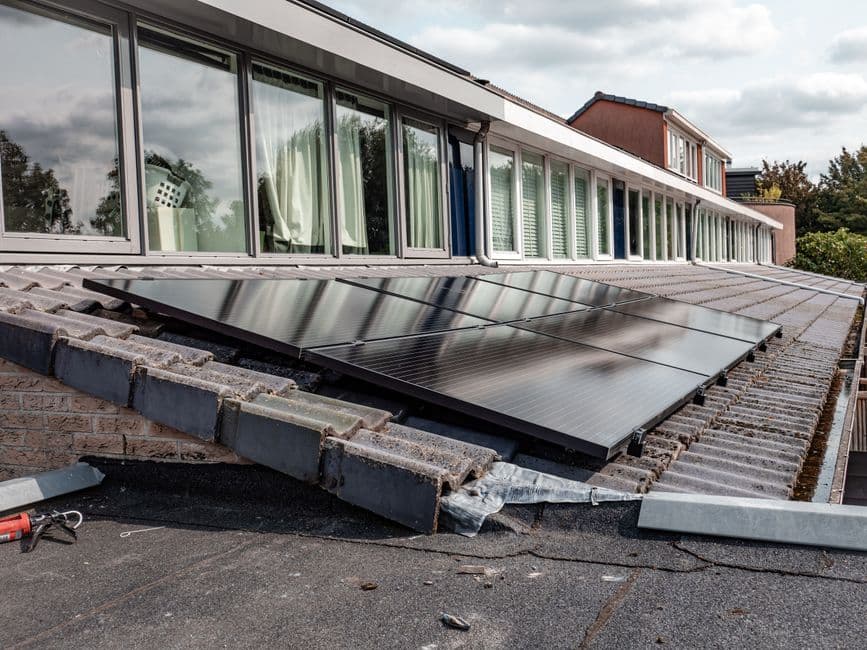
At a glance
The picks, ranked
Tap any row to jump to the full reasoning. Prices are live from Amazon where we have them, and read “check price” where we don’t — never a number we cannot verify today.
| # | Product | Best for | Price |
|---|---|---|---|
| 1 | 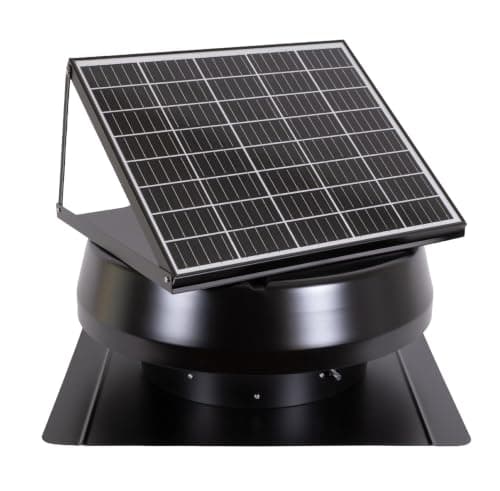 The solar case iLIVING 14" Solar Roof Attic Exhaust Fan 1,150 CFM from a 40 W panel with a thermostat, no wiring and no running cost — and a 15-year warranty. | An attic with no circuit nearby, or a roof where running cable is the hard part | |
| 2 | 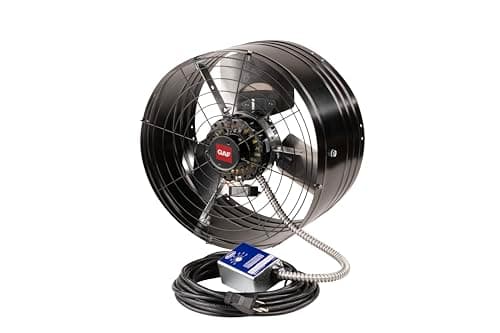 The electric case Maxx Air Premium 1,600 CFM Gable-Mount Power Attic Ventilator 1,600 CFM on demand through an existing gable opening — more airflow, full thermostat control, no roof penetration. | A house with an existing gable vent and power in the attic |
What solar saves
The running cost is not the reason
Attic ventilators are not big consumers. A residential unit draws in the region of 100 to 200 W while running, and it only runs on hot afternoons. Over a summer that is a few dollars, not a few hundred.
So the solar premium buys three specific things:
- No electrical work. No circuit, no switch, no electrician, no permit for wiring.
- Nothing on the meter, which matters more for people tracking a net-zero or off-grid setup than for the bill.
- Independence from the panel. It keeps ventilating during an outage, which is the one time an attic can get genuinely dangerous to work in.
This one is not a DIY job
Neither escapes it
Both need the same intake
The rule manufacturers publish is 0.48 square inches of net free soffit area per CFM. That applies to a solar fan exactly as it applies to a mains one:
- 1,150 CFM solar needs 552 square inches, 3.8 square feet.
- 1,600 CFM electric needs 768 square inches, 5.3 square feet.
Short of that, either fan makes up the difference by pulling conditioned air out of the house below — which is the failure mode explained in attic intake versus exhaust, and the reason a smaller fan matched to real intake beats a larger one that is starved.
Installation
Where each one goes
| Solar | Electric | |
|---|---|---|
| Published airflow | 1,150 CFM | 1,600 CFM |
| Runs after sunset | No | Yes |
| Needs a circuit | No | Yes |
| Roof penetration | Yes, roof-mounted | No, if gable-mounted |
| Running cost | None | 25¢ per 8 hours |
| Thermostat | Yes, 50 to 130 F | Yes, typically |
| Warranty | 15 years | Varies by maker |
| Intake required | 3.8 sq ft | 5.3 sq ft |
The roof-penetration row is the one that surprises people. Solar fans are almost always roof-mounted, because the panel wants sky; electric fans are commonly gable-mounted, because the wiring can come to them. So the “easier” option is the one that cuts your roof, which is the trade laid out in gable versus roof mount.
Verdict
Which to buy
- Solar when there is no power in the attic, when the roof already needs work, or when the house is off-grid or solar-minded. Check the aspect before you buy: shade on the panel is the failure nobody plans for.
- Electric when a gable vent and a circuit already exist. More airflow, full control, no new hole in the weather surface.
- Neither until the soffits are clear. Both fans are limited by intake, and clearing blocked eaves is free.
Say the unwelcome thing
Do not buy solar for the electricity saving.
An attic fan running eight hours on a hot day costs about 25¢. Across a season that is a rounding error against the purchase price difference, so a payback calculation built on running cost will not come out in solar’s favor.
Buy solar to avoid running a circuit, not to avoid paying for electricity. Where the wiring is the obstacle, 1,150 CFM from a 40 W panel removes it entirely. Where a gable vent and power already exist, 1,600 CFM with no roof penetration is the better ventilator.
In full
Every pick, and what is wrong with it
Published specifications only, each linked to the page it came from. Where a manufacturer publishes nothing, the row says so — we do not fill blanks in.
1. The solar case
iLIVING 14" Solar Roof Attic Exhaust Fan
iLIVING · model ILG8SF301
1,150 CFM from a 40 W panel with a thermostat, no wiring and no running cost — and a 15-year warranty.
The argument for solar is not the electricity saved. An electric attic fan costs a few dollars a season to run. The argument is that there is no circuit to install, which on many houses is the difference between a morning’s work and an electrician’s visit.
This one publishes 1,150 CFM from a 40 W adjustable panel, with a thermostat that can be set between 50 and 130°F and a 15-year warranty — unusually long in a category where motors are consumables.
The honest limitation: output follows the sun. On the hottest, clearest afternoons it is at its best, which is convenient. Under cloud, in late afternoon, or with a tree that has grown since installation, it slows down exactly when you might still want it.
What’s wrong with it
Airflow depends on sunlight, the panel needs a clear southern aspect, and it is a roof-mounted unit, so installing it means cutting and flashing the deck.
Running cost
iLIVING does not publish a wattage for the ILG8SF301, so we cannot calculate what it costs to run. We are not going to estimate one. If iLIVING publishes a nameplate figure, this block will show the arithmetic.
| Air delivery | 1,150 CFM |
|---|---|
| Fan diameter | 14 in |
| Solar panel | 40 W, adjustable tilt |
| Motor | Brushless, IP68 rated |
| Thermostat | Adjustable, 50 - 122 degrees F |
| Coverage claim | Up to 2,900 sq ft |
| Dimensions | 23.5 x 23.5 x 10.5 in |
| Weight | 32 lb |
| Warranty | 15 years |
| Noise | Not published |
| ENERGY STAR | No program exists for attic ventilators |
Every figure above is from iLiving USA product page, ILG8SF301. Blanks are shown as “not published” rather than filled in.
2. The electric case
Maxx Air Premium 1,600 CFM Gable-Mount Power Attic Ventilator
Maxx Air · model CX1600 BLU
1,600 CFM on demand through an existing gable opening — more airflow, full thermostat control, no roof penetration.
An electric fan does not care about the sky. It runs when the thermostat says so, at full output, including the hour after sunset when a roof is still radiating the day’s heat into the attic.
1,600 CFM is also more air than the solar unit moves at its best, and mounted in an existing gable vent it makes no new roof penetration — a genuine advantage over any roof-mounted fan, solar or not.
Running cost is real but small. At a typical attic-fan draw of around 170 W, eight hours is 25¢ and a 60-day season of that is about $15 at 18.34¢/kWh.
What’s wrong with it
It needs a circuit in the attic, it costs something to run every hour it runs, and if the wiring is not already there the install gets expensive.
Running cost
Maxx Air does not publish a wattage for the CX1600 BLU, so we cannot calculate what it costs to run. We are not going to estimate one. If Maxx Air publishes a nameplate figure, this block will show the arithmetic.
| Air delivery | 1,600 CFM |
|---|---|
| Mount | Gable |
| Blade | 14 in |
| Motor | 1/10 HP, 3.3 A at 120 V, 60 Hz |
| Thermostat | Adjustable, 50 - 120 degrees F, pre-wired |
| Humidistat | Not included; XXDUOSTAT thermostat/humidistat sold separately |
| Coverage claim | Attics up to 2,400 sq ft |
| Dimensions | 15 H x 15 W x 5.875 D in |
| Weight | 12 lb |
| Warranty | 2 years, limited |
| Noise | Not published |
| ENERGY STAR | No program exists for attic ventilators |
Every figure above is from Maxx Air product page, CX1600 BLU premium gable-mount power attic ventilator. Blanks are shown as “not published” rather than filled in.
Questions people actually ask
Frequently asked
Are solar attic fans worth it?
Where there is no circuit in the attic, yes — they remove the electrical work entirely and keep running in an outage. As an energy saving they are hard to justify: an electric attic fan costs only a few dollars a season to run.
Do solar attic fans work on cloudy days?
They slow down with available sunlight, so output falls under cloud and in late afternoon. Hybrid-ready models accept an AC supply as a backup, which brings back the wiring the format was chosen to avoid.
How much does an electric attic fan cost to run?
At a typical 170-watt draw, about 25 cents for an eight-hour day at the national average rate, or roughly $15 across a 60-day stretch of hot afternoons. It only runs when the thermostat calls for it.
Do solar attic fans need soffit vents?
Exactly as much as mains-powered ones: 0.48 square inches of net free intake per CFM, so 552 square inches for a 1,150 CFM fan. Solar changes the power source, not the air that has to come in from somewhere. The intake arithmetic.
Is a roof-mounted solar fan a leak risk?
Any roof penetration is, which is the honest cost of the format — solar fans need sky, so they mount on the roof. If your house has a usable gable vent, an electric fan behind it avoids cutting the weather surface at all. Gable vs roof mount.
Sources
Where these numbers came from
- iLiving USA product page, ILG8SF301 — 1,150 CFM, 40 W adjustable solar panel, thermostat range 50 to 130 F, 15-year warranty
- Maxx Air product page, CX1600 — 1,600 CFM gable-mount power attic ventilator
- Broan-NuTone attic ventilation FAQ — 0.48 square inches of soffit intake per CFM, which applies to both power sources
- EIA Electric Power Monthly, Table 5.3 — average residential electricity price
Read next
Where to go from here
Back to Whole-House Airflow, or read how we pick.