The picks
The best drum fans, on published airflow and decibels
This is the one fan category where the numbers are all published, and they settle the question in both directions: the most air per watt on this site, and the loudest thing on it.
By Sawyer V. · Published
The short answer
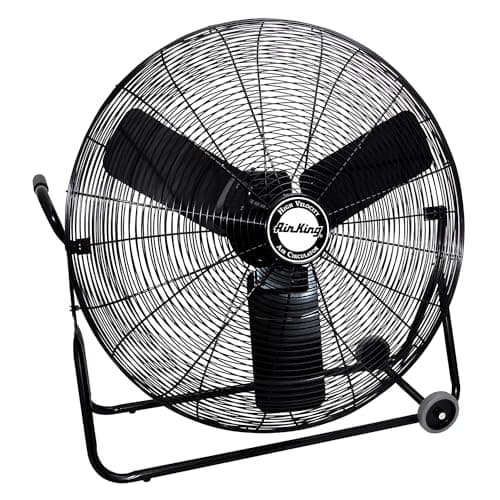
The Air King 9230, at 7,400 CFM on 255 W — 29.0 CFM per watt on high and 32.3 on low, which is the highest airflow-per-watt figure of any air mover on this site outside the ceiling fan category. It is also the loudest: 75 dB on high, published. For a garage, workshop, barn or covered patio this is the right machine. For any room you sit in, it is not, and the decibel figure is why.
Fan & Frost earns a commission when you buy through our links, at no cost to you. It never changes a ranking, and we say so when the right answer is the cheaper unit or nothing at all. Full disclosure · How we pick.
At a glance
The picks, ranked
Tap any row to jump to the full reasoning. Prices are live from Amazon where we have them, and read “check price” where we don’t — never a number we cannot verify today.
| # | Product | Best for | Price |
|---|---|---|---|
| 1 | Best overall Air King 9230 30" Industrial Grade Pivoting Drum Fan 7,400 CFM on 255 W, at 29.0 CFM per watt. More air than any portable fan we can source specs for, and the best efficiency on the site outside ceiling fans. | A two-car garage, a workshop, a barn or a covered patio — any space over about 500 sq ft | |
| 2 | Best for a single garage bay Air King 9224 24" Industrial Grade Pivoting Drum Fan 5,130 CFM on 252 W with a 72 dB high setting — 70 per cent of the big fan's air, 87 per cent of its weight saved off the width, and 3 dB quieter. | A one-car garage, a home workshop, or anywhere 48 lb of fan is more than you want to move | |
| 3 | Quietest in the class Air King 9220 20" Industrial Grade Pivoting Drum Fan 48 dB on low — the only setting in this entire class that is genuinely quiet — and still 2,940 CFM, which is more air than a 20-inch box fan manages on high. | A home workshop, a garage gym, or a space where someone has to hear a phone | |
| 4 | 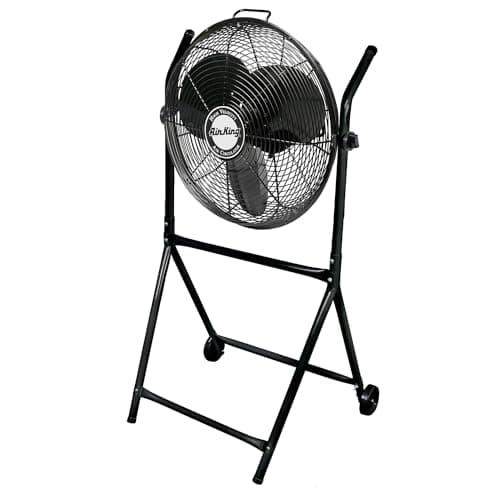 Best on a stand Air King 9219 18" Industrial Grade Roll-About Drum Fan The same 18-inch head on a wheeled roll-about stand, 48 inches tall. A drum fan on the floor cools the floor; this one reaches chest height. | Aiming air at people rather than at a floor — a workshop bench, a garage gym, an outdoor event | |
| — | 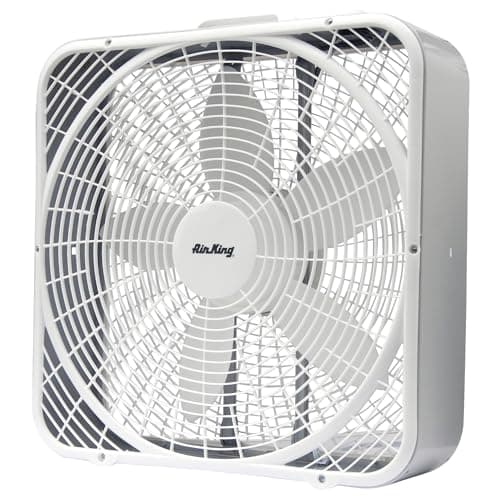 The one to skip for a space this size Air King 9723 20" Commercial Grade Box Fan 2,163 CFM on 105 W, and no published noise figure. A third of the air of the 30-inch drum fan, which in a garage is the wrong economy. | A window, a doorway or a single room — not a garage, and not a workshop |
A drum fan is a large-diameter blade in a round steel housing, sitting on the floor or a stand, with a head that pivots so the whole output can be aimed. They get sold as drum fans, barrel fans, shop fans and industrial floor fans, and they are the same thing.
They are also, oddly, the best-documented category in portable cooling. Every other kind of fan on this site has gaps — box fans publish no airflow, tower fans publish no noise, circulators publish neither. The industrial floor fan line this page is built on publishes CFM, RPM, amps, watts and decibels at all three speeds for every model. That is why this page can rank them properly and most of the internet cannot.
Criteria
How these are ranked, in order
- Published airflow, at a published wattage. Not a listing claim. A fan whose maker states 7,400 CFM on 255 W has committed to a figure; one that appears only in a retail description has committed to nothing, and there is no mandatory airflow test procedure for portable fans in the United States.
- CFM per watt, calculated from those two numbers. This is the only honest efficiency measure available, because no certification programme covers this category — ENERGY STAR certifies ceiling fans and ventilating fans, and nothing else that moves air in a home.
- Published decibels. A drum fan is loud. A category that publishes the figure lets you decide how loud is too loud, which is the single most useful thing a manufacturer can do here.
- Fit. Width, height and weight, because a 33-inch, 48 lb fan has to physically go somewhere and a garage with a car in it has less floor than people remember.
- Motor rating. HP, enclosure and bearing type. This is a class bought to run for whole days in dusty air, and it is the specification that separates a fan that survives three summers from one that does not.
We have tested none of these. Every figure below is the manufacturer’s own published number, with the arithmetic we did on them marked as ours. How we pick.
The numbers
Every published figure in the line
| Model | Blade | CFM, high | Watts, high | CFM per watt | dB, high / low | Weight |
|---|---|---|---|---|---|---|
| 9230 | 30 in | 7,400 | 255 W | 29.0 | 75 / 67 | 48.3 lb |
| 9224 | 24 in | 5,130 | 252 W | 20.4 | 72 / 64 | 41.8 lb |
| 9220 | 20 in | 3,670 | 184 W | 19.9 | 62 / 48 | 24.0 lb |
| 9219 stand | 18 in | 3,190 | 180 W | 17.7 | 67 / 49 | 27.9 lb |
| 9218 | 18 in | 3,190 | 180 W | 17.7 | 67 / 49 | 21.4 lb |
| 9214 | 14 in | 1,650 | 63 W | 26.2 | 58 / 48 | 13.6 lb |
| 9212 | 12 in | 1,360 | 85 W | 16.0 | 56 / 42 | 12.1 lb |
Blade, airflow, wattage, decibels and weight from Air King’s industrial grade floor fan specification table. CFM per watt is our arithmetic. The 9218 and 9219 are the same head on a floor mount and a roll-about stand; the 9214 and 9212 are included for completeness but are too small to be drum fans in any useful sense.
The finding
In this category, bigger is dramatically more efficient
Read the CFM-per-watt column across the four drum-sized models and the pattern is the opposite of what most appliance categories do. 29.0 at 30 inches, 20.4 at 24, 19.9 at 20 and 17.7 at 18 — the 30-inch fan is 64 per cent more efficient than the 18-inch one.
The two smallest models in the table do not follow it, and we are not going to pretend they do: the 14-inch publishes 26.2 CFM per watt on 63 W while the 12-inch publishes 16.0 on 85 W — the smaller fan drawing more power than the larger one, on a nominally larger 1/25 HP motor against 1/20. Those figures may well be right for two very different little motors, but they are not a trend, and neither fan is a drum fan in any practical sense.
The mechanism is blade area against blade speed. Airflow scales roughly with swept area, which goes up with the square of the diameter, while the aerodynamic losses that waste power go up steeply with blade tip speed. The 30-inch fan turns at 1,040 RPM; the 18-inch turns at 1,500. The big fan is moving far more air far more gently, and that is simply cheaper in watts.
This is worth naming because it inverts the finding this site publishes for room air conditioners, where certified efficiency falls at the top of the size range — CEER holds at 16.0 up to 14,000 BTU and drops to 12.7 at 24,000. Why efficiency metrics behave differently by category. With fans, buy the biggest blade the space will take and run it slowly.
This one is not a DIY job
Run a drum fan on low and point it at the ceiling. Low is where the efficiency is — 32.3 CFM per watt against 29.0 on the 30-inch, and 48 dB against 62 on the 20-inch. Aimed up, the air sets the whole volume rotating instead of blasting one corner, which is what you actually want in a garage.
Noise
What 75 dB means, and why this class publishes it
Drum fans are the only portable fan category on this site where the manufacturer publishes a decibel figure for every model at every speed. Box fans publish none. Tower fans mostly publish none. Pedestal fans publish none.
The reason is the market: these are sold into workplaces, where OSHA noise exposure limits apply and a purchasing manager needs the number. A domestic buyer gets the benefit of a disclosure that was never aimed at them.
Use it honestly. 75 dB on the 30-inch is roughly a vacuum cleaner at close range, and OSHA’s permissible exposure limit is 90 dBA over eight hours — so this is not hearing-damage territory, but it is firmly in the range where you raise your voice and get tired of it. 67 dB on its low setting is still louder than a 20-inch window fan on high.
If you need a large fan in a space where people are talking, the 20-inch pivoting model at 48 dB on low is the only genuinely quiet option in the class, and it still moves more air than a box fan at full speed. The full decibel scale for cooling hardware.
Sizing
How much air a garage or workshop actually needs
Fans do not lower air temperature, so the useful way to size one for a large space is by how fast it turns the air over. Volume divided by CFM gives you the time for one complete change.
| Space | Volume | 30 in, 7,400 CFM | 20 in box fan, 2,163 CFM |
|---|---|---|---|
| Single garage, 12 x 20 x 9 ft | 2,160 cu ft | 18 sec | 60 sec |
| Two-car garage, 20 x 20 x 9 ft | 3,600 cu ft | 29 sec | 100 sec |
| Workshop, 24 x 30 x 10 ft | 7,200 cu ft | 58 sec | 3 min 20 s |
| Small barn, 30 x 40 x 12 ft | 14,400 cu ft | 1 min 57 s | 6 min 39 s |
Our arithmetic: volume divided by published CFM. These are times for one complete air change with the door open, not a cooling claim.
One thing this arithmetic makes obvious: a drum fan needs an opening. Turning the air over every 29 seconds does nothing if it is the same hot air going round. Open the garage door, or put the fan in the doorway pointing out and let cooler air in somewhere else — the same principle as using a box fan in a window, at three times the rate.
Say the unwelcome thing
Do not buy a drum fan for a bedroom, a living room or an office.
The quietest high setting in the class is 62 dB and the loudest is 75. For comparison, a DC tower fan publishes 23 dBA and a certified ceiling fan draws about 1 W on low. A drum fan in a bedroom is not a compromise, it is a mistake, and the published decibels say so before you spend the money.
The other mistake is buying one on a listing’s CFM claim. Drum fans are routinely listed at 8,700 or even 30,000 CFM by sellers with no specification sheet behind the number. If the figure is not on the manufacturer’s own page, it is copy.
Buying
What to check before you buy
- Measure the floor, not the space. A 30-inch drum fan is 33.75 inches wide and 35.5 tall. In a garage with a car in it, the usable floor is narrower than the garage.
- Check the amps against the circuit. 2.4 A at 120 V is nothing on its own, but a garage circuit often already carries a door opener, a freezer and power tools. How to work out what a circuit will carry.
- Buy a pivoting head. Every fan on this page has one, and it is what lets a single fan serve a bench, a doorway and a ceiling at different times of day.
- Prefer a totally enclosed, ball-bearing motor if the space is dusty. It is the difference between a three-summer fan and a ten-summer one.
- Decide about wheels. A roll-about stand puts the air at chest height and makes the fan mobile; a floor model is lower, more stable and cheaper.
- Read the decibel figure before you buy, not after. This is the one fan category that gives you one.
Alternatives
When something else is the better buy
- A 15-inch air mover sits on the same shelf at a lower price and draws more power than the 20-inch drum fan — 178 W — for airflow its maker does not publish at all. It is a good tool for drying a floor and a poor one for cooling a space, because you cannot compare it with anything. High-velocity fans.
- A whole-house or garage exhaust fan removes hot air rather than stirring it, which is a different and often better job in a garage that gets afternoon sun. Garage exhaust fans.
- An evaporative cooler genuinely lowers temperature in a dry climate, and a garage with the door open is the ideal application for one. Swamp coolers for garages.
- A mini-split is the only thing that actually air-conditions a garage, and it costs an order of magnitude more. Mini-splits for a garage.
In full
Every pick, and what is wrong with it
Published specifications only, each linked to the page it came from. Where a manufacturer publishes nothing, the row says so — we do not fill blanks in.
1. Best overall
Air King 9230 30" Industrial Grade Pivoting Drum Fan
Air King · model 9230
7,400 CFM on 255 W, at 29.0 CFM per watt. More air than any portable fan we can source specs for, and the best efficiency on the site outside ceiling fans.
7,400 / 6,360 / 4,980 CFM on 255 / 200 / 154 W. Our arithmetic on those published figures gives 29.0 CFM per watt on high and 32.3 on low — and that low-speed figure is the highest we hold for any air mover on this site other than a ceiling fan, which is tested in free air and not comparable.
For scale, the best 20-inch window fan we can document manages 27.4 CFM per watt and the best box fan 22.5. A big blade turning slowly — 1,040 RPM here against 1,220 on a 20-inch box fan — is simply a more efficient way to move air.
75 / 71 / 67 dB, published. This is the number to take seriously, and almost nothing else in portable fans publishes one at all. 75 dB is vacuum-cleaner territory. Even the low setting, at 67 dB, is loud enough that you raise your voice over it.
1/4 HP, totally enclosed, ball bearing, on a 10 ft three-conductor cord, ETL listed and OSHA compliant. That motor specification is the reason it costs several times a box fan: it is rated to run all day, every day, in a dusty space.
Running cost is still trivial. 37¢ for an eight-hour shift on high at 18.34¢/kWh, or 23¢ on low.
48.3 lb and 33.75 inches wide. Measure the floor space before you buy. The pivoting head is what makes that footprint worth it — you can aim the whole 7,400 CFM at a ceiling, a wall or an open door rather than at whatever happens to be in front of it.
What’s wrong with it
75 dB on high, 48.3 lb, and 33.75 inches wide. It is a two-handed lift, it needs floor space, and it is far too loud for a room anyone is trying to relax in.
Running cost — 9230
| Nameplate power | 154 W – 255 W | manufacturer's published figure |
|---|---|---|
| Energy, 8-hour night | 2.04 kWh | 255 ÷ 1000 × 8 |
| Cost per hour | 4.7¢ | at 18.34¢/kWh |
| Cost per 8-hour night | 37¢ | on the highest speed |
| Cost per 30 nights | $11 | 61.2 kWh |
| Same month, lowest speed | $6.78 | at 154 W |
Rate: 18.34¢/kWh, the US average residential price for June 2026 (EIA Electric Power Monthly, Table 5.3). Yours will differ — swap it in: (watts ÷ 1000) × hours × your rate.
| Air delivery | 7,400 / 6,360 / 4,980 CFM (high / medium / low) |
|---|---|
| Power | 255 / 200 / 154 W (2.4 / 1.9 / 1.5 A) |
| Efficiency | 29.0 CFM per watt on high, 32.3 on low (our arithmetic) |
| Noise | 75 / 71 / 67 dB (high / medium / low) |
| Blade speed | 1,040 / 902 / 860 RPM |
| Blade | 30 in |
| Motor | 1/4 HP, 120 V, 1 phase, totally enclosed, ball bearing |
| Speeds | 3 |
| Head | Pivoting |
| Dimensions | 33.75 W x 12.25 D x 35.5 H in |
| Weight | 48.3 lb |
| Cord | 10 ft, 3-conductor SJT |
| Listing | ETL listed, OSHA compliant |
Every figure above is from Air King industrial grade floor fan product page, model 9230. Blanks are shown as “not published” rather than filled in.
2. Best for a single garage bay
Air King 9224 24" Industrial Grade Pivoting Drum Fan
Air King · model 9224
5,130 CFM on 252 W with a 72 dB high setting — 70 per cent of the big fan's air, 87 per cent of its weight saved off the width, and 3 dB quieter.
5,130 / 4,490 / 3,670 CFM on 252 / 199 / 157 W, at 72 / 69 / 64 dB.
This is the fan to buy when the 30-inch will not physically work. 27 inches wide against 33.75, and 41.8 lb against 48.3. In a single garage bay with a car in it, those six inches are often the whole decision.
Be clear about what the step down costs, because it is more than it looks. 252 W against 255 — essentially the same motor load — for 5,130 CFM against 7,400. Efficiency falls from 29.0 to 20.4 CFM per watt. You are paying the same electricity for 31 per cent less air.
37¢ for an eight-hour shift on high, 23¢ on low. The efficiency gap is real but the money involved is pennies, so buy on fit, not on CFM per watt.
64 dB on low is the useful figure here. That is about the level of normal conversation, and it is the quietest setting in the line that still moves more air than any box fan on high.
What’s wrong with it
20.4 CFM per watt against 29.0. It draws almost exactly the same power as the 30-inch model for 2,270 CFM less air, which makes it the worst value per watt in the line.
Running cost — 9224
| Nameplate power | 157 W – 252 W | manufacturer's published figure |
|---|---|---|
| Energy, 8-hour night | 2.02 kWh | 252 ÷ 1000 × 8 |
| Cost per hour | 4.6¢ | at 18.34¢/kWh |
| Cost per 8-hour night | 37¢ | on the highest speed |
| Cost per 30 nights | $11 | 60.5 kWh |
| Same month, lowest speed | $6.91 | at 157 W |
Rate: 18.34¢/kWh, the US average residential price for June 2026 (EIA Electric Power Monthly, Table 5.3). Yours will differ — swap it in: (watts ÷ 1000) × hours × your rate.
| Air delivery | 5,130 / 4,490 / 3,670 CFM (high / medium / low) |
|---|---|
| Power | 252 / 199 / 157 W (2.4 / 1.9 / 1.5 A) |
| Efficiency | 20.4 CFM per watt on high, 23.4 on low (our arithmetic) |
| Noise | 72 / 69 / 64 dB (high / medium / low) |
| Blade speed | 1,060 / 925 / 745 RPM |
| Blade | 24 in |
| Motor | 1/4 HP, 120 V, 1 phase |
| Speeds | 3 |
| Head | Pivoting |
| Dimensions | 27 W x 12 D x 28.75 H in |
| Weight | 41.8 lb |
| Listing | ETL listed, OSHA compliant |
Every figure above is from Air King industrial grade floor fan product page, model 9224. Blanks are shown as “not published” rather than filled in.
3. Quietest in the class
Air King 9220 20" Industrial Grade Pivoting Drum Fan
Air King · model 9220
48 dB on low — the only setting in this entire class that is genuinely quiet — and still 2,940 CFM, which is more air than a 20-inch box fan manages on high.
62 / 55 / 48 dB is what makes this one interesting. Every other fan in the class starts at 64 dB and goes up; this one has a 48 dB low setting, which is quieter than the 50 dB that a 20-inch whole-house window fan publishes.
And it is not a token setting. 2,940 CFM on 130 W at that noise level is more air than a 20-inch box fan moves on high (2,163 CFM on 105 W), for 25 W more and a published decibel figure the box fan does not have.
3,670 / 3,330 / 2,940 CFM on 184 / 155 / 130 W, at 1,500 / 1,310 / 1,050 RPM, on a 1/6 HP motor. 24.0 lb, the lightest pivoting fan in the line and the only one a single person moves comfortably.
The honest limit: 20 inches of blade is 20 inches of blade. At 19.9 CFM per watt it is the least efficient of the pivoting fans, and if the space is a two-car garage on a 95-degree afternoon you want the 30-inch.
27¢ on high for eight hours, 19¢ on low.
What’s wrong with it
19.9 CFM per watt on high is the worst efficiency of the three pivoting fans here, and 3,670 CFM will not do a two-car garage in a heat wave.
Running cost — 9220
| Nameplate power | 130 W – 184 W | manufacturer's published figure |
|---|---|---|
| Energy, 8-hour night | 1.47 kWh | 184 ÷ 1000 × 8 |
| Cost per hour | 3.4¢ | at 18.34¢/kWh |
| Cost per 8-hour night | 27¢ | on the highest speed |
| Cost per 30 nights | $8.10 | 44.2 kWh |
| Same month, lowest speed | $5.72 | at 130 W |
Rate: 18.34¢/kWh, the US average residential price for June 2026 (EIA Electric Power Monthly, Table 5.3). Yours will differ — swap it in: (watts ÷ 1000) × hours × your rate.
| Air delivery | 3,670 / 3,330 / 2,940 CFM (high / medium / low) |
|---|---|
| Power | 184 / 155 / 130 W (1.6 / 1.3 / 1.1 A) |
| Efficiency | 19.9 CFM per watt on high, 22.6 on low (our arithmetic) |
| Noise | 62 / 55 / 48 dB (high / medium / low) |
| Blade speed | 1,500 / 1,310 / 1,050 RPM |
| Blade | 20 in |
| Motor | 1/6 HP, 120 V, 1 phase |
| Speeds | 3 |
| Head | Pivoting |
| Dimensions | 25.75 x 12.5 x 25 in, as published |
| Weight | 24.0 lb |
| Listing | ETL listed, OSHA compliant |
Every figure above is from Air King industrial grade floor fan product page, model 9220. Blanks are shown as “not published” rather than filled in.
4. Best on a stand
Air King 9219 18" Industrial Grade Roll-About Drum Fan
Air King · model 9219
The same 18-inch head on a wheeled roll-about stand, 48 inches tall. A drum fan on the floor cools the floor; this one reaches chest height.
Height is the problem a floor-standing drum fan has, and this is the fix. 48 inches tall on a wheeled stand, which puts the air at chest height rather than at your ankles.
3,190 / 2,970 / 2,660 CFM on 180 / 150 / 125 W, at 67 / 58 / 49 dB. The 49 dB low setting is the second-quietest figure in the class.
The wheels matter more than they sound. A 28 lb fan you roll is a fan that ends up where the work is; a 48 lb fan you carry tends to live wherever you first set it down.
17.7 CFM per watt on high is the weakest figure in the line, which is what an 18-inch blade on a 1/6 HP motor buys. If efficiency is the point, the 30-inch does 64 per cent better.
26¢ for eight hours on high. One safety note the specification implies: a 48-inch stand on a 25-inch base is top-heavy. Fan safety around children and pets.
What’s wrong with it
3,190 CFM on 180 W is 17.7 CFM per watt, the worst in the line, and a 48-inch stand with a 25-inch base is a genuine tipping and trip hazard around children.
Running cost — 9219
| Nameplate power | 125 W – 180 W | manufacturer's published figure |
|---|---|---|
| Energy, 8-hour night | 1.44 kWh | 180 ÷ 1000 × 8 |
| Cost per hour | 3.3¢ | at 18.34¢/kWh |
| Cost per 8-hour night | 26¢ | on the highest speed |
| Cost per 30 nights | $7.92 | 43.2 kWh |
| Same month, lowest speed | $5.50 | at 125 W |
Rate: 18.34¢/kWh, the US average residential price for June 2026 (EIA Electric Power Monthly, Table 5.3). Yours will differ — swap it in: (watts ÷ 1000) × hours × your rate.
| Air delivery | 3,190 / 2,970 / 2,660 CFM (high / medium / low) |
|---|---|
| Power | 180 / 150 / 125 W (1.5 / 1.3 / 1.0 A) |
| Efficiency | 17.7 CFM per watt on high, 21.3 on low (our arithmetic) |
| Noise | 67 / 58 / 49 dB (high / medium / low) |
| Blade speed | 1,500 / 1,300 / 1,100 RPM |
| Blade | 18 in |
| Motor | 1/6 HP, 120 V, 1 phase |
| Speeds | 3 |
| Mount | Roll-about stand, wheeled |
| Dimensions | 24 L x 25 W x 48 H in |
| Weight | 27.9 lb |
| Listing | ETL listed, OSHA compliant |
Every figure above is from Air King industrial grade floor fan product page, model 9219. Blanks are shown as “not published” rather than filled in.
Skip this one
Air King 9723 20" Commercial Grade Box Fan
Air King · model 9723
2,163 CFM on 105 W, and no published noise figure. A third of the air of the 30-inch drum fan, which in a garage is the wrong economy.
This is the best box fan we can document and it is the wrong answer to this page’s question.
2,163 CFM against 7,400. In a 20 by 20 ft garage with a 9 ft ceiling — 3,600 cubic feet — the drum fan turns the air over once every 29 seconds and the box fan once every 100. That is the difference between a garage that becomes workable and one that stays hot.
No published decibel figure, from Air King or anyone, for any box fan. The drum fans on this page publish three each. When you are choosing a fan you will stand next to all day, that absence matters.
Where the box fan wins outright is a window, where it exchanges hot indoor air for cooler outdoor air rather than stirring what is already there, and a 1/25 HP motor is all that job needs. Box fans, and what they are actually for.
What’s wrong with it
It is the fan people buy instead of a drum fan and then replace. 20 inches of blade in a plastic-and-steel frame is not built to run eight hours a day in a dusty space.
Running cost — 9723
| Nameplate power | 65 W – 105 W | manufacturer's published figure |
|---|---|---|
| Energy, 8-hour night | 0.84 kWh | 105 ÷ 1000 × 8 |
| Cost per hour | 1.9¢ | at 18.34¢/kWh |
| Cost per 8-hour night | 15¢ | on the highest speed |
| Cost per 30 nights | $4.62 | 25.2 kWh |
| Same month, lowest speed | $2.86 | at 65 W |
Rate: 18.34¢/kWh, the US average residential price for June 2026 (EIA Electric Power Monthly, Table 5.3). Yours will differ — swap it in: (watts ÷ 1000) × hours × your rate.
| Air delivery | 2,163 / 1,900 / 1,463 CFM (high / medium / low) |
|---|---|
| Power | 105 / 87 / 65 W (0.94 / 0.72 / 0.56 A) |
| Efficiency | 20.6 CFM per watt on high, 22.5 on low (our arithmetic) |
| Blade speed | 1,220 / 1,075 / 855 RPM |
| Blade | 20 in |
| Speeds | 3 |
| Motor | 1/25 HP, 120 V, 1 phase |
| Dimensions | 21.38 W x 6.38 D x 22.5 H in |
| Weight | 11.4 lb |
| Oscillation | No |
| Noise | Not published |
Every figure above is from Air King commercial box fan product page, model 9723. Blanks are shown as “not published” rather than filled in.
We are not linking a buy button for this one. If you want to look at it anyway, it is easy enough to find — but we would rather send you to something that fits your room.
Questions people actually ask
Frequently asked
What is the best drum fan?
The Air King 9230, a 30-inch model rated at 7,400 CFM on 255 W. That works out at 29.0 CFM per watt, the highest airflow-per-watt figure of any air mover on this site outside the ceiling fan category, and it publishes 75 / 71 / 67 dB across its three speeds.
How many CFM does a drum fan move?
Between about 1,360 and 7,400 CFM depending on blade size, on published figures: 7,400 at 30 inches, 5,130 at 24, 3,670 at 20 and 3,190 at 18. For comparison, the highest published figure for a 20-inch box fan is 2,163 CFM.
How loud is a drum fan?
62 to 75 dB on high, published, depending on size. A 30-inch model is 75 dB on high and 67 on low; a 20-inch is 62 on high and 48 on low. Drum fans are the only portable fan category where the manufacturer publishes a decibel figure for every model and speed, because they are sold into workplaces. How loud a fan actually is.
Is a drum fan better than a box fan for a garage?
Yes, by a wide margin. In a 20 by 20 ft garage with a 9 ft ceiling, a 30-inch drum fan turns the air over once every 29 seconds against once every 100 for a 20-inch box fan, and it does it on a motor rated to run all day in dusty air. A box fan's best use is a window, not a large room. Box fans, and what they are for.
Are bigger drum fans more efficient?
Substantially, and this is the opposite of how room air conditioners behave. Published CFM per watt runs 29.0 at 30 inches, 20.4 at 24, 19.9 at 20 and 17.7 at 18 — the 30-inch fan is 64 per cent more efficient than the 18-inch. A larger blade turning more slowly moves more air for less power.
What size drum fan do I need for a garage?
For a single garage bay, a 20 or 24-inch model. For a two-car garage, a 30-inch. The useful test is air-change time rather than square feet: a two-car garage is about 3,600 cubic feet, which a 7,400 CFM fan turns over every 29 seconds and a 3,670 CFM fan every 59. Whichever you pick, the fan needs an opening to work through. Sizing a fan properly.
Can I use a drum fan indoors?
In a garage, workshop, basement or covered patio, yes. In a bedroom, living room or office, no — the quietest high setting in the class is 62 dB and most are 72 to 75, against 23 dBA for a DC tower fan. The published decibel figures make this an easy decision before you buy.
Sources
Where these numbers came from
- Air King industrial grade floor fan specifications — CFM, RPM, amps, watts, dB, weight and dimensions for models 9230, 9224, 9220, 9219, 9218, 9214 and 9212
- Air King commercial box fan specifications, model 9723 — 2,163 CFM on 105 W, no noise figure published
- Air King whole house window fan, 9155 — 2,470 CFM on 90 W, 27.4 CFM per watt
- Lasko U15720 Max Performance air mover — 160-178 W, no airflow published
- OSHA occupational noise exposure standard, 29 CFR 1910.95 — 90 dBA over 8 hours
- EIA Electric Power Monthly, Table 5.3 — electricity rate
Read next
Where to go from here
Back to Fans, or read how we pick.