Guide and picks
How to read a cooling spec sheet
Nine numbers appear on cooling products. Three are independently certified, two are marketing, and one is routinely misread as another.
By Sawyer V. · Published
The short answer
Read the certified numbers first: CEER for room air conditioners, CFM per watt for ceiling and ventilating fans, and SEER2, EER2, HSPF2 and COP for mini-splits. Treat ASHRAE BTU and square-footage coverage claims as marketing. And note that sones are linear while decibels are logarithmic — 1.4 sones really is twice as loud as 0.7.
Fan & Frost earns a commission when you buy through our links, at no cost to you. It never changes a ranking, and we say so when the right answer is the cheaper unit or nothing at all. Full disclosure · How we pick.
At a glance
The picks, ranked
Tap any row to jump to the full reasoning. Prices are live from Amazon where we have them, and read “check price” where we don’t — never a number we cannot verify today.
| # | Product | Best for | Price |
|---|---|---|---|
| 1 | 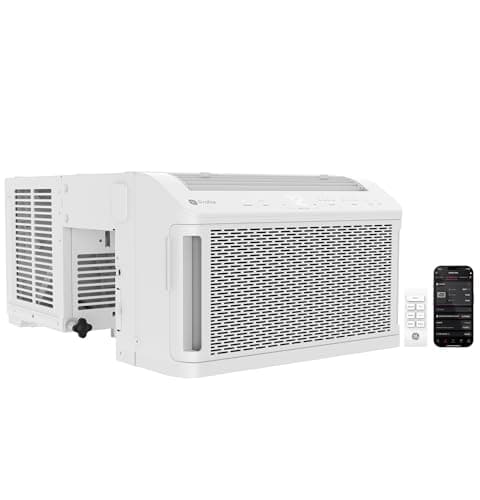 A spec sheet with nothing to hide GE Profile ClearView Window Air Conditioner, 8,000 BTU CEER 16, 375 kWh a year, 47 percent below the federal standard — every figure independently verified. | Seeing what a fully certified listing looks like | |
| 2 | 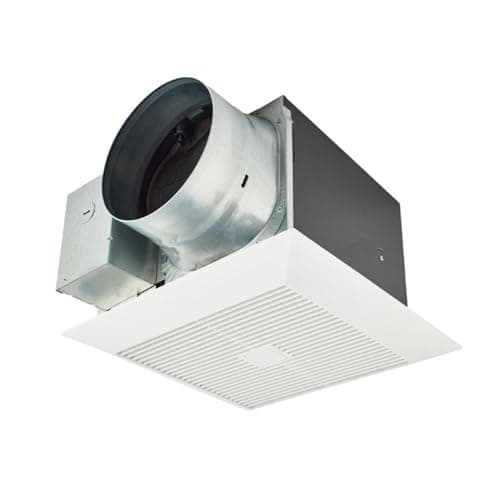 The one metric everyone misreads Panasonic WhisperGreen Select Ventilation Fan 0.7 sones at 158.7 CFM and 13.7 CFM per watt — and the sone figure is the one people get wrong. | Understanding why sones are not decibels | |
| 3 | 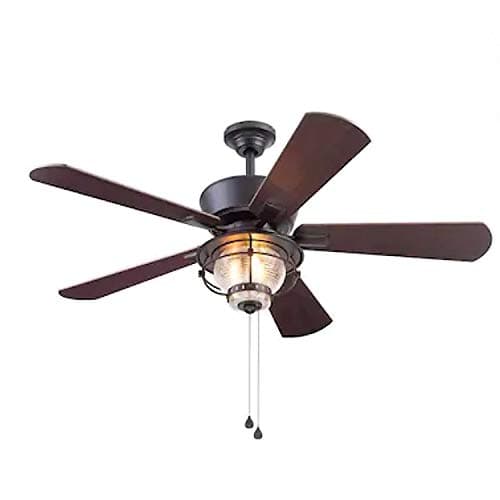 The efficiency metric that is not comparable across categories Harbor Breeze Cando 84" Ceiling Fan 422.2 CFM per watt on 30.6 W — certified, and roughly thirty times a ventilating fan's figure for a reason. | Seeing why 422 CFM/W and 14 CFM/W are not what they look like | |
| — | The two numbers that are not the same number Whynter ARC-14S Dual Hose Portable Air Conditioner 14,000 BTU on the box, 9,500 BTU SACC in the DOE test — a 32.1 percent difference, both published on the same page. | Understanding the ASHRAE-to-SACC gap |
Cooling products carry more acronyms than almost any other category of home appliance, and the acronyms are not equally trustworthy. Some are the output of a government test procedure. Some are the output of a marketing department.
Here is all of it, in one place.
The reference
Every metric, decoded
| Metric | Applies to | Measures | Certified? |
|---|---|---|---|
| BTU/h | All cooling | Rate of heat removal | Depends on the test standard |
| SACC | Portable AC | BTU/h with duct heat and infiltration counted | DOE-mandated, no ENERGY STAR program |
| CEER | Room AC | BTU per watt-hour, including standby | Yes — ENERGY STAR |
| SEER2 | Mini-splits | Seasonal cooling efficiency | Yes — ENERGY STAR |
| EER2 | Mini-splits | Steady-state cooling efficiency | Yes — ENERGY STAR |
| HSPF2 | Heat pumps | Seasonal heating efficiency | Yes — ENERGY STAR |
| COP at 5°F | Heat pumps | Heat delivered per watt in a cold snap | Yes — ENERGY STAR |
| CFM | Fans | Air volume moved per minute | Yes for ceiling and ventilating fans |
| CFM per watt | Fans | Air moved per watt consumed | Yes — but only comparable within a category |
| Sones | Ventilating fans | Perceived loudness, linear scale | Yes — ENERGY STAR |
| dBA | Portable fans and portable AC | Sound pressure, logarithmic scale | No — manufacturer claim |
| Coverage, sq ft | Everything | Nothing standardized | No — marketing |
Trap one
Two BTU numbers describe the same machine
A BTU per hour figure is a rate of heat removal, and on its own it is meaningless without knowing which test produced it.
ASHRAE-128 is the older standard and produces the larger number. It measures the unit’s raw cooling output.
SACC — Seasonally Adjusted Cooling Capacity — is the DOE-mandated figure for portable air conditioners. It subtracts the heat radiating off the hot exhaust duct inside your room, and the cooling load created by hot outdoor air infiltrating to replace the room air the unit blows outside.
The gap is not small and it is not consistent. Across the units we have checked it runs from 14.3 percent to 50 percent. Two units both sold as “14,000 BTU” can differ by 2,500 BTU of actual rated capacity.
The full explanation of what SACC subtracts and why.
Trap two
Efficiency ratios are not interchangeable
CEER, SEER2 and EER2 are all “BTU per watt-hour”, which makes them look comparable. They are not.
- CEER rates room air conditioners at a single rating condition, plus standby power.
- EER2 rates mini-splits at a steady-state condition. It is the closest thing to an apples-to-apples comparison with CEER.
- SEER2 rates mini-splits across a modeled cooling season, including part-load operation — which is why the numbers are so much larger.
So a SEER2 35 mini-split is not twice as efficient as a CEER 16 window unit. The honest comparison is EER2 against CEER, where the certified maxima are 19.1 and 16 respectively.
Trap three
Sones and decibels behave differently
This is the most consequential misreading in the whole category, because the two scales invite opposite intuitions.
Sones are linear. Two sones sounds twice as loud as one sone. Four sounds four times as loud. Certified ventilating fans use this scale.
Decibels are logarithmic. A 3 dB difference is a small perceived change; roughly 10 dB is a doubling. Portable fans and portable air conditioners use this scale, and never as a certified figure.
So 0.7 sones against 1.4 is a genuine halving, while 46 dBA against 48.7 dBA is barely noticeable. Reading the sone figure with dB intuition makes you underrate a real difference; reading dBA with sone intuition makes you overrate a trivial one.
And note the coverage gap: window air conditioners publish no noise figure of any kind in the certified dataset, and manufacturer dBA claims on fans and portables are not independently tested.
Trap four
Square-footage claims are calculated, not measured
Every category on this site carries some version of “cools rooms up to X square feet”, and none of them come from a test.
We found the arithmetic. Across Honeywell’s evaporative cooler range — spanning a thirteenfold difference in airflow — every published coverage claim equals the CFM divided by 1.64. The CL25AE at 764 CFM claims 466 sq ft. The CO60PM at 2,697 CFM claims 1,643 sq ft. Both are the same division.
A formula applied to airflow cannot know your ceiling height, your insulation, your glazing, your climate or how many people are in the room. It is a marketing figure with the shape of a specification.
Notably, the certified datasets contain no coverage field at all. The manufacturers who decline to publish one — Hessaire, for instance — are being more honest than the ones who do.
The full working on that finding.
This one is not a DIY job
Where the certified data actually lives. All of it is public, free, and queryable without an account.
Room air conditioners — CEER, annual kWh, capacity, dimensions, weight. No noise field.
Ceiling fans — CFM per watt, wattage at high and low, blade span, indoor/outdoor classification. No damp/wet rating.
Ventilating fans — CFM at 0.25 in w.g., CFM per watt, sones, duct size. No sone figure for in-line units.
Mini-split heat pumps — SEER2, EER2, HSPF2, COP at 5°F, heating capacity at 47, 17 and 5°F, cold climate flag.
Portable air conditioners — no program exists. Nothing about a portable is independently certified.
Every source link at the foot of this page goes straight to the dataset. You can check anything we publish.
Method
How to read any listing in five steps
- Identify the category, because it determines which metrics are certified and which are claims.
- Find the certified efficiency figure — CEER, CFM per watt, or SEER2/EER2. If there is not one, you are looking at a category with no certification program.
- Find the capacity figure and check which standard produced it. On a portable, that means finding the SACC number and ignoring the ASHRAE one.
- Find the wattage or annual kWh. A product with no published power draw cannot be compared with anything on running cost. That absence is itself information.
- Ignore the square footage. Size from the room instead. ENERGY STAR’s sizing table does the job the coverage claim pretends to.
Say the unwelcome thing
Do not compare CFM per watt across product categories.
It looks like the perfect cross-category metric — air moved per watt consumed, same unit everywhere. It is not, and the numbers involved are dramatic enough to mislead badly.
A certified ceiling fan reaches 422.2 CFM per watt. A certified in-line ventilating fan manages 4.0. That is not a hundredfold engineering gap.
Ventilating fans are tested pushing against 0.25 inches of water gauge of static pressure — a duct, a damper, an exterior cap. Ceiling fans are tested in free air, against nothing. Moving air through a pipe is simply a much harder job than stirring it in a room.
Compare within a category. Between categories, the number is telling you about the test, not the product.
In full
Every pick, and what is wrong with it
Published specifications only, each linked to the page it came from. Where a manufacturer publishes nothing, the row says so — we do not fill blanks in.
1. A spec sheet with nothing to hide
GE Profile ClearView Window Air Conditioner, 8,000 BTU
GE Profile · model PWJV08W
CEER 16, 375 kWh a year, 47 percent below the federal standard — every figure independently verified.
Worth studying as a model listing. CEER 16 is the certified efficiency ratio, 375 kWh a year the certified consumption, and 47 percent less energy than the federal standard the certified comparison. All three come from the same test, run by a body that is not the manufacturer.
Note what is not here. No square-footage claim. No “cools rooms up to” figure. Those numbers are absent because the certification program does not produce them.
$69 for a season, and the arithmetic is checkable: 375 kWh at the published average residential rate.
The gap is acoustic. Not one window unit in the certified dataset publishes a noise rating. The program does not measure it.
What’s wrong with it
Even here, one number is missing: no window air conditioner in the certified dataset publishes a noise rating.
Running cost — PWJV08W
| Annual energy use | 375 kWh | ENERGY STAR certified figure |
|---|---|---|
| Annual cost | $69 | 375 × 18.34¢/kWh |
| Per cooling month | $17 | spread over a four-month season |
The annual figure is the certified value from the ENERGY STAR Certified Room Air Conditioners dataset, which models a standard cooling season rather than your actual summer. It is more useful than a nameplate wattage here, because a variable-speed compressor spends most of its life well below nameplate.
Rate: 18.34¢/kWh, the US average residential price for June 2026 (EIA Electric Power Monthly, Table 5.3). Yours will differ — swap it in: (watts ÷ 1000) × hours × your rate.
| Cooling capacity | 8,000 BTU/h |
|---|---|
| CEER | 16 |
| Annual energy use | 375 kWh/yr |
| vs federal standard | 47% less energy |
| Dimensions | 12.6 H x 18.6 W x 15.3 D in |
| Weight | 46.2 lb |
| Refrigerant | R-32 |
| Installation | Does not straddle the windowsill |
| Compressor | Variable speed |
| ENERGY STAR | Certified, and on the Most Efficient list |
Every figure above is from ENERGY STAR Certified Room Air Conditioners dataset. Blanks are shown as “not published” rather than filled in.
2. The one metric everyone misreads
Panasonic WhisperGreen Select Ventilation Fan
Panasonic · model WhisperGreen Select
0.7 sones at 158.7 CFM and 13.7 CFM per watt — and the sone figure is the one people get wrong.
Ventilating fans are rated in sones, and the sone scale is linear against perceived loudness. Two sones sounds twice as loud as one sone. There is no logarithm.
Decibels are logarithmic, so a 3 dB difference is often dismissed as marginal. People carry that intuition across and badly underestimate what a sone figure is telling them.
0.7 sones here against 1.4 for the Broan, at essentially identical airflow through an identical duct size, is genuinely half the loudness. Not a nuance — half.
158.7 CFM at 0.25 in w.g., 13.7 CFM per watt. Both certified. Full ventilating fan comparison.
What’s wrong with it
13.7 CFM per watt is marginally below the best certified ventilating fan, so it is not the efficiency winner.
Running cost
Panasonic does not publish a wattage for the WhisperGreen Select, so we cannot calculate what it costs to run. We are not going to estimate one. If Panasonic publishes a nameplate figure, this block will show the arithmetic.
| Air delivery | 158.7 CFM at 0.25 in w.g. |
|---|---|
| Efficacy | 13.7 CFM per watt |
| Noise | 0.7 sones |
| Duct size | 6 in diameter |
| Unit type | Ceiling-mounted, bathroom/utility room |
| Power | Not published in the certified dataset |
| ENERGY STAR | Certified |
Every figure above is from ENERGY STAR Certified Ventilating Fans dataset. Blanks are shown as “not published” rather than filled in.
3. The efficiency metric that is not comparable across categories
Harbor Breeze Cando 84" Ceiling Fan
Harbor Breeze · model 84" Cando
422.2 CFM per watt on 30.6 W — certified, and roughly thirty times a ventilating fan's figure for a reason.
422.2 CFM per watt. The most efficient certified fan at an 84-inch span, and a perfect illustration of a trap.
A certified ventilating fan manages 4.0 to 14.2 CFM per watt. Same unit, same program, thirty times the difference — and it does not mean ceiling fans are thirty times better engineered.
Ventilating fans are tested at 0.25 inches of water gauge static pressure. They are pushing against a duct, a damper and an exterior cap. A ceiling fan is tested in free air, pushing against nothing.
The rule this gives you: CFM per watt is only comparable within a category. Across categories it is measuring different physics.
What’s wrong with it
The figure is measured in free air, so comparing it with a ducted fan's CFM per watt is comparing two different tests.
Running cost — 84" Cando
| Nameplate power | 6 W – 30.6 W | manufacturer's published figure |
|---|---|---|
| Energy, 8-hour night | 0.24 kWh | 30.6 ÷ 1000 × 8 |
| Cost per hour | 0.6¢ | at 18.34¢/kWh |
| Cost per 8-hour night | 4.5¢ | on the highest speed |
| Cost per 30 nights | $1.35 | 7.3 kWh |
| Same month, lowest speed | 26¢ | at 6 W |
Rate: 18.34¢/kWh, the US average residential price for June 2026 (EIA Electric Power Monthly, Table 5.3). Yours will differ — swap it in: (watts ÷ 1000) × hours × your rate.
| Blade span | 84 in |
|---|---|
| Efficiency | 422.2 CFM per watt |
| Power, high speed | 30.6 W |
| Power, low speed | 6.0 W |
| Type | Outdoor ceiling fan |
| ENERGY STAR | Certified |
Every figure above is from ENERGY STAR Certified Ceiling Fans dataset. Blanks are shown as “not published” rather than filled in.
Skip this one
Whynter ARC-14S Dual Hose Portable Air Conditioner
Whynter · model ARC-14S
14,000 BTU on the box, 9,500 BTU SACC in the DOE test — a 32.1 percent difference, both published on the same page.
The clearest example of the single biggest trap in cooling specs. 14,000 BTU and 9,500 BTU SACC describe the same machine.
ASHRAE-128 measures raw cooling output. It does not account for heat radiating off the exhaust duct, or for hot outdoor air infiltrating to replace the room air the unit blows outside.
SACC, the DOE-mandated figure, accounts for both. It is what the unit does in a room rather than on a bench.
Across the units we checked, that gap ranges from 14.3 to 50 percent. And it varies wildly even within one hose configuration.
To Whynter’s credit, both figures and a 1,300 W draw are published. Many competitors publish neither the SACC pair nor a wattage at all.
What’s wrong with it
Portable air conditioners have no certification program at all, so nothing about this unit is independently verified.
Running cost — ARC-14S
| Nameplate power | 1300 W | manufacturer's published figure |
|---|---|---|
| Energy, 8-hour night | 10.40 kWh | 1300 ÷ 1000 × 8 |
| Cost per hour | 24¢ | at 18.34¢/kWh |
| Cost per 8-hour night | $1.91 | on the highest speed |
| Cost per 30 nights | $57 | 312.0 kWh |
Rate: 18.34¢/kWh, the US average residential price for June 2026 (EIA Electric Power Monthly, Table 5.3). Yours will differ — swap it in: (watts ÷ 1000) × hours × your rate.
| Marketing capacity | 14,000 BTU (ASHRAE-128) |
|---|---|
| DOE-rated capacity | 9,500 BTU SACC |
| Hoses | Dual |
| Power | 1,300 W / 11.6 A at 115 V |
| Noise | Under 51 dBA low, under 56 dBA high |
| Dehumidification | 71 pints/day |
| Refrigerant | R-32 |
| Dimensions | 16 W x 19 D x 35.5 H in |
| Weight | 73 lb |
| Manufacturer coverage claim | 500 sq ft |
| Warranty | 1 year unit, 3 years compressor |
Every figure above is from Whynter product page, ARC-14S. Blanks are shown as “not published” rather than filled in.
We are not linking a buy button for this one. If you want to look at it anyway, it is easy enough to find — but we would rather send you to something that fits your room.
Questions people actually ask
Frequently asked
What is the difference between BTU and SACC?
They measure the same machine under different test standards. ASHRAE-128 BTU is raw cooling output; SACC is the DOE figure that subtracts heat radiating off the exhaust duct and the cooling load from hot outdoor air infiltrating to replace exhausted room air. The gap runs from 14 to 50 percent.
Is SEER2 comparable to CEER?
No. SEER2 rates mini-splits across a modeled cooling season including part-load operation; CEER rates room air conditioners at a single condition plus standby. The closest fair comparison is EER2 against CEER, where certified maxima are 19.1 and 16.
Are sones the same as decibels?
No, and confusing them is the most consequential misreading in the category. Sones are linear — two sones is twice as loud as one. Decibels are logarithmic, so a 3 dB difference is minor. A 0.7 versus 1.4 sone difference is a genuine halving of loudness.
Can I trust the square footage a cooler claims to cover?
No. Across Honeywell's evaporative range, spanning a thirteenfold airflow difference, every published coverage claim is exactly the CFM divided by 1.64 — a formula, not a measurement. No certified dataset contains a coverage field at all.
Which cooling products are independently certified?
Room air conditioners, ceiling fans, ventilating fans and mini-split heat pumps are all covered by ENERGY STAR. Portable air conditioners are not — there is no program for them, so every efficiency figure on a portable is a manufacturer claim.
Why do window air conditioners never list a noise rating?
Because the certification program does not measure it. The ENERGY STAR room air conditioner dataset records capacity, CEER, annual kWh, dimensions and weight, with no acoustic field at all. Judge by architecture instead — a U-shape puts the compressor outside a closed window.
Sources
Where these numbers came from
- ENERGY STAR Certified Room Air Conditioners dataset — CEER, annual kWh, capacity
- ENERGY STAR Certified Ceiling Fans dataset — CFM per watt, wattage by speed
- ENERGY STAR Certified Ventilating Fans dataset — CFM at 0.25 in w.g., sones
- ENERGY STAR Certified Mini-Split Heat Pumps dataset — SEER2, EER2, HSPF2, COP at 5°F
- Honeywell CO60PM and CL25AE product pages — the coverage claims behind the CFM ÷ 1.64 finding
- Whynter ARC-14S product page — 14,000 BTU ASHRAE and 9,500 BTU SACC, both published
Read next
Where to go from here
Back to Guides & Calculators, or read how we pick.