Guide and picks
Cooling a short-term rental
The machine you would buy for yourself is rarely the machine to put in a property other people use for three nights at a time.
By Sawyer V. · Published
The short answer
Buy for durability and remote control, not for features. A guest will run cooling with the windows open, leave it on for a checkout day, and never clean a filter. The setup that survives: a certified window or through-wall unit you can see and set remotely, ceiling fans with wall controls, and a dehumidifier running on a permanent drain between stays.
Fan & Frost earns a commission when you buy through our links, at no cost to you. It never changes a ranking, and we say so when the right answer is the cheaper unit or nothing at all. Full disclosure · How we pick.

At a glance
The picks, ranked
Tap any row to jump to the full reasoning. Prices are live from Amazon where we have them, and read “check price” where we don’t — never a number we cannot verify today.
| # | Product | Best for | Price |
|---|---|---|---|
| 1 | 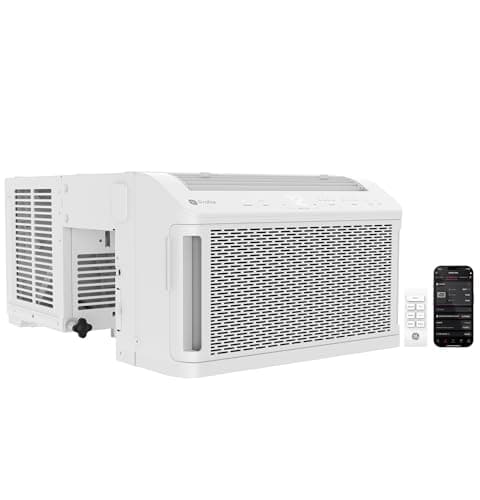 Best cooling for a rental room GE Profile ClearView Smart Window Air Conditioner, 10,300 BTU CEER 14.7 and 525.5 certified kWh with app control — you can check it is off after checkout without driving over. | A bedroom or living space where you need to see and set it remotely | |
| 2 | 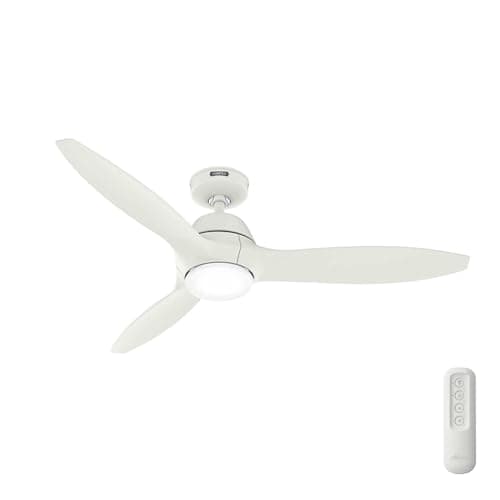 Best guest-proof comfort Hunter Skyway 52" Ceiling Fan with Light Kit 363.8 certified CFM per watt on 16.3 W — nothing to break, nothing to store, and it costs almost nothing when left running. | Every bedroom in the property, permanently | |
| 3 | 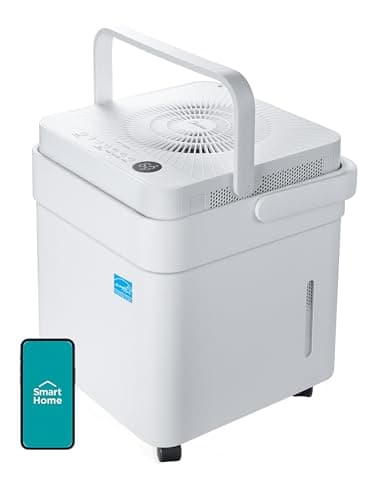 Best between-stay insurance Midea Dehumidifier, 20 pints/day 20.16 certified pints a day at 249 kWh a year — it keeps a shut property from smelling damp before the next guest arrives. | A closed-up property in a humid climate, and any basement space | |
| — | The one to skip in a rental Whynter ARC-14S Dual Hose Portable Air Conditioner 9,500 BTU SACC from 1,300 W, with a window kit and a condensate system a guest has to operate correctly. | Owner-occupied rooms where someone understands the hose |
The difference
What changes when someone else uses it
In your own home, cooling equipment is operated by someone with an interest in the electricity bill and a memory of how it works. In a rental neither is true, and the equipment has to absorb that.
- It will run with windows open. Assume it, and prefer machines that fail gracefully rather than icing up.
- Nothing will be cleaned. Filters are your job at turnover, so choose units with washable filters you can reach in seconds.
- Anything portable will be moved. Fixed equipment stays where it works.
- Set points will be extreme. Guests set 64°F because they are hot now. A unit that cannot reach it will run continuously, which is a cost and a noise complaint.
This one is not a DIY job
Setup
A configuration that holds up
- Fixed cooling in the bedrooms. Window or through-wall units, sized for the room rather than optimistically — see sizing.
- Ceiling fans everywhere else, on wall controls.
- Remote visibility on at least one unit, so you can confirm the property is not cooling an empty house.
- A dehumidifier on a drain if the climate or the basement calls for it.
- Blackout or thermal blinds on the sunniest windows. The envelope argument is in window film and insulation.
Cost control
Keeping the bill predictable
Certified annual figures assume normal domestic use. A rental is not that: units run harder, longer and with doors and windows open. Three things reduce the damage without touching guest comfort.
- Buy efficient units in the first place. The gap between CEER 13 and CEER 15 is paid every hour someone leaves it running.
- Use ceiling fans to lift the set point. Air movement makes a warmer room comfortable, which is the cheapest saving available — the arithmetic is here.
- Check between stays. A remote-visible unit turns a forgotten thermostat into a two-second fix instead of a week of cooling an empty property.
Maintenance
The turnover checklist
Five minutes per changeover, and it prevents most of what goes wrong: rinse or vacuum the filter, check the condensate is draining, confirm the window kit or side panels are still sealed, make sure remotes are present, and set the unit back to your baseline. The deeper clean is in cleaning a window air conditioner, and off-season storage is in storing one.
Say the unwelcome thing
Do not put a portable air conditioner in a listing.
It is the format most likely to generate a message. The hose gets removed so the window will close, the window kit goes missing, the tank fills and the unit shuts down, and the guest reports that the air conditioning does not work — accurately, from their point of view.
Fit something that cannot be operated wrongly. A window unit you can check remotely plus ceiling fans on wall controls covers almost every property, and neither has a part a guest can defeat.
In full
Every pick, and what is wrong with it
Published specifications only, each linked to the page it came from. Where a manufacturer publishes nothing, the row says so — we do not fill blanks in.
1. Best cooling for a rental room
GE Profile ClearView Smart Window Air Conditioner, 10,300 BTU
GE Profile · model PHNT10CC
CEER 14.7 and 525.5 certified kWh with app control — you can check it is off after checkout without driving over.
Remote visibility is the feature that pays for itself in a rental. Not because guests are careless, but because a unit left running through a two-day gap between bookings costs real money and nobody is there to notice.
Certified at CEER 14.7 and 525.5 kWh a year, about $96 a season at 18.34¢/kWh in normal use.
The ClearView chassis also keeps the window usable and lockable, which removes a category of message: the guest who wants the window open and the unit in the way.
What’s wrong with it
Smart features depend on your guest network staying up, and any app-controlled appliance is one more thing to support at 11 p.m.
Running cost — PHNT10CC
| Annual energy use | 525.5 kWh | ENERGY STAR certified figure |
|---|---|---|
| Annual cost | $96 | 525.5 × 18.34¢/kWh |
| Per cooling month | $24 | spread over a four-month season |
The annual figure is the certified value from the GE Appliances product page, PHNT10CC, with certified figures filed as PHNT10CCH1 in the ENERGY STAR Room Air Conditioners dataset, which models a standard cooling season rather than your actual summer. It is more useful than a nameplate wattage here, because a variable-speed compressor spends most of its life well below nameplate.
Rate: 18.34¢/kWh, the US average residential price for June 2026 (EIA Electric Power Monthly, Table 5.3). Yours will differ — swap it in: (watts ÷ 1000) × hours × your rate.
| Cooling capacity | 10,300 BTU/h |
|---|---|
| CEER | 14.7 |
| Annual energy use | 525.5 kWh/yr |
| vs federal standard | 35% less energy |
| Coverage claim | Up to 450 sq ft |
| Smart control | Built-in Wi-Fi via SmartHQ; Alexa, Google Assistant, IFTTT, Nest and Sonos |
| Condensate | Built-in pump |
| Dimensions | 12.8 H x 19.7 W x 28.0 D in |
| Weight | 80.0 lb |
| Refrigerant | R-32 |
| Installation | Straddles the windowsill |
| Support bracket | Required |
| Compressor | Variable speed |
| Noise | Not published as a dBA figure |
| ENERGY STAR | Certified; NOT on the Most Efficient list |
Every figure above is from GE Appliances product page, PHNT10CC, with certified figures filed as PHNT10CCH1 in the ENERGY STAR Room Air Conditioners dataset. Blanks are shown as “not published” rather than filled in.
2. Best guest-proof comfort
Hunter Skyway 52" Ceiling Fan with Light Kit
Hunter · model 52" Skyway (damp-rated)
363.8 certified CFM per watt on 16.3 W — nothing to break, nothing to store, and it costs almost nothing when left running.
A ceiling fan is the most rental-appropriate cooling device there is. It is fixed, it has no filter, no tank, no hose and no window kit, and a guest leaving it on for three days costs 22¢ rather than three days of air conditioning.
Certified at 363.8 CFM per watt and 16.3 W on high, it also raises the temperature at which guests are comfortable, which lets the air conditioning set point sit a degree or two higher across the season.
Fit wall controls rather than relying on a remote. Remotes disappear between stays; wall switches do not.
What’s wrong with it
It cools people rather than rooms, so it cannot carry a hot property on its own, and installation is an electrician's job in most rentals.
Running cost — 52" Skyway (damp-rated)
| Nameplate power | 2.1 W – 16.3 W | manufacturer's published figure |
|---|---|---|
| Energy, 8-hour night | 0.13 kWh | 16.3 ÷ 1000 × 8 |
| Cost per hour | 0.3¢ | at 18.34¢/kWh |
| Cost per 8-hour night | 2.4¢ | on the highest speed |
| Cost per 30 nights | 72¢ | 3.9 kWh |
| Same month, lowest speed | 9.2¢ | at 2.1 W |
Rate: 18.34¢/kWh, the US average residential price for June 2026 (EIA Electric Power Monthly, Table 5.3). Yours will differ — swap it in: (watts ÷ 1000) × hours × your rate.
| Blade span | 52 in |
|---|---|
| Efficiency | 363.8 CFM per watt |
| Power, high speed | 16.3 W |
| Power, low speed | 2.1 W |
| Standby power | 0.4 W |
| Type | Indoor, with light kit; damp-rated |
| Warranty | 3 years, components |
| ENERGY STAR | Certified |
Every figure above is from ENERGY STAR Certified Ceiling Fans dataset. Blanks are shown as “not published” rather than filled in.
3. Best between-stay insurance
Midea Dehumidifier, 20 pints/day
Midea · model MAD20S1QWT
20.16 certified pints a day at 249 kWh a year — it keeps a shut property from smelling damp before the next guest arrives.
The characteristic short-term rental problem is a property closed up between bookings in humid weather. Nobody is there, nothing is running, and the review afterwards mentions a musty smell.
A dehumidifier on a permanent drain, set near 50%, prevents that for 249 kWh a year — $46 at 18.34¢/kWh. Give it a hose to a floor drain so it never stops with a full tank, as in continuous drainage.
Put it somewhere guests will not adjust it: a utility room, a basement, a closet with a louverd door.
What’s wrong with it
It adds heat to the space it dries, and if a guest switches it off at the socket you will not know until the next turnover.
Running cost — MAD20S1QWT
| Annual energy use | 249 kWh | ENERGY STAR certified figure |
|---|---|---|
| Annual cost | $46 | 249 × 18.34¢/kWh |
| Per cooling month | $11 | spread over a four-month season |
The annual figure is the certified value from the ENERGY STAR Certified Dehumidifiers dataset, which models a standard cooling season rather than your actual summer. It is more useful than a nameplate wattage here, because a variable-speed compressor spends most of its life well below nameplate.
Rate: 18.34¢/kWh, the US average residential price for June 2026 (EIA Electric Power Monthly, Table 5.3). Yours will differ — swap it in: (watts ÷ 1000) × hours × your rate.
| Water removal | 20.16 pints/day (DOE Appendix X1) |
|---|---|
| Efficiency (IEF) | 1.70 L/kWh |
| Annual energy use | 249 kWh/yr |
| Refrigerant | HFC-32 (GWP 675) |
| Connected | No |
| Noise | Not published in the certified dataset |
| ENERGY STAR | Certified |
Every figure above is from ENERGY STAR Certified Dehumidifiers dataset. Blanks are shown as “not published” rather than filled in.
Skip this one
Whynter ARC-14S Dual Hose Portable Air Conditioner
Whynter · model ARC-14S
9,500 BTU SACC from 1,300 W, with a window kit and a condensate system a guest has to operate correctly.
Portables fail in rentals for operational reasons rather than technical ones. The hose gets disconnected so the window closes, the window kit gets removed and lost, and the unit then vents hot air into the room it is cooling.
They are also the least efficient format at roughly 7.3 BTU per watt-hour, which matters when the electricity is on your bill and the thermostat is in someone else’s hands.
If a window genuinely cannot take a unit, a portable is the fallback — install the window kit permanently and screw it in place so it cannot be casually removed.
What’s wrong with it
A hose and window kit guests can defeat, condensate to manage, 73 lb to move, and the highest running cost of any format here.
Running cost — ARC-14S
| Nameplate power | 1300 W | manufacturer's published figure |
|---|---|---|
| Energy, 8-hour night | 10.40 kWh | 1300 ÷ 1000 × 8 |
| Cost per hour | 24¢ | at 18.34¢/kWh |
| Cost per 8-hour night | $1.91 | on the highest speed |
| Cost per 30 nights | $57 | 312.0 kWh |
Rate: 18.34¢/kWh, the US average residential price for June 2026 (EIA Electric Power Monthly, Table 5.3). Yours will differ — swap it in: (watts ÷ 1000) × hours × your rate.
| Marketing capacity | 14,000 BTU (ASHRAE-128) |
|---|---|
| DOE-rated capacity | 9,500 BTU SACC |
| Hoses | Dual |
| Power | 1,300 W / 11.6 A at 115 V |
| Noise | Under 51 dBA low, under 56 dBA high |
| Dehumidification | 71 pints/day |
| Refrigerant | R-32 |
| Dimensions | 16 W x 19 D x 35.5 H in |
| Weight | 73 lb |
| Manufacturer coverage claim | 500 sq ft |
| Warranty | 1 year unit, 3 years compressor |
Every figure above is from Whynter product page, ARC-14S. Blanks are shown as “not published” rather than filled in.
We are not linking a buy button for this one. If you want to look at it anyway, it is easy enough to find — but we would rather send you to something that fits your room.
Questions people actually ask
Frequently asked
What is the best air conditioner for an Airbnb or short-term rental?
A fixed window or through-wall unit with remote visibility, sized for the room. Remote control matters less for guest comfort than for checking the property is not cooling itself through an empty two-day gap.
Should I put portable air conditioners in a rental?
Only where no window will take a unit. Portables have a hose and window kit guests can remove, condensate to manage, and the highest running cost of any format — and when the hose comes off, the unit heats the room it is meant to cool.
How do I stop guests running the AC with the windows open?
You mostly cannot, so buy equipment that tolerates it and reduce the incentive: ceiling fans so a warmer room is comfortable, blackout blinds on sunny windows, and a clear card by the controls. Remote visibility catches the extreme cases.
How do I keep a closed-up rental from smelling musty?
A dehumidifier on a permanent drain, set near 50 percent, running between stays. A certified 20-pint unit uses 249 kWh a year, and it prevents the single most common complaint about properties that sit empty in humid weather. Where to put it.
Are ceiling fans worth installing in a rental?
Yes — they are the most guest-proof cooling there is. Nothing to store, no filter, no window kit, 16.3 watts on high, and they raise the temperature at which a room feels comfortable so the air conditioning can sit a degree or two higher.
Sources
Where these numbers came from
- ENERGY STAR Certified Room Air Conditioners dataset — CEER 14.7 and 525.5 kWh/yr for the smart window unit referenced here
- ENERGY STAR Certified Ceiling Fans dataset — 363.8 CFM per watt and 16.3 W high-speed input power
- ENERGY STAR Certified Dehumidifiers dataset — 20.16 pints/day and 249 kWh/yr for the dehumidifier referenced here
- EIA Electric Power Monthly, Table 5.3 — average residential electricity price
Read next
Where to go from here
Back to Room Cooling, or read how we pick.