Guide and picks
How to clean a fan, and why a dirty one gets louder
A fan that got noisier over a season is usually not failing. It is unbalanced, because dust never lands evenly — and that is a twenty-minute fix.
By Sawyer V. · Published
The short answer
Unplug it, then: box and pedestal fans unscrew at the grille for a full blade wash; tower fans do not open, so use compressed air through the intake grille; ceiling fans get a damp cloth over each blade with a pillowcase to catch the dust. Do it at the start and end of each season.
Fan & Frost earns a commission when you buy through our links, at no cost to you. It never changes a ranking, and we say so when the right answer is the cheaper unit or nothing at all. Full disclosure · How we pick.

At a glance
The picks, ranked
Tap any row to jump to the full reasoning. Prices are live from Amazon where we have them, and read “check price” where we don’t — never a number we cannot verify today.
| # | Product | Best for | Price |
|---|---|---|---|
| 1 | Easiest to clean properly Lasko Power Plus 20" Box Fan A box fan's grille unscrews, which makes it the only common form factor you can fully clean without compressed air. | Anyone who wants to actually reach the blade | |
| 2 | 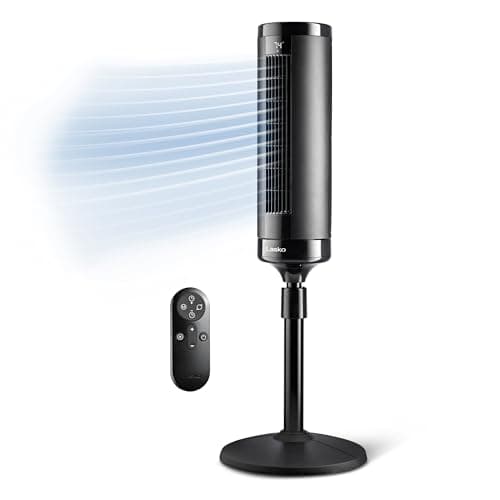 Hardest to clean, easiest to live with Lasko EcoQuiet 42" DC Tower Fan A tower fan does not open — but its enclosed impeller collects dust more slowly than an exposed blade, and 23 dBA gives you a baseline to notice drift from. | A bedroom, where sealed construction is a fair trade | |
| 3 | 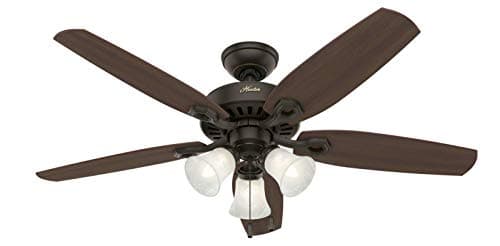 The one that most needs cleaning Hunter Vespucci 52" Ceiling Fan Ceiling fan blades collect dust year-round from still air, and an unbalanced blade at 52 inches produces a wobble you feel across the room. | Any ceiling fan, which collects dust whether or not it runs | |
| — | 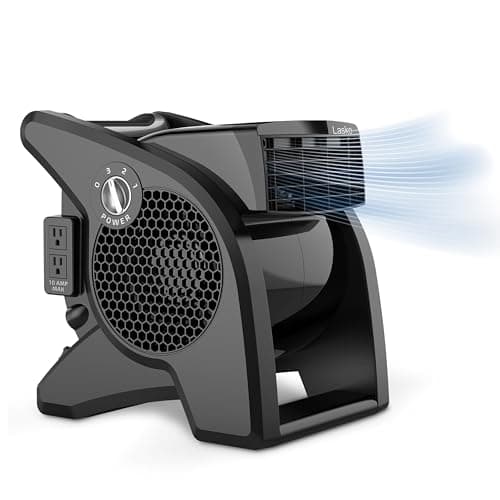 The one not to open Lasko Max Performance 15" Air Mover An air mover with two live accessory outlets in the housing is not a fan to take apart on a kitchen table. | Wiping down, not disassembling |
Most people clean a fan because it looks dirty. The better reason is that it has started making a noise it did not use to make, and dust is almost always why.
The mechanism
Dust does not land evenly, and that is the problem
A fan blade is a rotating mass. It is balanced at the factory so that the weight is distributed symmetrically around the hub, and at a few hundred RPM even a small asymmetry produces a measurable vibration.
Dust accumulates unevenly. More collects on the leading edge than the trailing edge, more on the blade facing the room than the one facing a wall, and more wherever a little grease or humidity has made the surface tacky. Within a season you have an unbalanced rotating mass.
That produces three symptoms, in order of how much they annoy people:
- A rattle or a wobble, which is vibration transmitted into the housing or the mount. This is the one people notice.
- A change in pitch, because the blade is no longer cutting air cleanly.
- Slightly less airflow, because dust changes the blade’s profile and a clogged intake grille restricts what the fan can draw.
Intermittent, tonal noise is exactly the kind your brain refuses to ignore — which is why a dusty fan ruins sleep in a way a genuinely louder but steady fan does not. More on why steady beats quiet here.
By type
How to clean each kind
Unplug it first. Every time, all four types. A fan blade can be turned by hand into a switch position, and impellers store surprising momentum.
Box, pedestal and floor fans — full disassembly
- Unplug. Lay the fan on newspaper.
- Remove the grille screws — typically four to six around the rim. Keep them in a cup; they are usually not identical.
- Lift off the front grille. On most pedestal fans the blade is held by a plastic nut that unscrews clockwise (reverse thread), which is the step people force and break.
- Wash blade and grilles in warm soapy water. Dry completely — water in a motor housing is the one way to turn cleaning into a repair.
- Wipe the motor housing with a barely damp cloth. Do not soak it and do not open it.
- Reassemble, checking the blade is seated flat before tightening.
Tower fans — compressed air only
Tower fans are sealed by design and there is no user-serviceable route to the impeller. Do not pry the housing apart; the clips break and it will never sit flush again.
- Unplug.
- Vacuum the intake grille (usually the back) with a brush attachment to lift the surface layer.
- Blow compressed air through the intake, working along its length, with the outlet pointed somewhere you do not mind dust landing. Outdoors is ideal.
- Hold the impeller from spinning freely while you do it — compressed air can spin a fan motor faster than it is designed to turn.
- Wipe the outer housing with a damp cloth.
Ceiling fans — the pillowcase trick
- Switch off at the wall, and let the blades stop completely.
- Slide an old pillowcase over one blade, press gently top and bottom, and draw it back off. The dust stays inside the case.
- Repeat per blade, then wipe the motor housing.
- Check the blades are all seated at the same angle. A blade knocked out of pitch causes a wobble that cleaning will not fix.
- While you are up there, check the direction switch — counterclockwise for summer.
Window fans — the seasonal one
A window fan lives in the dirtiest position in the house, pulling outdoor air with whatever is in it. Clean it at the end of every season before storing, and check the extender panels and seals for grit that stops them closing properly.
This one is not a DIY job
Do not open a motor housing. On every fan type, the sealed motor assembly is where cleaning stops. Bearings on domestic fan motors are usually sealed and not intended to be lubricated; adding oil through a vent attracts dust and makes things worse.
If a fan is noisy after a proper clean and rebalance, the bearings are worn. At the prices in this category that is a replacement rather than a repair, and opening a motor to find out is not worth the risk.
Cadence
How often
| Fan | How often | Method |
|---|---|---|
| Box / window fan | Start and end of season | Full disassembly, wash |
| Pedestal / floor fan | Start and end of season | Full disassembly, wash |
| Tower fan | Every 2-3 months in use | Vacuum + compressed air |
| Ceiling fan | Twice a year, plus before first summer use | Pillowcase + damp cloth |
| Air mover / utility fan | Monthly in a workshop | External wipe + compressed air |
The single most valuable one is the ceiling fan before first summer use, because it has been collecting dust all winter and the first run redistributes it around the room.
Say the unwelcome thing
Do not tape a filter to a fan to keep it clean.
The box-fan-plus-furnace-filter idea circulates as both an air purifier and a way of keeping the blade clean. It does neither safely.
A box fan motor is designed to spin in free air, not to pull against the static pressure of a filter. Restricting the intake makes it work harder, run hotter and draw more current than its design point — and several fire services have warned about the practice for exactly that reason.
Clean the blade twice a season instead. If you want filtered air, buy something built to pull through a filter.
Worth knowing
Storage matters more than cleaning
Most of a fan’s dust load arrives during the eight months it is not running. A fan stored uncovered in a garage or loft collects far more than one used daily in a bedroom.
Clean it at the end of the season rather than the start, then bag or box it. That way the dust never bonds to the blade over winter, and next summer it works properly the day you take it out. Keeping the original box makes this trivial and is worth the shelf space — a 7.8 lb tower fan boxes away into almost nothing.
In full
Every pick, and what is wrong with it
Published specifications only, each linked to the page it came from. Where a manufacturer publishes nothing, the row says so — we do not fill blanks in.
1. Easiest to clean properly
Lasko Power Plus 20" Box Fan
Lasko · model B20801
A box fan's grille unscrews, which makes it the only common form factor you can fully clean without compressed air.
The open frame that makes a box fan cheap also makes it serviceable. Four to six screws around the grille and the blade is exposed for a proper wash.
That matters because a box fan accumulates dust fastest — it pulls the most air through the largest opening, often while sitting in a window collecting whatever blows in. A weather-resistant motor tolerates the environment; the blade still needs cleaning.
$4.49 for a month of eight-hour nights, and a clean blade is the difference between that being quiet money and noisy money.
What’s wrong with it
73-102 W and no published noise figure, so you cannot tell from the spec sheet whether cleaning has helped. It also collects the most dust of any fan here, because it moves the most air.
Running cost — B20801
| Nameplate power | 73 W – 102 W | manufacturer's published figure |
|---|---|---|
| Energy, 8-hour night | 0.82 kWh | 102 ÷ 1000 × 8 |
| Cost per hour | 1.9¢ | at 18.34¢/kWh |
| Cost per 8-hour night | 15¢ | on the highest speed |
| Cost per 30 nights | $4.49 | 24.5 kWh |
| Same month, lowest speed | $3.21 | at 73 W |
Rate: 18.34¢/kWh, the US average residential price for June 2026 (EIA Electric Power Monthly, Table 5.3). Yours will differ — swap it in: (watts ÷ 1000) × hours × your rate.
| Power | 73 W - 102 W (0.6-0.9 A at 120 V) |
|---|---|
| Speeds | 3 |
| Dimensions | 21.25 H x 22.5 x 4.75 in |
| Weight | 10.1 lb |
| Motor | Weather-resistant |
| Air delivery (CFM) | Not published |
| Warranty | 2 years |
Every figure above is from Lasko product page, B20801. Blanks are shown as “not published” rather than filled in.
2. Hardest to clean, easiest to live with
Lasko EcoQuiet 42" DC Tower Fan
Lasko · model T42710
A tower fan does not open — but its enclosed impeller collects dust more slowly than an exposed blade, and 23 dBA gives you a baseline to notice drift from.
Sealed towers are the trade-off case. You give up the ability to fully clean the blade, and in return the impeller is shielded from most of what settles on an open fan.
The published 23 dBA on low is quietly useful for maintenance: it gives you a reference point. If a fan that was inaudible starts being audible, something has changed, and dust on an impeller is the usual reason.
Compressed air through the intake grille, with the fan unplugged and held so the impeller cannot spin freely. More on tower fan construction here.
What’s wrong with it
You cannot reach the impeller. Cleaning means compressed air through the grille, and if something gets inside the housing there is no user-serviceable route to it.
Running cost — T42710
| Nameplate power | 2.9 W – 19 W | manufacturer's published figure |
|---|---|---|
| Energy, 8-hour night | 0.15 kWh | 19 ÷ 1000 × 8 |
| Cost per hour | 0.3¢ | at 18.34¢/kWh |
| Cost per 8-hour night | 2.8¢ | on the highest speed |
| Cost per 30 nights | 84¢ | 4.6 kWh |
| Same month, lowest speed | 13¢ | at 2.9 W |
Rate: 18.34¢/kWh, the US average residential price for June 2026 (EIA Electric Power Monthly, Table 5.3). Yours will differ — swap it in: (watts ÷ 1000) × hours × your rate.
| Power | 2.9 W - 19 W (0.06-0.303 A at 120 V) |
|---|---|
| Noise | 23 dBA low, 46 dBA high |
| Speeds | 12 |
| Height | 41.6 in |
| Footprint | 12.8 x 12.8 in |
| Weight | 7.8 lb |
| Timer | 8 hours |
| Air delivery (CFM) | Not published |
| Warranty | 2 years |
Every figure above is from Lasko product page, T42710. Blanks are shown as “not published” rather than filled in.
3. The one that most needs cleaning
Hunter Vespucci 52" Ceiling Fan
Hunter · model Vespucci
Ceiling fan blades collect dust year-round from still air, and an unbalanced blade at 52 inches produces a wobble you feel across the room.
Ceiling fans are the worst offenders and the least often cleaned, because the dust sits on the top surface of the blades where nobody sees it. It accumulates all winter while the fan is off.
At 1.8 W on low and 13.9 W on high this is the cheapest fan in the house to run — about 7.9¢ a month of nights — so keeping it balanced and quiet is protecting the best cooling value you own.
The pillowcase method is the one worth knowing: slide a pillowcase over each blade, press gently, and pull it back. The dust ends up in the case rather than on the bed underneath.
What’s wrong with it
It is work at height, and a wobble that persists after cleaning needs a balancing kit rather than more wiping. Blades must be at least 7 ft from the floor, so a stable ladder is not optional.
Running cost — Vespucci
| Nameplate power | 1.8 W – 13.9 W | manufacturer's published figure |
|---|---|---|
| Energy, 8-hour night | 0.11 kWh | 13.9 ÷ 1000 × 8 |
| Cost per hour | 0.3¢ | at 18.34¢/kWh |
| Cost per 8-hour night | 2.0¢ | on the highest speed |
| Cost per 30 nights | 61¢ | 3.3 kWh |
| Same month, lowest speed | 7.9¢ | at 1.8 W |
Rate: 18.34¢/kWh, the US average residential price for June 2026 (EIA Electric Power Monthly, Table 5.3). Yours will differ — swap it in: (watts ÷ 1000) × hours × your rate.
| Blade span | 52 in |
|---|---|
| Efficiency | 366.7 CFM per watt |
| Power, high speed | 13.9 W |
| Power, low speed | 1.8 W |
| Standby power | 0.8 W |
| Type | Indoor, fan only (no light kit) |
| Warranty | 3 years, components |
| ENERGY STAR | Certified |
Every figure above is from ENERGY STAR Certified Ceiling Fans dataset. Blanks are shown as “not published” rather than filled in.
Skip this one
Lasko Max Performance 15" Air Mover
Lasko · model U15720
An air mover with two live accessory outlets in the housing is not a fan to take apart on a kitchen table.
Included as a genuine caution rather than a product criticism. This unit carries two 120 V accessory outlets in its body, which means mains wiring runs through the housing to serve them.
Wipe it down, blow the grille out with compressed air, and leave the housing closed. If it develops a rattle or the outlets stop working, that is a repair question rather than a cleaning one.
It lives in a garage or workshop, where it will get dusty faster than anything indoors.
What’s wrong with it
160-178 W and integrated 120 V outlets. The blade is behind a fixed grille, and the housing carries mains wiring to the accessory sockets — external cleaning only.
Running cost — U15720
| Nameplate power | 160 W – 178 W | manufacturer's published figure |
|---|---|---|
| Energy, 8-hour night | 1.42 kWh | 178 ÷ 1000 × 8 |
| Cost per hour | 3.3¢ | at 18.34¢/kWh |
| Cost per 8-hour night | 26¢ | on the highest speed |
| Cost per 30 nights | $7.83 | 42.7 kWh |
| Same month, lowest speed | $7.04 | at 160 W |
Rate: 18.34¢/kWh, the US average residential price for June 2026 (EIA Electric Power Monthly, Table 5.3). Yours will differ — swap it in: (watts ÷ 1000) × hours × your rate.
| Power | 160 W - 178 W (1.35-1.53 A at 120 V) |
|---|---|
| Speeds | 3 |
| Dimensions | 14.5 H x 14.0 D x 11.5 W in |
| Weight | 12.55 lb |
| Extras | Two 120 V accessory outlets, 9.5 ft cord, pivoting head |
| Air delivery (CFM) | Not published |
| Warranty | 1 year |
Every figure above is from Lasko product page, U15720. Blanks are shown as “not published” rather than filled in.
We are not linking a buy button for this one. If you want to look at it anyway, it is easy enough to find — but we would rather send you to something that fits your room.
Questions people actually ask
Frequently asked
Why has my fan got louder?
Almost always uneven dust on the blade. Dust collects more on leading edges and room-facing surfaces, which unbalances a rotating mass and turns a steady hum into a rattle or wobble. Cleaning and reseating the blade usually fixes it completely.
How do you clean a tower fan?
You cannot open one — they are sealed and prying the housing breaks the clips. Unplug it, vacuum the intake grille with a brush attachment, then blow compressed air through the intake while holding the impeller so it cannot spin freely.
How often should I clean a fan?
Box, window, pedestal and floor fans at the start and end of each season with a full disassembly. Tower fans every two to three months in use. Ceiling fans twice a year, and especially before first summer use after collecting dust all winter.
How do you clean ceiling fan blades without making a mess?
Slide an old pillowcase over each blade, press gently on both surfaces, and draw it back off. The dust ends up inside the case rather than on the floor. Then wipe the motor housing and check all blades sit at the same angle.
Can I use water to clean a fan?
On the blade and grilles, yes — warm soapy water, dried completely before reassembly. Never on the motor housing beyond a barely damp cloth, and never open the motor assembly. Water inside a motor turns a cleaning job into a replacement.
My fan still wobbles after cleaning. What now?
On a ceiling fan, check every blade sits at the same angle and use a balancing kit if one is out. On a portable fan, check the blade is seated flat on its hub. If it persists after both, the bearings are worn — at these prices that is a replacement rather than a repair.
Sources
Where these numbers came from
Read next
Where to go from here
Back to Fans, or read how we pick.