The picks
Window air conditioners with heat
A reverse-cycle window unit heats and cools from one machine. The surprise is that the heating version is also the most efficient cooler certified.
By Sawyer V. · Published
The short answer
Only 33 of 485 certified room air conditioners also heat. The Midea MAH09B1AGR leads them at CEER 17.6 and 404.8 kWh a year — which is also the highest CEER of any room air conditioner in the entire certified dataset, heating or not. The catch is format: the most efficient units are saddle-style, averaging 31 inches deep and 104 lb.
Fan & Frost earns a commission when you buy through our links, at no cost to you. It never changes a ranking, and we say so when the right answer is the cheaper unit or nothing at all. Full disclosure · How we pick.

At a glance
The picks, ranked
Tap any row to jump to the full reasoning. Prices are live from Amazon where we have them, and read “check price” where we don’t — never a number we cannot verify today.
| # | Product | Best for | Price |
|---|---|---|---|
| 1 | Most efficient room AC certified, and it heats Midea Window Heat Pump Air Conditioner, 9,500 BTU CEER 17.6 and 404.8 kWh a year at 9,500 BTU — 80% less energy than the federal standard, and the top CEER in the whole dataset. | A room that needs both, where the window can take a saddle unit | |
| 2 | 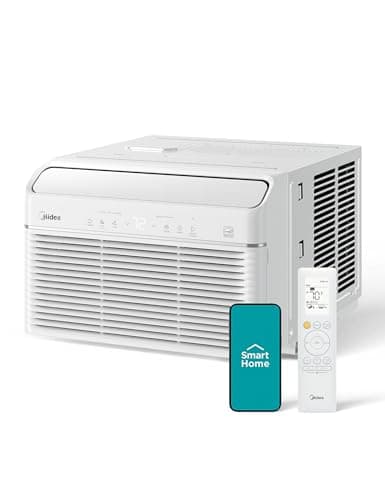 The one you can actually install Midea Window Air Conditioner with Heat, 8,000 BTU 8,000 BTU with heat at CEER 15.1 and 397.4 kWh — and 56 lb in a conventional 22-inch-deep body. | Anyone who wants heat without a 129 lb machine in the window | |
| 3 | Most capacity with heat Friedrich Kuhl+ Window Heat Pump, 12,600 BTU 12,600 BTU at CEER 15.8 — the most cooling capacity of any certified reverse-cycle room unit we hold data for. | A larger room needing both heating and cooling from one unit | |
| — | The heaviest install here Gradient CCHP11 Window Heat Pump, 9,300 BTU 9,300 BTU at CEER 16.8 and 415.2 kWh — excellent numbers attached to a 140 lb machine. | A room where the saddle format suits — with help and a bracket |
A reverse-cycle room air conditioner is a heat pump in a window frame. Same compressor, same coils, plus a reversing valve that swaps which coil absorbs heat and which releases it — so the machine that cooled you in July heats you in November.
It is a small and unusual category, and the certified data holds a genuine surprise.
The finding
The best cooler in the dataset is a heater
We pulled all 485 certified room air conditioners and sorted them by CEER, expecting the reverse-cycle models to sit somewhere mid-field — heating hardware usually costs something on the cooling side.
It does not. The highest CEER in the entire dataset, 17.6, belongs to a heat pump. So does the second-highest, at 16.8.
| Unit | BTU | CEER | kWh/yr | Weight | vs standard |
|---|---|---|---|---|---|
| Midea MAH09B1AGR | 9,500 | 17.6 | 404.8 | 129 lb | 80% |
| Gradient CCHP11 | 9,300 | 16.8 | 415.2 | 140 lb | 71% |
| Friedrich Kühl+ KHVS12B33B | 12,600 | 15.8 | 598.1 | 115 lb | 61% |
| Midea MAW08HV1KWT-A | 8,000 | 15.1 | 397.4 | 56 lb | 54% |
| GREE GJH09BW-A6DRNL1A | 9,300 | 15.1 | 461.9 | 116 lb | — |
The five highest-CEER reverse-cycle units in the ENERGY STAR Certified Room Air Conditioners dataset, 33 of which carry heating mode. All five are on the Most Efficient list.
The likely explanation is selection rather than physics. Reverse-cycle room units are a small, recent and premium category — 33 units out of 485 — so the field is made up almost entirely of current-generation designs with variable-speed compressors and R-32 refrigerant. There are no old, cheap models dragging the average down.
Either way, the practical conclusion holds: adding heating does not cost you cooling efficiency. If you were choosing on CEER alone you would end up here anyway.
The catch
The efficient ones are saddle units
The certified dataset records how each unit mounts, and the pattern is clear once you look at it.
| Mounting type | Units | Mean depth | Mean weight |
|---|---|---|---|
| Does not straddle window or sill | 277 | 21.0 in | 63.4 lb |
| Straddles the window | 177 | 21.9 in | 62.7 lb |
| Straddles the windowsill (saddle) | 31 | 31.3 in | 104.3 lb |
Computed by us across all 485 certified room air conditioners.
Saddle units average 31.3 inches deep and 104.3 lb, against roughly 21 inches and 63 lb for everything else. Half again the depth and two thirds more weight.
That is the format that buys the efficiency — a much larger outdoor coil hanging over the sill, and a deeper air path — and it is the format that makes installation a genuinely different job. Our installation guide assumes a conventional unit; a 129 lb saddle machine is beyond what it describes.
This one is not a DIY job
How well these heat is not in the certified data. The room air conditioner program publishes cooling figures only — CEER, annual kWh, capacity. There is no HSPF2, no COP, and no heating capacity at low outdoor temperature.
That is a real gap, because heat pump heating performance falls off as it gets colder and the rate varies enormously between machines. For mini-splits, where the data does exist, certified COP at 5°F ranges from 1.3 to 2.89 across the field.
So: ask the manufacturer for the heating capacity at your design temperature before assuming one of these will carry a room through winter. Treat the heating as a useful shoulder-season supplement unless you have a number saying otherwise.
Worth it?
When the heating earns its keep
Strong case: the room has electric resistance heating — baseboards, a panel heater, a fan heater. Resistance heating converts electricity to heat at best one-for-one; a heat pump moves existing heat and delivers several times that per unit of electricity. Replacing resistance heat is where this category genuinely pays.
Strong case: the room has no heating at all — a converted garage, a sunroom, an addition, a finished basement. One machine instead of two, one window occupied instead of two appliances.
Weak case: the house has central heating that already serves the room adequately. You are buying a second heating system, and the cooling-only units are lighter, cheaper to install, and available in far more shapes.
Say the unwelcome thing
Do not buy a saddle unit without measuring the window first.
These are not shaped like the window air conditioner you have installed before, and a unit that will not fit is an expensive discovery to make on the day.
Three measurements, all of them. Sash opening width, because the body must pass through it. Sill depth and what is behind it — a saddle unit hangs 31 inches on average, so a storm window, a security grille or a shallow ledge stops it dead. Sash travel, since a unit 24 inches tall needs the window to open that far.
And read the weight honestly. 104 lb is the average for this format and 140 lb is on this page. That is not a two-people-and-an-afternoon job in the way a 56 lb conventional unit is.
In full
Every pick, and what is wrong with it
Published specifications only, each linked to the page it came from. Where a manufacturer publishes nothing, the row says so — we do not fill blanks in.
1. Most efficient room AC certified, and it heats
Midea Window Heat Pump Air Conditioner, 9,500 BTU
Midea · model MAH09B1AGR
CEER 17.6 and 404.8 kWh a year at 9,500 BTU — 80% less energy than the federal standard, and the top CEER in the whole dataset.
CEER 17.6. Across all 485 certified room air conditioners — every window and through-the-wall unit in the program — nothing rates higher. The most efficient cooler certified happens to be a heat pump.
404.8 kWh a year, about $74 for a cooling season, and 80% less energy than the federal standard — the largest margin in the dataset.
The format is the trade. It straddles the windowsill: the machine hangs over the sill like a saddle, with the compressor half outside and the room half inside, and the sash closes into a gap between them. That geometry is why it is 41.2 inches deep and 129 lb.
No support bracket required, which is unusual at that weight — the saddle design carries its own load over the sill.
What’s wrong with it
129 lb and 41.2 inches deep. This is a saddle-style unit and it is a serious piece of equipment to install.
Running cost — MAH09B1AGR
| Annual energy use | 404.8 kWh | ENERGY STAR certified figure |
|---|---|---|
| Annual cost | $74 | 404.8 × 18.34¢/kWh |
| Per cooling month | $19 | spread over a four-month season |
The annual figure is the certified value from the ENERGY STAR Certified Room Air Conditioners dataset, which models a standard cooling season rather than your actual summer. It is more useful than a nameplate wattage here, because a variable-speed compressor spends most of its life well below nameplate.
Rate: 18.34¢/kWh, the US average residential price for June 2026 (EIA Electric Power Monthly, Table 5.3). Yours will differ — swap it in: (watts ÷ 1000) × hours × your rate.
| Cooling capacity | 9,500 BTU/h |
|---|---|
| Heating mode | Yes, reverse cycle |
| CEER | 17.6 |
| Annual energy use | 404.8 kWh/yr |
| vs federal standard | 80% less energy |
| Dimensions | 20.9 H x 25.0 W x 41.2 D in |
| Weight | 129.0 lb |
| Installation | Straddles the windowsill (saddle style) |
| Support bracket | Not required |
| Compressor | Variable speed |
| Refrigerant | R-32 |
| ENERGY STAR | Certified, and on the Most Efficient list |
Every figure above is from ENERGY STAR Certified Room Air Conditioners dataset. Blanks are shown as “not published” rather than filled in.
2. The one you can actually install
Midea Window Air Conditioner with Heat, 8,000 BTU
Midea · model MAW08HV1KWT-A
8,000 BTU with heat at CEER 15.1 and 397.4 kWh — and 56 lb in a conventional 22-inch-deep body.
56 lb. That is the number that matters, because it is less than half the weight of the efficiency leader and it fits a normal window in the normal way.
13.9 H x 19.4 W x 22.2 D inches, does not straddle the sill, no support bracket required. If you have installed a window air conditioner before, this is that job.
The efficiency cost is real but not severe: CEER 15.1 and 397.4 kWh a year, about $73. Interestingly it uses less annual energy than the more efficient saddle unit, because it is a smaller machine — 8,000 BTU against 9,500.
Variable-speed compressor, R-32, and on the Most Efficient list. For most people this is the practical pick.
What’s wrong with it
CEER 15.1 against the saddle unit's 17.6, and 54% below the federal standard against 80%.
Running cost — MAW08HV1KWT-A
| Annual energy use | 397.4 kWh | ENERGY STAR certified figure |
|---|---|---|
| Annual cost | $73 | 397.4 × 18.34¢/kWh |
| Per cooling month | $18 | spread over a four-month season |
The annual figure is the certified value from the ENERGY STAR Certified Room Air Conditioners dataset, which models a standard cooling season rather than your actual summer. It is more useful than a nameplate wattage here, because a variable-speed compressor spends most of its life well below nameplate.
Rate: 18.34¢/kWh, the US average residential price for June 2026 (EIA Electric Power Monthly, Table 5.3). Yours will differ — swap it in: (watts ÷ 1000) × hours × your rate.
| Cooling capacity | 8,000 BTU/h |
|---|---|
| Heating mode | Yes, reverse cycle |
| CEER | 15.1 |
| Annual energy use | 397.4 kWh/yr |
| vs federal standard | 54% less energy |
| Dimensions | 13.9 H x 19.4 W x 22.2 D in |
| Weight | 56.0 lb |
| Installation | Does not straddle the windowsill |
| Support bracket | Not required |
| Compressor | Variable speed |
| Refrigerant | R-32 |
| ENERGY STAR | Certified, and on the Most Efficient list |
Every figure above is from ENERGY STAR Certified Room Air Conditioners dataset. Blanks are shown as “not published” rather than filled in.
3. Most capacity with heat
Friedrich Kuhl+ Window Heat Pump, 12,600 BTU
Friedrich · model KHVS12B33B
12,600 BTU at CEER 15.8 — the most cooling capacity of any certified reverse-cycle room unit we hold data for.
12,600 BTU at CEER 15.8, which is a genuinely good efficiency figure at that capacity — the best 14,000 to 20,000 BTU cooling-only unit in the dataset manages 16.2.
598.1 kWh a year, about $110 for a cooling season, and 61% below the federal standard.
At 15.9 inches high and 29 inches deep it is a lower-profile saddle unit than the Midea, which matters for windows with limited sash travel. 115 lb, and a support bracket is required — budget for that and for two people.
If the room is genuinely large, compare against the cooling-only options first.
What’s wrong with it
598.1 kWh a year and 115 lb, with a support bracket required. It is a big machine for a big room.
Running cost — KHVS12B33B
| Annual energy use | 598.1 kWh | ENERGY STAR certified figure |
|---|---|---|
| Annual cost | $110 | 598.1 × 18.34¢/kWh |
| Per cooling month | $27 | spread over a four-month season |
The annual figure is the certified value from the ENERGY STAR Certified Room Air Conditioners dataset, which models a standard cooling season rather than your actual summer. It is more useful than a nameplate wattage here, because a variable-speed compressor spends most of its life well below nameplate.
Rate: 18.34¢/kWh, the US average residential price for June 2026 (EIA Electric Power Monthly, Table 5.3). Yours will differ — swap it in: (watts ÷ 1000) × hours × your rate.
| Cooling capacity | 12,600 BTU/h |
|---|---|
| Heating mode | Yes, reverse cycle |
| CEER | 15.8 |
| Annual energy use | 598.1 kWh/yr |
| vs federal standard | 61% less energy |
| Dimensions | 15.9 H x 25.9 W x 29.0 D in |
| Weight | 115.0 lb |
| Installation | Straddles the windowsill |
| Support bracket | Required |
| Compressor | Variable speed |
| Refrigerant | R-32 |
| ENERGY STAR | Certified, and on the Most Efficient list |
Every figure above is from ENERGY STAR Certified Room Air Conditioners dataset. Blanks are shown as “not published” rather than filled in.
Skip this one
Gradient CCHP11 Window Heat Pump, 9,300 BTU
Gradient · model CCHP11
9,300 BTU at CEER 16.8 and 415.2 kWh — excellent numbers attached to a 140 lb machine.
Nothing is wrong with the machine. CEER 16.8 is the second-highest figure in the entire certified room AC dataset, and 415.2 kWh a year is about $76.
It is listed as a skip purely on installability. 140 lb, 24 inches tall, 37.3 inches deep, and a support bracket required. That is not a two-person afternoon; it is a job with equipment.
If you are having it installed professionally and the window suits it, the efficiency case is strong. If you are lifting it yourself, the 56 lb Midea is the realistic choice.
71% below the federal standard, R-32, variable-speed compressor, Most Efficient listed.
What’s wrong with it
140 lb is the heaviest unit on this page, it requires a support bracket, and 24 inches tall needs real sash travel.
Running cost — CCHP11
| Annual energy use | 415.2 kWh | ENERGY STAR certified figure |
|---|---|---|
| Annual cost | $76 | 415.2 × 18.34¢/kWh |
| Per cooling month | $19 | spread over a four-month season |
The annual figure is the certified value from the ENERGY STAR Certified Room Air Conditioners dataset, which models a standard cooling season rather than your actual summer. It is more useful than a nameplate wattage here, because a variable-speed compressor spends most of its life well below nameplate.
Rate: 18.34¢/kWh, the US average residential price for June 2026 (EIA Electric Power Monthly, Table 5.3). Yours will differ — swap it in: (watts ÷ 1000) × hours × your rate.
| Cooling capacity | 9,300 BTU/h |
|---|---|
| Heating mode | Yes, reverse cycle |
| CEER | 16.8 |
| Annual energy use | 415.2 kWh/yr |
| vs federal standard | 71% less energy |
| Dimensions | 24.0 H x 25.3 W x 37.3 D in |
| Weight | 140.0 lb |
| Installation | Straddles the window (saddle style) |
| Support bracket | Required |
| Compressor | Variable speed |
| Refrigerant | R-32 |
| ENERGY STAR | Certified, and on the Most Efficient list |
Every figure above is from ENERGY STAR Certified Room Air Conditioners dataset. Blanks are shown as “not published” rather than filled in.
We are not linking a buy button for this one. If you want to look at it anyway, it is easy enough to find — but we would rather send you to something that fits your room.
Questions people actually ask
Frequently asked
Do window air conditioners with heat exist?
Yes, but the category is small — 33 of the 485 certified room air conditioners carry a heating mode. They are reverse-cycle heat pumps: the same compressor and coils, with a valve that swaps which coil absorbs heat and which releases it.
Does adding heating make a window unit less efficient at cooling?
No. The highest CEER in the entire certified dataset, 17.6, belongs to a heat pump, and so does the second-highest at 16.8. The category is small, recent and premium, so it contains almost no old designs to drag the average down.
What is a saddle-style window air conditioner?
One that straddles the windowsill, hanging over it like a saddle with the compressor half outside and the room half inside. It buys efficiency through a larger outdoor coil, and costs size — saddle units average 31.3 inches deep and 104.3 lb against 21 inches and 63 lb for conventional units.
How well do heated window air conditioners work in cold weather?
The certified data does not say. The room air conditioner program publishes cooling figures only — no HSPF2, no COP, no heating capacity at low outdoor temperature. Ask the manufacturer for capacity at your design temperature rather than assuming. Heat pump vs air conditioner.
Is a window heat pump worth it?
Strongly, if the room currently uses electric resistance heating — a heat pump moves existing heat rather than converting electricity one-for-one. Also strong for a room with no heating at all. Weak if central heating already serves the room adequately.
Which window air conditioner with heat is easiest to install?
The Midea MAW08HV1KWT-A at 56 lb in a conventional 22-inch-deep body, with no support bracket required. The more efficient units on this page are saddle-style at 115 to 140 lb, which is a materially different installation.
Sources
Where these numbers came from
- ENERGY STAR Certified Room Air Conditioners dataset — CEER, annual kWh, heating mode, mounting type, weight, support bracket (485 records analyzed, 33 with heating)
- ENERGY STAR Certified Mini-Split Heat Pumps dataset — COP at 5°F range, for the heating-performance comparison
- EIA Electric Power Monthly, Table 5.3 — electricity rate
Read next
Where to go from here
Back to Air Conditioners, or read how we pick.