The picks
Best ceiling fans for high ceilings
We analyzed all 1,398 certified ceiling fans by span. The median rises steadily with size, and the very best result comes from a fan two feet smaller than the biggest.
By Sawyer V. · Published
The short answer
For a tall room, go large — but not because the biggest fans are the most efficient. Across 1,398 certified US ceiling fans, median efficiency rises from 148.6 CFM per watt at 43 inches or less to 306.0 at 84 inches. The single best figure, however, is 483.0 CFM per watt on a 60-inch fan, beating every 84-inch model. Span raises the floor; motor and blade design set the ceiling.
Fan & Frost earns a commission when you buy through our links, at no cost to you. It never changes a ranking, and we say so when the right answer is the cheaper unit or nothing at all. Full disclosure · How we pick.

At a glance
The picks, ranked
Tap any row to jump to the full reasoning. Prices are live from Amazon where we have them, and read “check price” where we don’t — never a number we cannot verify today.
| # | Product | Best for | Price |
|---|---|---|---|
| 1 | Most efficient certified fan, any span Aeratron AE+2 60" Ceiling Fan 483.0 CFM per watt on 16.2 W — the highest figure in the entire 1,398-record certified dataset, at 60 inches. | A tall room where you want the best air-per-watt available | |
| 2 | 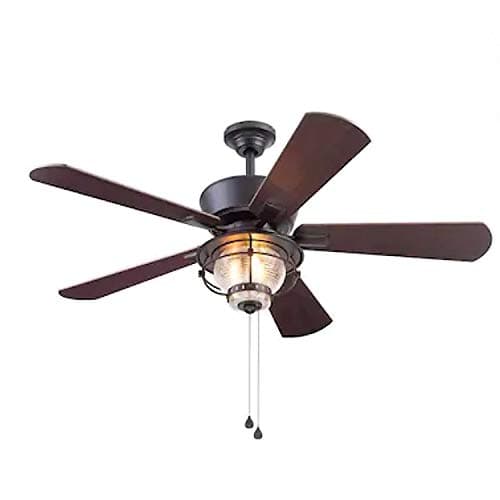 Best coverage, and outdoor-rated Harbor Breeze Cando 84" Ceiling Fan 422.2 CFM per watt on 30.6 W at 84 inches — the best outdoor-rated figure certified, and the widest coverage here. | A genuinely large or vaulted space, indoors or on a covered patio | |
| 3 | 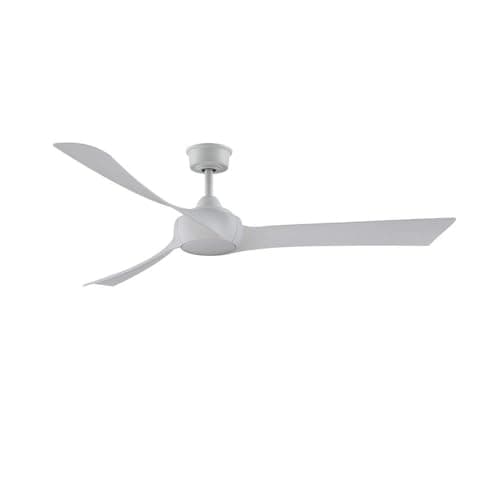 Lowest low-speed draw at 84 inches Fanimation 84" Ceiling Fan (MAD8531) 420.0 CFM per watt at 84 inches, and 3.3 W on low — half the Harbor Breeze's low-speed draw. | A big room you want stirring gently and continuously | |
| — | What a small fan costs you up high Maxim 42" Ceiling Fan with Light Kit 242.3 CFM per watt at 42 inches. Half the efficiency of the pick above, and nowhere near the coverage a tall room needs. | A small room with a normal ceiling — not a tall one |
A high ceiling changes two things at once: there is more air volume to move, and the fan is further from the people it is meant to serve. Both push toward a larger fan on a longer downrod.
Our analysis
What 1,398 certified fans show about span
We pulled the complete ENERGY STAR Certified Ceiling Fans dataset and grouped every US-market record by blade span.
| Span | Fans | Median CFM/W | Best CFM/W |
|---|---|---|---|
| 43 in or less | 61 | 148.6 | 338.0 |
| 44 – 47 in | 103 | 163.0 | 304.5 |
| 48 – 51 in | 21 | 223.5 | 377.0 |
| 52 – 59 in | 747 | 190.4 | 368.0 |
| 60 – 71 in | 360 | 229.0 | 483.0 |
| 72 – 83 in | 69 | 287.0 | 409.2 |
| 84 in and up | 37 | 306.0 | 422.2 |
Computed by us across 1,398 US-market records in the ENERGY STAR Certified Ceiling Fans dataset.
Two things fall out of that table, and they point in different directions.
The median rises steadily with span — 148.6 to 306.0, a little over twice. So if you pick a fan at random, a bigger one will very likely be more efficient. The physics is straightforward: a larger disc moves the same air more slowly, and drag rises steeply with speed, so slow air is disproportionately cheap.
The maximum does not. The best 60-inch fan reaches 483.0 CFM per watt; the best 84-inch reaches 422.2. There are 360 records in the 60–71 inch band and only 37 at 84 inches, so part of that is sample size — but the practical conclusion holds.
Span raises the floor. Motor and blade design set the ceiling. Buying big improves your odds; buying well beats it.
Height
Getting the fan down to where the air is useful
A fan mounted tight to a fourteen-foot ceiling is stirring air nobody is standing in. The airflow spreads and slows long before it reaches head height, and the room below stays still.
A downrod fixes that by lowering the blade disc into the occupied zone. The usual guidance is to keep blades at least 7 feet above the floor, with roughly 8 to 9 feet being where most fans are aimed for.
Which gives a rough starting point: subtract about 9 feet from your ceiling height and that is the downrod length to look at. A twelve-foot ceiling wants something in the region of three feet of rod.
Check the manufacturer’s own downrod chart before ordering — they differ, and the fan body height counts toward the total. Mounting and downrod detail.
This one is not a DIY job
A sloped or vaulted ceiling needs a compatible canopy. Most fans ship with a canopy rated to a certain slope — commonly around 15 to 20 degrees — and steeper ceilings need an angled mount kit. Check the fan’s stated maximum before you buy, not after.
Blade clearance still applies at height. Keep tips at least 18 inches from the nearest wall or beam. In a vaulted room the slope brings the ceiling down toward the walls, so a fan centered in the room may still be close to structure at the edges of its sweep.
Longer rod, more leverage on the mount. A three-foot downrod amplifies any angular error at the top into a visible circle at the tips, so a large fan on a long rod is unforgiving of a sloppy install. Diagnosing wobble.
Winter
The other reason tall rooms want a fan
Stratification scales with ceiling height. In an eight-foot room the temperature difference between floor and ceiling is small enough to ignore. In a vaulted or double-height space it is the reason the room never feels warm in January despite the heating running.
Run the fan clockwise and on its lowest speed and it pulls room air up the middle, pushing the warm ceiling layer gently down the walls without creating a draft you can feel.
At 2.9 to 6.0 W on low across the fans here, that costs between 0.6¢ and 1.3¢ for a twelve-hour evening — against heat you have already paid for and are currently collecting at the ceiling.
The winter method in full, and sunrooms, where stratification is worst.
Say the unwelcome thing
Do not buy the biggest fan that fits and assume it is the most efficient.
The dataset supports going large as a default and does not support treating span as a proxy for efficiency.
The best 60-inch fan reaches 483.0 CFM per watt on 16.2 W. The best 84-inch reaches 422.2 on 30.6 W. The smaller fan is more efficient and uses less than half the power — it simply covers less floor.
So choose span from the room and the coverage you need, then compare the certified CFM-per-watt figures within that span. The spread inside a single band is large: 60–71 inch fans run from well under the 229.0 median up to 483.0.
The number is published for every certified fan, so there is no reason to guess.
In full
Every pick, and what is wrong with it
Published specifications only, each linked to the page it came from. Where a manufacturer publishes nothing, the row says so — we do not fill blanks in.
1. Most efficient certified fan, any span
Aeratron AE+2 60" Ceiling Fan
Aeratron · model AE+2WI60
483.0 CFM per watt on 16.2 W — the highest figure in the entire 1,398-record certified dataset, at 60 inches.
483.0 CFM per watt. We pulled every US-market record in the certified ceiling fan dataset and nothing beats this — not at 60 inches, not at 84.
The efficiency comes from the machine rather than the size. 16.2 W on high is less than half what the 84-inch fans here draw, and 2.9 W on low is about 0.4¢ for an eight-hour night.
For a high ceiling that combination is close to ideal: a long downrod puts a 60-inch disc down into the occupied zone, where its air movement is actually useful, at a wattage that makes running it continuously a non-decision.
On the Most Efficient list, three-year component warranty, and no ENERGY STAR lamp — which is true of every certified fan. Why that matters.
What’s wrong with it
Indoor-rated only, no light kit, and 60 inches covers less floor area than the 84-inch fans below.
Running cost — AE+2WI60
| Nameplate power | 2.9 W – 16.2 W | manufacturer's published figure |
|---|---|---|
| Energy, 8-hour night | 0.13 kWh | 16.2 ÷ 1000 × 8 |
| Cost per hour | 0.3¢ | at 18.34¢/kWh |
| Cost per 8-hour night | 2.4¢ | on the highest speed |
| Cost per 30 nights | 71¢ | 3.9 kWh |
| Same month, lowest speed | 13¢ | at 2.9 W |
Rate: 18.34¢/kWh, the US average residential price for June 2026 (EIA Electric Power Monthly, Table 5.3). Yours will differ — swap it in: (watts ÷ 1000) × hours × your rate.
| Blade span | 60 in |
|---|---|
| Efficiency | 483.0 CFM per watt |
| Power, high speed | 16.2 W |
| Power, low speed | 2.9 W |
| Type | Indoor |
| Light kit | No ENERGY STAR lamp shipped |
| Warranty | 3 years, components |
| ENERGY STAR | Certified, and on the Most Efficient list |
Every figure above is from ENERGY STAR Certified Ceiling Fans dataset. Blanks are shown as “not published” rather than filled in.
2. Best coverage, and outdoor-rated
Harbor Breeze Cando 84" Ceiling Fan
Harbor Breeze · model 84" Cando
422.2 CFM per watt on 30.6 W at 84 inches — the best outdoor-rated figure certified, and the widest coverage here.
When the room is wide as well as tall, coverage matters more than peak efficiency. An 84-inch disc moves a large volume slowly across a much bigger footprint than a 60-inch fan reaches.
422.2 CFM per watt on 30.6 W — about 3.4¢ for a six-hour evening — and 6.0 W on low. That is the highest figure of any outdoor-rated fan in the certified data.
The outdoor rating widens where it works: a covered patio, a barn-style space, a room with a lean-to glazed roof. Confirm damp versus wet rating with the manufacturer — the dataset does not record it.
What’s wrong with it
84 inches needs the width as well as the height, and 30.6 W is nearly double the 60-inch Aeratron for less air per watt.
Running cost — 84" Cando
| Nameplate power | 6 W – 30.6 W | manufacturer's published figure |
|---|---|---|
| Energy, 8-hour night | 0.24 kWh | 30.6 ÷ 1000 × 8 |
| Cost per hour | 0.6¢ | at 18.34¢/kWh |
| Cost per 8-hour night | 4.5¢ | on the highest speed |
| Cost per 30 nights | $1.35 | 7.3 kWh |
| Same month, lowest speed | 26¢ | at 6 W |
Rate: 18.34¢/kWh, the US average residential price for June 2026 (EIA Electric Power Monthly, Table 5.3). Yours will differ — swap it in: (watts ÷ 1000) × hours × your rate.
| Blade span | 84 in |
|---|---|
| Efficiency | 422.2 CFM per watt |
| Power, high speed | 30.6 W |
| Power, low speed | 6.0 W |
| Type | Outdoor ceiling fan |
| ENERGY STAR | Certified |
Every figure above is from ENERGY STAR Certified Ceiling Fans dataset. Blanks are shown as “not published” rather than filled in.
3. Lowest low-speed draw at 84 inches
Fanimation 84" Ceiling Fan (MAD8531)
Fanimation · model MAD8531
420.0 CFM per watt at 84 inches, and 3.3 W on low — half the Harbor Breeze's low-speed draw.
3.3 W on low against 6.0 W for the other 84-inch fan on this page. In a tall room, low speed is where the fan spends most of its life — both for gentle summer circulation and for winter destratification, which matters far more when the ceiling is high.
0.7¢ for a twelve-hour run against 1.3¢. Small in absolute terms; a real difference in proportion.
420.0 CFM per watt at 84 inches, on the Most Efficient list, three-year component warranty. Indoor-rated.
What’s wrong with it
36.4 W on high is the second-highest here, so it costs more than the Cando when you actually turn it up.
Running cost — MAD8531
| Nameplate power | 3.3 W – 36.4 W | manufacturer's published figure |
|---|---|---|
| Energy, 8-hour night | 0.29 kWh | 36.4 ÷ 1000 × 8 |
| Cost per hour | 0.7¢ | at 18.34¢/kWh |
| Cost per 8-hour night | 5.3¢ | on the highest speed |
| Cost per 30 nights | $1.60 | 8.7 kWh |
| Same month, lowest speed | 15¢ | at 3.3 W |
Rate: 18.34¢/kWh, the US average residential price for June 2026 (EIA Electric Power Monthly, Table 5.3). Yours will differ — swap it in: (watts ÷ 1000) × hours × your rate.
| Blade span | 84 in |
|---|---|
| Efficiency | 420.0 CFM per watt |
| Power, high speed | 36.4 W |
| Power, low speed | 3.3 W |
| Type | Indoor |
| Warranty | 3 years, components |
| ENERGY STAR | Certified, and on the Most Efficient list |
Every figure above is from ENERGY STAR Certified Ceiling Fans dataset. Blanks are shown as “not published” rather than filled in.
Skip this one
Maxim 42" Ceiling Fan with Light Kit
Maxim · model 994403FTBK
242.3 CFM per watt at 42 inches. Half the efficiency of the pick above, and nowhere near the coverage a tall room needs.
Included to show the size of the gap. 242.3 CFM per watt against 483.0 — the 60-inch pick moves twice the air per watt.
The dataset makes the pattern general rather than anecdotal. Fans of 43 inches or less have a median of 148.6 CFM per watt across 61 records; 84-inch fans have a median of 306.0 across 37.
And in a tall room the disadvantage compounds. The fan is further from you, the air column has further to travel, and there is more room volume to move. A fan that is merely adequate at eight feet is not adequate at fourteen.
What’s wrong with it
In a high-ceilinged room a small fan is working against a much larger air volume, from further away.
Running cost — 994403FTBK
| Nameplate power | 3.7 W – 11.8 W | manufacturer's published figure |
|---|---|---|
| Energy, 8-hour night | 0.09 kWh | 11.8 ÷ 1000 × 8 |
| Cost per hour | 0.2¢ | at 18.34¢/kWh |
| Cost per 8-hour night | 1.7¢ | on the highest speed |
| Cost per 30 nights | 52¢ | 2.8 kWh |
| Same month, lowest speed | 16¢ | at 3.7 W |
Rate: 18.34¢/kWh, the US average residential price for June 2026 (EIA Electric Power Monthly, Table 5.3). Yours will differ — swap it in: (watts ÷ 1000) × hours × your rate.
| Blade span | 42 in |
|---|---|
| Efficiency | 242.3 CFM per watt |
| Power, high speed | 11.8 W |
| Power, low speed | 3.7 W |
| Type | Indoor, with light kit |
| ENERGY STAR | Certified |
Every figure above is from ENERGY STAR Certified Ceiling Fans dataset. Blanks are shown as “not published” rather than filled in.
We are not linking a buy button for this one. If you want to look at it anyway, it is easy enough to find — but we would rather send you to something that fits your room.
Questions people actually ask
Frequently asked
What size ceiling fan for a high ceiling?
Go large for coverage — 60 inches and up — and put it on a downrod that brings the blades to roughly 8 to 9 feet above the floor. A fan mounted tight to a tall ceiling stirs air nobody is standing in.
Are bigger ceiling fans more efficient?
On average, yes. Across 1,398 certified fans the median rises from 148.6 CFM per watt at 43 inches or less to 306.0 at 84 inches. But the single best figure, 483.0, belongs to a 60-inch fan — span raises the floor, design sets the ceiling.
How long a downrod do I need?
As a starting point, subtract about 9 feet from your ceiling height — a twelve-foot ceiling suggests around three feet of rod. Check the manufacturer's own chart before ordering, since the fan body height counts toward the total. Downrod and mounting guide.
Can I use a ceiling fan on a vaulted ceiling?
Yes, but check the canopy's rated slope. Most ship rated to roughly 15 to 20 degrees, and steeper ceilings need an angled mount kit. Blade clearance also gets tighter near the walls where a vaulted ceiling comes down.
Do high ceilings make winter fan use more worthwhile?
Considerably. Stratification scales with ceiling height, so a tall room collects a large warm layer near the ceiling that a fan run clockwise on low can push back down — at 2.9 to 6.0 watts, against heat you already paid for.
What is the most efficient ceiling fan?
Across all 1,398 US-market certified records, the highest figure is 483.0 CFM per watt on a 60-inch Aeratron drawing 16.2 W on high and 2.9 W on low. The best 84-inch fan reaches 422.2, and the best outdoor-rated fan is that same 84-inch model.
Sources
Where these numbers came from
Read next
Where to go from here
Back to Whole-House Airflow, or read how we pick.