Guide and picks
What a mini-split costs to run
This is the one cooling category where the figure you actually want is not published, so it has to be built from the two ratios that are.
By Sawyer V. · Published
The short answer
An efficient 9,000 BTU mini-split draws about 471 W at full load — 8.6¢ an hour, 69¢ for an eight-hour night, and $83 for a four-month season of overnight running at 18.34¢/kWh. Treat that as a ceiling, not an estimate: it assumes the compressor runs flat out for every one of those hours, which an inverter unit never does.
Fan & Frost earns a commission when you buy through our links, at no cost to you. It never changes a ranking, and we say so when the right answer is the cheaper unit or nothing at all. Full disclosure · How we pick.
At a glance
The picks, ranked
Tap any row to jump to the full reasoning. Prices are live from Amazon where we have them, and read “check price” where we don’t — never a number we cannot verify today.
| # | Product | Best for | Price |
|---|---|---|---|
| 1 | Cheapest to run Fujitsu Mini-Split Heat Pump, 9,000 BTU EER2 19.1 is the highest figure in the entire 9,000 BTU class — 471 W at full load. | A single room, where 9,000 BTU is the right size | |
| 2 | Best on the published figures overall Mitsubishi Electric Mini-Split Heat Pump, 9,000 BTU EER2 18.35 costs three dollars a season more than the leader and brings a far lower-GWP refrigerant. | The same room, if refrigerant GWP is on your list | |
| 3 | Best at 18,000 BTU Carrier Mini-Split Heat Pump, 18,000 BTU EER2 15.3 is the ceiling of its own capacity class — and that ceiling is almost four points below the 9,000 BTU one. | A large room or an open plan, where the capacity is genuinely needed | |
| — | 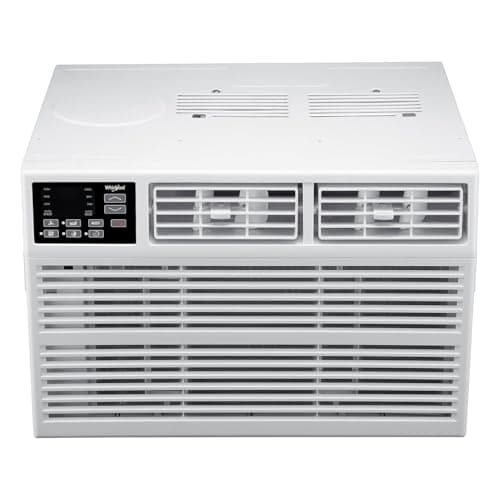 The one to skip on running cost Whirlpool Window Air Conditioner, 24,000 BTU 1,417.3 kWh a year certified — the most expensive unit to run on this site, and the figure is not in dispute. | Nothing, if a mini-split is on the table |
The table
Four units, costed at full load
Every figure in the Watts and Season columns below is computed, not published. The method is one division and one multiplication: capacity ÷ EER2 gives the full-load draw, and that draw over 960 hours at 18.34¢/kWh gives the season cost. Nothing else is assumed.
| Unit | Capacity | SEER2 | EER2 | Watts | Season |
|---|---|---|---|---|---|
| Fujitsu AOUH09KTAP1 | 9,000 BTU | 33.5 | 19.1 | 471 W | $83 |
| Mitsubishi MUZ-FX09NLHZ | 9,000 BTU | 33.1 | 18.35 | 490 W | $86 |
| Hisense AO-09U3T25P | 9,000 BTU | 32.0 | 18.35 | 490 W | $86 |
| 9,000 BTU class average | 9,000 BTU | — | 13.8 | 652 W | $115 |
| 9,000 BTU class worst | 9,000 BTU | — | 10.5 | 857 W | $151 |
| Carrier 38MPRBQ18AA3 | 18,000 BTU | 26.3 | 15.3 | 1176 W | $207 |
| 18,000 BTU class average | 18,000 BTU | — | 12.61 | 1427 W | $251 |
The spread inside a single capacity is the part worth sitting with. At 9,000 BTU the best and worst certified units are 471 W and 857 W — $68 a season apart for identical cooling output. That is a larger gap than most buyers expect, and it is invisible if you only read SEER2.
What the number means
And why there isn’t a certified one
Window air conditioners publish a certified annual kWh per model. Mini-splits do not. The certified mini-split dataset holds 18,036 units and carries SEER2, EER2, HSPF2, capacity, refrigerant and COP — and no annual energy field of any kind. There is also no sound field, which is why noise claims for this category always trace back to the manufacturer rather than the program.
So the running cost has to be built from a ratio, and the two available ratios answer different questions:
- EER2 is a single-condition, full-load rating. Capacity divided by EER2 is a real wattage, which is why it is the one you can do arithmetic with. It describes the unit working as hard as it ever works.
- SEER2 is a seasonal average across a range of outdoor temperatures and part-load conditions. It is the better description of a whole summer — and it cannot be converted into kWh without the bin hours and load assumptions buried in the test procedure, which the published dataset does not include.
- The gap between them is the inverter. Across the dataset EER2 averages 12.5 while SEER2 averages 21.4. That spread exists because these units spend almost all their time modulating below full output, where they are much more efficient than the full-load rating suggests.
Which leads to the one rule that matters here: the season figures in the table are ceilings. A real inverter mini-split, cycling and modulating through a real summer, will land under them — often well under. Use them to compare two units against each other, which is exactly what they are good for. Where EER2 and SEER2 sit among the other figures.
The comparison
How high an EER2 you can actually buy
The ratings on this page are not typical, and it is worth being precise about how atypical. Of all 18,036 certified units:
- 1,219 reach EER2 15 — 6.8% of the category.
- 435 reach EER2 16 — 2.4%.
- 136 reach EER2 17 — 0.75%.
- 84 reach EER2 18 — 0.47%.
- 20 reach EER2 19 — 0.11%, and the Fujitsu above is one of them.
The whole dataset runs from EER2 7.3 to 21.45. So the practical difference between a carefully chosen unit and a default one is close to a factor of two in full-load draw, and almost none of it shows up in the marketing, which leads with SEER2.
Against the rest of home cooling, at the hours in the table:
- A ceiling fan on low: 2.3 W. 40¢ for the entire season. It cools people rather than air, which is the only reason that number is possible.
- An evaporative cooler: 250 W. $44 a season, and only in dry air.
- A 1,300 W portable air conditioner: $229 a season at nameplate draw — against $83 for the 9,000 BTU mini-split’s full-load ceiling. The comparison in full.
The full league table puts every product on this site in one ranking by watts.
This one is not a DIY job
Two numbers on this page are assumptions, and both are yours to change. The rate is a single national average of 18.34¢/kWh, and the season is 960 hours of overnight running.
Your hours assumption moves the answer more than your choice of unit does. The same Fujitsu is $21 over thirty eight-hour nights and $63 if you leave it running around the clock for a month — from one unit, one rate, and nothing changed but hours.
Take the watts from the table, divide by 1,000, multiply by your own hours and your own rate from your bill. That is the whole calculation, and it is the same one behind every figure here.
Lowering it
The levers that actually move the number
- Size it to the room, not to the weather. Capacity is the dominant term, and through the small sizes oversizing costs twice — more watts, and a capacity class whose best certified EER2 is lower than the one you left. What size the room actually needs.
- Read EER2, not just SEER2. Within a capacity, EER2 is the figure that separates 471 W from 857 W. SEER2 compresses that difference and the marketing leads with SEER2.
- Let it modulate. The whole efficiency advantage of the category comes from running continuously at low output rather than cycling hard. Setting back aggressively overnight and recovering in the morning fights the thing you paid for.
- Reduce the load before the capacity. Shading and sealing lower the size you need, which is the lever with the largest effect on the table above.
- Run a fan alongside it. At 2.3 W, air movement buys a degree or two of set point for a rounding error, and set point is run time. Where to set it.
- Check your tariff before your unit. On time-of-use pricing, when you run it can move the bill as much as which one you bought — which hours matter.
Say the unwelcome thing
Do not turn SEER2 into a dollar figure.
It is the most common piece of bad arithmetic in this category, and it always produces a number that is too low.
SEER2 is a seasonal ratio, not a wattage. Dividing capacity by SEER2 gives you a figure in watts that looks plausible — 9,000 BTU over SEER2 33.5 is 269 W — but it is not the draw at any operating point the unit has. It is an average efficiency being misused as an instantaneous one.
The honest version is the one on this page: divide by EER2, get a full-load ceiling, and say out loud that it is a ceiling. Then compare two units on the same basis.
And do not compare either figure to a window unit’s certified annual kWh. That number includes cycling, part load and standby across a defined season; a mini-split figure computed from EER2 includes none of those things. Comparing 375 kWh certified against a computed full-load total is two different measurements, not a comparison — which is why the only certified figure on this page sits in the skip slot, where the comparison is like for like.
In full
Every pick, and what is wrong with it
Published specifications only, each linked to the page it came from. Where a manufacturer publishes nothing, the row says so — we do not fill blanks in.
1. Cheapest to run
Fujitsu Mini-Split Heat Pump, 9,000 BTU
Fujitsu · model AOUH09KTAP1
EER2 19.1 is the highest figure in the entire 9,000 BTU class — 471 W at full load.
Of the 2,207 certified units at exactly 9,000 BTU, this one holds the highest EER2 in the dataset. Nothing at this capacity is rated to draw less power at full load.
EER2 19.1 against a class average of 13.8 works out to 471 W against 652 W — a season gap of $32. Against the worst unit in the class at EER2 10.5, the gap is $68.
SEER2 33.5 is the seasonal figure, and it is the higher of the two numbers for a reason: it credits the part-load running that EER2 ignores. It is also the number you cannot turn into dollars, for reasons covered below.
HSPF2 14.0 and a COP of 2.48 at 5°F, on R-32 at a GWP of 675. The heating side is the strongest of the four units here, which matters if the unit is the room’s only conditioning.
What’s wrong with it
The EER2 ceiling is a peak-condition rating, so the advantage over the next unit down is three dollars a season, not a transformation.
Running cost
Fujitsu does not publish a wattage for the AOUH09KTAP1, so we cannot calculate what it costs to run. We are not going to estimate one. If Fujitsu publishes a nameplate figure, this block will show the arithmetic.
| Cooling capacity | 9,000 BTU/h |
|---|---|
| SEER2 | 33.5 |
| EER2 | 19.1 |
| HSPF2 | 14.00 |
| COP at 5 degrees F | 2.48 |
| Cold climate | Yes |
| Refrigerant | R-32 (GWP 675) |
| ENERGY STAR | Certified, and on the Most Efficient list |
| Noise | Not published in the certified dataset |
Every figure above is from ENERGY STAR Certified Mini-Split Heat Pumps dataset. Blanks are shown as “not published” rather than filled in.
2. Best on the published figures overall
Mitsubishi Electric Mini-Split Heat Pump, 9,000 BTU
Mitsubishi Electric · model MUZ-FX09NLHZ
EER2 18.35 costs three dollars a season more than the leader and brings a far lower-GWP refrigerant.
EER2 18.35 is 490 W at full load against the leader’s 471 W. Over a 960-hour season that is a difference of $3.39 — which is the honest size of the gap between the first and second most efficient units at this capacity.
R-454B at a GWP of 470 against R-32 at 675. Both are enormous improvements on the R-410A still shipping in most of the category at 2,088, and the choice between 470 and 675 is a judgment call rather than a running-cost one.
HSPF2 13.3, a COP of 2.20 at 5°F, and cold-climate certification. On the ENERGY STAR Most Efficient list, as all three 9,000 BTU units on this page are.
The Hisense AO-09U3T25P carries the identical EER2 18.35 and the same R-454B, so it computes to exactly the same running cost — but at SEER2 32.0 and HSPF2 11.8 it is behind this unit on both of the other published figures.
What’s wrong with it
SEER2 33.1 and HSPF2 13.3 are both marginally behind the Fujitsu, so you are trading a little of both.
Running cost
Mitsubishi Electric does not publish a wattage for the MUZ-FX09NLHZ, so we cannot calculate what it costs to run. We are not going to estimate one. If Mitsubishi Electric publishes a nameplate figure, this block will show the arithmetic.
| Cooling capacity | 9,000 BTU/h |
|---|---|
| SEER2 | 33.1 |
| EER2 | 18.35 |
| HSPF2 | 13.30 |
| COP at 5 degrees F | 2.20 |
| Cold climate | Yes |
| Refrigerant | R-454B (GWP 470) |
| ENERGY STAR | Certified, and on the Most Efficient list |
| Noise | Not published in the certified dataset |
Every figure above is from ENERGY STAR Certified Mini-Split Heat Pumps dataset. Blanks are shown as “not published” rather than filled in.
3. Best at 18,000 BTU
Carrier Mini-Split Heat Pump, 18,000 BTU
Carrier · model 38MPRBQ18AA3
EER2 15.3 is the ceiling of its own capacity class — and that ceiling is almost four points below the 9,000 BTU one.
This is the most useful unit on the page, because it shows what capacity does to the arithmetic. Across 2,093 certified units at 18,000 BTU, the highest EER2 available is 15.3 — and this unit is tied at that ceiling. There is nothing more efficient at this size.
At 1176 W it costs $207 for the same season that costs the Fujitsu $83. Most of that is capacity rather than inefficiency: at a matched 9,000 BTU, EER2 15.3 would draw 588 W, not 1176 W.
18,000 BTU is the worst-served capacity in the category. The best certified EER2 falls at every step from 6,000 BTU up to here — 21.45, then 19.1 at 9,000, 17.1 at 12,000, 15.3 here — and then recovers to 17.0 at 24,000 BTU and 17.2 at 36,000. So buying double the 9,000 BTU capacity does not just double the draw; it lands you in the one class where the best available rating bottoms out.
One oddity worth knowing: this exact model number is certified under five outdoor-unit brands — Bryant, Carrier, Midea, Payne and Weathermaker — all on the same 38MP series, all at SEER2 26.3 and EER2 15.3. The badge on the cabinet makes no difference to what it costs to run. How the brands actually differ.
What’s wrong with it
R-410A at a GWP of 2,088, where both 9,000 BTU units above are on refrigerants under 700.
Running cost
Carrier does not publish a wattage for the 38MPRBQ18AA3, so we cannot calculate what it costs to run. We are not going to estimate one. If Carrier publishes a nameplate figure, this block will show the arithmetic.
| Cooling capacity | 18,000 BTU/h |
|---|---|
| SEER2 | 26.3 |
| EER2 | 15.3 |
| HSPF2 | 11.00 |
| COP at 5 degrees F | 2.89 |
| Cold climate | Yes |
| Refrigerant | R-410A (GWP 2,088) |
| ENERGY STAR | Certified, and on the Most Efficient list |
| Noise | Not published in the certified dataset |
Every figure above is from ENERGY STAR Certified Mini-Split Heat Pumps dataset. Blanks are shown as “not published” rather than filled in.
Skip this one
Whirlpool Window Air Conditioner, 24,000 BTU
Whirlpool · model WHAW-241IN
1,417.3 kWh a year certified — the most expensive unit to run on this site, and the figure is not in dispute.
Included because it is the one unit here whose running cost is certified rather than computed, and it is the highest on the site: 1,417.3 kWh a year, or $260 at 18.34¢/kWh.
CEER 12.7 is a window-unit rating and not directly comparable to EER2, but the direction is clear enough: at the top of the capacity range, a window unit is the expensive way to buy cooling.
If you need this much capacity in one room, the 18,000 BTU mini-split above is the comparison to make — on installation, on noise, and on the fact that it also heats. The full side by side.
What’s wrong with it
CEER 12.7 at 24,000 BTU, 115.7 lb, and it occupies the window for the season.
Running cost — WHAW-241IN
| Annual energy use | 1417.3 kWh | ENERGY STAR certified figure |
|---|---|---|
| Annual cost | $260 | 1417.3 × 18.34¢/kWh |
| Per cooling month | $65 | spread over a four-month season |
The annual figure is the certified value from the ENERGY STAR Certified Room Air Conditioners dataset, which models a standard cooling season rather than your actual summer. It is more useful than a nameplate wattage here, because a variable-speed compressor spends most of its life well below nameplate.
Rate: 18.34¢/kWh, the US average residential price for June 2026 (EIA Electric Power Monthly, Table 5.3). Yours will differ — swap it in: (watts ÷ 1000) × hours × your rate.
| Cooling capacity | 24,000 BTU/h |
|---|---|
| CEER | 12.7 |
| Annual energy use | 1,417.3 kWh/yr |
| vs federal standard | 35% less energy |
| Dimensions | 20.7 H x 30.0 W x 28.8 D in |
| Weight | 115.7 lb |
| Refrigerant | R-32 |
| Installation | Straddles the window; support bracket territory |
| ENERGY STAR | Certified |
Every figure above is from ENERGY STAR Certified Room Air Conditioners dataset. Blanks are shown as “not published” rather than filled in.
We are not linking a buy button for this one. If you want to look at it anyway, it is easy enough to find — but we would rather send you to something that fits your room.
Questions people actually ask
Frequently asked
How much does a mini-split cost to run?
An efficient 9,000 BTU unit draws about 471 W at full load — 8.6¢ an hour, 69¢ for an eight-hour night, and $83 for a four-month season of overnight running at 18.34¢/kWh. That is a full-load ceiling, so real consumption lands under it.
Why can't I look up a mini-split's annual kWh?
Because the certification program does not publish one. All 18,036 certified units carry SEER2, EER2, HSPF2, capacity and refrigerant data, but no annual energy figure — unlike window and through-the-wall units, which do publish a certified annual kWh per model. The category that does publish it.
Should I use SEER2 or EER2 to work out running cost?
EER2. It is a full-load rating at a single condition, so capacity divided by EER2 is a real wattage you can multiply by hours. SEER2 is a seasonal average and cannot be converted to kWh without the test procedure's bin assumptions, which are not published in the dataset.
Is the computed figure what I will actually pay?
No — it is an upper bound. It assumes the compressor runs at full output for every hour, and an inverter mini-split spends almost all its time modulating below that. Across the dataset EER2 averages 12.5 while SEER2 averages 21.4, and that gap is exactly the part-load efficiency the full-load figure ignores. What the inverter is doing.
How high an EER2 can I actually buy?
Not very. Of 18,036 certified units, 6.8% reach EER2 15, 2.4% reach 16, and just 20 units — 0.11% — reach 19. The dataset runs from 7.3 to 21.45, so choosing carefully is close to a factor of two in full-load draw.
Does a bigger mini-split cost proportionally more to run?
More than proportionally, because the efficiency ceiling drops as capacity rises. The best EER2 available at 9,000 BTU is 19.1; at 18,000 BTU the best anyone certifies is 15.3. You get more watts for the capacity and a worse best-case rating to spend them at.
How does it compare to running a fan?
A ceiling fan on low draws 2.3 W, about 40¢ for a whole season against $83 for the mini-split's ceiling. A fan does not remove heat, it moves air so you feel cooler — which is why it belongs alongside a mini-split rather than instead of one. Everything, ranked by watts.
Sources
Where these numbers came from
- ENERGY STAR Certified Air Source Heat Pumps dataset — 18,036 units; SEER2, EER2, HSPF2, capacity, refrigerant and GWP, Most Efficient flag, and no annual kWh field
- ENERGY STAR Certified Room Air Conditioners dataset — certified annual kWh and CEER for the window units compared here
- EIA Electric Power Monthly, Table 5.3 — average residential electricity price
Read next
Where to go from here
Back to Guides & Calculators, or read how we pick.