Guide and picks
Cooling an RV or camper
In a house, running cost is measured in cents. In a camper it is measured in hours of battery left, and that changes everything.
By Sawyer V. · Published
The short answer
On shore power, a small mains fan or the built-in roof air conditioner. Off hookup, a battery fan is the only sensible answer — the Milwaukee M12 mounting fan runs up to 16 hours on one battery at 400 CFM, and the Ryobi PCL813B moves 2,300 CFM when you need volume. An air conditioner draws roughly a thousand watts, which no practical camper battery bank sustains for a night.
Fan & Frost earns a commission when you buy through our links, at no cost to you. It never changes a ranking, and we say so when the right answer is the cheaper unit or nothing at all. Full disclosure · How we pick.
At a glance
The picks, ranked
Tap any row to jump to the full reasoning. Prices are live from Amazon where we have them, and read “check price” where we don’t — never a number we cannot verify today.
| # | Product | Best for | Price |
|---|---|---|---|
| 1 | 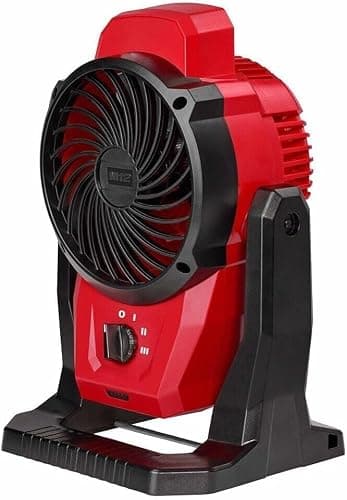 Best for boondocking Milwaukee M12 Mounting Fan Up to 16 hours on one M12 XC 6.0 battery at 400 CFM, with magnets and a clamp built in. | Overnight airflow with no hookup and no drain on the house battery | |
| 2 | 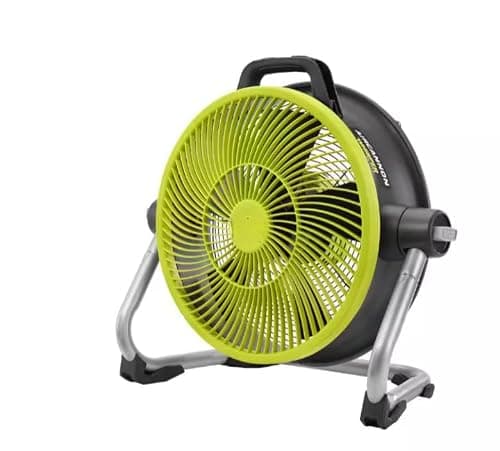 Most air when you need to purge Ryobi ONE+ 18V Hybrid Whisper Series 14" Air Cannon Fan 2,300 CFM on high from an 18V battery or a barrel-plug adapter — enough to change the air in a small van quickly. | Clearing built-up heat from a van fast, at a campsite or on hookup | |
| 3 | 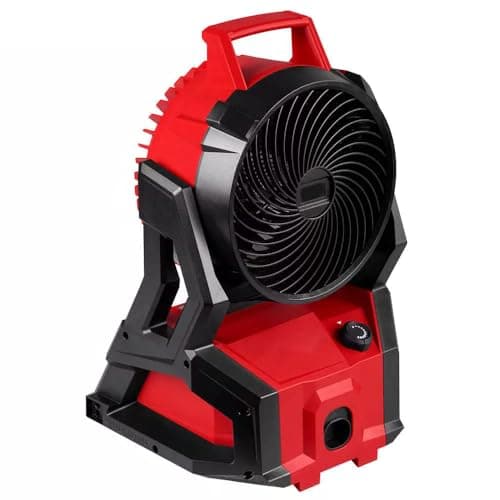 The one that does both Milwaukee M18 Brushless PACKOUT Fan 850 CFM with over 3 hours on high and 6.5 hours at 75% — and an integrated AC plug for shore power. | A camper used both on hookup and off it | |
| — | Hookup only, and think twice even then Whynter ARC-14S Dual Hose Portable Air Conditioner 1,300 W and 9,500 BTU SACC — the power figure alone rules it out for anything off hookup. | A camper on a 30-amp post, parked, in serious heat |
Everywhere else on this site, running cost is measured in cents and the answer is usually “it barely matters”. In a camper off hookup, power is a finite store you are also using for the fridge, the water pump and the lights — and that reframes the whole decision.
The constraint
Watts are the whole problem
Here is the same table that reads as trivial for a house, read as a camper.
| Option | Power | 8 hours | Off hookup? |
|---|---|---|---|
| Battery fan, low | battery | up to 16 h on one pack | Yes |
| Lasko EcoQuiet tower, low | 2.9 W | 0.02 kWh | With a small inverter |
| Lasko EcoQuiet tower, high | 19 W | 0.15 kWh | With a small inverter |
| Air King clip-on, high | 12 W | 0.10 kWh | With a small inverter |
| Evaporative cooler | 220 W | 1.76 kWh | Marginal |
| Portable air conditioner | 1,300 W | 10.4 kWh | No |
Manufacturer-published wattage. Energy figures are our arithmetic; delivering them from a 12V bank through an inverter costs more again in conversion losses.
In a house, the gap between the top and bottom rows is a few dollars a month. In a camper it is the difference between a full night’s airflow and flattening your bank before midnight.
That is why the answer here is a fan, and why the fan question is mostly about where its energy comes from.
Energy source
Three ways to power a fan in a camper
- A tool battery. Separate from the house bank, swappable, chargeable while driving, and it publishes a run time. Nothing you do with it affects the fridge. This is the cleanest answer for extended off-grid use.
- The 12V system directly. Efficient — no inversion losses — but it draws down the bank you need for everything else, and a fan running all night is a meaningful share of a modest system.
- An inverter and a mains fan. Gives you access to quiet, efficient DC tower fans that publish dBA, at the cost of inverter conversion losses and the inverter’s own idle draw. For a 2.9 W fan, that idle draw may exceed the fan itself.
The last point is worth pausing on. A fan drawing 2.9 W on low is wonderful in a house and slightly absurd through an inverter, because many inverters consume more than that simply being switched on.
Do this first
Stop the heat getting in
A camper is a small, thin-walled, largely uninsulated box with a lot of glazing, parked in the open. The free measures matter more here than in any building.
- Park in shade, and think about orientation. Which way the largest window faces at 3pm changes the interior temperature more than any fan will.
- Cover the windows. Reflective screens on the windscreen and side glass are the highest-value item in the vehicle for this. External covers beat internal ones for the same reason they do in a house.
- Open the roof vent. Hot air collects at the ceiling in a van exactly as it does in a room. A roof vent lets it leave by itself.
- Create a path. One opening low on the shaded side, one high on the other, and the stack effect does work for free. Then a fan increases the rate. Placement for cross-ventilation.
- Purge on arrival. The air inside a van parked in sun is far hotter than outside. Replacing it takes minutes with real airflow and is the fastest improvement available.
This one is not a DIY job
Lithium batteries do not like heat, which is awkward in a product you are using because it is hot. Do not leave tool packs on a dashboard, in direct sun, or in a sealed locker on a hot day. Store them part-charged and in the coolest part of the vehicle.
Compare platforms at equal watt-hours. Amp-hours times voltage: an 18V 4.0 Ah pack and a 12V 6.0 Ah pack both hold 72 Wh. Run-time claims only compare meaningfully on that basis, and every published figure is quoted against one specific battery — usually the largest in the range.
Anything you mount must not become a projectile. A magnet-mounted fan is fine parked and is not a securing method for driving. Stow loose equipment before moving off.
Air conditioning
The honest position on cooling a camper
A roof-mounted RV air conditioner on shore power is a real and effective option, and it is what those units exist for. It is outside what this site covers — we work from certified residential data, and RV units are a separate category with their own ratings.
A domestic portable air conditioner in a van is a poor idea on three counts. It draws roughly 1,300 W, which no practical battery bank sustains overnight. It needs its exhaust ducted outdoors, which in a van means a purpose-cut panel in a window or vent. And its rated capacity is well below its headline figure — 9,500 BTU SACC from a 14,000 BTU box.
An evaporative cooler works in a dry climate with the vents open, at 220 to 250 W. That is marginal off-grid but plausible with solar and a decent bank, and it is a genuine temperature drop rather than felt cooling. Only where the air is dry, and it means carrying water.
Say the unwelcome thing
Do not run a domestic air conditioner off an inverter to save on a hookup.
The arithmetic does not work and it is worth seeing why before spending on inverter capacity.
1,300 W for eight hours is 10.4 kWh. From a 12V bank that is roughly 870 amp-hours before inverter losses, and well over a thousand once conversion efficiency and usable depth of discharge are accounted for.
Practical camper banks are a fraction of that. You would flatten the system, potentially damage it, and still be warm by 2am.
A battery fan running 16 hours on one pack solves the actual problem — airflow across skin while you sleep — without touching the house bank at all. Save the air conditioning for nights on a post.
In full
Every pick, and what is wrong with it
Published specifications only, each linked to the page it came from. Where a manufacturer publishes nothing, the row says so — we do not fill blanks in.
1. Best for boondocking
Milwaukee M12 Mounting Fan
Milwaukee · model 0820-20
Up to 16 hours on one M12 XC 6.0 battery at 400 CFM, with magnets and a clamp built in.
Up to 16 hours on a single battery. That is the figure that makes this genuinely useful rather than a novelty: it covers a full night without touching your house battery bank.
That last point matters more than it sounds. Running a fan off the camper’s own 12V system draws down the bank you need for the fridge, the pump and the lights. A tool battery is a separate, swappable energy store that you can charge while driving.
400 CFM and up to 14 MPH is personal airflow — aimed at a bunk, which is exactly the requirement.
4.41 lb, with magnets, a 2-inch clamp, keyholes and pass-through holes. In a vehicle full of steel and frames, that mounting flexibility is worth as much as the airflow.
What’s wrong with it
Battery only, no AC input at all — so on shore power it is still running off a pack you have to charge.
Running cost
Milwaukee does not publish a wattage for the 0820-20, so we cannot calculate what it costs to run. We are not going to estimate one. If Milwaukee publishes a nameplate figure, this block will show the arithmetic.
| Air delivery | Up to 400 CFM |
|---|---|
| Air speed | Up to 14 MPH |
| Run time | Up to 16 hours on an M12 XC 6.0 battery |
| Speeds | 3 (high, medium, low) |
| Power source | M12 battery only, no AC option |
| Weight | 4.41 lb |
| Mounting | Magnets, 2 in spring-loaded clamp, keyholes, pass-through holes |
| Noise | Not published |
| Warranty | 1 year |
Every figure above is from Milwaukee Tool product page, 0820-20. Blanks are shown as “not published” rather than filled in.
2. Most air when you need to purge
Ryobi ONE+ 18V Hybrid Whisper Series 14" Air Cannon Fan
Ryobi · model PCL813B
2,300 CFM on high from an 18V battery or a barrel-plug adapter — enough to change the air in a small van quickly.
A camper parked in sun becomes very hot very fast, and the first job on arrival is not cooling — it is replacing the air. That needs volume, briefly.
2,300 CFM on high does that. For scale, the highest published airflow of any mains fan on this site is 720 CFM. This moves roughly three times that, from a battery, through a 225-degree pivoting head.
The barrel-plug AC adapter means it also works on hookup without draining anything, which suits a fan you use in bursts.
The gaps are real: no published run time, weight or noise rating. Run it high to purge, then switch to something smaller for the night.
What’s wrong with it
Ryobi publishes no run time, no weight and no dBA, so three of the four things you would compare are missing.
Running cost
Ryobi does not publish a wattage for the PCL813B, so we cannot calculate what it costs to run. We are not going to estimate one. If Ryobi publishes a nameplate figure, this block will show the arithmetic.
| Air delivery | 2,300 CFM on high |
|---|---|
| Fan size | 14 in |
| Speeds | 3 (high, medium, low) |
| Power source | 18V ONE+ battery or barrel-plug AC adapter |
| Pivoting head | 225 degrees |
| Run time | Not published |
| Weight | Not published |
| Noise | Not published (marketed as over 55% quieter) |
| Warranty | Not published on the product page |
Every figure above is from Ryobi Tools product page, PCL813B. Blanks are shown as “not published” rather than filled in.
3. The one that does both
Milwaukee M18 Brushless PACKOUT Fan
Milwaukee · model 0818-20
850 CFM with over 3 hours on high and 6.5 hours at 75% — and an integrated AC plug for shore power.
The compromise pick, and the only fan here that publishes both airflow and endurance: 850 CFM, with over 3 hours on high and 6.5 hours at 75% speed on an M18 REDLITHIUM XC5.0.
That 75% figure is the useful one for camping. Dropping one notch off maximum roughly doubles the run time — the same pattern that shows up across certified ventilating fans, where lower speeds are usually the efficient ones.
The integrated AC plug takes a standard extension cord, so on hookup it runs off the post rather than the battery. 300-degree head rotation and PACKOUT compatibility.
20.5 MPH from a 7-inch blade — directional rather than broad.
What’s wrong with it
Milwaukee publishes no weight and no noise rating, and an M18 battery is a real purchase if you do not own one.
Running cost
Milwaukee does not publish a wattage for the 0818-20, so we cannot calculate what it costs to run. We are not going to estimate one. If Milwaukee publishes a nameplate figure, this block will show the arithmetic.
| Air delivery | 850 CFM |
|---|---|
| Air speed | Up to 20.5 MPH |
| Blade size | 7 in |
| Run time, high | Over 3 hours on an M18 REDLITHIUM XC5.0 battery |
| Run time, 75% speed | 6.5 hours on the same battery |
| Power source | M18 battery or integrated AC plug |
| Head rotation | 300 degrees |
| Speeds | Variable-speed dial |
| Weight | Not published |
| Noise | Not published |
| Warranty | 1 year |
Every figure above is from Milwaukee Tool product page, 0818-20. Blanks are shown as “not published” rather than filled in.
Skip this one
Whynter ARC-14S Dual Hose Portable Air Conditioner
Whynter · model ARC-14S
1,300 W and 9,500 BTU SACC — the power figure alone rules it out for anything off hookup.
Worth doing the arithmetic on, because people ask.
1,300 W for eight hours is 10.4 kWh. Delivered through an inverter from a 12V bank that is roughly 870 amp-hours before inverter losses — and realistically well over a thousand once you account for conversion efficiency and usable depth of discharge.
No practical camper battery bank sustains that for a night. On shore power it is possible, though a 1,300 W draw is a substantial share of a 30-amp post before you have run anything else.
The capacity is also smaller than the box says: 9,500 BTU SACC from a 14,000 BTU headline, a 32.1% haircut, and venting it in a van is its own problem.
What’s wrong with it
1,300 W is roughly a hundred amp-hours of 12V battery per eight-hour night through an inverter, before inverter losses.
Running cost — ARC-14S
| Nameplate power | 1300 W | manufacturer's published figure |
|---|---|---|
| Energy, 8-hour night | 10.40 kWh | 1300 ÷ 1000 × 8 |
| Cost per hour | 24¢ | at 18.34¢/kWh |
| Cost per 8-hour night | $1.91 | on the highest speed |
| Cost per 30 nights | $57 | 312.0 kWh |
Rate: 18.34¢/kWh, the US average residential price for June 2026 (EIA Electric Power Monthly, Table 5.3). Yours will differ — swap it in: (watts ÷ 1000) × hours × your rate.
| Marketing capacity | 14,000 BTU (ASHRAE-128) |
|---|---|
| DOE-rated capacity | 9,500 BTU SACC |
| Hoses | Dual |
| Power | 1,300 W / 11.6 A at 115 V |
| Noise | Under 51 dBA low, under 56 dBA high |
| Dehumidification | 71 pints/day |
| Refrigerant | R-32 |
| Dimensions | 16 W x 19 D x 35.5 H in |
| Weight | 73 lb |
| Manufacturer coverage claim | 500 sq ft |
| Warranty | 1 year unit, 3 years compressor |
Every figure above is from Whynter product page, ARC-14S. Blanks are shown as “not published” rather than filled in.
We are not linking a buy button for this one. If you want to look at it anyway, it is easy enough to find — but we would rather send you to something that fits your room.
Questions people actually ask
Frequently asked
What is the best way to cool an RV without hookup?
A battery fan, plus shade and ventilation. Airflow across skin is what makes you feel cooler, and a tool-battery fan can run up to 16 hours on one pack without drawing on the house bank you need for the fridge and lights.
Can I run an air conditioner off my camper battery?
Not realistically. A portable air conditioner drawing 1,300 W for eight hours is 10.4 kWh, which is roughly 870 amp-hours from a 12V bank before inverter losses — far beyond a practical camper system.
Should I use the 12V system or a tool battery for a fan?
A tool battery keeps the load off the bank you need for the fridge, pump and lights, is swappable, charges while driving, and publishes a run time. Running from 12V directly is more efficient but draws down the system everything else depends on.
Is an inverter worth it for a fan?
Often not for a small one. A DC tower fan drawing 2.9 watts on low is excellent in a house, but many inverters consume more than that simply being switched on, so the conversion overhead can exceed the load.
How do I cool a van parked in the sun?
Purge the air first — the interior is far hotter than outside, and replacing it takes minutes with real airflow. Then cover the glass with reflective screens, open the roof vent so hot air can leave, and create a low-to-high path across the vehicle. Cross-ventilation placement.
Do evaporative coolers work in a camper?
In a dry climate with the vents open, yes — and they produce a genuine temperature drop rather than felt cooling. At 220 to 250 W they are marginal off-grid without solar and a decent bank, and they mean carrying water.
Sources
Where these numbers came from
- Milwaukee 0820-20 product page — 400 CFM, 14 MPH, up to 16 h on M12 XC 6.0, 4.41 lb
- Milwaukee 0818-20 product page — 850 CFM, 3 h high / 6.5 h at 75%, integrated AC plug
- Ryobi PCL813B product page — 2,300 CFM, 3 speeds, 225-degree pivot, barrel-plug adapter
- Whynter ARC-14S product page — 1,300 W, 9,500 BTU SACC
Read next
Where to go from here
Back to Room Cooling, or read how we pick.