Head to head
Air King 9230 vs 9219 drum fan
Two industrial fans from the same published table. One is the most efficient air mover on this site; the other is the only one you can roll to where the work is.
By Sawyer V. · Published
The short answer
Buy the 30-inch 9230 for air — 7,400 CFM on 255 W is 29.0 CFM per watt, the most efficient air mover on this site outside ceiling fans, and 2.3 times the smaller fan’s output. Buy the 18-inch 9219 for height and quiet: a wheeled stand puts the air at chest level, and 49 dB on low against 67 is the difference between a fan you can talk over and one you cannot.
Fan & Frost earns a commission when you buy through our links, at no cost to you. It never changes a ranking, and we say so when the right answer is the cheaper unit or nothing at all. Full disclosure · How we pick.

At a glance
The picks, ranked
Tap any row to jump to the full reasoning. Prices are live from Amazon where we have them, and read “check price” where we don’t — never a number we cannot verify today.
| # | Product | Best for | Price |
|---|---|---|---|
| 1 | 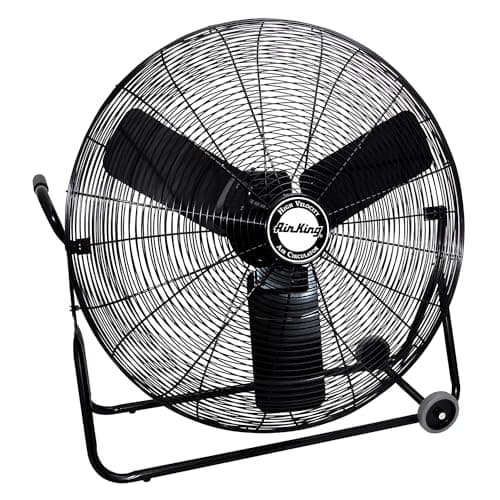 The 30-inch case Air King 9230 30" Industrial Grade Pivoting Drum Fan 7,400 CFM on 255 W, at 29.0 CFM per watt on high and 32.3 on low. Nothing portable on this site moves more air, and nothing moves it more cheaply per watt. | A two-car garage, workshop or barn — any space over about 500 sq ft that needs its air turned over | |
| 2 | 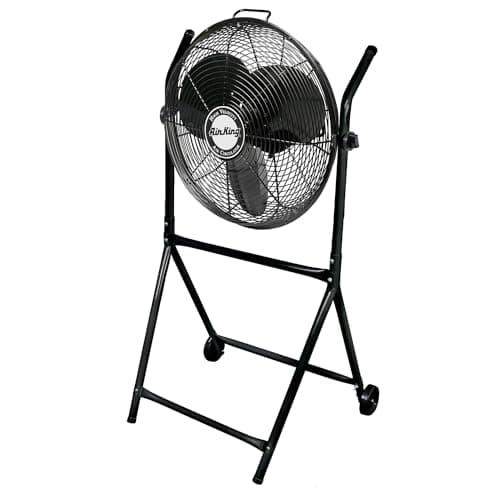 The 18-inch roll-about case Air King 9219 18" Industrial Grade Roll-About Drum Fan 3,190 CFM on 180 W with a 49 dB low setting, on a wheeled stand 48 inches tall. The only fan of the two you can move one-handed and hold a conversation beside. | Aiming air at people rather than at a floor — a workbench, a garage gym, an outdoor event |
Both of these come out of the same Air King industrial floor fan table, which publishes CFM, RPM, amps, watts and decibels at three speeds for every model in the line. That makes this the rare fan comparison where every number on both sides is directly comparable.
Our drum fan roundup covers the whole line and gives these two different jobs. This page is the head-to-head for the one decision that page cannot make for you: floor or stand.
Head to head
Published figures, side by side
| 9230, 30 in | 9219, 18 in stand | |
|---|---|---|
| Air delivery, high | 7,400 CFM | 3,190 CFM |
| Air delivery, low | 4,980 CFM | 2,660 CFM |
| Power | 255 / 200 / 154 W | 180 / 150 / 125 W |
| CFM per watt, high | 29.0 | 17.7 |
| CFM per watt, low | 32.3 | 21.3 |
| Noise | 75 / 71 / 67 dB | 67 / 58 / 49 dB |
| Blade speed | 1,040 - 860 RPM | 1,500 - 1,100 RPM |
| Motor | 1/4 HP, enclosed, ball bearing | 1/6 HP |
| Mount | Floor, pivoting head | Wheeled stand, 48 in tall |
| Weight | 48.3 lb | 27.9 lb |
| Width | 33.75 in | 25 in base |
Figures from Air King’s industrial grade floor fan specification table; CFM per watt is our arithmetic. Prices checked 11 October 2026: the 30-inch was $349.99 and the 18-inch $197.64. The buttons above carry the live price and the date it was read.
Air-change arithmetic
What the airflow gap means in a real space
Fans do not lower air temperature, so the honest way to size one for a large space is how fast it turns the air over. Volume divided by CFM gives the time for one complete change.
| Space | Volume | 30 in | 18 in |
|---|---|---|---|
| Single garage, 12 x 20 x 9 ft | 2,160 cu ft | 18 sec | 41 sec |
| Two-car garage, 20 x 20 x 9 ft | 3,600 cu ft | 29 sec | 68 sec |
| Workshop, 24 x 30 x 10 ft | 7,200 cu ft | 58 sec | 2 min 16 s |
Our arithmetic: volume divided by published high-speed CFM. These are air-change times with the door open, not a cooling claim.
This one is not a DIY job
The 30-inch on low beats the 18-inch on high, and it is quieter per unit of air. 4,980 CFM on 154 W at 67 dB against 3,190 CFM on 180 W at 67 dB — same noise, 56 per cent more air, 26 W less power. If you can fit the big fan, running it on low is the best setting either fan offers.
Which one
How to choose
- A two-car garage or bigger: the 30-inch. The air-change table makes this one-sided.
- Anyone needs to hold a conversation: the 18-inch. 49 dB on low is the only genuinely quiet setting between them.
- Air aimed at people, not the floor: the 18-inch on its stand, at chest height.
- You move the fan around: the 18-inch. Wheels and 27.9 lb against a 48.3 lb two-handed lift.
- Cheapest air per watt: the 30-inch on low, at 32.3 CFM per watt — 23¢ for an eight-hour shift.
Say the unwelcome thing
Do not buy either of these for a room in the house.
67 dB is the quietest setting on the bigger fan and 49 dB on the smaller. For comparison a DC tower fan publishes 23 dBA and a certified ceiling fan draws about 1 W on low. These are garage, workshop and job-site tools, and the published decibels say so before you spend the money.
A drum fan also needs an opening to work through. Turning a garage's air over every 29 seconds achieves nothing if it is the same hot air going round.
In full
Every pick, and what is wrong with it
Published specifications only, each linked to the page it came from. Where a manufacturer publishes nothing, the row says so — we do not fill blanks in.
1. The 30-inch case
Air King 9230 30" Industrial Grade Pivoting Drum Fan
Air King · model 9230
7,400 CFM on 255 W, at 29.0 CFM per watt on high and 32.3 on low. Nothing portable on this site moves more air, and nothing moves it more cheaply per watt.
7,400 / 6,360 / 4,980 CFM on 255 / 200 / 154 W at 1,040 / 902 / 860 RPM. Our arithmetic on those figures gives 29.0 CFM per watt on high and 32.3 on low, and that low-speed figure is the highest we hold for any air mover outside the ceiling fan category.
The mechanism is blade area against blade speed. This fan turns a 30-inch blade at 1,040 RPM; the 18-inch turns at 1,500. Moving more air more slowly is simply cheaper in watts, which is why the bigger fan is also the more efficient one — the opposite of how room air conditioners behave.
1/4 HP, totally enclosed, ball bearing, on a 10 ft three-conductor cord, ETL listed and OSHA compliant. That motor rating is what separates a fan rated to run all day in dust from one that is not.
37¢ for an eight-hour shift on high at 18.34¢/kWh, 23¢ on low.
75 / 71 / 67 dB, published. Take that seriously: 67 dB on its quietest setting is louder than the 18-inch fan on full speed.
What’s wrong with it
75 dB on high, 48.3 lb, and 33.75 inches wide. It is a two-handed lift, it eats floor space, and its lowest setting is still louder than the other fan's highest.
Running cost — 9230
| Nameplate power | 154 W – 255 W | manufacturer's published figure |
|---|---|---|
| Energy, 8-hour night | 2.04 kWh | 255 ÷ 1000 × 8 |
| Cost per hour | 4.7¢ | at 18.34¢/kWh |
| Cost per 8-hour night | 37¢ | on the highest speed |
| Cost per 30 nights | $11 | 61.2 kWh |
| Same month, lowest speed | $6.78 | at 154 W |
Rate: 18.34¢/kWh, the US average residential price for June 2026 (EIA Electric Power Monthly, Table 5.3). Yours will differ — swap it in: (watts ÷ 1000) × hours × your rate.
| Air delivery | 7,400 / 6,360 / 4,980 CFM (high / medium / low) |
|---|---|
| Power | 255 / 200 / 154 W (2.4 / 1.9 / 1.5 A) |
| Efficiency | 29.0 CFM per watt on high, 32.3 on low (our arithmetic) |
| Noise | 75 / 71 / 67 dB (high / medium / low) |
| Blade speed | 1,040 / 902 / 860 RPM |
| Blade | 30 in |
| Motor | 1/4 HP, 120 V, 1 phase, totally enclosed, ball bearing |
| Speeds | 3 |
| Head | Pivoting |
| Dimensions | 33.75 W x 12.25 D x 35.5 H in |
| Weight | 48.3 lb |
| Cord | 10 ft, 3-conductor SJT |
| Listing | ETL listed, OSHA compliant |
Every figure above is from Air King industrial grade floor fan product page, model 9230. Blanks are shown as “not published” rather than filled in.
2. The 18-inch roll-about case
Air King 9219 18" Industrial Grade Roll-About Drum Fan
Air King · model 9219
3,190 CFM on 180 W with a 49 dB low setting, on a wheeled stand 48 inches tall. The only fan of the two you can move one-handed and hold a conversation beside.
3,190 / 2,970 / 2,660 CFM on 180 / 150 / 125 W at 67 / 58 / 49 dB. Less than half the airflow, and the noise figures are where it earns its place.
49 dB on low against 67 for the big fan. On a decibel scale that is not a small gap — it is roughly the difference between a quiet office and a busy restaurant. If anyone has to take a call in the space, this is the fan.
48 inches tall on a wheeled stand. A floor-standing drum fan cools the floor; this one puts the air at chest height where people actually are. The wheels matter more than they sound: a 28 lb fan you roll ends up where the work is, while a 48 lb fan you carry tends to stay wherever you first set it down.
27.9 lb against 48.3, on a 1/6 HP motor. 26¢ for eight hours on high.
The efficiency cost is real: 17.7 CFM per wattagainst 29.0. You are paying about 64 per cent more per unit of air for height, quiet and mobility.
What’s wrong with it
17.7 CFM per watt is the worst efficiency in the line, and a 48-inch stand on a 25-inch base is top-heavy around children and pets.
Running cost — 9219
| Nameplate power | 125 W – 180 W | manufacturer's published figure |
|---|---|---|
| Energy, 8-hour night | 1.44 kWh | 180 ÷ 1000 × 8 |
| Cost per hour | 3.3¢ | at 18.34¢/kWh |
| Cost per 8-hour night | 26¢ | on the highest speed |
| Cost per 30 nights | $7.92 | 43.2 kWh |
| Same month, lowest speed | $5.50 | at 125 W |
Rate: 18.34¢/kWh, the US average residential price for June 2026 (EIA Electric Power Monthly, Table 5.3). Yours will differ — swap it in: (watts ÷ 1000) × hours × your rate.
| Air delivery | 3,190 / 2,970 / 2,660 CFM (high / medium / low) |
|---|---|
| Power | 180 / 150 / 125 W (1.5 / 1.3 / 1.0 A) |
| Efficiency | 17.7 CFM per watt on high, 21.3 on low (our arithmetic) |
| Noise | 67 / 58 / 49 dB (high / medium / low) |
| Blade speed | 1,500 / 1,300 / 1,100 RPM |
| Blade | 18 in |
| Motor | 1/6 HP, 120 V, 1 phase |
| Speeds | 3 |
| Mount | Roll-about stand, wheeled |
| Dimensions | 24 L x 25 W x 48 H in |
| Weight | 27.9 lb |
| Listing | ETL listed, OSHA compliant |
Every figure above is from Air King industrial grade floor fan product page, model 9219. Blanks are shown as “not published” rather than filled in.
Questions people actually ask
Frequently asked
Which Air King drum fan should I buy, the 9230 or the 9219?
The 30-inch 9230 for airflow — 7,400 CFM on 255 W, at 29.0 CFM per watt against 17.7. The 18-inch 9219 on its wheeled stand for height, mobility and quiet: it publishes 49 dB on low where the bigger fan's quietest setting is 67 dB.
How much air does the Air King 9230 move?
7,400 CFM on high, 6,360 on medium and 4,980 on low, drawing 255 / 200 / 154 W. That works out at 29.0 CFM per watt on high and 32.3 on low — the highest airflow-per-watt figures we hold for any air mover outside the ceiling fan category.
Is a bigger drum fan more efficient?
Yes, markedly, which is the opposite of how room air conditioners behave. The 30-inch publishes 29.0 CFM per watt and the 18-inch 17.7 — a 64 per cent gap. A larger blade turning more slowly (1,040 RPM against 1,500) moves more air for less power. The full drum fan line.
How loud are these drum fans?
The 30-inch publishes 75 / 71 / 67 dB and the 18-inch 67 / 58 / 49 dB. Drum fans are the only portable fan category where the manufacturer publishes a decibel figure for every model and speed, because they are sold into workplaces where noise exposure limits apply. How loud a fan actually is.
Is the roll-about stand worth it?
If the air needs to reach people, yes. A floor-standing drum fan pushes air along the floor; a 48-inch stand puts it at chest height. The cost is efficiency — 17.7 CFM per watt against 29.0 — and a top-heavy 48-inch fan on a 25-inch base is a genuine tipping hazard around children.
What do these cost to run?
Between 18¢ and 37¢ for an eight-hour shift at 18.34¢/kWh, depending on fan and speed. The best value setting is the 30-inch on low: 23¢ for 4,980 CFM, which is more air than the 18-inch moves on full power.
Sources
Where these numbers came from
- Air King industrial grade floor fan specifications, models 9230 and 9219 — CFM, RPM, amps, watts, dB, weight and dimensions
- Air King commercial box fan, 9723 — 2,163 CFM on 105 W, for the box fan comparison
- OSHA occupational noise exposure standard, 29 CFR 1910.95 — 90 dBA over 8 hours
- EIA Electric Power Monthly, Table 5.3 — electricity rate
Read next
Where to go from here
Back to Fans, or read how we pick.