Guide and picks
Attic fan thermostat and humidistat settings
The two dials on an attic ventilator solve different problems in different seasons, and setting them as though they were one control is the usual mistake.
By Sawyer V. · Published
The short answer
Set the thermostat for summer heat — published ranges run 50 to 120°F, and somewhere around 100°F is the usual starting point. The humidistat is a winter control: it runs the fan to clear moisture that would otherwise condense on cold roof framing. Published ranges are 30% to 90% relative humidity.
Fan & Frost earns a commission when you buy through our links, at no cost to you. It never changes a ranking, and we say so when the right answer is the cheaper unit or nothing at all. Full disclosure · How we pick.
At a glance
The picks, ranked
Tap any row to jump to the full reasoning. Prices are live from Amazon where we have them, and read “check price” where we don’t — never a number we cannot verify today.
| # | Product | Best for | Price |
|---|---|---|---|
| 1 | 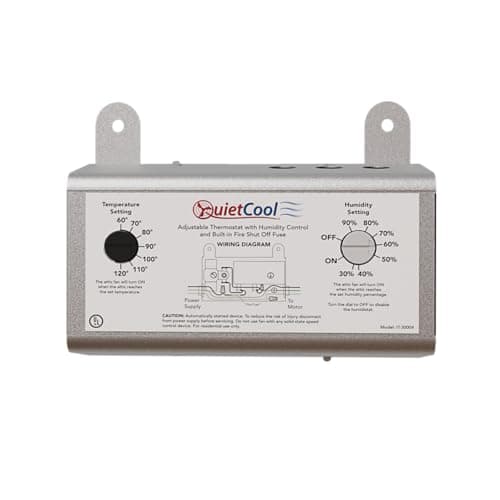 Best control to fit QuietCool Attic Fan Adjustable Thermostat and Humidistat Adjustable 50 to 120°F thermostat plus a 30 to 90% humidistat, with a fire-safety shut-off above 182°F. | Adding a humidistat, or replacing a failed thermostat | |
| 2 | 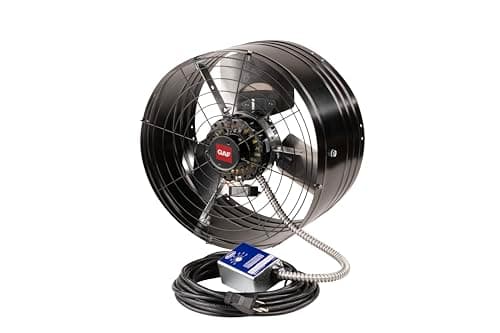 Best gable ventilator Maxx Air Premium 1,600 CFM Gable-Mount Power Attic Ventilator 1,600 CFM from a 14-inch blade with a pre-wired 50 to 120°F thermostat, and an optional humidistat upgrade. | An attic with a gable vent and up to about 2,400 sq ft of floor | |
| 3 | 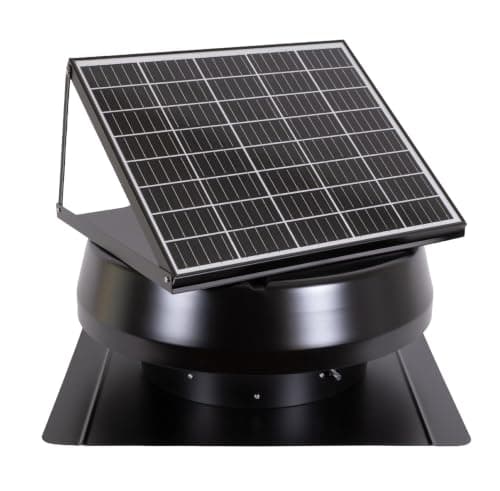 Best with no wiring iLIVING 14" Solar Roof Attic Exhaust Fan 1,150 CFM from a 40 W solar panel with a 50 to 122°F adjustable thermostat — it draws nothing from the house at all. | An attic with no circuit run to it, in a sunny climate | |
| — | A different machine entirely QuietCool Stealth Pro X Whole House Fan, 4,280 CFM 4,280 CFM pulling air through the living space, not the attic — the thing people think an attic fan does. | Cooling the house — which an attic fan does not do |
A powered attic ventilator usually arrives with a thermostat, sometimes with a humidistat, and almost never with a clear explanation of what to set either to. The two controls exist for different seasons and different problems.
Thermostat
The thermostat is the summer control
This is the one everybody uses, and the published adjustment ranges are wide: 50 to 120°F on the units we hold data for, and 50 to 122°F on one.
That range is much wider than the useful range, which is the source of most bad settings. Consider what each end does:
| Setting | What happens |
|---|---|
| Near 50°F | Runs almost constantly from spring to autumn. Wastes electricity. |
| Around 90°F | Runs on most warm days, including mild ones. |
| Around 100°F | The usual starting point — runs on genuinely hot afternoons. |
| Around 110°F | Runs only in real heat. Conservative, and defensible. |
| Near 120°F | Rarely triggers at all. Close to having no fan. |
The honest position: there is no certified optimum, and anyone quoting one to a single degree is guessing. What we can say is that an attic reaches temperatures far above outdoor air on a sunny day, so a setting near the bottom of the dial produces near-constant running for little benefit, and a setting near the top produces no running at all.
Start around 100°F, then adjust. If the fan runs most of the day in mild weather, raise it. If the attic is clearly baking and the fan is idle, lower it.
This one is not a DIY job
A powered attic fan only helps if the intake vents can supply the air it is trying to move. A 1,600 CFM fan with inadequate soffit ventilation will pull its make-up air from the easiest available source — which is your conditioned house, through every ceiling penetration. Check the intake area before turning the setting down.
Humidistat
The humidistat is a winter control
This is the part most people have backwards, and it is the reason a humidistat is worth having at all.
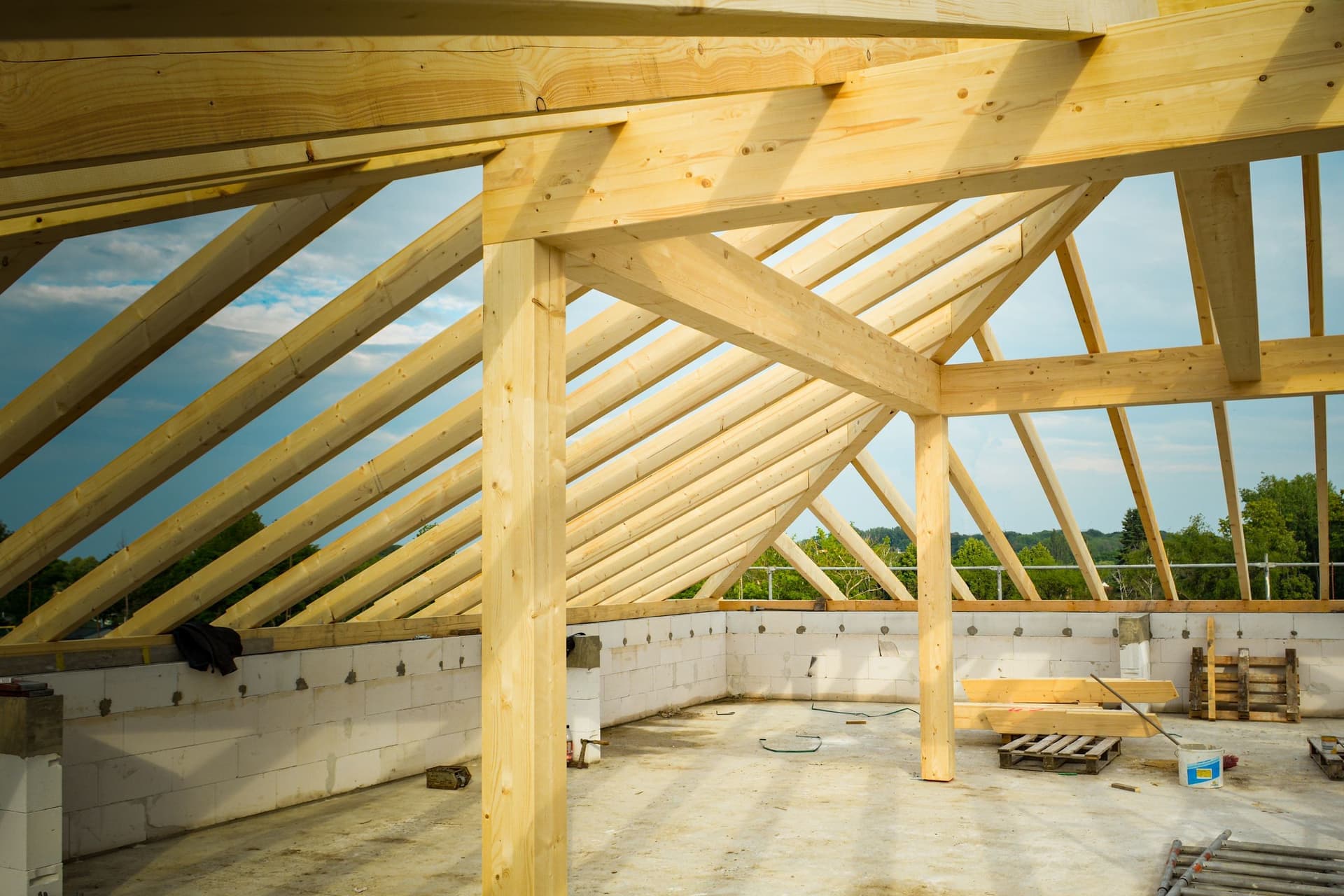
In winter, warm moist air from the house rises into the attic through every gap — light fittings, loft hatches, pipe penetrations. It meets cold roof framing and the underside of the deck, where it condenses.
Sustained condensation up there produces exactly what you would expect: damp insulation that no longer insulates, staining on ceilings, mold on the sheathing, and eventually rot. It is invisible until it is expensive.
A humidistat runs the fan when attic humidity rises above its setpoint, exchanging the moist air for drier outdoor air. Published adjustment ranges are 30% to 90% relative humidity, with an off position.
- A mid-range setting is the usual starting point, because the goal is to prevent condensation rather than to dry the attic out.
- Set it too low and the fan runs constantly, including in humid summer weather where outdoor air is wetter than attic air and running it actively makes things worse.
- Turn it off entirely in a humid summer climate. This is why a genuine off position matters. Bringing in 85% outdoor air to fix 70% attic air is not an improvement.
The underlying fix for winter attic moisture is air-sealing the ceiling plane so the moist air never gets up there. A humidistat manages the symptom, well, and it is not a substitute.
Fire safety
The cutout nobody mentions
One of the controls here publishes a fire-safety shut-off that stops the fan above 182°F. It is worth understanding why that exists.
A powered ventilator moves a large volume of air through the roof space. In a fire, that is feeding oxygen to it and accelerating spread. A thermal cutout that kills power well above any temperature an attic reaches in normal weather removes that contribution.
If you are replacing a control, this is worth having and costs nothing extra. It is not a substitute for smoke alarms.
Which product
Make sure you have the right machine first
Attic fans and whole-house fans are confused constantly, and the settings on this page apply only to the first.
- An attic ventilator moves air through the roof space only. The house stays closed. It lowers attic temperature so your ceiling is radiated at less.
- A whole-house fan moves air through the living space with windows open, then out through the attic. It is a night-purge device that genuinely lowers indoor temperature — whether one suits your house.
- A bathroom or in-line fan removes moisture from one room and must duct to outside, never into the attic — bathroom extraction.
There is no ENERGY STAR program for attic ventilators or whole-house fans, so none of these products carries a certified efficiency figure. Every airflow number on this page is a manufacturer claim, and the CFM-per-watt figures are our arithmetic on published numbers — the two compared directly.
Say the unwelcome thing
Do not set the humidistat low and forget it.
It is the setting that does the most harm, because it looks cautious. A humidistat set near the bottom of its range runs the fan whenever attic humidity is even slightly elevated — which in a humid climate is continuously.
In summer that is worse than useless. If outdoor air is more humid than attic air, the fan is importing moisture, running a motor to do it, and drawing make-up air from your conditioned house if the soffit vents cannot keep up.
Treat it as a winter control with a genuine off position. Set the thermostat for summer heat, switch the humidistat off through the humid months, and turn it on in autumn. A control with both dials and a fire cutout makes that a two-minute seasonal job.
In full
Every pick, and what is wrong with it
Published specifications only, each linked to the page it came from. Where a manufacturer publishes nothing, the row says so — we do not fill blanks in.
1. Best control to fit
QuietCool Attic Fan Adjustable Thermostat and Humidistat
QuietCool · model IT-30004
Adjustable 50 to 120°F thermostat plus a 30 to 90% humidistat, with a fire-safety shut-off above 182°F.
Most attic ventilators ship with a thermostat and no humidistat, and this is the component that adds one without replacing the fan.
Adjustable thermostat, 50 to 120°F. A wide enough range to cover any climate, and wide enough to be set badly — see the settings section below.
Adjustable humidistat, which is either off entirely or set to trigger somewhere between 30% and 90% relative humidity. Having a genuine off position matters, because a humidistat left on in a humid summer climate runs the fan for no benefit.
A fire-safety shut-off above 182°F, which stops the fan feeding a fire with air. Rated to 4 A. Neither warranty nor dimensions are published, which we note rather than fill in.
What’s wrong with it
Neither warranty nor dimensions are published, and compatibility is described only in general terms.
Running cost
QuietCool does not publish a wattage for the IT-30004, so we cannot calculate what it costs to run. We are not going to estimate one. If QuietCool publishes a nameplate figure, this block will show the arithmetic.
| Thermostat | Adjustable, 50 - 120 degrees F |
|---|---|
| Humidistat | Adjustable; OFF, or ON between 30% and 90% relative humidity |
| Fire-safety shut-off | Turns the fan off above 182 degrees F |
| Electrical rating | Up to 4 A |
| Fits | Powered attic ventilators, as a replacement control |
| Dimensions | Not published |
| Warranty | Not published |
| ENERGY STAR | No program exists for attic ventilation controls |
Every figure above is from QuietCool store page, IT-30004 adjustable thermostat and humidistat. Blanks are shown as “not published” rather than filled in.
2. Best gable ventilator
Maxx Air Premium 1,600 CFM Gable-Mount Power Attic Ventilator
Maxx Air · model CX1600 BLU
1,600 CFM from a 14-inch blade with a pre-wired 50 to 120°F thermostat, and an optional humidistat upgrade.
A gable-mount ventilator is the easiest powered attic fan to fit, because it goes in an existing vent opening rather than through the roof.
1,600 CFM from a 14-inch blade on a 1/10 HP motor drawing 3.3 A at 120 V. That is roughly 58¢ for eight hours at 18.34¢/kWh if it ran continuously, which it should not — a thermostat exists precisely so it does not.
A pre-wired adjustable thermostat, 50 to 120°F, with a thermostat-and-humidistat combination available separately.
2,400 sq ft coverage claim at 15 by 15 by 5.875 inches and 12 lb, with a two-year limited warranty. No noise figure is published — and no ENERGY STAR program exists for attic ventilators, so nothing here is third-party certified.
What’s wrong with it
No noise figure is published, and the humidistat is a separate purchase.
Running cost
Maxx Air does not publish a wattage for the CX1600 BLU, so we cannot calculate what it costs to run. We are not going to estimate one. If Maxx Air publishes a nameplate figure, this block will show the arithmetic.
| Air delivery | 1,600 CFM |
|---|---|
| Mount | Gable |
| Blade | 14 in |
| Motor | 1/10 HP, 3.3 A at 120 V, 60 Hz |
| Thermostat | Adjustable, 50 - 120 degrees F, pre-wired |
| Humidistat | Not included; XXDUOSTAT thermostat/humidistat sold separately |
| Coverage claim | Attics up to 2,400 sq ft |
| Dimensions | 15 H x 15 W x 5.875 D in |
| Weight | 12 lb |
| Warranty | 2 years, limited |
| Noise | Not published |
| ENERGY STAR | No program exists for attic ventilators |
Every figure above is from Maxx Air product page, CX1600 BLU premium gable-mount power attic ventilator. Blanks are shown as “not published” rather than filled in.
3. Best with no wiring
iLIVING 14" Solar Roof Attic Exhaust Fan
iLIVING · model ILG8SF301
1,150 CFM from a 40 W solar panel with a 50 to 122°F adjustable thermostat — it draws nothing from the house at all.
The load matching is close to perfect: it runs hardest exactly when the sun is hitting the roof hardest, which is when the attic needs it.
1,150 CFM from a 40 W panel with adjustable tilt, driving a 14-inch brushless IP68-rated motor.
Adjustable thermostat, 50 to 122°F, so it only runs when the attic is genuinely hot rather than whenever the sun is out. That distinction matters in spring and autumn.
15-year warranty and a 2,900 sq ft coverage claim. The honest limits: no mains option and no humidistat, which means it does nothing about the winter moisture problem at all — solar attic fans compared.
What’s wrong with it
No mains fallback, so it does nothing on a cloudy day or at night, and no humidistat option.
Running cost
iLIVING does not publish a wattage for the ILG8SF301, so we cannot calculate what it costs to run. We are not going to estimate one. If iLIVING publishes a nameplate figure, this block will show the arithmetic.
| Air delivery | 1,150 CFM |
|---|---|
| Fan diameter | 14 in |
| Solar panel | 40 W, adjustable tilt |
| Motor | Brushless, IP68 rated |
| Thermostat | Adjustable, 50 - 122 degrees F |
| Coverage claim | Up to 2,900 sq ft |
| Dimensions | 23.5 x 23.5 x 10.5 in |
| Weight | 32 lb |
| Warranty | 15 years |
| Noise | Not published |
| ENERGY STAR | No program exists for attic ventilators |
Every figure above is from iLiving USA product page, ILG8SF301. Blanks are shown as “not published” rather than filled in.
Skip this one
QuietCool Stealth Pro X Whole House Fan, 4,280 CFM
QuietCool · model QC STL PRO-4.8X
4,280 CFM pulling air through the living space, not the attic — the thing people think an attic fan does.
Flagged because the two products get confused constantly, and the settings advice on this page applies to only one of them.
An attic fan ventilates the attic. It pulls outdoor air through the soffit vents and out of the roof, lowering the attic temperature. Your ceiling gets less heat radiated at it.
A whole-house fan ventilates the house. It pulls air through open windows, across the living space, into the attic and out. It is a night-purge device and it genuinely changes indoor temperature.
4,280 CFM high, 2,361 CFM low, on 408 W and 73.9 W. Our arithmetic gives 31.9 CFM per watt on low against 10.5 on high — three times the air per watt — the two compared directly.
What’s wrong with it
It needs windows open to work, and it is a much larger install than an attic ventilator.
Running cost — QC STL PRO-4.8X
| Nameplate power | 73.9 W – 408 W | manufacturer's published figure |
|---|---|---|
| Energy, 8-hour night | 3.26 kWh | 408 ÷ 1000 × 8 |
| Cost per hour | 7.5¢ | at 18.34¢/kWh |
| Cost per 8-hour night | 60¢ | on the highest speed |
| Cost per 30 nights | $18 | 97.9 kWh |
| Same month, lowest speed | $3.25 | at 73.9 W |
Rate: 18.34¢/kWh, the US average residential price for June 2026 (EIA Electric Power Monthly, Table 5.3). Yours will differ — swap it in: (watts ÷ 1000) × hours × your rate.
| Air delivery, high | 4,280 CFM |
|---|---|
| Air delivery, medium | 3,500 CFM |
| Air delivery, low | 2,361 CFM |
| Power, high | 408 W |
| Power, medium | 225 W |
| Power, low | 73.9 W |
| Coverage claim | 1,427 - 2,140 sq ft |
| Motor | ECM |
| Warranty | 15 years |
| Noise | Not published as sones or dBA |
| ENERGY STAR | No program exists for whole-house fans |
Every figure above is from QuietCool Stealth Pro X specification sheet, QC STL PRO-4.8. Blanks are shown as “not published” rather than filled in.
We are not linking a buy button for this one. If you want to look at it anyway, it is easy enough to find — but we would rather send you to something that fits your room.
Questions people actually ask
Frequently asked
What temperature should I set my attic fan thermostat to?
Around 100°F is the usual starting point, within published adjustment ranges of 50 to 120°F. There is no certified optimum — anyone quoting one to a single degree is guessing. If the fan runs most of a mild day, raise it; if the attic bakes and the fan is idle, lower it.
What should an attic fan humidistat be set to?
A mid-range setting within the published 30 to 90% relative humidity range, and treated as a winter control. The goal is preventing condensation on cold roof framing, not drying the attic out. Set too low it runs constantly for no benefit.
Should the humidistat be on in summer?
Usually not in a humid climate. If outdoor air is more humid than attic air, running the fan imports moisture rather than removing it. This is why a genuine off position matters — switch it off through the humid months and back on in autumn.
What is the difference between an attic fan and a whole-house fan?
An attic fan ventilates the roof space only, with the house closed, so your ceiling is radiated at less. A whole-house fan pulls air through the living space with windows open and out through the attic — it is a night-purge device that genuinely lowers indoor temperature. The two compared.
Can an attic fan pull air out of my house?
Yes, if the intake ventilation cannot supply what it is moving. A 1,600 CFM fan with inadequate soffit vents draws make-up air from the easiest source — which is your conditioned house, through every ceiling penetration. Check the intake area first.
Do attic fans have a fire safety cutout?
Some controls do. One publishes a shut-off above 182°F, which stops the fan feeding a fire with air. It is well above any temperature an attic reaches in normal weather, costs nothing extra on a replacement control, and is not a substitute for smoke alarms.
Sources
Where these numbers came from
- QuietCool store page, IT-30004 — adjustable thermostat 50 to 120°F, humidistat off or 30 to 90% RH, fire-safety shut-off above 182°F, rated to 4 A
- Maxx Air product page, CX1600 BLU — 1,600 CFM, 14 in blade, 1/10 HP, 3.3 A at 120 V, adjustable thermostat 50 to 120°F, optional XXDUOSTAT humidistat, 2,400 sq ft claim, 12 lb, 2-year warranty
- iLiving USA product page, ILG8SF301 — 1,150 CFM, 40 W panel, adjustable thermostat 50 to 122°F, 15-year warranty
- QuietCool Stealth Pro X specification sheet — published CFM and wattage at each speed, from which the CFM-per-watt figures are our arithmetic
- EIA Electric Power Monthly, Table 5.3 — average residential electricity price
Read next
Where to go from here
Back to Whole-House Airflow, or read how we pick.