The picks
The best dehumidifiers for a garage
Every other room on this site is heated. A garage is not, and that breaks the machine in a way the certified data cannot warn you about.
By Sawyer V. · Published
The short answer
A garage wants a 45 to 60 pint unit plumbed to a drain, and the efficiency leaders are 2.24 and 2.20 L/kWh at 444 and 471 kWh a year. The specification that matters most is one the certified data does not record at all: minimum operating temperature. A refrigerant dehumidifier ices its coil in a cold garage, so check the manual before you buy.
Fan & Frost earns a commission when you buy through our links, at no cost to you. It never changes a ranking, and we say so when the right answer is the cheaper unit or nothing at all. Full disclosure · How we pick.
At a glance
The picks, ranked
Tap any row to jump to the full reasoning. Prices are live from Amazon where we have them, and read “check price” where we don’t — never a number we cannot verify today.
| # | Product | Best for | Price |
|---|---|---|---|
| 1 | Best overall Waykar Dehumidifier, 49 pints/day 49.43 pints a day at 2.20 L/kWh and 471 kWh a year — full capacity without the usual efficiency penalty. | A garage used year-round that stays above the unit's minimum temperature | |
| 2 | Most efficient Vellgoo Taurus Pro Dehumidifier, 45 pints/day 2.24 L/kWh at 45 pints a day and 444 kWh a year — the highest IEF of any certified portable. | A garage that is damp rather than wet, in a mild climate | |
| 3 | 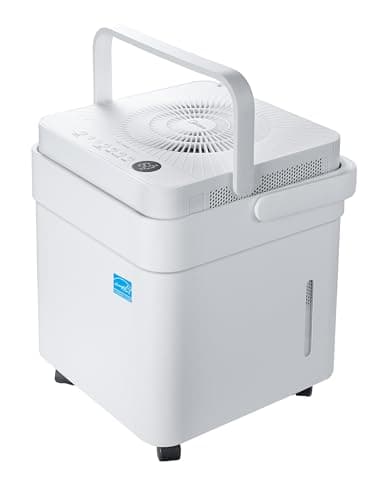 Best supported brand Midea Dehumidifier, 50 pints/day 2.08 L/kWh at 49.67 pints a day — the best figure any household-name brand reaches here. | A hard-working installation where a repair path matters | |
| — | Too small for this room Vissani Dehumidifier, 27 pints/day 26.87 pints a day at 283 kWh a year. Excellent in a bedroom, and it will run continuously in a garage. | A bedroom — not a garage |
Every other room on this site is inside the heated envelope. A garage is not, and that changes the failure mode of the machine.
The gap
The specification the certified data does not record
The ENERGY STAR Certified Dehumidifiers dataset records, for every one of its 554 models: capacity in pints per day, integrated energy factor, annual energy consumption, refrigerant type and charge, connectivity, market availability and the Most Efficient flag.
It does not record minimum operating temperature. There is no field for it.
For a bedroom that omission does not matter. For a garage it is the most important specification there is, because of how these machines work:
- A refrigerant dehumidifier removes water by condensing it on a cold coil. The coil has to be colder than the air.
- In a cold room, that coil drops below freezing. The condensate turns to ice instead of running off.
- Ice on the coil blocks airflow, so water removal collapses while the compressor keeps running.
- Many units have an auto-defrost cycle that manages this down to a stated temperature. Below it, they simply do not work.
So the question “how cold does my garage get?” decides whether the machine functions, and the certified data cannot answer whether any given unit copes. The manufacturer’s manual is the only source.
Refrigerant
The one clue the data does give
The dataset records refrigerant type, and there is a meaningful split across the 502 certified portables:
| Refrigerant | Certified portables | GWP |
|---|---|---|
| R-32 / HFC-32 | About 420 | 675 |
| R-290 (propane) | About 69 | 3 |
R-290 has a global warming potential of 3 against 675 for R-32 — a very large difference, and the reason it exists in this category at all.
The catch is that R-290 units cluster at very small capacities. The most efficient R-290 portables in the dataset remove 9 pints a day, which is nowhere near a garage load. If you want both low GWP and real capacity, the certified field does not currently offer it. What GWP figures mean.
The room
Why a garage is a hard case
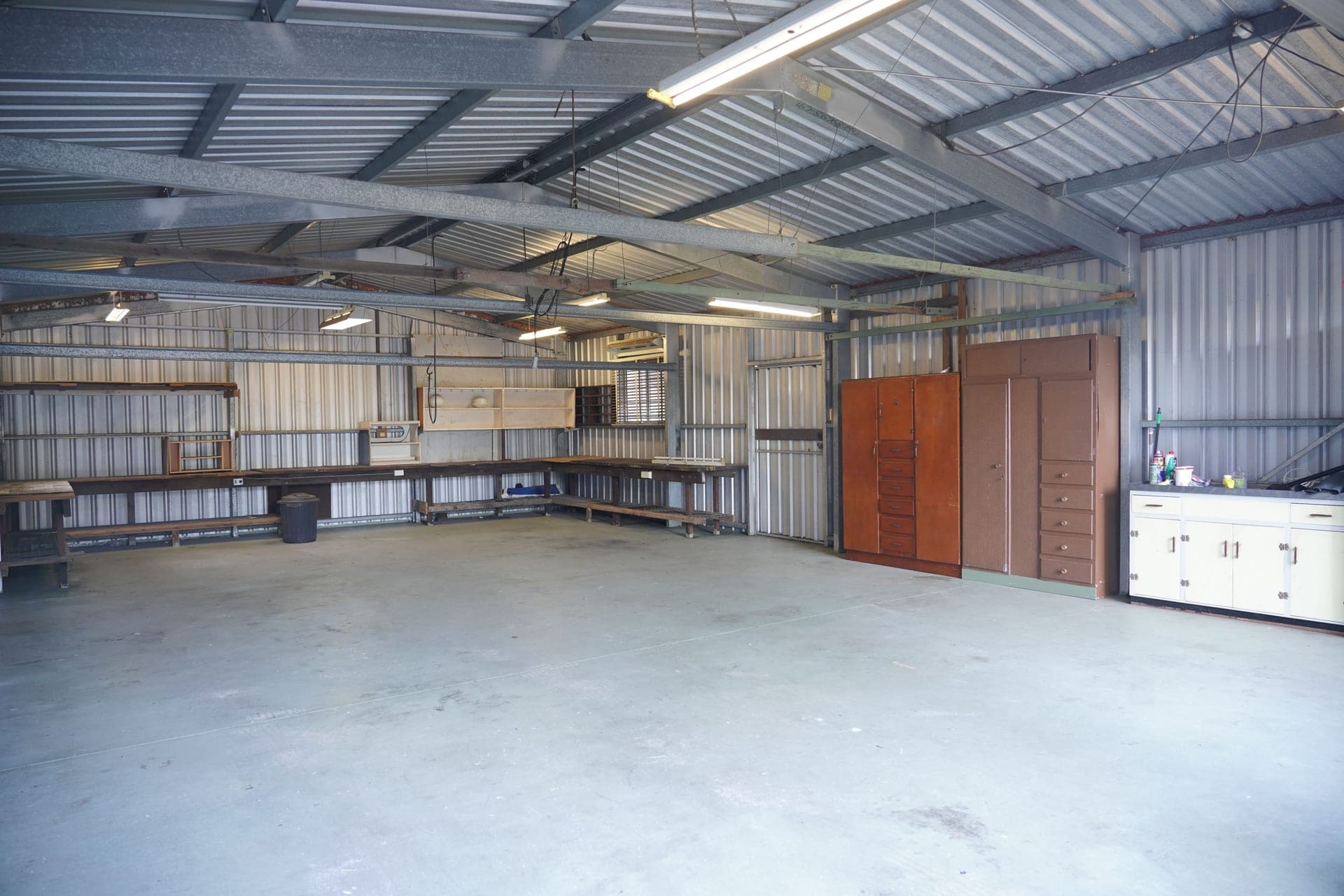
A garage generates and admits moisture in ways a heated room does not.
- A car brings water in. Rain, snow and road spray arrive on the vehicle and evaporate into the space over hours.
- The slab wicks ground moisture, exactly as a basement floor does, and a garage slab is rarely sealed.
- The door seals badly by design. It has to move, so it has gaps that admit humid outdoor air continuously.
- Cold surfaces everywhere. An uninsulated garage runs close to outdoor temperature, so warm humid air condenses on walls, tools and the car.
- The consequences are expensive. Rust on tools, on fasteners and on the vehicle itself, plus mold on anything stored in cardboard.
That combination argues for capacity and for continuous drainage, and against trying to save money with a small unit.
Setup
Getting it right in this room
- Check the minimum operating temperature first. Before capacity, before efficiency, before price. If the garage drops below it, nothing else matters.
- Plumb the drain. A tank that fills and stops the unit is the most common reason a garage dehumidifier does nothing, and nobody checks a garage daily.
- Watch for freezing in the drain line. A hose running across a cold slab to an outside drain can freeze and back up. Keep the run short and inside.
- Seal the garage door perimeter. Bottom, sides and top. Cheap, and it reduces the load more than any purchase decision.
- Get it off the floor and clear of walls. A garage is dusty at floor level, and these need clearance to move air.
- Clean the filter often. Sawdust, road dust and brake dust load a filter far faster than household air, and a blocked filter cuts water removal directly.
This one is not a DIY job
Never run a vehicle in an enclosed garage. Carbon monoxide is lethal and a dehumidifier does not remove it — it recirculates air rather than exchanging it, exactly like a room air conditioner.
If the garage is attached to living space, the wall and ceiling between them is usually a fire separation required by code. Do not cut through it to route a drain or a duct.
Electrical safety matters more here than in a house. A garage circuit is often shared with door openers and outlets, and damp concrete floors make GFCI protection important. Confirm the circuit can carry the load.
Persistent standing water or damp is a building problem — grading, drainage, a failed slab seal — and belongs to a contractor rather than an appliance.
Say the unwelcome thing
Do not buy a garage dehumidifier without checking its minimum operating temperature.
It is the one specification that decides whether the machine works at all in this room, and it is the one the certified data does not record.
A refrigerant dehumidifier condenses water on a cold coil. In a cold garage that coil goes below freezing, the condensate turns to ice, the ice blocks airflow, and water removal collapses while the compressor keeps drawing power. Many units defrost automatically down to a stated temperature and simply stop working below it.
The certification program records capacity, efficiency, annual energy, refrigerant and connectivity for all 554 models. It has no minimum temperature field, so the manual is your only source.
Once you have confirmed it, 49 pints at 2.20 L/kWh or 45 pints at 2.24 are the efficient picks — and plumb the drain.
In full
Every pick, and what is wrong with it
Published specifications only, each linked to the page it came from. Where a manufacturer publishes nothing, the row says so — we do not fill blanks in.
1. Best overall
Waykar Dehumidifier, 49 pints/day
Waykar · model CTH150D
49.43 pints a day at 2.20 L/kWh and 471 kWh a year — full capacity without the usual efficiency penalty.
A garage runs a dehumidifier hard, because the space is unconditioned and the moisture keeps arriving. Efficiency compounds here the way it does in a basement.
2.20 L/kWh against the 2.01 that every mainstream 50-pint unit manages, and 471 kWh a year — about $86 at 18.34¢/kWh — against 515 to 530 for the same water.
49.43 pints a day and Most Efficient certified, one of only 5 units in the 155-strong 45 to 60 pint band to reach that bar.
The caveat is the one this whole page is about: check the manufacturer’s stated minimum operating temperature against how cold your garage actually gets, because the certified dataset does not record it.
What’s wrong with it
Minimum operating temperature is not in the certified data, and a garage is where that matters most.
Running cost — CTH150D
| Annual energy use | 471 kWh | ENERGY STAR certified figure |
|---|---|---|
| Annual cost | $86 | 471 × 18.34¢/kWh |
| Per cooling month | $22 | spread over a four-month season |
The annual figure is the certified value from the ENERGY STAR Certified Dehumidifiers dataset, which models a standard cooling season rather than your actual summer. It is more useful than a nameplate wattage here, because a variable-speed compressor spends most of its life well below nameplate.
Rate: 18.34¢/kWh, the US average residential price for June 2026 (EIA Electric Power Monthly, Table 5.3). Yours will differ — swap it in: (watts ÷ 1000) × hours × your rate.
| Water removal | 49.43 pints/day (DOE Appendix X1) |
|---|---|
| Efficiency (IEF) | 2.20 L/kWh |
| Annual energy use | 471 kWh/yr |
| Refrigerant | HFC-32 (GWP 675) |
| Connected | No |
| Noise | Not published in the certified dataset |
| ENERGY STAR | Certified, and on the Most Efficient list |
Every figure above is from ENERGY STAR Certified Dehumidifiers dataset. Blanks are shown as “not published” rather than filled in.
2. Most efficient
Vellgoo Taurus Pro Dehumidifier, 45 pints/day
Vellgoo · model TAURUS PRO-RCS50(Y)-N4-3-25
2.24 L/kWh at 45 pints a day and 444 kWh a year — the highest IEF of any certified portable.
The efficiency leader of the entire certified portable field, and a sensible pick where the garage is humid rather than actively wet.
2.24 L/kWh and 444 kWh a year, about $81 at 18.34¢/kWh — the cheapest way to remove a given amount of water from a portable machine.
45.00 pints a day under the DOE test, which is about 9% below the 49-pint units. In a garage with a car bringing in rain and snow, that headroom is worth having.
Most Efficient certified, HFC-32 refrigerant. Same temperature caveat applies.
What’s wrong with it
45 pints is slightly less headroom, and no minimum temperature is published in the certified data.
Running cost — TAURUS PRO-RCS50(Y)-N4-3-25
| Annual energy use | 444 kWh | ENERGY STAR certified figure |
|---|---|---|
| Annual cost | $81 | 444 × 18.34¢/kWh |
| Per cooling month | $20 | spread over a four-month season |
The annual figure is the certified value from the ENERGY STAR Certified Dehumidifiers dataset, which models a standard cooling season rather than your actual summer. It is more useful than a nameplate wattage here, because a variable-speed compressor spends most of its life well below nameplate.
Rate: 18.34¢/kWh, the US average residential price for June 2026 (EIA Electric Power Monthly, Table 5.3). Yours will differ — swap it in: (watts ÷ 1000) × hours × your rate.
| Water removal | 45.00 pints/day (DOE Appendix X1) |
|---|---|
| Efficiency (IEF) | 2.24 L/kWh |
| Annual energy use | 444 kWh/yr |
| Refrigerant | HFC-32 (GWP 675) |
| Connected | No |
| Noise | Not published in the certified dataset |
| ENERGY STAR | Certified, and on the Most Efficient list |
Every figure above is from ENERGY STAR Certified Dehumidifiers dataset. Blanks are shown as “not published” rather than filled in.
3. Best supported brand
Midea Dehumidifier, 50 pints/day
Midea · model MDUDMB-50AEN8-BB0F
2.08 L/kWh at 49.67 pints a day — the best figure any household-name brand reaches here.
A garage dehumidifier lives in a dusty, cold, hard environment. A brand with parts and a service path behind it is a defensible choice even at a small efficiency cost.
2.08 L/kWh is the highest of any household brand in the certified set — Hisense, Frigidaire, LG, Whirlpool, Danby and GE all stop at 2.01.
49.67 pints a day and 515 kWh a year, about $94 at 18.34¢/kWh — $8.07 a year more than the Waykar for effectively the same water.
Not Most Efficient certified, which is a fair reflection of where 2.08 sits. The full field.
What’s wrong with it
515 kWh a year, and it does not carry the Most Efficient designation.
Running cost — MDUDMB-50AEN8-BB0F
| Annual energy use | 515 kWh | ENERGY STAR certified figure |
|---|---|---|
| Annual cost | $94 | 515 × 18.34¢/kWh |
| Per cooling month | $24 | spread over a four-month season |
The annual figure is the certified value from the ENERGY STAR Certified Dehumidifiers dataset, which models a standard cooling season rather than your actual summer. It is more useful than a nameplate wattage here, because a variable-speed compressor spends most of its life well below nameplate.
Rate: 18.34¢/kWh, the US average residential price for June 2026 (EIA Electric Power Monthly, Table 5.3). Yours will differ — swap it in: (watts ÷ 1000) × hours × your rate.
| Water removal | 49.67 pints/day (DOE Appendix X1) |
|---|---|
| Efficiency (IEF) | 2.08 L/kWh |
| Annual energy use | 515 kWh/yr |
| Refrigerant | HFC-32 (GWP 675) |
| Connected | No |
| Noise | Not published in the certified dataset |
| ENERGY STAR | Certified |
Every figure above is from ENERGY STAR Certified Dehumidifiers dataset. Blanks are shown as “not published” rather than filled in.
Skip this one
Vissani Dehumidifier, 27 pints/day
Vissani · model VAD25S1AWTS
26.87 pints a day at 283 kWh a year. Excellent in a bedroom, and it will run continuously in a garage.
Flagged because the small units are cheap and a garage is exactly where undersizing punishes you.
26.87 pints a day is a bedroom’s load. A garage has an uninsulated door, gaps by design, a concrete slab and a car that arrives wet.
An undersized dehumidifier has a real failure mode: it runs continuously, never reaches setpoint, and uses more energy over a season than the larger machine would have — while leaving the space damp.
283 kWh a year in its proper room, which is the lowest certified figure we hold. Put it where it belongs.
What’s wrong with it
An undersized dehumidifier runs at 100% duty forever and never reaches setpoint.
Running cost — VAD25S1AWTS
| Annual energy use | 283 kWh | ENERGY STAR certified figure |
|---|---|---|
| Annual cost | $52 | 283 × 18.34¢/kWh |
| Per cooling month | $13 | spread over a four-month season |
The annual figure is the certified value from the ENERGY STAR Certified Dehumidifiers dataset, which models a standard cooling season rather than your actual summer. It is more useful than a nameplate wattage here, because a variable-speed compressor spends most of its life well below nameplate.
Rate: 18.34¢/kWh, the US average residential price for June 2026 (EIA Electric Power Monthly, Table 5.3). Yours will differ — swap it in: (watts ÷ 1000) × hours × your rate.
| Water removal | 26.87 pints/day (DOE Appendix X1) |
|---|---|
| Efficiency (IEF) | 2.01 L/kWh |
| Annual energy use | 283 kWh/yr |
| Refrigerant | HFC-32 (GWP 675) |
| Connected | No |
| Noise | Not published in the certified dataset |
| ENERGY STAR | Certified |
Every figure above is from ENERGY STAR Certified Dehumidifiers dataset. Blanks are shown as “not published” rather than filled in.
We are not linking a buy button for this one. If you want to look at it anyway, it is easy enough to find — but we would rather send you to something that fits your room.
Questions people actually ask
Frequently asked
What size dehumidifier do I need for a garage?
Usually the 45 to 60 pint class. A garage has an uninsulated door with gaps by design, an unsealed slab, and a car bringing in rain and snow — so it wants capacity and headroom rather than the smallest unit that might cope. Sizing properly.
Will a dehumidifier work in a cold garage?
It depends entirely on the unit's minimum operating temperature, and the certified data does not record that field for any of the 554 models. A refrigerant dehumidifier ices its coil in a cold room, which blocks airflow and collapses water removal. Check the manual before buying.
Why does my garage dehumidifier ice up?
Because it removes water by condensing it on a coil colder than the air. In a cold garage that coil drops below freezing, so the condensate turns to ice instead of running off. Many units defrost automatically down to a stated temperature and stop working below it.
Should a garage dehumidifier drain continuously?
Yes. Nobody checks a garage daily, and a tank that fills and shuts the unit off is the most common reason one appears to have stopped working. Keep the drain run short and inside — a hose across a cold slab can freeze and back up.
What refrigerant do dehumidifiers use?
About 420 of the 502 certified portables use R-32 at GWP 675, and about 69 use R-290 at GWP 3. The catch is that R-290 units cluster at very small capacities — around 9 pints a day — so low GWP and garage capacity are not currently available together. What GWP means.
How much does a garage dehumidifier cost to run?
Certified 45 to 50 pint units run 444 to 530 kWh a year, which is $81 to $97 at 18.34¢/kWh. A garage unit frequently exceeds the certified figure because it runs against a continuous source rather than the standard test load.
Sources
Where these numbers came from
Read next
Where to go from here
Back to Dehumidifiers, or read how we pick.