Guide and picks
Do fans actually cool a room?
A fan makes a room very slightly warmer. It also makes you feel considerably cooler. Both are true, and the difference decides every purchase here.
By Sawyer V. · Published
The short answer
No. A fan does not lower air temperature — its motor actually adds a small amount of heat. What it does is move air across your skin, which accelerates evaporative and convective heat loss and makes you feel several degrees cooler. So a fan in an empty room is worse than useless. The one exception is a fan in a window, which exchanges indoor air for cooler outdoor air and genuinely does lower the temperature.
Fan & Frost earns a commission when you buy through our links, at no cost to you. It never changes a ranking, and we say so when the right answer is the cheaper unit or nothing at all. Full disclosure · How we pick.

At a glance
The picks, ranked
Tap any row to jump to the full reasoning. Prices are live from Amazon where we have them, and read “check price” where we don’t — never a number we cannot verify today.
| # | Product | Best for | Price |
|---|---|---|---|
| 1 | 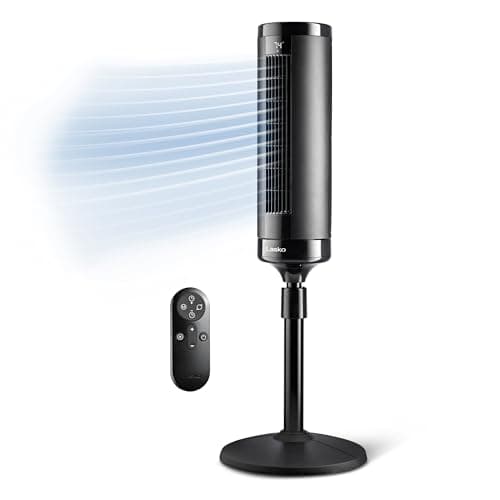 Cheapest way to feel cooler Lasko EcoQuiet 42" DC Tower Fan 2.9 W on low at 23 dBA — the least heat added and the least money spent for the felt-cooling effect. | A room with a person in it, which is the only case a fan helps | |
| 2 | The exception that really cools Lasko Twin Window Fan with Remote Up to 560 CFM on 22 to 31 W with a thermostat — it replaces the air rather than stirring it. | Actually lowering air temperature, once outdoor air is cooler | |
| 3 | 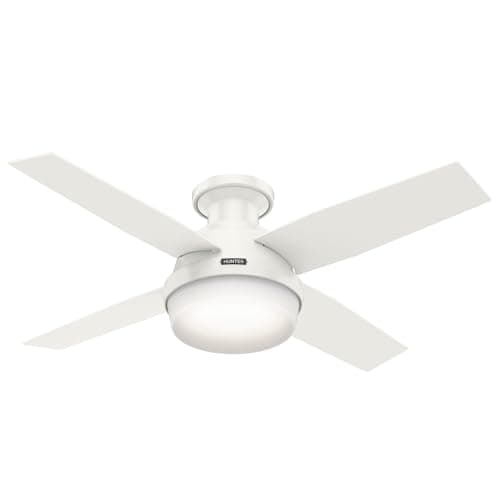 Least heat added, per unit of comfort Hunter Martindale 44" Ceiling Fan 1.1 W on low at 304.5 CFM per watt — the lowest certified wattage of any product on this site. | A room you own, running continuously for almost nothing | |
| — | 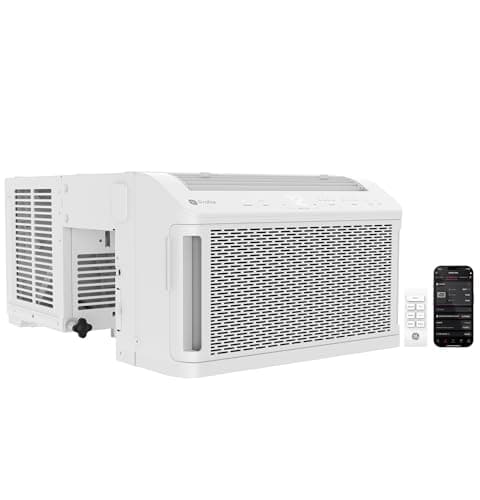 When you need the temperature to actually drop GE Profile ClearView Window Air Conditioner, 8,000 BTU CEER 16 and 375 kWh a year — it moves heat out of the room, which no fan does. | A room that is genuinely too hot, not just too still |
It is the most-asked question in this category and the answer is genuinely counterintuitive: a fan makes a room slightly warmer, and makes you feel considerably cooler.
The mechanism
Why a fan adds heat
A fan motor converts electricity into the kinetic energy of moving air. That air then slows down through friction with the room, the furniture and itself — and friction turns kinetic energy into heat.
Essentially all of a fan’s power draw ends up as heat in the room. Energy is conserved; there is nowhere else for it to go.
The amounts are small enough not to matter for the good fans:
| Fan | Power | Heat added |
|---|---|---|
| Ceiling fan, low | 1.1 W | About one LED bulb |
| DC tower fan, low | 2.9 W | Negligible |
| Ceiling fan, high | 13.9 W | Small |
| DC tower fan, high | 19 W | Small |
| Box fan, high | 102 W | A person sitting in the room |
| Air mover, high | 178 W | Noticeable in a small room |
A 1.1 W ceiling fan adding heat to a room is not a practical concern. A 178 W air mover in a small closed room genuinely is — it is contributing about as much heat as a seated adult.
Why it works anyway
You are not the room
Your body sheds heat several ways, and once the air approaches skin temperature most of them stop working — there is no longer a useful gradient.
What is left is evaporation. Sweat absorbs heat as it changes from liquid to vapor and carries that heat away.
A thin layer of air sits against your skin, and it becomes locally saturated as you sweat into it. Once saturated, evaporation into it stops even if the room as a whole is dry.
A fan strips that layer away and replaces it with room air that still has capacity to absorb moisture. Evaporation resumes, and you feel dramatically cooler — with the air temperature unchanged or a fraction higher.
Two conclusions follow directly, and both are useful:
- A fan in an empty room is worse than useless. No skin, no boundary layer, no benefit — and the motor is still adding heat. Turn it off.
- A fan loses effect as humidity rises. If room air is already near saturation, the replacement air has no more capacity than the layer it displaced. Why humidity changes everything.
This one is not a DIY job
The exception: a fan in a window. That is a genuinely different machine doing a genuinely different thing.
Instead of stirring the air already in the room, it exchanges it. Once outdoor air is cooler than indoor, replacing indoor air with outdoor air lowers the room temperature — measurably, on a thermometer.
The precondition is absolute: it only works while the outdoor air is actually cooler. Running a window fan at 3pm on a hot day imports heat.
Two openings beat one, because the air needs somewhere to leave. A purpose-built twin window fan with independent intake and exhaust motors does it through a single window.
Practical
What this means for what you buy
If the room feels stuffy and there are people in it, a fan is the right and enormously cheaper answer. At 1.1 to 2.9 W on low, the running cost is not a factor in the decision.
If the room is genuinely hot when nobody is in it, no fan of any size will fix that. You need either air exchange (a window fan, once outdoor air cools) or heat removal (an air conditioner).
If nobody is in the room, turn the fan off. This is the single most common waste in the category — a fan running in an empty room all day is adding heat and achieving nothing.
Aim it at people, not at the room, unless you are deliberately trying to circulate. Placement for each goal.
The number
How much cooler does it feel?
We are not going to publish a precise degree figure, because the honest answer is that it depends heavily on humidity, air speed, clothing and the individual — and every confident number you see quoted traces back to conditions that may not be yours.
What is reliable is the direction and the shape of it. The effect is substantial in dry air, reduced in humid air, and it increases with air speed up to a point and then adds little.
Which is why twelve speeds beats three: you can find the setting where the effect has largely arrived and the noise and power have not.
Say the unwelcome thing
Do not leave a fan running in an empty room.
It is the most common misunderstanding in this category, and it costs money to achieve slightly less than nothing.
A fan cools people, not air. With nobody there, the entire mechanism is absent — and the motor is converting every watt it draws into heat in the room you wanted cool.
The amounts are small for an efficient fan. A 102 W box fan running all day in an empty room adds about as much heat as a seated adult, plus 15¢ a day.
The one case where leaving a fan on genuinely helps an empty room is a window fan exchanging air while outdoor air is cooler, or a ceiling fan on low keeping a room from stratifying. Both are doing something other than the skin-cooling mechanism.
In full
Every pick, and what is wrong with it
Published specifications only, each linked to the page it came from. Where a manufacturer publishes nothing, the row says so — we do not fill blanks in.
1. Cheapest way to feel cooler
Lasko EcoQuiet 42" DC Tower Fan
Lasko · model T42710
2.9 W on low at 23 dBA — the least heat added and the least money spent for the felt-cooling effect.
If a fan works by moving air over you, the useful specification is how little power it needs to do that. 2.9 W on low is about 0.4¢ for an eight-hour night.
It also matters because of the mechanism: all 2.9 W ends up as heat in the room. A fan drawing 100 W adds thirty-four times as much — still small against a room’s heat load, and no longer negligible.
23 dBA on low is the quietest published figure on this site, and twelve DC speeds let you find the setting that is just enough rather than choosing between three.
What’s wrong with it
It does nothing whatsoever for an empty room, and 19 W on high is nearly seven times its low draw.
Running cost — T42710
| Nameplate power | 2.9 W – 19 W | manufacturer's published figure |
|---|---|---|
| Energy, 8-hour night | 0.15 kWh | 19 ÷ 1000 × 8 |
| Cost per hour | 0.3¢ | at 18.34¢/kWh |
| Cost per 8-hour night | 2.8¢ | on the highest speed |
| Cost per 30 nights | 84¢ | 4.6 kWh |
| Same month, lowest speed | 13¢ | at 2.9 W |
Rate: 18.34¢/kWh, the US average residential price for June 2026 (EIA Electric Power Monthly, Table 5.3). Yours will differ — swap it in: (watts ÷ 1000) × hours × your rate.
| Power | 2.9 W - 19 W (0.06-0.303 A at 120 V) |
|---|---|
| Noise | 23 dBA low, 46 dBA high |
| Speeds | 12 |
| Height | 41.6 in |
| Footprint | 12.8 x 12.8 in |
| Weight | 7.8 lb |
| Timer | 8 hours |
| Air delivery (CFM) | Not published |
| Warranty | 2 years |
Every figure above is from Lasko product page, T42710. Blanks are shown as “not published” rather than filled in.
2. The exception that really cools
Lasko Twin Window Fan with Remote
Lasko · model W09550
Up to 560 CFM on 22 to 31 W with a thermostat — it replaces the air rather than stirring it.
This is the one format on the site that changes what a thermometer reads, and it does it by a completely different mechanism from every other fan.
Instead of stirring the air already in the room, it replaces it. Once outdoor air is cooler than indoor, that genuinely lowers the room temperature.
Two independent motors let one window intake and exhaust at once, and the adjustable thermostat stops it when the room is cool enough — which is what makes overnight use practical.
22 to 31 W, about 4.5¢ a night. Window fan comparison.
What’s wrong with it
It only works while outdoor air is cooler than indoor, and it fits 24 to 32 inch windows only.
Running cost — W09550
| Nameplate power | 22 W – 31 W | manufacturer's published figure |
|---|---|---|
| Energy, 8-hour night | 0.25 kWh | 31 ÷ 1000 × 8 |
| Cost per hour | 0.6¢ | at 18.34¢/kWh |
| Cost per 8-hour night | 4.5¢ | on the highest speed |
| Cost per 30 nights | $1.36 | 7.4 kWh |
| Same month, lowest speed | 97¢ | at 22 W |
Rate: 18.34¢/kWh, the US average residential price for June 2026 (EIA Electric Power Monthly, Table 5.3). Yours will differ — swap it in: (watts ÷ 1000) × hours × your rate.
| Power | 22 W - 31 W at 120 V |
|---|---|
| Air delivery | Up to 560 CFM |
| Window fit | 24 - 32 in wide |
| Modes | Intake, exhaust or exchange (independent motors) |
| Thermostat | Adjustable |
| Speeds | 3 |
| Dimensions | 12.9 H x 24.0 W x 4.9 D in |
| Weight | 8.0 lb |
| Warranty | 1 year |
Every figure above is from Lasko product page, W09550. Blanks are shown as “not published” rather than filled in.
3. Least heat added, per unit of comfort
Hunter Martindale 44" Ceiling Fan
Hunter · model 44in Martindale
1.1 W on low at 304.5 CFM per watt — the lowest certified wattage of any product on this site.
1.1 watts. Twelve hours costs 0.2¢, and the heat it adds to the room is genuinely negligible — roughly what a small LED bulb contributes.
304.5 CFM per watt certified is the best small-fan efficiency in our data, which in this context means the most air movement for the least added heat.
The trade against a portable fan is aim. A ceiling fan circulates the whole room rather than pointing at one person, which is better for several people and worse for one.
What’s wrong with it
It is an electrical installation and cannot be aimed at you, so it circulates rather than targeting.
Running cost — 44in Martindale
| Nameplate power | 1.1 W – 10.1 W | manufacturer's published figure |
|---|---|---|
| Energy, 8-hour night | 0.08 kWh | 10.1 ÷ 1000 × 8 |
| Cost per hour | 0.2¢ | at 18.34¢/kWh |
| Cost per 8-hour night | 1.5¢ | on the highest speed |
| Cost per 30 nights | 44¢ | 2.4 kWh |
| Same month, lowest speed | 4.8¢ | at 1.1 W |
Rate: 18.34¢/kWh, the US average residential price for June 2026 (EIA Electric Power Monthly, Table 5.3). Yours will differ — swap it in: (watts ÷ 1000) × hours × your rate.
| Blade span | 44 in |
|---|---|
| Efficiency | 304.5 CFM per watt |
| Power, high speed | 10.1 W |
| Power, low speed | 1.1 W |
| Standby power | 0.4 W |
| Type | Indoor, fan only |
| Warranty | 3 years, components |
| ENERGY STAR | Certified |
Every figure above is from ENERGY STAR Certified Ceiling Fans dataset. Blanks are shown as “not published” rather than filled in.
Skip this one
GE Profile ClearView Window Air Conditioner, 8,000 BTU
GE Profile · model PWJV08W
CEER 16 and 375 kWh a year — it moves heat out of the room, which no fan does.
Listed as a skip because it is the escalation, not the first move — but it is the honest answer when a fan is genuinely not enough.
An air conditioner is a heat pump. It takes heat from the room air and rejects it outside, so the thermometer actually falls. That is a different thing from what a fan does, and it costs accordingly.
375 kWh a year, about $69 for a season, against 22¢ for a ceiling fan run twelve hours a night for the same period.
The test for which you need: does the room feel bad when nobody is moving air, or is it genuinely hot? Sizing, if it is the latter.
What’s wrong with it
About a hundred times the seasonal cost of a ceiling fan. That is what changing the air temperature costs.
Running cost — PWJV08W
| Annual energy use | 375 kWh | ENERGY STAR certified figure |
|---|---|---|
| Annual cost | $69 | 375 × 18.34¢/kWh |
| Per cooling month | $17 | spread over a four-month season |
The annual figure is the certified value from the ENERGY STAR Certified Room Air Conditioners dataset, which models a standard cooling season rather than your actual summer. It is more useful than a nameplate wattage here, because a variable-speed compressor spends most of its life well below nameplate.
Rate: 18.34¢/kWh, the US average residential price for June 2026 (EIA Electric Power Monthly, Table 5.3). Yours will differ — swap it in: (watts ÷ 1000) × hours × your rate.
| Cooling capacity | 8,000 BTU/h |
|---|---|
| CEER | 16 |
| Annual energy use | 375 kWh/yr |
| vs federal standard | 47% less energy |
| Dimensions | 12.6 H x 18.6 W x 15.3 D in |
| Weight | 46.2 lb |
| Refrigerant | R-32 |
| Installation | Does not straddle the windowsill |
| Compressor | Variable speed |
| ENERGY STAR | Certified, and on the Most Efficient list |
Every figure above is from ENERGY STAR Certified Room Air Conditioners dataset. Blanks are shown as “not published” rather than filled in.
We are not linking a buy button for this one. If you want to look at it anyway, it is easy enough to find — but we would rather send you to something that fits your room.
Questions people actually ask
Frequently asked
Do fans cool a room?
No — they cool people. A fan does not lower air temperature and its motor actually adds a small amount of heat. What it does is move air across skin, which accelerates evaporation and makes you feel several degrees cooler.
Does a fan make a room hotter?
Very slightly, yes. Essentially all of a fan's power draw ends up as heat in the room. At 1.1 to 2.9 watts for an efficient fan that is negligible; at 178 watts for an air mover it is comparable to a seated adult.
Should I leave a fan on in an empty room?
No. The cooling mechanism requires skin, so with nobody there the fan achieves nothing while adding its own motor heat. The exceptions are a window fan exchanging air, or a ceiling fan on low preventing stratification.
Can any fan actually lower the temperature?
A fan in a window can, because it replaces indoor air with outdoor air rather than stirring what is there. That only works while the outdoor air is cooler than indoor — running one on a hot afternoon imports heat. Window fans, ranked.
Why do fans feel less effective in humid weather?
Because the cooling comes from evaporating sweat, and that needs air with spare capacity to absorb moisture. In near-saturated air the replacement air a fan brings has no more capacity than the layer it displaced.
How many degrees cooler does a fan make you feel?
It depends too much on humidity, air speed, clothing and the individual for a single honest number. What is reliable is that the effect is substantial in dry air, reduced in humid air, and increases with air speed only up to a point.
Sources
Where these numbers came from
Read next
Where to go from here
Back to Fans, or read how we pick.