Head to head
LG Dual Inverter vs Midea 5,000 BTU
The most efficient small window unit on this site against the cheapest. The efficient one uses more electricity, and that is not a contradiction.
By Sawyer V. · Published
The short answer
Buy the Midea unless you specifically need the extra capacity. The LG is the more efficient machine — CEER 15.5 and on the ENERGY STAR Most Efficient list against the Midea’s 14.4 — but it is a 6,000 BTU unit, so it uses more total electricity (290.3 kWh a year against 260.4), weighs 62.0 lb against 30.2, and costs roughly two and a half times as much. The premium does not pay back on energy, ever.
Fan & Frost earns a commission when you buy through our links, at no cost to you. It never changes a ranking, and we say so when the right answer is the cheaper unit or nothing at all. Full disclosure · How we pick.

At a glance
The picks, ranked
Tap any row to jump to the full reasoning. Prices are live from Amazon where we have them, and read “check price” where we don’t — never a number we cannot verify today.
| # | Product | Best for | Price |
|---|---|---|---|
| 1 | 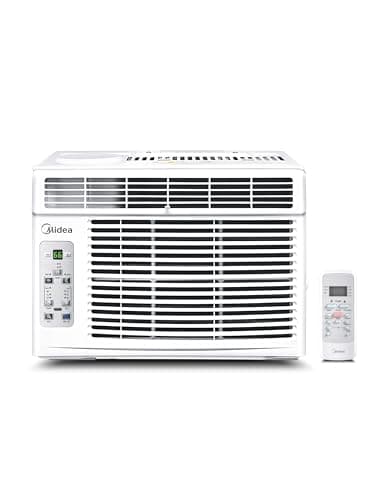 The Midea case Midea Window Air Conditioner, 5,000 BTU CEER 14.4 on 260.4 kWh a year, 30.2 lb, no support bracket required, at under half the LG's price. The lowest total electricity use of the two. | A room up to about 150 sq ft, an upper-floor window, or a unit you install yourself | |
| 2 | 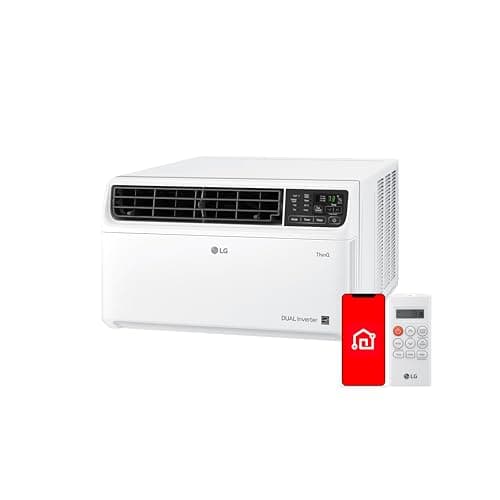 The LG case LG Dual Inverter Window Air Conditioner, 6,000 BTU CEER 15.5 and on the ENERGY STAR Most Efficient list — the highest certified efficiency of any small window unit here — with 20 per cent more cooling capacity. | A room of 200 to 260 sq ft where 5,000 BTU genuinely is not enough, on a ground floor or a sill that can take the weight |
These two sit at opposite ends of the small window unit market, and the comparison is useful mainly because it shows what an efficiency rating does and does not tell you.
Head to head
Certified figures, side by side
| Midea MAW05R1VWWT | LG LW6023IVSM | |
|---|---|---|
| Cooling capacity | 5,000 BTU/h | 6,000 BTU/h |
| CEER | 14.4 | 15.5 |
| Annual energy use | 260.4 kWh/yr | 290.3 kWh/yr |
| Annual running cost | $48 | $53 |
| ENERGY STAR | Certified | Certified, Most Efficient |
| Weight | 30.2 lb | 62.0 lb |
| Support bracket | Not required | Not required |
| Compressor | Variable speed | Variable speed |
| Room guidance | Up to ~150 sq ft | Up to ~260 sq ft |
Capacity, CEER and annual kWh from the ENERGY STAR Certified Room Air Conditioners dataset; running cost is our arithmetic at 18.34¢/kWh. Prices checked 11 October 2026: the Midea was $157.99 and the LG $399.00. The buttons above carry the live price and the date.
The finding
A higher CEER does not mean a lower bill
This pair is the clearest illustration on the site of a thing that trips up almost every buyer. CEER is efficiency per unit of cooling, not total consumption. The LG converts electricity into cold more effectively — 15.5 against 14.4 — and then does more of it, because it is a 6,000 BTU machine rather than a 5,000 BTU one.
The result is that the Most Efficient unit uses $5.48 a year more electricity than the merely-certified one. Neither figure is wrong and neither unit is mislabelled. They answer different questions.
So the premium here is not an energy investment. At roughly $240 more to buy and more electricity every year, the LG never pays back on running cost. It pays back only if you need the capacity.
This one is not a DIY job
Size first, then compare efficiency within that size. Comparing a 5,000 BTU unit with a 6,000 BTU one on CEER answers a question nobody asked. Work out the BTU the room needs, then pick the most efficient unit at that capacity. How to work out the BTU.
Which one
How to choose
- Room under about 150 sq ft: the Midea. The LG is more unit than the room needs, and oversizing short-cycles and removes less humidity.
- Room of 200 to 260 sq ft: the LG. 5,000 BTU will not do it, and at that point the LG’s efficiency is a genuine bonus.
- An upper-floor window, installing alone: the Midea. 30.2 lb against 62.0.
- Lowest electricity bill: the Midea, at $48 a year against $53.
- Best efficiency per BTU: the LG, clearly — and that is the only contest it wins outright.
Say the unwelcome thing
Do not buy the bigger unit 'to be safe'.
ENERGY STAR is explicit that an oversized room air conditioner "costs more to purchase, wastes energy and does not provide better cooling." An oversized unit reaches the set temperature fast, shuts off, and stops dehumidifying — which is why an oversized room often feels clammy rather than cool.
Oversizing is worse than undersizing in this category. If you are between sizes, read the room properly rather than rounding up.
In full
Every pick, and what is wrong with it
Published specifications only, each linked to the page it came from. Where a manufacturer publishes nothing, the row says so — we do not fill blanks in.
1. The Midea case
Midea Window Air Conditioner, 5,000 BTU
Midea · model MAW05R1VWWT-T
CEER 14.4 on 260.4 kWh a year, 30.2 lb, no support bracket required, at under half the LG's price. The lowest total electricity use of the two.
CEER 14.4 on 260.4 kWh a year — about $48 of electricity annually at 18.34¢/kWh, and the lower of the two figures despite the lower efficiency rating. That is the whole subtlety of this comparison and it is explained below.
30.2 lb against 62.0, with Midea stating no support bracket is required. Less than half the weight is the difference between a one-person install on a second floor and a job you need help and hardware for.
12.1 H x 16.0 W x 13.3 D inches and a variable-speed compressor on R-32. Note that the variable-speed compressor is not an LG exclusive — the entire certified room AC field is variable-speed now, so "inverter" on a box is no longer information. Why that claim stopped meaning anything.
$48 a year to run, and the lowest purchase price of any certified window unit we hold data for.
What’s wrong with it
5,000 BTU will not cool a 250 sq ft room, CEER 14.4 is a point behind the LG, and it is not on the Most Efficient list — though nothing at this capacity is.
Running cost — MAW05R1VWWT-T
| Annual energy use | 260.4 kWh | ENERGY STAR certified figure |
|---|---|---|
| Annual cost | $48 | 260.4 × 18.34¢/kWh |
| Per cooling month | $12 | spread over a four-month season |
The annual figure is the certified value from the ENERGY STAR Certified Room Air Conditioners dataset, which models a standard cooling season rather than your actual summer. It is more useful than a nameplate wattage here, because a variable-speed compressor spends most of its life well below nameplate.
Rate: 18.34¢/kWh, the US average residential price for June 2026 (EIA Electric Power Monthly, Table 5.3). Yours will differ — swap it in: (watts ÷ 1000) × hours × your rate.
| Cooling capacity | 5,000 BTU/h |
|---|---|
| CEER | 14.4 |
| Annual energy use | 260.4 kWh/yr |
| vs federal standard | 31% less energy |
| Dimensions | 12.1 H x 16.0 W x 13.3 D in |
| Weight | 30.2 lb |
| Installation | Does not straddle the windowsill |
| Support bracket | Not required |
| Compressor | Variable speed |
| Refrigerant | R-32 |
| ENERGY STAR | Certified (not on the Most Efficient list) |
Every figure above is from ENERGY STAR Certified Room Air Conditioners dataset. Blanks are shown as “not published” rather than filled in.
2. The LG case
LG Dual Inverter Window Air Conditioner, 6,000 BTU
LG · model LW6023IVSM
CEER 15.5 and on the ENERGY STAR Most Efficient list — the highest certified efficiency of any small window unit here — with 20 per cent more cooling capacity.
CEER 15.5, certified, and on the Most Efficient list — which the Midea is not, and which no 5,000 BTU unit is. On efficiency per unit of cooling this is the better machine and it is not close.
6,000 BTU/h against 5,000. That is the real reason to buy it: 20 per cent more capacity, which is the difference between a 150 sq ft room and a 250 sq ft one. If your room needs 6,000 BTU, the Midea is simply the wrong unit and its efficiency is irrelevant.
290.3 kWh a year, or about $53 — $5.48 a year more than the Midea. A higher CEER with a higher capacity still means a higher bill.
62.0 lb is the practical catch. LG states no support bracket is required, but 62 lb in a sash is a two-person install and a sill you should look at properly first. Weight, tilt and the seal.
What’s wrong with it
62.0 lb, roughly two and a half times the price, and 290.3 kWh a year. It is more efficient per BTU and uses more electricity in total.
Running cost — LW6023IVSM
| Annual energy use | 290.3 kWh | ENERGY STAR certified figure |
|---|---|---|
| Annual cost | $53 | 290.3 × 18.34¢/kWh |
| Per cooling month | $13 | spread over a four-month season |
The annual figure is the certified value from the ENERGY STAR Certified Room Air Conditioners dataset, which models a standard cooling season rather than your actual summer. It is more useful than a nameplate wattage here, because a variable-speed compressor spends most of its life well below nameplate.
Rate: 18.34¢/kWh, the US average residential price for June 2026 (EIA Electric Power Monthly, Table 5.3). Yours will differ — swap it in: (watts ÷ 1000) × hours × your rate.
| Cooling capacity | 6,000 BTU/h |
|---|---|
| CEER | 15.5 |
| Annual energy use | 290.3 kWh/yr |
| Weight | 62.0 lb |
| Installation | Does not straddle the windowsill |
| Support bracket | Not required |
| Compressor | Variable speed |
| ENERGY STAR | Certified, and on the Most Efficient list |
Every figure above is from ENERGY STAR Certified Room Air Conditioners dataset. Blanks are shown as “not published” rather than filled in.
Questions people actually ask
Frequently asked
Is the LG Dual Inverter worth it over a cheap Midea?
Only if you need 6,000 BTU rather than 5,000. The LG is more efficient per unit of cooling — CEER 15.5 against 14.4, and on the Most Efficient list — but it costs about two and a half times as much, weighs 62.0 lb against 30.2, and uses more total electricity per year because it is a larger machine.
Why does the more efficient air conditioner use more electricity?
Because CEER measures efficiency per unit of cooling, not total consumption. The LG is 6,000 BTU at CEER 15.5 and certifies at 290.3 kWh a year; the Midea is 5,000 BTU at CEER 14.4 and certifies at 260.4 kWh. The LG converts power into cold more effectively and then does more of it.
Does 'dual inverter' mean a better air conditioner?
Not any more. Every unit in the certified room air conditioner field now uses a variable-speed compressor, including the cheap Midea here, so 'inverter' on a box has stopped being a point of difference. Compare CEER and annual kWh instead. Inverter vs fixed speed.
What does each of these cost to run per year?
About $48 for the Midea and $53 for the LG at 18.34¢/kWh, from certified annual figures of 260.4 and 290.3 kWh. The LG costs roughly $5.48 a year more, so its purchase premium never pays back on energy.
Is 6,000 BTU much better than 5,000?
It is 20 per cent more cooling, which in practice is the difference between a room up to about 150 sq ft and one up to about 260. That matters only if your room is in the larger band — buying extra capacity you do not need causes short-cycling, worse humidity removal and a higher bill. Sizing an air conditioner.
Do I need a support bracket for the 62 lb LG?
LG states one is not required, as does Midea for its 30.2 lb unit. In practice 62 lb in a sash window is a two-person install and worth inspecting the sill for first. Our analysis of the certified field found bracket requirement tracks mounting design rather than weight. Support brackets.
Sources
Where these numbers came from
Read next
Where to go from here
Back to Air Conditioners, or read how we pick.