Head to head
Twin window fan vs single window fan
Two small motors or one big blade. The honest answer depends on a measurement you have probably not taken.
By Sawyer V. · Published
The short answer
A single big blade moves about four times the air. The 16-inch Air King publishes 2,470 CFM on 90 W; a Lasko twin publishes 560 CFM on 31 W. But the twin fits an opening 13 inches high where the single needs 22, and its two motors can run in opposite directions at once. Small opening or one bedroom, buy the twin. Moving a house’s air, buy the single.
Fan & Frost earns a commission when you buy through our links, at no cost to you. It never changes a ranking, and we say so when the right answer is the cheaper unit or nothing at all. Full disclosure · How we pick.

At a glance
The picks, ranked
Tap any row to jump to the full reasoning. Prices are live from Amazon where we have them, and read “check price” where we don’t — never a number we cannot verify today.
| # | Product | Best for | Price |
|---|---|---|---|
| 1 | The twin case Lasko Twin Window Fan with Remote 560 CFM on 22 to 31 W from two independently reversible 9-inch motors, in a body 12.9 inches tall and 8 lb. | A bedroom, a short opening, or a window you want air moving both ways in | |
| 2 | 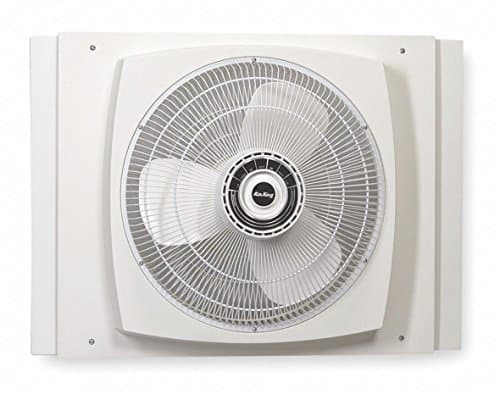 The single case Air King 16" Whole House Window Fan 2,470 CFM on 90 W — 4.4 times the airflow of a twin at 27.4 CFM per watt, the best in the category. | Changing the air in a whole floor, not one room |
The numbers
What each format publishes
Nobody certifies window fans, so every figure below is a manufacturer claim from their own product page, and the efficiency column is our division of one by the other.
| Fan | Airflow | Power | CFM/W | Opening |
|---|---|---|---|---|
| Lasko W09550 twin | 560 CFM | 22 - 31 W | 18.1 | 24 - 32 in wide, 12.9 in tall |
| Comfort Zone CZ319WT twin | Not published | Not published | — | 22.25 - 33 in wide |
| Air King 9155, 16 in single | 2,470 CFM | 52 - 90 W | 27.4 | 26.5 - 34.5 in wide, 22 in tall |
| Air King 9166F, 20 in single | 3,560 CFM | 115 - 170 W | 20.9 | 27 - 38 in wide, 26.25 in tall |
| Vornado Transom single | Not published | Not published | — | 26 - 40 in wide, 10 in clearance |
Two things in that table are worth saying plainly. The first is that the gap is a factor of four, not a few percent. The second is that the two most convenient fans in the list — the cheap twin and the low-profile Vornado — publish no airflow figure at all, so nobody can tell you where they sit.
Fit
The measurement that usually decides it
Width gets all the attention because that is what the accordion panels adjust. Height is what rules fans out.
- A twin needs roughly 13 inches of clear opening height. Most sashes clear that.
- A 16-inch single needs 22 inches, and a 20-inch single needs 26.25. Plenty of windows — and nearly every apartment window with a sash stop — do not open that far.
Measure the clear opening with the window fully open, not the glass. If the answer is under about 22 inches, the choice is made for you, and the twin is not a compromise so much as the only format that fits. If your window slides sideways or cranks out, neither format may fit at all, and the casement and slider problem is its own page.
This one is not a DIY job
Noise
Small and many, or big and slow
Neither format publishes much here. Air King gives 64 / 57 / 50 dB for the 20-inch model and nothing for the 16-inch; Lasko publishes no figure for the W09550 at all.
What is knowable is the shape of the problem. A twin’s 9-inch blades have to spin fast to move any air, and small fast blades make higher-pitched noise, which people find more intrusive at the same measured level. A 16 or 20-inch blade at low speed moves far more air for a lower, duller sound — which is why the quietest useful setting is usually a big fan turned down, not a small fan turned up. The general version of that argument is in how loud a fan actually is.
Control
Where the twin wins on paper
The twin format has absorbed every convenience feature in the category. The Lasko has three speeds, an eight-hour timer, a remote, an adjustable thermostat that cycles the fan against room temperature, and independent control of each motor. The single-blade whole-house fans have a rotary switch.
That matters more than it sounds for overnight running: a thermostat is what stops a fan pulling in air at 4 a.m. that is colder than you wanted, and a timer is what stops it running until noon. If those are the features you are shopping for, the wider field is in fans with remotes and timers.
The verdict
Which one to buy
- Buy a twin if the opening is under 22 inches high, if the room has only one usable window, or if you want a thermostat and a remote. It is also the only format light enough to move between rooms without thinking about it.
- Buy a single if the opening takes it and the job is a whole floor rather than one room — overnight flush-outs, a house that holds the day’s heat, or anywhere you would otherwise be running two twins.
- Buy neither if outdoor air is not cooler than indoor air for some part of the day. A window fan can only deliver the air outside; when that air is 88 degrees, the honest answer is an air conditioner.
Say the unwelcome thing
Do not buy two twins instead of one single.
It is the upgrade people reach for when one twin underperforms, and the arithmetic does not support it. Two Lasko twins is 1,120 CFM for 62 W in two windows. One 16-inch single is 2,470 CFM for 90 W in one window — more than twice the air for less than half again the power, and one thing to install.
The exception is the genuine one: two twins in two rooms are two rooms’ worth of airflow. One 16-inch fan and one open window elsewhere beats two fans in the same room almost every time.
In full
Every pick, and what is wrong with it
Published specifications only, each linked to the page it came from. Where a manufacturer publishes nothing, the row says so — we do not fill blanks in.
1. The twin case
Lasko Twin Window Fan with Remote
Lasko · model W09550
560 CFM on 22 to 31 W from two independently reversible 9-inch motors, in a body 12.9 inches tall and 8 lb.
The twin format exists for one reason: two small motors fit where one big blade does not. This fan stands 12.9 inches tall and spans 24 to 32 inches, against the 22 inches of height every whole-house window fan demands. On a sash that only lifts a foot, that is the difference between a fan in the window and no fan in the window.
The second reason is direction. Two independently controlled motors can run one in and one out at the same time, in a single opening. Lasko calls it exchange mode. A single-blade fan can do intake or exhaust, never both, so getting air to circulate means finding a second window — which is the whole argument of running a window fan on exhaust.
It is also the cheap option to run. At 31 W on high, an eight-hour night costs 4.5¢ at 18.34¢/kWh, against 13¢ for the 16-inch single. Over thirty nights that gap is $2.60 — real, but not the reason to choose either one.
What’s wrong with it
560 CFM is roughly a quarter of what a 16-inch single moves, and at 18.1 CFM per watt it is the least efficient format per watt as well.
Running cost — W09550
| Nameplate power | 22 W – 31 W | manufacturer's published figure |
|---|---|---|
| Energy, 8-hour night | 0.25 kWh | 31 ÷ 1000 × 8 |
| Cost per hour | 0.6¢ | at 18.34¢/kWh |
| Cost per 8-hour night | 4.5¢ | on the highest speed |
| Cost per 30 nights | $1.36 | 7.4 kWh |
| Same month, lowest speed | 97¢ | at 22 W |
Rate: 18.34¢/kWh, the US average residential price for June 2026 (EIA Electric Power Monthly, Table 5.3). Yours will differ — swap it in: (watts ÷ 1000) × hours × your rate.
| Power | 22 W - 31 W at 120 V |
|---|---|
| Air delivery | Up to 560 CFM |
| Window fit | 24 - 32 in wide |
| Modes | Intake, exhaust or exchange (independent motors) |
| Thermostat | Adjustable |
| Speeds | 3 |
| Dimensions | 12.9 H x 24.0 W x 4.9 D in |
| Weight | 8.0 lb |
| Warranty | 1 year |
Every figure above is from Lasko product page, W09550. Blanks are shown as “not published” rather than filled in.
2. The single case
Air King 16" Whole House Window Fan
Air King · model 9155
2,470 CFM on 90 W — 4.4 times the airflow of a twin at 27.4 CFM per watt, the best in the category.
One 16-inch blade in a 26.5-inch housing moves 2,470 CFM on high. That is 4.4 times the twin, and it arrives with better arithmetic behind it: 27.4 CFM per watt against 18.1, on published figures divided by published wattage.
Put both against a room. A 400-square-foot living room with an 8-foot ceiling holds 3,200 cubic feet. The single changes that air in about 78 seconds; the twin takes about five and a half minutes. For a bedroom neither matters much. For a floor of a house, it is the whole question.
The single also brings Storm Guard, which lets the sash close behind the fan rather than resting on it — weather, and a window that still locks with a fan in it.
What’s wrong with it
Needs 22 inches of opening height and 26.5 of width, weighs 15 lb against 8, and has no thermostat, no remote and no exchange mode.
Running cost — 9155
| Nameplate power | 52 W – 90 W | manufacturer's published figure |
|---|---|---|
| Energy, 8-hour night | 0.72 kWh | 90 ÷ 1000 × 8 |
| Cost per hour | 1.7¢ | at 18.34¢/kWh |
| Cost per 8-hour night | 13¢ | on the highest speed |
| Cost per 30 nights | $3.96 | 21.6 kWh |
| Same month, lowest speed | $2.29 | at 52 W |
Rate: 18.34¢/kWh, the US average residential price for June 2026 (EIA Electric Power Monthly, Table 5.3). Yours will differ — swap it in: (watts ÷ 1000) × hours × your rate.
| Air delivery | 2,470 / 1,700 / 1,360 CFM (high / medium / low) |
|---|---|
| Power | 90 / 65 / 52 W (0.8 / 0.6 / 0.5 A) |
| Efficiency | 27.4 CFM per watt on high, 26.2 on low (our arithmetic) |
| Blade | 16 in |
| Speeds | 3 |
| Window required | 26.5 - 34.5 in wide x 22 in high |
| Dimensions | 26.5 W x 8.25 D x 22 H in |
| Weight | 15.0 lb |
| Storm Guard | Window can close behind the fan |
| Mounting | Hardware included |
| Noise | Not published |
| ENERGY STAR | No program exists for window fans |
Every figure above is from Air King whole house window fan product page, models 9155 and 9166F. Blanks are shown as “not published” rather than filled in.
Questions people actually ask
Frequently asked
Is a twin window fan better than a single?
Only where it fits and a single does not. A twin needs about 13 inches of opening height against 22 for a 16-inch single, and its two motors can run in opposite directions in one window. On airflow the single wins by roughly four to one.
How much air does a twin window fan move?
Lasko publishes up to 560 CFM for the W09550, drawing 22 to 31 watts. Many twins publish no airflow figure at all, including the Comfort Zone CZ319WT, so there is no way to compare those on anything but format and fit.
Can you run one side of a twin window fan in and one out?
On models with independently controlled motors, yes — Lasko calls it exchange mode. It is the one thing a single-blade window fan cannot do at all, because a single blade has one direction at a time.
Which window fan is quieter, twin or single?
Neither format publishes enough noise data to answer it with numbers. What is reliable is that a large blade turned down moves more air for less noise than a small blade turned up, because airflow rises with blade area and noise rises steeply with speed. What fan noise figures mean.
Do window fans use a lot of electricity?
No. A twin at 31 watts costs about 5 cents for an eight-hour night at the national average rate, and a 16-inch whole-house window fan at 90 watts costs about 13 cents. Both are a rounding error next to an air conditioner. Fan running costs in full.
Sources
Where these numbers came from
- Lasko product page, W09550 — up to 560 CFM, 22 to 31 W, 24 to 32 in window fit, 12.9 in height, twin reversible motors, thermostat, 8-hour timer, remote, 8.0 lb
- Air King whole house window fan product page — models 9155 and 9166F: CFM and watts at each speed, required window size, weight, Storm Guard, intake or exhaust operation
- Comfort Zone product page, CZ319WT — two 9 in fans, two speeds, reversible airflow control, 22.25 to 33 in width range; no airflow or wattage published
- Vornado product page, Transom — four speeds, electronic reversal, 26 to 40 in fit, 10 in minimum clearance; no CFM or wattage published
- EIA Electric Power Monthly, Table 5.3 — average residential electricity price
Read next
Where to go from here
Back to Fans, or read how we pick.