Head to head
U-shaped vs standard window air conditioner
Two 8,000 BTU units with identical certified numbers. Everything that separates them happens at the window.
By Sawyer V. · Published
The short answer
Efficiency is a tie; the window decides it. An 8,000 BTU U-shaped unit and a conventional one both certify at CEER 15 and 400 kWh a year. What the U-shape buys is a sash that closes through the unit — quieter indoors, lockable, and it leaves the window usable. What it costs is a sill depth requirement and a shape that will not fit every opening.
Fan & Frost earns a commission when you buy through our links, at no cost to you. It never changes a ranking, and we say so when the right answer is the cheaper unit or nothing at all. Full disclosure · How we pick.

At a glance
The picks, ranked
Tap any row to jump to the full reasoning. Prices are live from Amazon where we have them, and read “check price” where we don’t — never a number we cannot verify today.
| # | Product | Best for | Price |
|---|---|---|---|
| 1 | 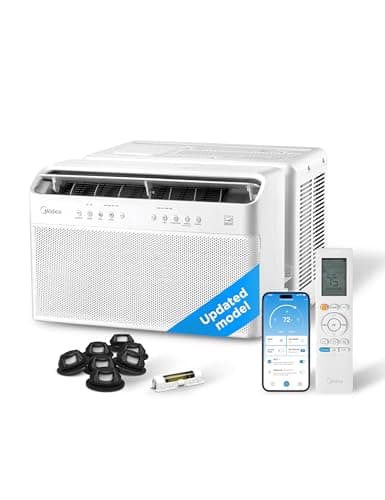 The U-shaped case Midea U-Shaped Window Air Conditioner, 8,000 BTU CEER 15 and 400 kWh a year, with the sash closing through the middle of the chassis instead of resting on top of it. | A standard sash window where noise and security matter | |
| 2 | 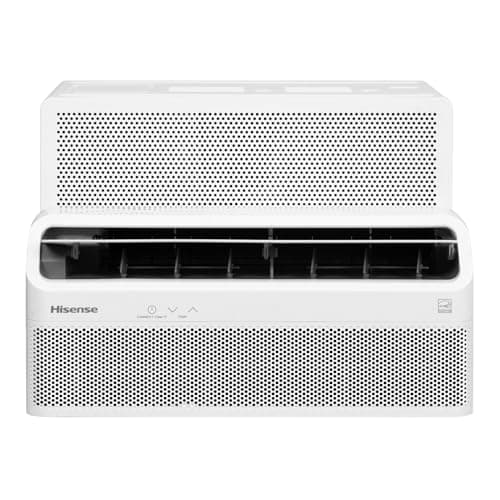 The conventional case Hisense Window Air Conditioner, 8,000 BTU The same CEER 15 and 400 kWh a year, in the format that fits the most windows. | Any window the U-shape will not fit |
The numbers
Where the two formats genuinely differ
| U-shaped | Conventional | |
|---|---|---|
| Certified CEER, 8,000 BTU | 15 | 15 |
| Certified annual kWh | 400 | 400 |
| Window closes on the unit | Through the middle | On top |
| Window lockable in use | Yes | No |
| Compressor position | Outside the glass line | In the opening |
| Sill depth needed | Greater | Standard |
| Fits narrow openings | Less often | More often |
| Chassis weight | Heavier for the capacity | Lighter |
The first two rows are the ones worth pausing on. These are certified federal figures, and they are identical. The U-shape is an installation innovation, not an efficiency one — the efficient U-shaped units are efficient because they use inverter compressors, and conventional units with inverter compressors certify just as well. The mechanism is in inverter versus fixed-speed.
This one is not a DIY job
Before you order
The three measurements that decide it
- Sash depth and the sill. A U-shaped unit straddles the sill, so the sill has to be deep enough and sound enough to carry it. This is the measurement people miss, and it is the one that sends units back.
- Window width at its narrowest. Both formats have a minimum; the U-shape’s is usually larger because the chassis is wider for the same capacity.
- What is outside. A U-shape hangs further out. A balcony railing, a security grille, a shutter or a neighboring wall within a few inches rules it out.
If your window slides sideways or cranks outward, neither format fits and the alternatives are in casement and sliding window air conditioners.
Who should buy which
The decision in one paragraph each
Buy the U-shape if the window is a standard double-hung with a solid sill, the room is one you sleep in, and the window matters to you for light, air or security. You are paying for a better installation, not for cheaper running.
Buy the conventional unit if the window is narrow, shallow, obstructed outside or non-standard, or if the room is one you are cooling rather than living in. The certified numbers say you lose nothing in efficiency. The full field is in window air conditioners, ranked, and the U-shaped field is in U-shaped and saddle units.
Say the unwelcome thing
Do not choose the U-shape for efficiency.
Both units here certify at CEER 15 and 400 kWh a year. If a listing implies the shape saves electricity, it is describing the inverter compressor inside it, which conventional units also use.
Choose it for the window, the lock and the compressor position — those are real. If none of them matter in your room, the same CEER 15 in a conventional chassis does the same cooling in a shape that fits more openings.
In full
Every pick, and what is wrong with it
Published specifications only, each linked to the page it came from. Where a manufacturer publishes nothing, the row says so — we do not fill blanks in.
1. The U-shaped case
Midea U-Shaped Window Air Conditioner, 8,000 BTU
Midea · model MAW08V1QWT-S
CEER 15 and 400 kWh a year, with the sash closing through the middle of the chassis instead of resting on top of it.
The U-shape exists for one structural reason: the compressor half sits outside, the quiet half sits inside, and the window closes through the gap between them. That single change does three things a conventional unit cannot.
It puts the compressor outside the glass line. On a conventional unit the whole machine is in the opening, so the compressor is effectively in the room. Here the closed sash sits between you and it.
The window still locks. A conventional installation leaves a window that cannot be closed, which is a security question on any floor a person can reach.
The efficiency is identical, not better. Certified at CEER 15 and 400 kWh a year — about $73 a season at 18.34¢/kWh — which is the same as the conventional 8,000 BTU unit below. Anyone selling the U-shape on efficiency is selling you the inverter compressor, not the shape.
What’s wrong with it
It needs a deep enough sill and the right sash geometry, it is heavier to lift into place, and it costs more than a conventional unit of the same capacity.
Running cost — MAW08V1QWT-S
| Annual energy use | 400 kWh | ENERGY STAR certified figure |
|---|---|---|
| Annual cost | $73 | 400 × 18.34¢/kWh |
| Per cooling month | $18 | spread over a four-month season |
The annual figure is the certified value from the ENERGY STAR Certified Room Air Conditioners dataset, which models a standard cooling season rather than your actual summer. It is more useful than a nameplate wattage here, because a variable-speed compressor spends most of its life well below nameplate.
Rate: 18.34¢/kWh, the US average residential price for June 2026 (EIA Electric Power Monthly, Table 5.3). Yours will differ — swap it in: (watts ÷ 1000) × hours × your rate.
| Cooling capacity | 8,000 BTU/h |
|---|---|
| CEER | 15 |
| Annual energy use | 400 kWh/yr |
| vs federal standard | 38% less energy |
| Dimensions | 13.5 H x 19.2 W x 22.0 D in |
| Weight | 53.2 lb |
| Refrigerant | R-32 |
| Installation | U-shape; sash closes through the middle of the unit |
| Compressor | Variable speed |
| ENERGY STAR | Certified |
Every figure above is from ENERGY STAR Certified Room Air Conditioners dataset. Blanks are shown as “not published” rather than filled in.
2. The conventional case
Hisense Window Air Conditioner, 8,000 BTU
Hisense · model AHW0823TW1W
The same CEER 15 and 400 kWh a year, in the format that fits the most windows.
The conventional window unit is the format every window in America was accidentally designed for. It rests on the sill, the sash comes down on top of it, accordion panels fill the sides, and that is the whole installation.
Certified at CEER 15 and 400 kWh a year, it is the efficiency equal of the U-shaped unit above. The running cost is $73 a season on the same arithmetic.
What you give up is what the U-shape was invented to fix: the machine sits in the opening, the window cannot close, and the compressor is closer to the room. What you gain is fit and weight — and on a narrow, shallow or unusually framed window, fit is the only thing that matters.
What’s wrong with it
The window stays open around it all season, the compressor is inside the glass line, and you lose the use of the window entirely.
Running cost — AHW0823TW1W
| Annual energy use | 400 kWh | ENERGY STAR certified figure |
|---|---|---|
| Annual cost | $73 | 400 × 18.34¢/kWh |
| Per cooling month | $18 | spread over a four-month season |
The annual figure is the certified value from the ENERGY STAR Certified Room Air Conditioners dataset, which models a standard cooling season rather than your actual summer. It is more useful than a nameplate wattage here, because a variable-speed compressor spends most of its life well below nameplate.
Rate: 18.34¢/kWh, the US average residential price for June 2026 (EIA Electric Power Monthly, Table 5.3). Yours will differ — swap it in: (watts ÷ 1000) × hours × your rate.
| Cooling capacity | 8,000 BTU/h |
|---|---|
| CEER | 15 |
| Annual energy use | 400 kWh/yr |
| vs federal standard | 38% less energy |
| Dimensions | 13.2 H x 18.5 W x 18.9 D in |
| Weight | 44.5 lb |
| Refrigerant | R-32 |
| Installation | Does not straddle the windowsill |
| Compressor | Variable speed |
| ENERGY STAR | Certified |
Every figure above is from ENERGY STAR Certified Room Air Conditioners dataset. Blanks are shown as “not published” rather than filled in.
Questions people actually ask
Frequently asked
Are U-shaped air conditioners more efficient?
Not because of the shape. The 8,000 BTU U-shaped and conventional units here both certify at CEER 15 and 400 kWh a year. Efficient models in either format get there with an inverter compressor, which is the thing to shop for.
Are U-shaped window air conditioners quieter?
Geometrically they should be: the compressor sits outside the glass line and the sash closes between it and the room. There is no certified noise figure for room air conditioners, so the claim rests on the design rather than on a measurement you can check.
What window do you need for a U-shaped air conditioner?
A standard double-hung sash with a sill deep and sound enough to carry a unit that straddles it, adequate width, and nothing directly outside — a railing, grille or shutter within a few inches will rule it out. U-shaped units, ranked.
Can you still open the window with a U-shaped AC installed?
The sash closes down through the U and locks against the chassis, so the window is secured rather than propped open. You cannot open it freely while the unit is installed, but it is not the permanently gaping opening a conventional unit leaves.
Is a U-shaped air conditioner harder to install?
It is heavier and it has to be positioned over the sill rather than rested on it, which usually makes it a two-person job. The mounting hardware and bracket questions are the same as any window unit. Installing a window unit.
Sources
Where these numbers came from
Read next
Where to go from here
Back to Air Conditioners, or read how we pick.