The picks
The best air quality monitors for a house that has been closed up all winter
From November the windows stay shut, and the room that felt fine in September starts feeling like a waiting room by nine at night. That is carbon dioxide, and it is the one thing in your air that a cheap instrument can measure properly.
By Sawyer V. · Published
The short answer
The Aranet4 HOME is the pick: a true NDIR sensor reading 0–9,999 ppm at a published ±(30 ppm + 3% of reading), on a battery Aranet rates for up to four years. If you also want particulate and radon on Wi-Fi, the Airthings View Plus is the only one here that publishes error bands for PM2.5 as well.
Fan & Frost earns a commission when you buy through our links, at no cost to you. It never changes a ranking, and we say so when the right answer is the cheaper unit or nothing at all. Full disclosure · How we pick.
At a glance
The picks, ranked
Tap any row to jump to the full reasoning. Prices are live from Amazon where we have them, and read “check price” where we don’t — never a number we cannot verify today.
| # | Product | Best for | Price |
|---|---|---|---|
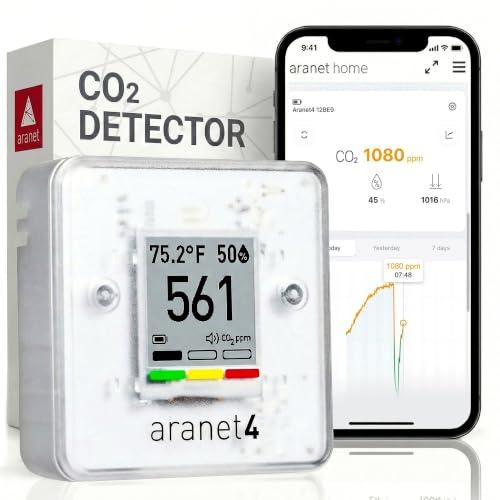
| 1 | Best overall Aranet4 HOME Indoor Air Quality Monitor A true NDIR sensor at ±(30 ppm + 3% of reading) across 0 to 9,999 ppm, on an e-ink screen, with a battery Aranet rates for up to four years. The tightest published CO2 accuracy on this page. | Anyone who wants one number they can trust and act on — a bedroom, a home office, a school run of rooms — and does not want a device that depends on a router or an app being online | |
| 2 | 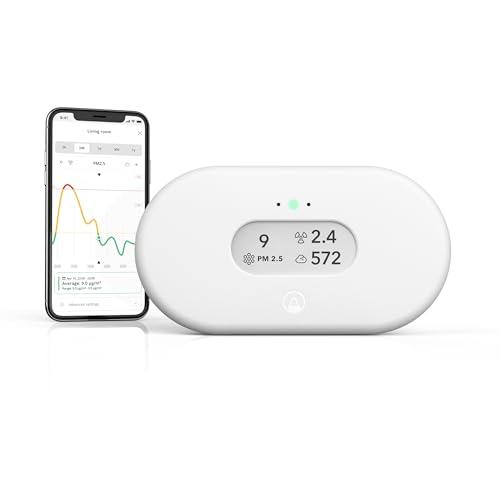 Most sensors, and the only published PM2.5 error band Airthings View Plus Air Quality Monitor Radon, PM2.5, CO2, VOC, temperature, humidity and pressure, with published accuracy for the first three. Wi-Fi on 2.4 GHz, six AA batteries or USB-C. | A whole-house view on Wi-Fi: radon in a basement, particulate from a wood stove or a gas hob, CO2 in the living room, all on one chart you can read from anywhere | |
| 3 | 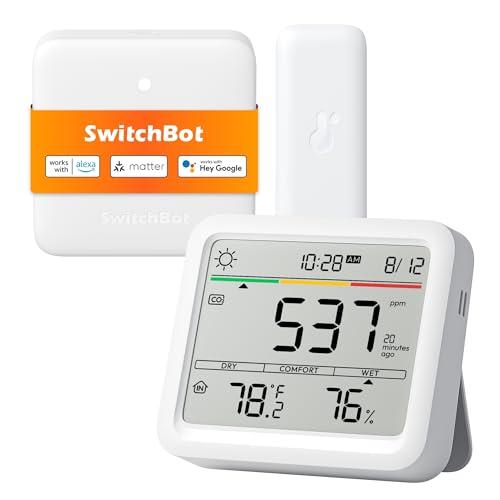 Best under $100 SwitchBot Meter Pro CO2 Monitor A Sensirion CO2 sensor at ±(50 ppm + 5% of reading) over 400 to 9,999 ppm, with temperature at ±0.2 C and humidity at ±2% RH — full accuracy figures for all three, at the lowest price here. | A second or third room, or a first instrument for someone who wants to find out whether their house has a CO2 problem before spending real money on measuring it | |
| 4 | 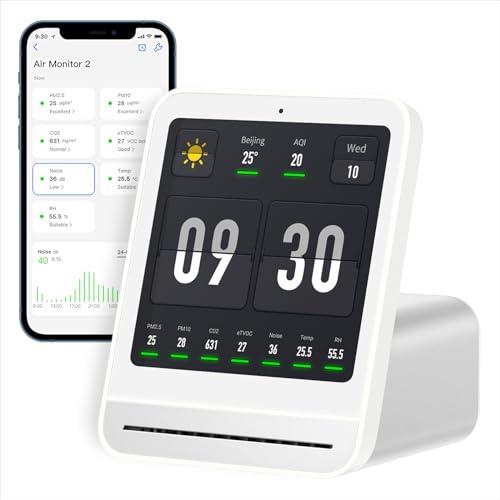 Most readings on one screen Qingping Air Quality Monitor Gen 2 PM2.5, PM10, CO2, noise, temperature and humidity on one display with an alarm clock function, in the middle of the price range. | A kitchen or open-plan room where you want particulate, CO2 and a noise reading in one glanceable display, and are content to treat the numbers as indicative | |
| — | 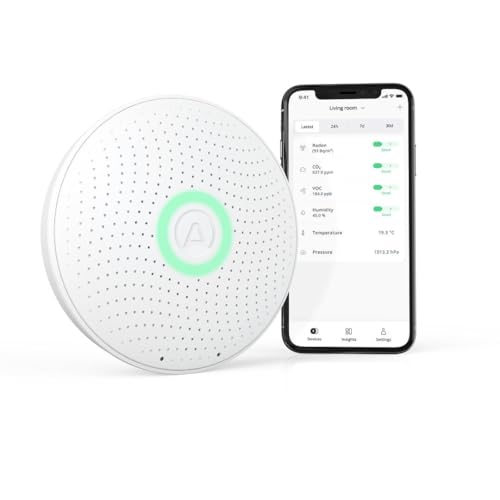 The one to skip Airthings Wave Plus Radon & Air Quality Monitor The tightest CO2 accuracy of the two Airthings units at ±30 ppm ±3%, on a device with no Wi-Fi. Bluetooth and SmartLink only, so remote reading needs a hub you buy separately. | Somebody who specifically wants radon plus CO2 and will always read it standing in the room — because without a hub, that is the only place its data goes |
This site spends most of the year telling readers to measure humidity. In a shut-up winter house there is a second number worth having, and the reason is already written on several pages here: an air conditioner does not reduce carbon dioxide, an air purifier does not reduce carbon dioxide, and the only thing that does is air exchange. Why filtering is not ventilating.
Which leaves a practical question every winter. The house is sealed, the heating is on, four people are breathing in the living room, and the air feels thick by nine o’clock. Is that real, or is it the sofa?
The filter
Only buy a reading somebody will stand behind
The hygrometer page on this site is built on one test: does the maker publish an accuracy figure? Apply the same test to CO2 monitors and the field sorts itself immediately.
| Monitor | CO2 accuracy | At 1,000 ppm | PM2.5 | Remote | Battery |
|---|---|---|---|---|---|
| Aranet4 HOME | ±(30 ppm + 3%) | ±60 ppm | No | Bluetooth | Up to 4 years |
| Airthings Wave Plus | ±30 ppm ±3% | ±60 ppm | No | Hub needed | 16 - 18 months |
| Airthings View Plus | ±50 ppm ±3% | ±80 ppm | Yes, with error bands | Wi-Fi | Up to 2 years |
| SwitchBot Meter Pro CO2 | ±(50 ppm + 5%) | ±100 ppm | No | Bluetooth / hub | 12 months |
| Qingping Gen 2 | Not published | Unknown | Yes, no error band | Wi-Fi | Not published |
Accuracy figures are each maker’s own, with their stated conditions omitted for width; the “at 1,000 ppm” column is our arithmetic on those formulas. Four of the five publish a CO2 accuracy specification, which is a better record than the hygrometer category manages.
That column of arithmetic is the useful part. The spread between the best and worst published uncertainty at an ordinary indoor reading is 40 ppm. If you are deciding whether to crack a window, any of them will do. If you are trying to tell whether a ventilation change moved the number by 100 ppm, only the top two will.
The trap
Resolution is not accuracy
Airthings publishes, for both the View Plus and the Wave Plus, a figure of ±0.1 degree for temperature and ±1% for humidity — under a heading that reads “Sensor Resolution”.
Those are different claims and the difference is not pedantic. Resolution is the smallest step the device will display. Accuracy is how far the displayed number may be from the truth. A thermometer can resolve to a tenth of a degree and be three degrees wrong.
Airthings publishes a real accuracy figure for CO2, for PM2.5 and for radon, and publishes resolution where temperature and humidity accuracy should be. The cheapest device on this page publishes banded accuracy for all three. That is worth knowing before you spend $330 to find out what the temperature is. Which humidity instruments publish accuracy.
This one is not a DIY job
A monitor is a diagnostic, not a solution. If the number is high, the only thing that lowers it is exchanging the air. In a cold climate the way to do that without throwing the heat out of the window is a heat or energy recovery ventilator, which transfers warmth from the outgoing stale air to the incoming fresh air. HVI certifies them on net airflow and sensible recovery efficiency at 32 F. Energy recovery ventilators, on certified figures. The free version is opening two windows at opposite ends of the house for a few minutes.
Where to put it
Breathing height, away from your face
- In the room people actually sit in, at roughly seated head height. CO2 is not meaningfully stratified in a heated room, but a monitor on the floor reads the floor.
- Not on the desk you are leaning over. Your own breath will swamp it. A meter away is plenty.
- Not in a draft, next to a vent or on a windowsill. Any of those reads the incoming air rather than the room.
- Take an outdoor reading once. It gives you the baseline your house is working against, and it also tells you whether the instrument’s automatic calibration has anything sensible to calibrate to.
Say the unwelcome thing
Do not buy a CO2 monitor as a safety device.
A carbon dioxide monitor is a ventilation instrument. It is not a carbon monoxide alarm, it is not a smoke alarm, and it is not a substitute for either. Carbon monoxide is a different gas, produced by incomplete combustion, and detecting it is a life-safety function with its own listed and tested hardware.
If you have a gas appliance, a wood stove, an attached garage or a fireplace, the CO alarm is the non-negotiable purchase and nothing on this page replaces it. Buy the ventilation monitor as well, for a different job.
In full
Every pick, and what is wrong with it
Published specifications only, each linked to the page it came from. Where a manufacturer publishes nothing, the row says so — we do not fill blanks in.
1. Best overall
Aranet4 HOME Indoor Air Quality Monitor
Aranet · model Aranet4 HOME (product code TDSPC2H3.012)
A true NDIR sensor at ±(30 ppm + 3% of reading) across 0 to 9,999 ppm, on an e-ink screen, with a battery Aranet rates for up to four years. The tightest published CO2 accuracy on this page.
±(30 ppm + 3% of reading) from a device Aranet describes as using “a true NDIR (non-dispersive infrared) sensor”, over a range of 0 to 9,999 ppm. Our arithmetic on that: at a reading of 1,000 ppm the stated uncertainty is ±60 ppm, and at 2,000 ppm it is ±90.
Temperature is 32 to 122 F at ±0.54 F, which is a genuine specification rather than a display resolution — and that distinction is the whole subject of the table below.
Up to four years of battery, on an e-ink screen. Those two facts belong together: e-ink needs power only when the number changes, which is why a CO2 meter can run for years on cells. There is nothing to charge and nothing to plug in, so it can live in a spare bedroom you check twice a winter.
Factory calibrated, with automatic background calibration in ventilated spaces, and Aranet recommends recalibrating once a year. That last sentence is the one most of this category omits: an NDIR sensor drifts, and the maker telling you so is a mark in its favor. The same argument, applied to humidity meters.
What’s wrong with it
Bluetooth only — there is no Wi-Fi, so you read it in the room or on a phone within range, not from the office. It measures no particulate and no radon, and Aranet publishes no humidity accuracy figure despite showing a humidity reading.
Running cost
Aranet does not publish a wattage for the Aranet4 HOME (product code TDSPC2H3.012), so we cannot calculate what it costs to run. We are not going to estimate one. If Aranet publishes a nameplate figure, this block will show the arithmetic.
| CO2 sensor | True NDIR (non-dispersive infrared) |
|---|---|
| CO2 range | 0 - 9,999 ppm |
| CO2 accuracy | ±(30 ppm + 3% of reading) |
| Temperature | 32 - 122 F, ±0.54 F |
| Humidity accuracy | Not published |
| Battery | Up to 4 years |
| Wireless | Bluetooth. No Wi-Fi |
| Display | E-ink |
| Calibration | Factory calibrated, with automatic background calibration in ventilated spaces. Aranet recommends recalibrating once a year |
| Warranty | 2 years, extendable to 3 |
Every figure above is from Aranet4 HOME product page — true NDIR sensor, 0-9,999 ppm, ±(30 ppm + 3% of reading), 32-122 F at ±0.54 F, up to 4 years of battery, 2-year warranty extendable to 3. Blanks are shown as “not published” rather than filled in.
2. Most sensors, and the only published PM2.5 error band
Airthings View Plus Air Quality Monitor
Airthings · model 2960 View Plus
Radon, PM2.5, CO2, VOC, temperature, humidity and pressure, with published accuracy for the first three. Wi-Fi on 2.4 GHz, six AA batteries or USB-C.
Seven measurements: radon, PM2.5, CO2, VOC, temperature, humidity and air pressure. Three of them come with real error statements.
CO2: NDIR, 400–5,000 ppm, ±50 ppm ±3% within 10–35 C and 0–80% RH after initial calibration. Note the conditions attached — this is an accuracy figure with a stated validity envelope, which is more honest than a bare number.
PM2.5: a laser-scattering optical particle counter, 0–1,000 µg/m³, with a published error of ±(5 µg/m³ + 15%) below 150 and ±(5 µg/m³ + 20%) above. Nothing else on this page publishes a particulate error band at all, and in a house with a wood stove or a gas hob that is the second number you want after CO2.
Radon: a passive diffusion chamber, 0–500 pCi/L, about 10% after seven days and 5% after two months at 5.4 pCi/L. A radon figure that improves with time is exactly right for the winter situation: the house is shut, so the long average is the meaningful one.
Wi-Fi 2.4 GHz, SmartLink and Bluetooth LE; six AA cells or USB-C, up to two years. The VOC gap is real and worth stating twice: Airthings publishes no sensor type, no range and no accuracy for it.
What’s wrong with it
Its CO2 accuracy is ±50 ppm ±3%, looser than the Aranet's, and it publishes no VOC sensor type, range or accuracy at all. Its temperature and humidity figures are published as sensor RESOLUTION, not accuracy, which is a different claim entirely. It is also the most expensive device here.
Running cost
Airthings does not publish a wattage for the 2960 View Plus, so we cannot calculate what it costs to run. We are not going to estimate one. If Airthings publishes a nameplate figure, this block will show the arithmetic.
| Measures | Radon, PM2.5, CO2, VOC, temperature, humidity, air pressure |
|---|---|
| CO2 sensor | NDIR, 400 - 5,000 ppm |
| CO2 accuracy | ±50 ppm ±3% within 10 - 35 C and 0 - 80% RH, after initial calibration |
| PM2.5 | Laser-scattering optical particle counter, 0 - 1,000 µg/m³; error ±(5 µg/m³ + 15%) below 150 and ±(5 µg/m³ + 20%) above |
| Radon | Passive diffusion chamber, 0 - 500 pCi/L; about 10% after 7 days and 5% after 2 months at 5.4 pCi/L |
| VOC | Sensor type, range and accuracy all not published |
| Temperature and humidity accuracy | Not published. Airthings prints ±0.1 degree and ±1% RH as sensor RESOLUTION, which is a different thing |
| Power | 6 AA batteries or USB-C; up to 2 years |
| Connectivity | Wi-Fi 2.4 GHz, Airthings SmartLink, Bluetooth LE |
| Dimensions | 17 x 9 x 3.3 cm, 360 g |
| Warranty | Standard, with a free 5-year extension if registered within 30 days |
Every figure above is from Airthings View Plus product page — radon, PM2.5, CO2, VOC, temperature, humidity and pressure; CO2 NDIR 400-5,000 ppm at ±50 ppm ±3%; PM2.5 optical with published error bands; Wi-Fi 2.4 GHz; 6 AA or USB-C. Blanks are shown as “not published” rather than filled in.
3. Best under $100
SwitchBot Meter Pro CO2 Monitor
SwitchBot · model Meter Pro CO2 Monitor
A Sensirion CO2 sensor at ±(50 ppm + 5% of reading) over 400 to 9,999 ppm, with temperature at ±0.2 C and humidity at ±2% RH — full accuracy figures for all three, at the lowest price here.
Sensirion CO2 sensor, 400 to 9,999 ppm, ±(50 ppm + 5% of reading) at 25 C and 50% RH. Naming the sensor supplier is itself informative: Sensirion is the company whose parts sit inside a great many instruments whose makers will not say so.
Temperature −20 to 80 C, ±0.2 C across 0 to 65 C (±0.4 below freezing, ±0.3 above 65 C). Humidity 0–99% RH, ±2% RH from 10 to 90%. That is a complete, banded accuracy statement for every quantity it displays — something the $330 device above does not manage for temperature and humidity.
Two AA cells, or a 5 V 1 A cord, with a 12-month battery mode, a built-in wall mount and a stand that adjusts from 0 to 90 degrees. For a room you are only sampling for a season, the cells are enough.
Where it loses to the Aranet is uncertainty at the top of the range, because its error term scales at 5% rather than 3%. For “is this room stale?” that is immaterial. For commissioning a ventilation system it is not. Ventilators, and the figures they are certified on.
What’s wrong with it
±(50 ppm + 5%) is the loosest published CO2 figure on the page: at 2,000 ppm that is ±150 ppm against the Aranet's ±90. Battery life is quoted as 12 months in battery mode rather than years, and the warranty is one year.
Running cost
SwitchBot does not publish a wattage for the Meter Pro CO2 Monitor, so we cannot calculate what it costs to run. We are not going to estimate one. If SwitchBot publishes a nameplate figure, this block will show the arithmetic.
| CO2 sensor | Sensirion, 400 - 9,999 ppm |
|---|---|
| CO2 accuracy | ±(50 ppm + 5% of reading) at 25 C and 50% RH |
| Temperature range | -20 to 80 C (-4 to 176 F) |
| Temperature accuracy | ±0.2 C from 0 to 65 C; ±0.4 C from -20 to 0 C; ±0.3 C from 65 to 80 C |
| Humidity range | 0 - 99% RH |
| Humidity accuracy | ±2% RH from 10 to 90%; ±3% RH outside that band |
| Power | 2 AA batteries (built in) or a 5 V 1 A cord; 12-month battery mode |
| Mounting | Built-in wall mount and a 0 - 90 degree stand |
| Warranty | 1 year |
Every figure above is from SwitchBot Meter Pro CO2 Monitor product page — Sensirion CO2 sensor 400-9,999 ppm at ±(50 ppm + 5% of reading), temperature ±0.2 C over 0-65 C, humidity ±2% RH over 10-90%, 12-month battery mode, 1-year warranty. Blanks are shown as “not published” rather than filled in.
4. Most readings on one screen
Qingping Air Quality Monitor Gen 2
Qingping · model Air Quality Monitor Gen 2
PM2.5, PM10, CO2, noise, temperature and humidity on one display with an alarm clock function, in the middle of the price range.
PM2.5, PM10, CO2, noise, temperature and humidity, which is the widest set of readings here apart from the Airthings — and the only one of these devices that measures sound.
The hardware reputation is good and the display is the nicest in the category. We cannot rank it any higher than this, for one reason: we could not find a published accuracy specification for any quantity it measures.
Qingping’s own site serves its product pages through JavaScript and returned no readable specification text at all from this build, and the retail listing publishes the measurement list without a single plus-or-minus figure. We are not going to assume that means the sensors are poor — only that nothing has been stated.
Buy it if you want a handsome multi-sensor display and will act on trends rather than absolute values. If the number has to be defensible, buy one of the three above. How we pick.
What’s wrong with it
Qingping publishes no accuracy figure for anything it measures on any page we could reach: its own site renders its specifications in JavaScript and served nothing, and the listing states only what it measures. On a measuring instrument, that is the one gap that matters.
Running cost
Qingping does not publish a wattage for the Air Quality Monitor Gen 2, so we cannot calculate what it costs to run. We are not going to estimate one. If Qingping publishes a nameplate figure, this block will show the arithmetic.
| Measures | PM2.5, PM10, CO2, noise, temperature, humidity |
|---|---|
| CO2 accuracy | Not published on the listing |
| PM2.5 accuracy | Not published on the listing |
| Temperature and humidity accuracy | Not published on the listing |
| Extras | Alarm clock function |
| Power | Not published on the listing |
| Warranty | Not published on the listing |
Every figure above is from Qingping Air Quality Monitor Gen 2 product listing — measures PM2.5, PM10, CO2, noise, temperature and humidity. Qingping's own site renders its specifications in JavaScript and served no readable figures, so no accuracy specification could be verified. Blanks are shown as “not published” rather than filled in.
Skip this one
Airthings Wave Plus Radon & Air Quality Monitor
Airthings · model Wave Plus (the listing says 2930; Airthings' page prints 2910)
The tightest CO2 accuracy of the two Airthings units at ±30 ppm ±3%, on a device with no Wi-Fi. Bluetooth and SmartLink only, so remote reading needs a hub you buy separately.
The Wave Plus is a good instrument sold into the wrong slot. Its published CO2 accuracy of ±30 ppm ±3% within 15–35 C is the equal of the Aranet’s, and it adds radon.
But it has no Wi-Fi. Airthings lists its connectivity as “Bluetooth & Airthings SmartLink”, and SmartLink needs the separate hub. Battery life is 16 months on Bluetooth, 18 with the hub.
So the comparison is: pay more than an Aranet4, get the same CO2 accuracy and a radon chamber, lose two and a half years of battery life, and still have to stand in the room to read it unless you buy a hub. If you want the Airthings platform, the View Plus has Wi-Fi built in and adds PM2.5.
One housekeeping note, since this site cares about model numbers: the retail listing calls it the 2930 and Airthings’ own page prints “Model 2910”. We could not reconcile that, so we are reporting both.
What’s wrong with it
No Wi-Fi and no PM2.5, at a price above the Aranet4 — which has better CO2 accuracy and four years of battery. Its temperature and humidity figures are again published as resolution rather than accuracy, and the listing's model number (2930) does not match the 2910 printed on Airthings' own page.
Running cost
Airthings does not publish a wattage for the Wave Plus (the listing says 2930; Airthings' page prints 2910), so we cannot calculate what it costs to run. We are not going to estimate one. If Airthings publishes a nameplate figure, this block will show the arithmetic.
| Measures | Radon, CO2, TVOC, temperature, humidity, air pressure. No PM2.5 |
|---|---|
| CO2 sensor | NDIR, 400 - 5,000 ppm |
| CO2 accuracy | ±30 ppm ±3% within 15 - 35 C and 0 - 80% RH |
| Radon | Passive diffusion chamber; about 10% after 7 days and 5% after 2 months at 5.4 pCi/L |
| TVOC | Sensor type, range and accuracy all not published |
| Connectivity | Bluetooth and Airthings SmartLink only. NO Wi-Fi |
| Power | 2 AA batteries |
| Battery life | 16 months on Bluetooth; 18 months with the SmartLink hub |
| Dimensions | 12 cm diameter x 3.6 cm, 219 g |
| Warranty | Standard, with a free 5-year extension if registered within 30 days |
Every figure above is from Airthings Wave Plus product page — radon, CO2, TVOC, temperature, humidity and pressure, no PM2.5; CO2 NDIR 400-5,000 ppm at ±30 ppm ±3%; Bluetooth and SmartLink only; 2 AA batteries. Blanks are shown as “not published” rather than filled in.
We are not linking a buy button for this one. If you want to look at it anyway, it is easy enough to find — but we would rather send you to something that fits your room.
Questions people actually ask
Frequently asked
What is the best indoor air quality monitor?
The Aranet4 HOME, on published accuracy: a true NDIR sensor reading 0 to 9,999 ppm at ±(30 ppm + 3% of reading), with temperature at ±0.54 F and a battery Aranet rates for up to four years. If you want particulate and radon as well, the Airthings View Plus is the only one here that publishes a PM2.5 error band.
Why does a closed-up house feel stale in winter?
Because carbon dioxide accumulates and nothing in a normal house removes it. Heating does not, air conditioning does not, and an air purifier does not — filtration captures particles and some gases but does not exchange air. The only thing that lowers indoor CO2 is bringing in outside air. Why filtering is not ventilating.
How accurate are CO2 monitors?
It depends on the maker, and four of the five here publish a figure. Aranet states ±(30 ppm + 3% of reading), Airthings ±30 ppm ±3% for the Wave Plus and ±50 ppm ±3% for the View Plus, and SwitchBot ±(50 ppm + 5% of reading). On our arithmetic that is ±60 to ±100 ppm at an indoor reading of 1,000 ppm. Qingping publishes none.
Is a CO2 monitor the same as a carbon monoxide alarm?
No, and the distinction matters. Carbon dioxide is what you exhale and it is a ventilation indicator. Carbon monoxide is a product of incomplete combustion and it is a life-safety hazard with its own listed alarms. Nothing on this page is a substitute for a CO alarm.
What does 'sensor resolution' mean on an air quality monitor spec sheet?
It is the smallest step the display will show, not how close the reading is to the truth. Airthings publishes ±0.1 degree and ±1% RH as resolution for both its monitors, and publishes no accuracy figure for temperature or humidity at all — while the cheapest device here publishes banded accuracy for both. The same test applied to humidity meters.
Do I need Wi-Fi on an air quality monitor?
Only if you want to read it while you are not there. The Aranet4 is Bluetooth-only and that is fine for a room you walk into; the Airthings Wave Plus is also Bluetooth-only and needs a separate hub for remote data, which is the main reason we do not recommend it. If remote matters, the View Plus has Wi-Fi 2.4 GHz built in.
How do I lower CO2 in a room without losing the heat?
A heat or energy recovery ventilator exchanges air while transferring warmth from the outgoing stale air to the incoming fresh air, and HVI certifies them on net airflow and sensible recovery efficiency at 32 F. The no-cost version is short, deliberate cross-ventilation: two windows at opposite ends, open wide for a few minutes rather than ajar all day. Energy recovery ventilators.
Sources
Where these numbers came from
- Aranet4 HOME product page — true NDIR sensor, 0-9,999 ppm, ±(30 ppm + 3% of reading), temperature 32-122 F at ±0.54 F, up to 4 years of battery, automatic background calibration with annual recalibration recommended, 2-year warranty extendable to 3
- Airthings View Plus product page — CO2 NDIR 400-5,000 ppm at ±50 ppm ±3%, PM2.5 optical counter with ±(5 µg/m3 + 15%) below 150 and ±(5 µg/m3 + 20%) above, radon 0-500 pCi/L, Wi-Fi 2.4 GHz, 6 AA or USB-C, and temperature and humidity figures published as sensor resolution
- Airthings Wave Plus product page — CO2 NDIR 400-5,000 ppm at ±30 ppm ±3% within 15-35 C, radon, TVOC with no published sensor type or accuracy, Bluetooth and SmartLink only, 2 AA cells, 16-18 months
- SwitchBot Meter Pro CO2 Monitor product page — Sensirion CO2 sensor 400-9,999 ppm at ±(50 ppm + 5% of reading), temperature -20 to 80 C with banded accuracy to ±0.2 C, humidity 0-99% RH at ±2% from 10-90%, 12-month battery mode, 1-year warranty
- Qingping Air Quality Monitor Gen 2 product listing — measures PM2.5, PM10, CO2, noise, temperature and humidity, with no accuracy specification published on the listing or reachable on qingping.co
- HVI Certified Products Directory, Section III (HRV/ERV listing) — the certification that covers recovery ventilators' net airflow and sensible recovery efficiency
Read next
Where to go from here
Back to Dehumidifiers, or read how we pick.