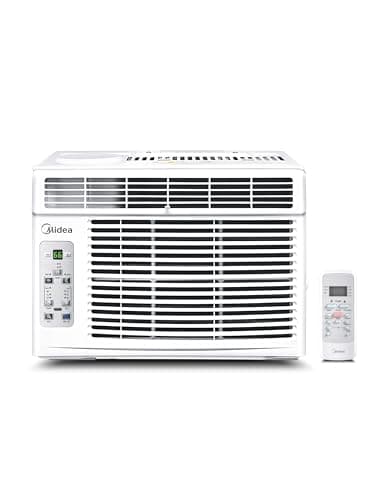
This is the only part of the site where something genuinely removes heat from a room. Fans move air; evaporative coolers work only in dry climates; an air conditioner absorbs heat on a cold coil and rejects it somewhere else, and it works anywhere.
The catch is that where the hot side is turns out to determine almost everything about how much it costs you.
The main decision
Window versus portable, decided by geometry
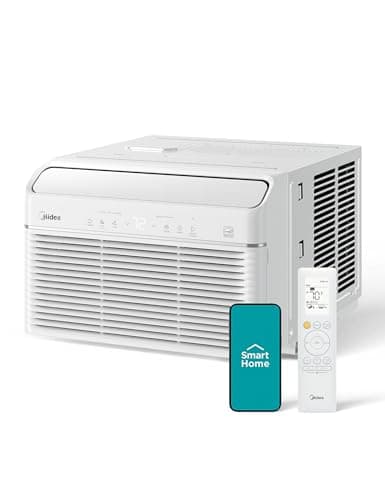
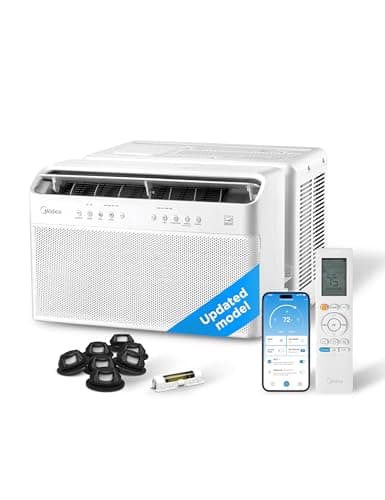
A window unit sits in the wall of the room. Cold side in, hot side out, and the heat it rejects lands outside.
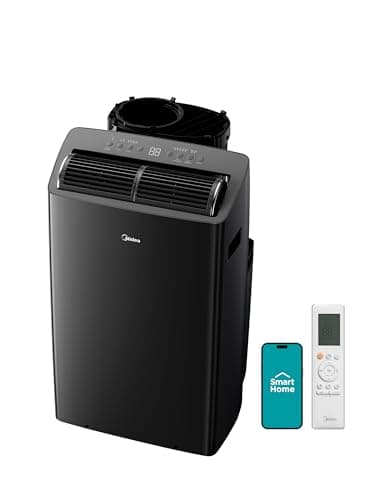
A portable sits inside the room and pushes its heat out through a duct. That duct is hot and it is in the space you are cooling. And a single-hose portable also blows room air outside, which gets replaced by hot outdoor air infiltrating in around doors and floors — so you are paying to pull the outdoors in.
The consequences are large and measurable:
| | Window unit | Portable |
|---|
| Running cost | 375 kWh/yr certified — $69 | 1,300 W — $57 for 30 nights |
|---|
| Efficiency certification | ENERGY STAR, tested CEER | No program exists |
|---|
| Labeled capacity | Is the real capacity | 14–32% above DOE SACC |
|---|
| Compressor location | Outside the glass | In the room with you |
|---|
| Floor space | None | About 2 sq ft plus hose |
|---|
Buy a portable when a window unit will not physically fit — a casement window, a slider, a lease that genuinely forbids it, or a need to move the machine between rooms. Not because it looked easier to set up. The full comparison is here.
The number problem
Why a portable's box BTU is not its capacity
Portable air conditioners carry two capacity figures, and they can differ by a third.
The box number is usually measured under a standard that ignores exhaust duct heat and infiltration. SACC — Seasonally Adjusted Cooling Capacity, the DOE-rated figure defined in 10 CFR part 430, appendix CC — subtracts both, and it is the one that describes your room.
The gap is not a fixed ratio, which is the part almost nobody publishes. From the manufacturers’ own pages:
- Midea Duo MAP14S1TBL: 14,000 BTU on the box, 12,000 SACC — a 14.3% reduction.
- Whynter ARC-14S: also 14,000 BTU on the box, 9,500 SACC — a 32.1% reduction.
Same headline number, 2,500 BTU apart in what reaches your room, and a whole capacity band apart in the room each can honestly serve. A roundup that ranks “14,000 BTU portables” without mentioning SACC has put two different machines in one bucket. The full explanation is here.
Window units need no such correction — their labeled capacity is their capacity — and there is no ENERGY STAR program for portable air conditioners at all, so no portable carries a tested efficiency figure you can compare.
Sizing
Size the room before you shop
The most expensive mistake in this category is not buying the wrong brand. It is buying too much capacity.
ENERGY STAR room air conditioner sizing table| Room area (sq ft) | Capacity needed (BTU/h) |
|---|
| 100 up to 150 | 5,000 |
|---|
| 150 up to 250 | 6,000 |
|---|
| 250 up to 300 | 7,000 |
|---|
| 300 up to 350 | 8,000 |
|---|
| 350 up to 400 | 9,000 |
|---|
| 400 up to 450 | 10,000 |
|---|
| 450 up to 550 | 12,000 |
|---|
| 550 up to 700 | 14,000 |
|---|
Source: ENERGY STAR, Room Air Conditioners. ENERGY STAR notes the capacities “are calculated based on an 8-foot ceiling.” The full chart, with the adjustments.
Measure length by width in feet, read across, then adjust: +10% if the room is very sunny, −10% if heavily shaded, +600 BTU per person beyond two, and +4,000 BTU if it is a kitchen — the adjustment people most often skip and the largest one.
Do not round up to be safe. An air conditioner removes moisture only while it is running. An oversized unit hits the set temperature in minutes, shuts off before it has dehumidified, and leaves the room cold and clammy — then short-cycles, which wastes energy and is hard on the compressor. ENERGY STAR states it directly: an oversized air conditioner “costs more to purchase, wastes energy and does not provide better cooling.” The full walkthrough with worked examples is here.
How we rank
The data these pages are built on
Window air conditioners are the best-documented category in home cooling, and we take advantage of that. ENERGY STAR certifies them and publishes, for every certified model, the tested CEER and a modeled annual energy use in kWh. A brand cannot write its own CEER, and the kWh figure already accounts for the compressor cycling across a season — which makes it far more honest than multiplying a nameplate by hours.
We pulled every US-market certified room air conditioner available from 2024 onward — 392 models — and ranked within capacity bands on CEER, then applied the physical constraints that decide whether a unit can go in your window at all: mounting type, depth, and weight.
The one thing that dataset does not record is noise. Not a single certified window unit carries a decibel rating, which is why our quiet-AC page argues from construction rather than from a number — and says so.
Before you buy
Three things worth checking first
- Your window type. Window units need a vertical sash that closes down onto them. A crank-out casement or a horizontal slider needs a portable, a through-the-wall install, or a casement-specific unit.
- Your lease, if you rent. Most clauses target brackets and exterior fixings rather than cooling, and a U-shaped unit needs neither — which changes the answer more often than people expect.
- Your circuit. A 1,300 W portable draws about 11.6 amps. On an older shared circuit with a microwave and a fridge, that trips a breaker. A window unit at 400–900 W is a far easier load, and neither should ever run on an extension cord.
And the question worth asking before all three: does this room actually need refrigeration? A lot of bedrooms are solvable for most of the season with a blind closed during the day and a 19 W fan. The bedroom page works that sequence through in order, and the compressor is step five rather than step one.