The picks
The best tower fans, on published watts and decibels
Two 42-inch towers from the same brand: one draws 19 watts and publishes 23 dBA, the other draws 49 and publishes no noise figure at all. That is the whole decision.
By Sawyer V. · Published
The short answer
The Lasko EcoQuiet T42710: 2.9–19 W, 23 dBA on low, 12 speeds, and about 84¢ for a month of eight-hour nights at full power. The AC-motor Lasko 2554 publishes 720 CFM but draws 37–49 W and no noise figure. If you have a ceiling to hang one from, a ceiling fan beats both.
Fan & Frost earns a commission when you buy through our links, at no cost to you. It never changes a ranking, and we say so when the right answer is the cheaper unit or nothing at all. Full disclosure · How we pick.
At a glance
The picks, ranked
Tap any row to jump to the full reasoning. Prices are live from Amazon where we have them, and read “check price” where we don’t — never a number we cannot verify today.
| # | Product | Best for | Price |
|---|---|---|---|
| 1 | 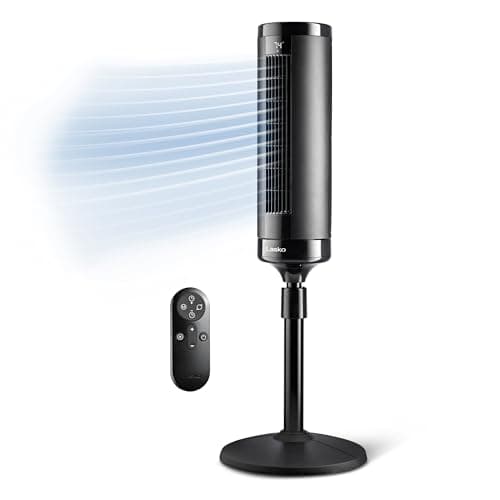 Best overall Lasko EcoQuiet 42" DC Tower Fan 23 dBA on low and 19 W flat out, from the only tower fan here that publishes a noise figure at all. | A bedroom, where quiet and running cost both matter | |
| 2 |  Most air for the money Lasko Wind Curve 42" Tower Fan 720 CFM published — the only airflow figure in this roundup — at the cost of 49 W and an unpublished noise level. | A living room, where noise matters less than airflow | |
| 3 | 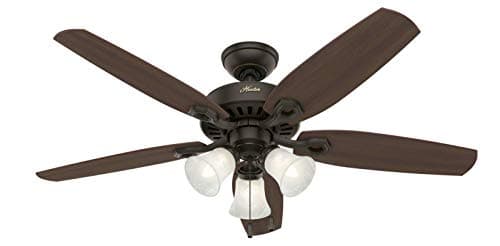 What you should buy instead, if you can Hunter Vespucci 52" Ceiling Fan 366.7 CFM per watt certified, and 1.8 W on low. A tower fan cannot come close on either count. | Any room with a ceiling you can mount to | |
| — | 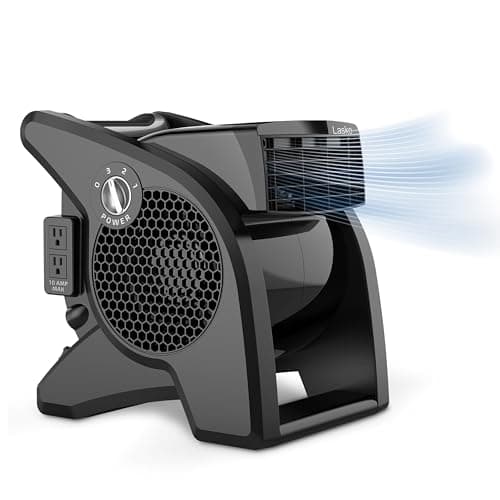 The one to skip for a bedroom Lasko Max Performance 15" Air Mover 178 W of high-velocity air mover, which is nine times the EcoQuiet's draw and built to be loud. | A garage or a drying job, not a living space |
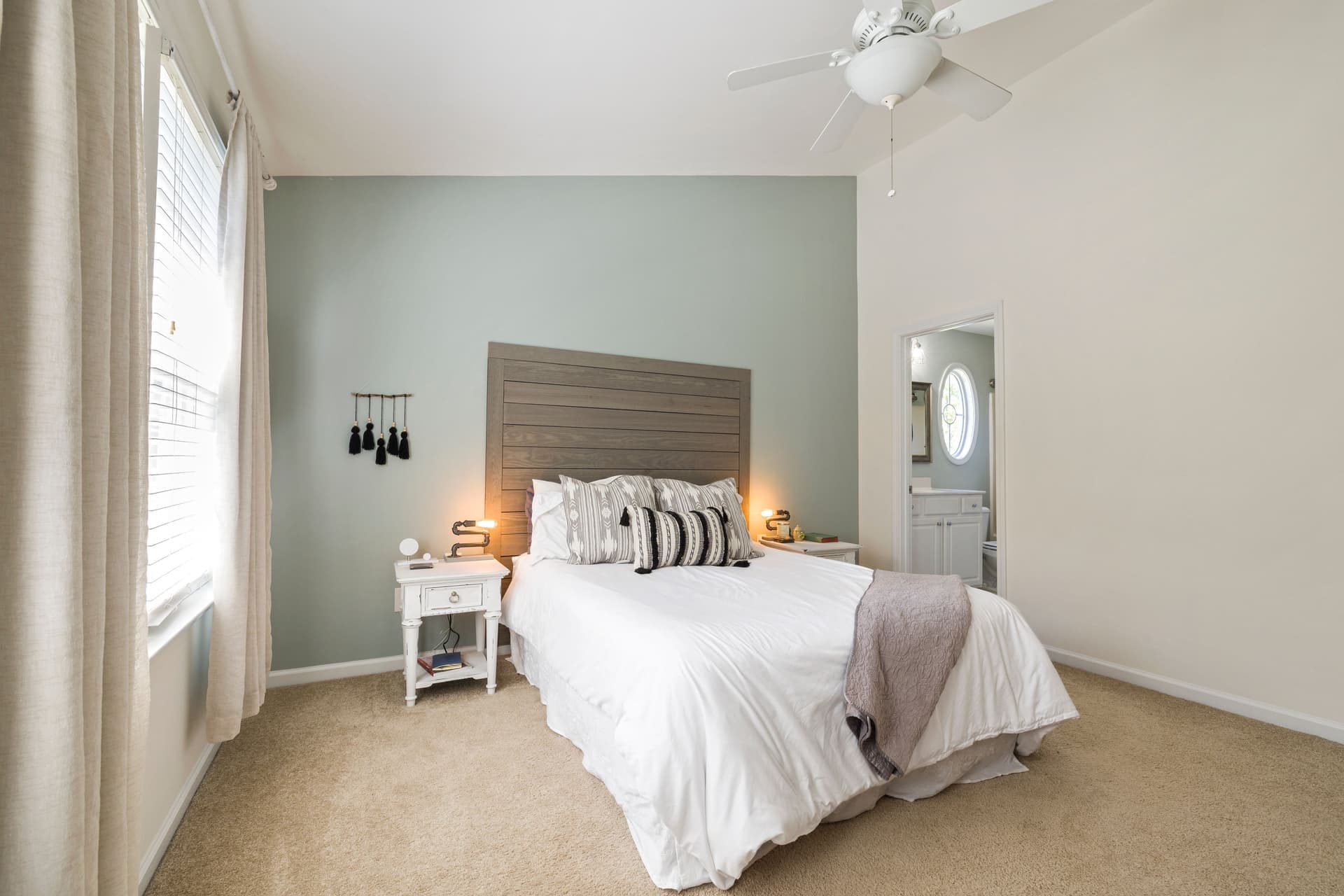
A tower fan is the default bedroom fan for a good reason: it takes up about a square foot of floor, spreads air over a tall column rather than firing it in one stream, and does not look like equipment. Within that, the choice is almost entirely about the motor.
The decision
DC versus AC, which is the whole thing
Lasko sells two 42-inch tower fans that look broadly similar on a shelf. Their published specifications are not similar at all.
| EcoQuiet T42710 (DC) | Wind Curve 2554 (AC) | |
|---|---|---|
| Power | 2.9 – 19 W | 37 – 49 W |
| Noise | 23 dBA low / 46 dBA high | Not published |
| Airflow | Not published | 720 CFM |
| Speeds | 12 | 3 |
| Timer | 8 hours | 7.5 hours |
| Weight | 7.8 lb | 10.62 lb |
| Warranty | 2 years | 1 year |
| 30 × 8-hr nights, high | 84¢ | $2.16 |
Specifications from Lasko’s own product pages; costs are our arithmetic at 18.34¢/kWh.
A DC motor is more efficient than an AC motor across the board, and much more efficient at low speed — which is where a bedroom fan spends its life. It also runs more quietly and allows many more speed steps, because speed control on a DC motor is straightforward electronics rather than tapped windings.
Notice the gap in what each one publishes, though, because it is revealing in both directions. The DC fan publishes noise and hides airflow. The AC fan publishes airflow and hides noise. Each is telling you its best number. Neither is lying; both are curating.
What we cannot tell you
The CFM problem
Only one fan in this entire roundup publishes an airflow figure, and that makes a proper efficiency ranking impossible.
We would like to rank tower fans the way we rank ceiling fans — on CFM per watt, which is the number that actually says how good a fan is. For ceiling fans, ENERGY STAR certifies and publishes exactly that. For portable fans there is no equivalent program and no common test procedure, so a manufacturer’s CFM claim — where one exists — is not comparable with anyone else’s.
So the ranking above uses what is genuinely comparable: published wattage, published noise, speed count, and warranty. Where a figure is missing, we say so rather than filling the gap.
Say the unwelcome thing
Do not buy on 'covers up to X square feet'.
Tower fan listings routinely claim a coverage area. There is no test procedure behind those numbers, and a fan does not cool an area at all — it moves air across the skin of whoever is in the stream.
A fan is doing nothing in an empty room. It has no effect on the room’s temperature, so “coverage” is describing something that does not happen. What matters is whether the airflow reaches where you sit or sleep, and that is about placement and oscillation, not square footage.
Placement
Getting more out of whichever you buy
- Point it at you, not at the room. The cooling effect is entirely about air moving across skin. A fan aimed at the middle of the room is decorative.
- Use it with a window once the outside air is cooler. A fan alone recirculates warm air. A fan plus an open window, once the outdoor temperature has dropped below the indoor temperature, genuinely lowers the room temperature — and a window fan does that job better.
- Run it on a middle speed, not maximum. On a DC fan the power curve is steep: the EcoQuiet uses 2.9 W on low and 19 W on high, so a mid setting costs a fraction of full power for most of the effect.
- Turn it off when you leave. No one in the airstream means no cooling at all, and the motor is adding a small amount of heat.
And if the room is genuinely hot rather than warm — above roughly 95°F, moving air stops helping at all, because air hotter than your skin adds heat faster than the extra evaporation removes it. At that point you need something that removes heat, and no fan will substitute.
In full
Every pick, and what is wrong with it
Published specifications only, each linked to the page it came from. Where a manufacturer publishes nothing, the row says so — we do not fill blanks in.
1. Best overall
Lasko EcoQuiet 42" DC Tower Fan
Lasko · model T42710
23 dBA on low and 19 W flat out, from the only tower fan here that publishes a noise figure at all.
23 dBA on low, 46 dBA on high. Both published. That matters more than the numbers themselves, because almost nobody in this category publishes a decibel figure — which makes “whisper quiet” impossible to check anywhere else.
23 dBA is genuinely quiet. It is below a whispered conversation, and in a bedroom it disappears within a minute of lying down.
The DC motor is doing the work. 2.9 W on low, 19 W on high, against 37–49 W for the AC-motor tower below. Over a month of eight-hour nights that is 84¢ against $2.16 at full power, or 13¢ if you run it on low. A DC motor holds its efficiency at low speed where an AC motor loses it, which is exactly the range a bedroom fan lives in.
Twelve speeds is the underrated specification. A three-speed fan frequently has nothing usable between “not enough air” and “too loud”. Twelve steps means you can find the point where the airflow is sufficient and the noise has not yet climbed, which is most of what makes a fan liveable overnight.
7.8 lb, 41.6 inches tall on a 12.8-inch square footprint, 8-hour timer, 2-year warranty — twice the coverage on the Wind Curve.
What’s wrong with it
Lasko publishes no CFM for it, so we cannot tell you how much air it moves — only how quietly and cheaply it does whatever it does. That is a real gap on a fan sold on airflow.
Running cost — T42710
| Nameplate power | 2.9 W – 19 W | manufacturer's published figure |
|---|---|---|
| Energy, 8-hour night | 0.15 kWh | 19 ÷ 1000 × 8 |
| Cost per hour | 0.3¢ | at 18.34¢/kWh |
| Cost per 8-hour night | 2.8¢ | on the highest speed |
| Cost per 30 nights | 84¢ | 4.6 kWh |
| Same month, lowest speed | 13¢ | at 2.9 W |
Rate: 18.34¢/kWh, the US average residential price for June 2026 (EIA Electric Power Monthly, Table 5.3). Yours will differ — swap it in: (watts ÷ 1000) × hours × your rate.
| Power | 2.9 W - 19 W (0.06-0.303 A at 120 V) |
|---|---|
| Noise | 23 dBA low, 46 dBA high |
| Speeds | 12 |
| Height | 41.6 in |
| Footprint | 12.8 x 12.8 in |
| Weight | 7.8 lb |
| Timer | 8 hours |
| Air delivery (CFM) | Not published |
| Warranty | 2 years |
Every figure above is from Lasko product page, T42710. Blanks are shown as “not published” rather than filled in.
2. Most air for the money
Lasko Wind Curve 42" Tower Fan
Lasko · model 2554
720 CFM published — the only airflow figure in this roundup — at the cost of 49 W and an unpublished noise level.
720 CFM, published. This is the only fan in the roundup with a stated airflow figure, and it is a genuinely useful number: it tells you this is a fan that moves real air, not just a quiet one.
The trade is power and silence. 37–49 W against the EcoQuiet’s 2.9–19, which is $2.16 versus 84¢ over a month of nights at 18.34¢/kWh. Over two or three summers that difference is a meaningful fraction of the price gap between the two fans.
And Lasko publishes no noise figure for this one. Given that they publish 23 and 46 dBA for the EcoQuiet, the absence here is conspicuous. We are not going to guess a number, but we would note that an AC motor at 49 W is not going to be quieter than a DC motor at 19 W.
For a living room, where you want air moved across a bigger space and a television is already making more noise than the fan, this is the sensible choice. For a bedroom it is not.
42.5 inches tall, 10.62 lb, 7.5-hour timer, ionizer, ETL listed, 1-year warranty.
What’s wrong with it
No published noise figure at all, a 1-year warranty against the EcoQuiet's 2, and 2.6× the power draw. In a bedroom the missing dBA number is the thing you would most want to know.
Running cost — 2554
| Nameplate power | 37 W – 49 W | manufacturer's published figure |
|---|---|---|
| Energy, 8-hour night | 0.39 kWh | 49 ÷ 1000 × 8 |
| Cost per hour | 0.9¢ | at 18.34¢/kWh |
| Cost per 8-hour night | 7.2¢ | on the highest speed |
| Cost per 30 nights | $2.16 | 11.8 kWh |
| Same month, lowest speed | $1.63 | at 37 W |
Rate: 18.34¢/kWh, the US average residential price for June 2026 (EIA Electric Power Monthly, Table 5.3). Yours will differ — swap it in: (watts ÷ 1000) × hours × your rate.
| Power | 37 W - 49 W (0.4 A at 120 V) |
|---|---|
| Air delivery | 720 CFM |
| Speeds | 3 |
| Height | 42.5 in |
| Footprint | 13 x 13 in |
| Weight | 10.62 lb |
| Timer | 7.5-hour auto-off |
| Noise | Not published |
| Warranty | 1 year |
Every figure above is from Lasko product page, 2554. Blanks are shown as “not published” rather than filled in.
3. What you should buy instead, if you can
Hunter Vespucci 52" Ceiling Fan
Hunter · model Vespucci
366.7 CFM per watt certified, and 1.8 W on low. A tower fan cannot come close on either count.
If you are choosing a fan for a room you own, this comparison is worth two minutes before you buy anything portable.
1.8 W on low, 13.9 W on high, at a certified 366.7 CFM per watt. A month of eight-hour nights on low costs about 7.9¢. The best tower fan here costs 84¢ for the same hours on high.
The reason is blade diameter. A 52-inch blade turning slowly displaces vastly more air per watt than a 13-inch column of impellers spinning fast. It is not a brand or engineering difference; it is geometry, and a tower fan cannot engineer its way past it.
The trade is mobility and installation. The full ceiling fan ranking is here. If you rent, or you need the fan in a different room next week, buy the EcoQuiet and do not think about it again.
What’s wrong with it
It is a permanent installation requiring wiring and a ceiling with adequate clearance — you cannot move it between rooms, and in a rental it is usually not an option at all.
Running cost — Vespucci
| Nameplate power | 1.8 W – 13.9 W | manufacturer's published figure |
|---|---|---|
| Energy, 8-hour night | 0.11 kWh | 13.9 ÷ 1000 × 8 |
| Cost per hour | 0.3¢ | at 18.34¢/kWh |
| Cost per 8-hour night | 2.0¢ | on the highest speed |
| Cost per 30 nights | 61¢ | 3.3 kWh |
| Same month, lowest speed | 7.9¢ | at 1.8 W |
Rate: 18.34¢/kWh, the US average residential price for June 2026 (EIA Electric Power Monthly, Table 5.3). Yours will differ — swap it in: (watts ÷ 1000) × hours × your rate.
| Blade span | 52 in |
|---|---|
| Efficiency | 366.7 CFM per watt |
| Power, high speed | 13.9 W |
| Power, low speed | 1.8 W |
| Standby power | 0.8 W |
| Type | Indoor, fan only (no light kit) |
| Warranty | 3 years, components |
| ENERGY STAR | Certified |
Every figure above is from ENERGY STAR Certified Ceiling Fans dataset. Blanks are shown as “not published” rather than filled in.
Skip this one
Lasko Max Performance 15" Air Mover
Lasko · model U15720
178 W of high-velocity air mover, which is nine times the EcoQuiet's draw and built to be loud.
These turn up in tower-fan searches because they are tall and they move a lot of air, and they are the wrong tool for a room you sit in.
160–178 W. That is $7.83 for a month of eight-hour nights, against 84¢ for the EcoQuiet — roughly nine times the cost, and an air mover is engineered for velocity rather than for a comfortable spread of air across a room.
Lasko publishes no CFM for it either, which is a notable gap on a machine whose entire purpose is moving air.
It is genuinely good at its actual job — two 120 V accessory outlets, a 9.5-foot cord, a pivoting head — and that job is a garage or a workshop. Not a bedroom.
What’s wrong with it
160-178 W and no published CFM. It is a utility blower — designed to dry a floor, not to make a room comfortable — and it sounds like one.
Running cost — U15720
| Nameplate power | 160 W – 178 W | manufacturer's published figure |
|---|---|---|
| Energy, 8-hour night | 1.42 kWh | 178 ÷ 1000 × 8 |
| Cost per hour | 3.3¢ | at 18.34¢/kWh |
| Cost per 8-hour night | 26¢ | on the highest speed |
| Cost per 30 nights | $7.83 | 42.7 kWh |
| Same month, lowest speed | $7.04 | at 160 W |
Rate: 18.34¢/kWh, the US average residential price for June 2026 (EIA Electric Power Monthly, Table 5.3). Yours will differ — swap it in: (watts ÷ 1000) × hours × your rate.
| Power | 160 W - 178 W (1.35-1.53 A at 120 V) |
|---|---|
| Speeds | 3 |
| Dimensions | 14.5 H x 14.0 D x 11.5 W in |
| Weight | 12.55 lb |
| Extras | Two 120 V accessory outlets, 9.5 ft cord, pivoting head |
| Air delivery (CFM) | Not published |
| Warranty | 1 year |
Every figure above is from Lasko product page, U15720. Blanks are shown as “not published” rather than filled in.
We are not linking a buy button for this one. If you want to look at it anyway, it is easy enough to find — but we would rather send you to something that fits your room.
Questions people actually ask
Frequently asked
What is the best tower fan?
The Lasko EcoQuiet T42710 on published specifications: 23 dBA on low, 2.9 to 19 W, and 12 speeds. It is the only tower fan here that publishes a noise figure at all, which is what makes it checkable rather than merely marketed as quiet.
Are DC tower fans worth the extra cost?
Usually, on two counts. Lasko's DC tower draws up to 19 W against 49 W for its AC-motor equivalent, which is 84¢ against $2.16 over a month of eight-hour nights. The DC motor is also quieter and offers 12 speeds rather than 3.
How much electricity does a tower fan use?
Between about 3 W and 50 W depending on the motor and speed. At 18.34¢/kWh, a 19 W DC fan costs roughly 2.8¢ for an eight-hour night and a 49 W AC fan about 7.2¢. The full wattage table.
How many CFM does a tower fan move?
Most manufacturers do not publish a figure. The Lasko Wind Curve 2554 states 720 CFM; the EcoQuiet T42710 publishes none. There is no common test procedure for portable fans as there is for ceiling fans, so where CFM claims exist they are not comparable between brands.
Is a tower fan or a ceiling fan better?
A ceiling fan, on every measure except mobility. A certified ceiling fan draws 1.8 W on low against a tower fan's 19 W on high, and moves far more air, because a 52-inch blade turning slowly is a much more efficient way to move air. A tower fan wins if you rent or need to move it. Ceiling fans ranked.
Do tower fans actually cool a room?
No. A tower fan does not lower the room's temperature, and its motor adds a small amount of heat. It cools you by moving air across your skin, which speeds evaporation and is worth several degrees of perceived temperature — but only for someone in the airstream.
Sources
Where these numbers came from
Read next
Where to go from here
Back to Fans, or read how we pick.