The picks
The best evaporative coolers for a patio
Outdoors there is no room to cool, only a person to cool — which changes what you should be shopping for. Throw distance and airflow, not coverage claims.
By Sawyer V. · Published
The short answer
The Honeywell CO60PM for most patios: 2,697 CFM on 220 W with a published 30 ft throw, oscillation, and a 15.9 gallon tank. The Hessaire MC37M moves more air (3,100 CFM) for a larger or windier space. Both need afternoon humidity below roughly 40%.
Fan & Frost earns a commission when you buy through our links, at no cost to you. It never changes a ranking, and we say so when the right answer is the cheaper unit or nothing at all. Full disclosure · How we pick.

At a glance
The picks, ranked
Tap any row to jump to the full reasoning. Prices are live from Amazon where we have them, and read “check price” where we don’t — never a number we cannot verify today.
| # | Product | Best for | Price |
|---|---|---|---|
| 1 | Best for most patios Honeywell CO60PM Indoor/Outdoor Evaporative Cooler A published 30 ft throw with oscillation, the biggest tank here, and every specification stated. | A covered patio or deck seating area, in dry air | |
| 2 | 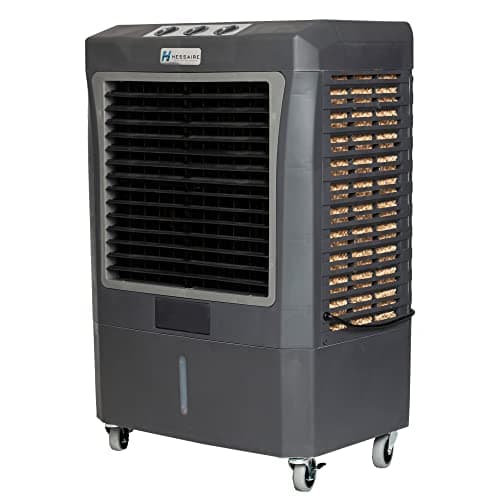 Most air, for a big or breezy space Hessaire MC37M Mobile Evaporative Cooler 3,100 CFM on 250 W, the highest airflow here, which is what an open or windy space needs. | A large uncovered deck, or anywhere with a breeze to fight | |
| 3 | 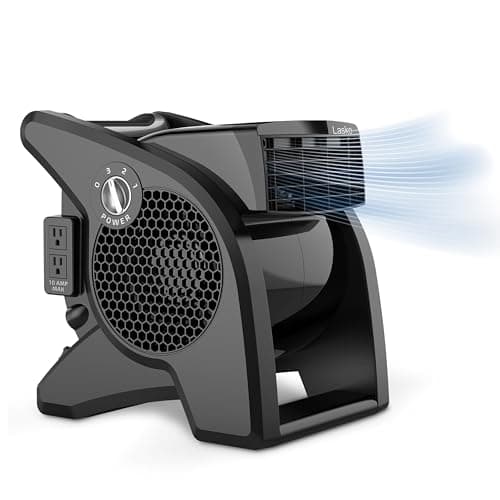 For humid-climate patios Lasko Max Performance 15" Air Mover No cooling, but a hard directed airstream, which is the only thing that helps outdoors in humid air. | An outdoor space where evaporative cooling cannot work | |
| — | The one to skip outdoors Honeywell CL25AE Indoor Evaporative Cooler 764 CFM disperses into open air long before it reaches anyone, at nearly the same power draw as units moving four times as much. | An indoor room, not a patio |
Cooling a patio is a different problem from cooling a room, and most advice about evaporative coolers does not adjust for it. Indoors you are lowering the temperature of a defined volume of air. Outdoors there is no volume — the air is unbounded, and anything you cool disperses within seconds.
So outdoors you are not cooling a space. You are cooling people. That changes the specifications you should be shopping on.
What matters outdoors
Three specifications, in order
- Throw distance. How far the cooled air actually travels before it disperses. This is the single most useful outdoor specification and the one least often published — Honeywell gives 30 ft for the CO60PM; Hessaire publishes nothing.
- Airflow (CFM). Volume is your only defense against open air and breeze. There is no enclosure helping you, so more air means the cooled stream survives further.
- Oscillation. A fixed stream cools one chair. On a patio with several people, oscillation is the difference between a cooler that works for the group and one that works for whoever sat in the right place.
Notice what is not on that list: the square-footage coverage claim. Outdoors it is meaningless twice over. It was never a measurement in the first place — every coverage figure in this category is the CFM divided by 1.64 — and outdoors there is no enclosed area for it to describe.
The numbers
The picks, compared
| Unit | CFM | Watts | Throw | Tank | 30 × 8 hrs |
|---|---|---|---|---|---|
| Honeywell CO60PM | 2,697 | 220 W | 30 ft | 15.9 gal | $9.68 |
| Hessaire MC37M | 3,100 | 250 W | Not published | 10.3 gal | $11 |
| Honeywell CL25AE | 764 | 235 W | 33 ft | 6.6 gal | $10 |
Specifications from each manufacturer’s product page; costs are our arithmetic at 18.34¢/kWh.
The CL25AE’s 33 ft throw looks competitive until you read it against the airflow. Throw distance describes how far the stream is detectable, not how much cooled air arrives — and 764 CFM spreading over 33 feet outdoors is a whisper by the time it gets there. Throw and volume have to be read together.
Say the unwelcome thing
Do not put an evaporative cooler on an enclosed sun porch or a screened room.
It is the worst of both configurations. You have the outdoor problem of unbounded air working against you if the space is large, and the indoor problem of rising humidity if it is at all enclosed — a screened porch on a still day traps moisture surprisingly well.
Either commit to an open patio, where these work, or treat the space as a room and look at a window unit. And if the porch has a ceiling, an outdoor-rated ceiling fan at 16 W is a far better permanent answer than anything on wheels.
Placement
Where to put it
- Upwind of where people sit. Work with the prevailing breeze rather than against it. Fighting a breeze with a fan is a losing proposition and you will simply hear the machine.
- In shade if possible. Sun on the cabinet heats the water in the tank, and warmer water evaporates less effectively.
- Close enough to matter. Cooled air disperses fast outdoors. Within 15 to 20 feet of the seating area is doing real work; 40 feet away is a noise source.
- Near a tap and a GFCI outlet. A continuous water connection changes the experience, and any outdoor electrical connection should be on a GFCI-protected circuit.
- Empty and store it before winter. Water left in a tank freezes and cracks things, and pads left damp grow mold.
And the climate check applies here as everywhere in this category. If your afternoon humidity is above roughly 60%, none of this works — the two-minute check is here.
In full
Every pick, and what is wrong with it
Published specifications only, each linked to the page it came from. Where a manufacturer publishes nothing, the row says so — we do not fill blanks in.
1. Best for most patios
Honeywell CO60PM Indoor/Outdoor Evaporative Cooler
Honeywell · model CO60PM
A published 30 ft throw with oscillation, the biggest tank here, and every specification stated.
Outdoors, the specification that matters most is not airflow in the abstract but how far the air actually gets. Honeywell publishes a 30 ft throw, which is enough to reach a seating area from the edge of a patio, and the unit oscillates so it sweeps rather than hitting one chair.
2,697 CFM on 220 W is 12.3 CFM per watt, essentially tied with the Hessaire for the best efficiency here. About 32¢ for an eight-hour afternoon and evening at 18.34¢/kWh.
The 15.9 gallon tank plus a continuous water hookup is the practical winner for entertaining — you are not refilling it halfway through the evening. Triple-sided honeycomb pads give more evaporative surface for the same airflow, which matters outdoors where you have no enclosure helping you.
The noise is the honest caveat. 61–65 dBA is conversational volume, which on a patio is precisely the thing you would rather not compete with. Three speeds means you can drop it when people arrive.
What’s wrong with it
61-65 dBA sits right in the range that makes conversation harder, which on a patio is the one thing you are trying to protect. Run it on a lower speed when people are talking.
Running cost — CO60PM
| Nameplate power | 220 W | manufacturer's published figure |
|---|---|---|
| Energy, 8-hour night | 1.76 kWh | 220 ÷ 1000 × 8 |
| Cost per hour | 4.0¢ | at 18.34¢/kWh |
| Cost per 8-hour night | 32¢ | on the highest speed |
| Cost per 30 nights | $9.68 | 52.8 kWh |
Rate: 18.34¢/kWh, the US average residential price for June 2026 (EIA Electric Power Monthly, Table 5.3). Yours will differ — swap it in: (watts ÷ 1000) × hours × your rate.
| Air delivery | 2,697 CFM |
|---|---|
| Power | 220 W |
| Water tank | 15.9 gallons, continuous hookup |
| Air throw | 30 ft |
| Noise | 61-65 dBA |
| Speeds | 3, with oscillation |
| Pads | Triple-sided honeycomb |
| Dimensions | 27.6 W x 18.3 D x 40 H in |
| Weight | 39.2 lb |
| Manufacturer coverage claim | 1,643 sq ft |
| Warranty | 1 year |
Every figure above is from Honeywell Air Comfort product page, CO60PM. Blanks are shown as “not published” rather than filled in.
2. Most air, for a big or breezy space
Hessaire MC37M Mobile Evaporative Cooler
Hessaire · model MC37M
3,100 CFM on 250 W, the highest airflow here, which is what an open or windy space needs.
The most airflow per watt of anything we looked at: 12.4 CFM/W, from 3,100 CFM on 250 W. Outdoors that headroom matters more than indoors, because there is no enclosure holding the cooled air near you — any breeze simply carries it away, and more volume is the only counter.
The 10.3 gallon tank runs a long evening, and it takes a continuous connection if you have an outdoor tap.
What you are accepting is missing information. Hessaire does not publish a throw distance, a noise figure, or a speed count on the product page. For a garage that hardly matters. On a patio, throw distance is arguably the most important specification there is, and not having it means buying on airflow alone and hoping.
$11 for thirty eight-hour sessions.
What’s wrong with it
Hessaire publishes no throw distance and no noise figure, so two of the three things that matter outdoors are unknown before you buy. No oscillation is stated either.
Running cost — MC37M
| Nameplate power | 250 W | manufacturer's published figure |
|---|---|---|
| Energy, 8-hour night | 2.00 kWh | 250 ÷ 1000 × 8 |
| Cost per hour | 4.6¢ | at 18.34¢/kWh |
| Cost per 8-hour night | 37¢ | on the highest speed |
| Cost per 30 nights | $11 | 60.0 kWh |
Rate: 18.34¢/kWh, the US average residential price for June 2026 (EIA Electric Power Monthly, Table 5.3). Yours will differ — swap it in: (watts ÷ 1000) × hours × your rate.
| Air delivery | 3,100 CFM |
|---|---|
| Power | 250 W / 2.4 A |
| Water tank | 10.3 gallons, continuous hookup capable |
| Dimensions | 24 L x 16 W x 38 H in |
| Weight | 40 lb |
| Pads | Industrial-grade cooling pads |
| Coverage claim | Not published on the product page |
Every figure above is from Hessaire product page, MC37M. Blanks are shown as “not published” rather than filled in.
3. For humid-climate patios
Lasko Max Performance 15" Air Mover
Lasko · model U15720
No cooling, but a hard directed airstream, which is the only thing that helps outdoors in humid air.
On a humid patio in Atlanta or Houston, an evaporative cooler is a fan that also makes you damp. This is at least honest about being a fan.
A high-velocity air mover drives a hard directed stream at people, which speeds evaporation of their own sweat — the same physics the swamp cooler uses, except your body supplies the water. In humid air that is genuinely the most effective thing available, and outdoors you are cooling people rather than a space anyway.
160–178 W published, so about $7.83 for thirty eight-hour sessions. Lasko publishes no CFM figure, which is a real gap for a machine sold on air movement.
Do not expect it to be attractive. It is a workshop tool in a patio role, and if aesthetics matter, an outdoor-rated ceiling fan under a covered patio is a better long-term answer — damp-rated models are in the ceiling fan roundup.
What’s wrong with it
178 W purely to move air, no CFM figure published, and it is a utility blower rather than something you want as patio furniture. It is loud and it looks like a jobsite tool.
Running cost — U15720
| Nameplate power | 160 W – 178 W | manufacturer's published figure |
|---|---|---|
| Energy, 8-hour night | 1.42 kWh | 178 ÷ 1000 × 8 |
| Cost per hour | 3.3¢ | at 18.34¢/kWh |
| Cost per 8-hour night | 26¢ | on the highest speed |
| Cost per 30 nights | $7.83 | 42.7 kWh |
| Same month, lowest speed | $7.04 | at 160 W |
Rate: 18.34¢/kWh, the US average residential price for June 2026 (EIA Electric Power Monthly, Table 5.3). Yours will differ — swap it in: (watts ÷ 1000) × hours × your rate.
| Power | 160 W - 178 W (1.35-1.53 A at 120 V) |
|---|---|
| Speeds | 3 |
| Dimensions | 14.5 H x 14.0 D x 11.5 W in |
| Weight | 12.55 lb |
| Extras | Two 120 V accessory outlets, 9.5 ft cord, pivoting head |
| Air delivery (CFM) | Not published |
| Warranty | 1 year |
Every figure above is from Lasko product page, U15720. Blanks are shown as “not published” rather than filled in.
Skip this one
Honeywell CL25AE Indoor Evaporative Cooler
Honeywell · model CL25AE
764 CFM disperses into open air long before it reaches anyone, at nearly the same power draw as units moving four times as much.
Indoors this is a sensible unit — quiet at 52–60 dBA, a 7.5-hour timer, a remote, and light at 25.4 lb. Outdoors it fails on the one thing that matters.
764 CFM on 235 W is 3.3 CFM per watt, against 12.3 and 12.4 for the two picks above. It draws more power than the CO60PM while moving 28% of the air. Indoors, where an enclosure holds the cooled air, that can still be enough. Outdoors there is nothing holding anything — the cooled air disperses into an infinite volume, and 764 CFM disappears within a few feet.
It is also an indoor unit by construction, and the larger Honeywell models are specified for indoor/outdoor use for a reason: motors, housings and electrical parts exposed to weather need to be built for it.
What’s wrong with it
3.3 CFM per watt, and 764 CFM outdoors is simply not enough volume to overcome open air and any breeze. It is also not built for outdoor exposure.
Running cost — CL25AE
| Nameplate power | 235 W | manufacturer's published figure |
|---|---|---|
| Energy, 8-hour night | 1.88 kWh | 235 ÷ 1000 × 8 |
| Cost per hour | 4.3¢ | at 18.34¢/kWh |
| Cost per 8-hour night | 34¢ | on the highest speed |
| Cost per 30 nights | $10 | 56.4 kWh |
Rate: 18.34¢/kWh, the US average residential price for June 2026 (EIA Electric Power Monthly, Table 5.3). Yours will differ — swap it in: (watts ÷ 1000) × hours × your rate.
| Air delivery | 764 CFM |
|---|---|
| Power | 235 W |
| Water tank | 6.6 gallons |
| Air throw | 33 ft |
| Noise | 52-60 dBA |
| Speeds | 3, oscillating louvers |
| Timer | Up to 7.5 hours |
| Dimensions | 18.9 x 14.6 x 33.3 in |
| Weight | 25.4 lb |
| Manufacturer coverage claim | 466 sq ft |
| Warranty | 1 year |
Every figure above is from Honeywell Air Comfort product page, CL25AE. Blanks are shown as “not published” rather than filled in.
We are not linking a buy button for this one. If you want to look at it anyway, it is easy enough to find — but we would rather send you to something that fits your room.
Questions people actually ask
Frequently asked
What is the best evaporative cooler for a patio?
The Honeywell CO60PM for most patios: 2,697 CFM on 220 W with a published 30 ft throw, oscillation, and a 15.9 gallon tank. The Hessaire MC37M moves more air at 3,100 CFM, which suits a larger or breezier space, but publishes no throw distance.
Do evaporative coolers work outside?
In dry air, yes, and outdoors is a natural fit because the ventilation these units need is unlimited. But you are cooling people rather than a space — the cooled air disperses into open air within seconds — so throw distance and airflow matter far more than any coverage claim.
How far does an evaporative cooler throw air?
Where it is published: 30 ft for the Honeywell CO60PM and 33 ft for the smaller CL25AE. Hessaire does not publish a figure. Read throw together with airflow, though — a long throw from a low-CFM unit means the stream is detectable at that distance, not that useful cooling arrives.
What size evaporative cooler do I need for a patio?
There is no meaningful square-footage calculation outdoors, because the air is unbounded. Aim for 2,500 CFM or more for a typical seating area, more if the space is open or breezy, and prioritize oscillation so the stream sweeps across everyone rather than one chair.
Can I leave an evaporative cooler outside?
Only models specified for outdoor use, and not through winter. Water left in a tank freezes and cracks components, and pads left damp grow mold. Drain, dry and store it at the end of the season, and keep any outdoor electrical connection on a GFCI circuit.
Are misting fans better than evaporative coolers for a patio?
They work on the same principle — evaporating water to absorb heat — and both fail in humid air for the same reason. A misting fan puts water droplets into the air directly, which can leave people and furniture damp; an evaporative cooler evaporates the water inside the unit and delivers cooled air.
Sources
Where these numbers came from
Read next
Where to go from here
Back to Evaporative Coolers, or read how we pick.