Guide and picks
Where evaporative coolers work in the US
This is the only cooling category whose answer depends on where you live, and the searcher usually already senses it.
By Sawyer V. · Published
The short answer
Check your own dew point, not a map. Evaporative cooling needs air with spare capacity to absorb water, and dew point measures exactly that while relative humidity does not. As a working rule it does well below roughly 40% relative humidity and very little above 60%. The Southwest and Mountain West generally qualify; the Gulf and Southeast generally do not — and many states are both.
Fan & Frost earns a commission when you buy through our links, at no cost to you. It never changes a ranking, and we say so when the right answer is the cheaper unit or nothing at all. Full disclosure · How we pick.

At a glance
The picks, ranked
Tap any row to jump to the full reasoning. Prices are live from Amazon where we have them, and read “check price” where we don’t — never a number we cannot verify today.
| # | Product | Best for | Price |
|---|---|---|---|
| 1 | 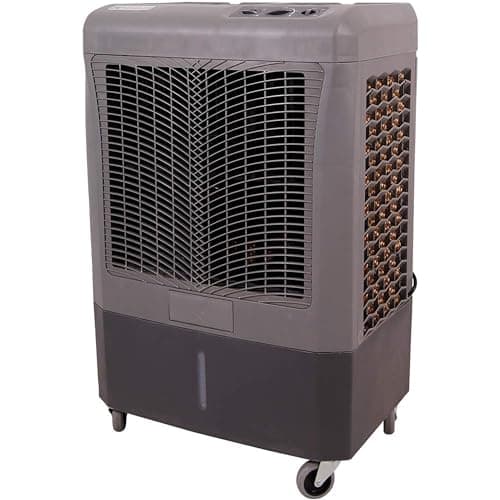 If your climate qualifies Hessaire MC37M Mobile Evaporative Cooler 3,100 CFM on 250 W — about a tenth the running cost of refrigerated cooling, where the air is dry enough. | A dry-climate garage, workshop or covered patio | |
| 2 | 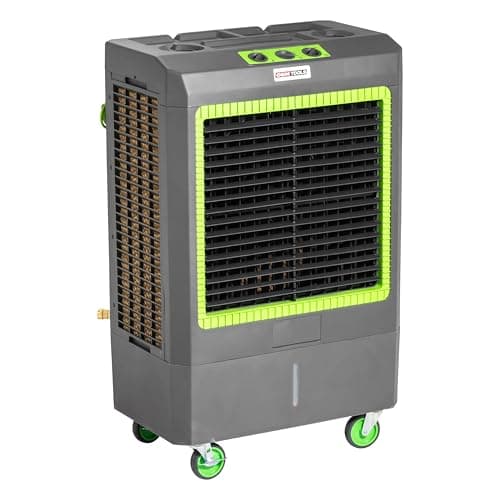 For a large dry-climate space Hessaire MC61M Mobile Evaporative Cooler, 5,300 CFM 5,300 CFM on 430 W — the most air any portable we hold data for moves, at 12.3 CFM per watt. | A workshop or barn in the Southwest or Mountain West | |
| 3 | If your climate does not qualify Midea Window Air Conditioner, 6,000 BTU CEER 16 and 281.3 kWh a year — refrigerated cooling works in any climate, including humid ones. | Anywhere the dew point rules evaporative cooling out | |
| — | The indoor trap in a humid state Honeywell CL25AE Indoor Evaporative Cooler 764 CFM on 235 W — it adds moisture to air that, in a humid climate, has none to spare. | A dry climate, with a window open — not a humid one |
Every other category on this site gives the same answer everywhere. This one does not, and the regional question deserves a straight answer.
The measure
Dew point, not relative humidity
Relative humidity is the number everyone quotes and it is the wrong one for this decision, because it changes with temperature even when the actual moisture in the air has not.
Dew point is an absolute measure. It is the temperature at which the air would become saturated, and it tells you directly how much water the air is already carrying. Low dew point means spare capacity, which is exactly what an evaporative cooler needs.
The practical reason this matters: a morning at 70°F and 60% relative humidity and an afternoon at 95°F and 25% relative humidity can have the same dew point and the same absolute moisture. Relative humidity moved; the air did not change.
Every weather app shows dew point. It is usually one tap away from the main screen, and it is the single number that settles whether this category is for you.
The rule
A working threshold
As a working rule, and stated as a rule rather than a precise threshold:
- Below roughly 40% relative humidity at the time of day you want cooling — evaporative cooling works well and is dramatically cheaper than refrigeration.
- Between 40% and 60% — diminishing returns. You will get some drop, and it will not feel like air conditioning.
- Above roughly 60% — very little cooling, and you are adding moisture to air that already has too much.
The physics behind it is the same mechanism that makes humid heat feel worse: evaporation needs air with spare capacity. Your sweat and the cooler’s pads are competing for the same thing.
By region
Broad patterns, and why the state is the wrong unit
| Region | Typical summer character | Evaporative cooling |
|---|---|---|
| Desert Southwest | Very hot, very dry | Works well — the home ground |
| Mountain West and Great Basin | Hot days, low humidity | Works well |
| Southern and Central Plains | Hot, moderate humidity | Mixed, and varies by day |
| Pacific Northwest, inland | Warm and dry in summer | Often works |
| Midwest and Ohio Valley | Hot and humid | Generally poor |
| Southeast and Gulf Coast | Hot and very humid | Generally does not work |
| Northeast | Humid summers | Generally poor |
State borders are a poor guide and Texas is the clearest example. El Paso sits in the desert Southwest and is prime evaporative territory. Houston is on the Gulf Coast and is emphatically not. They are the same state, about 750 miles apart, with entirely different answers.
California splits the same way — the interior deserts against the coast — as do Oregon and Washington east and west of the Cascades, and Colorado either side of the Front Range.
This is why the instruction is to check your own dew point rather than to look your state up. The table above is orientation, not an answer.
The trap
Your climate changes during the season
Even where the annual picture is favorable, the summer is not uniform, and this catches people who bought on a good week.
- Monsoon season. Large parts of Arizona, New Mexico and southern Nevada see a mid-to-late-summer period of substantially higher humidity. Evaporative cooling that works in June can underperform in August.
- Time of day. Relative humidity is highest at dawn and lowest in mid-afternoon. A cooler that seems weak in the morning may be working fine at three o’clock.
- Rain and its aftermath. Dew point rises for a day or two after significant rain, anywhere.
- Irrigation and vegetation raise local humidity in otherwise dry areas.
Which argues for something people do anyway in the Southwest: keep both. Run the evaporative cooler for the long dry stretches and a refrigerated unit for the humid weeks.
Testing it
Settle it in a week, before you buy
- Open your weather app and find dew point. Usually under an expanded or hourly view.
- Check it at the hour you want cooling, not the daily average. Mid-afternoon is usually the driest and hottest.
- Do it for a week spanning a range of weather, not one perfect day.
- Note the relative humidity at that hour too. Under 40% consistently is a strong signal.
- Check your monsoon or wet season if your region has one, and decide whether you can live with a machine that fades for several weeks.
A cheap thermometer-hygrometer outdoors does the same job and costs very little.
This one is not a DIY job
We hold no climate dataset, and these are orientation categories rather than measurements. The regional table above reflects broad, well-established summer patterns; it is not derived from a dataset we have queried, and it should not be treated as one.
Your own local data — from a weather service or an outdoor hygrometer — is authoritative over any national generalisation, and microclimate varies enormously within a region.
Fixed whole-house evaporative systems are sized and specified against local design conditions by a contractor, and those design figures are the ones to use for an installation.
Adding moisture to an enclosed space has building consequences. Persistent condensation on windows or walls means the ventilation is inadequate.
Say the unwelcome thing
Do not buy an evaporative cooler because it worked for someone in a different state.
This is the only cooling category where a recommendation is not transferable, and the reviews reflect it — the same machine gets rated brilliant and useless by people who are both correct.
Evaporative cooling depends entirely on the air having spare capacity to absorb water. Where it does, you get a large temperature drop for about 18¢ of electricity over four hours. Where it does not, you get a 250 W fan and a damper room.
State borders do not settle it either. El Paso and Houston are the same state and opposite answers.
Check your own dew point at the hour you want cooling, for a week. If it qualifies, 3,100 CFM on 250 W is excellent value. If it does not, 281.3 kWh a year of refrigeration works in any climate.
In full
Every pick, and what is wrong with it
Published specifications only, each linked to the page it came from. Where a manufacturer publishes nothing, the row says so — we do not fill blanks in.
1. If your climate qualifies
Hessaire MC37M Mobile Evaporative Cooler
Hessaire · model MC37M
3,100 CFM on 250 W — about a tenth the running cost of refrigerated cooling, where the air is dry enough.
The case for evaporative cooling in a dry climate is genuinely strong, and the running cost is the reason.
3,100 CFM on 250 W is about 18¢ for a four-hour session at 18.34¢/kWh. A 1,300 W portable air conditioner is 95¢ for the same four hours.
That gap exists because evaporation does the cooling rather than a compressor — and it is entirely conditional on the air having capacity to absorb water.
Continuous hookup capable with a 10.3 gallon tank. In a dry climate it is one of the best value purchases on this site. In a humid one it is a fan that makes things damp.
What’s wrong with it
Above roughly 60% relative humidity it does very little, whatever you paid.
Running cost — MC37M
| Nameplate power | 250 W | manufacturer's published figure |
|---|---|---|
| Energy, 8-hour night | 2.00 kWh | 250 ÷ 1000 × 8 |
| Cost per hour | 4.6¢ | at 18.34¢/kWh |
| Cost per 8-hour night | 37¢ | on the highest speed |
| Cost per 30 nights | $11 | 60.0 kWh |
Rate: 18.34¢/kWh, the US average residential price for June 2026 (EIA Electric Power Monthly, Table 5.3). Yours will differ — swap it in: (watts ÷ 1000) × hours × your rate.
| Air delivery | 3,100 CFM |
|---|---|
| Power | 250 W / 2.4 A |
| Water tank | 10.3 gallons, continuous hookup capable |
| Dimensions | 24 L x 16 W x 38 H in |
| Weight | 40 lb |
| Pads | Industrial-grade cooling pads |
| Coverage claim | Not published on the product page |
Every figure above is from Hessaire product page, MC37M. Blanks are shown as “not published” rather than filled in.
2. For a large dry-climate space
Hessaire MC61M Mobile Evaporative Cooler, 5,300 CFM
Hessaire · model MC61M
5,300 CFM on 430 W — the most air any portable we hold data for moves, at 12.3 CFM per watt.
Where the climate qualifies and the space is large, this is the most air available from a plug-in machine.
5,300 CFM on 430 W is 12.3 CFM per watt, about four times what small indoor coolers manage.
14.6 gallon reservoir with a float valve for continuous supply, which at this airflow is a requirement rather than a convenience.
57 lb and 28 by 17 by 46 inches. Size it from the air-change arithmetic rather than the coverage claim — the method.
What’s wrong with it
430 W, 57 lb, and it needs a large exhaust opening to work at all.
Running cost — MC61M
| Nameplate power | 430 W | manufacturer's published figure |
|---|---|---|
| Energy, 8-hour night | 3.44 kWh | 430 ÷ 1000 × 8 |
| Cost per hour | 7.9¢ | at 18.34¢/kWh |
| Cost per 8-hour night | 63¢ | on the highest speed |
| Cost per 30 nights | $19 | 103.2 kWh |
Rate: 18.34¢/kWh, the US average residential price for June 2026 (EIA Electric Power Monthly, Table 5.3). Yours will differ — swap it in: (watts ÷ 1000) × hours × your rate.
| Air delivery | 5,300 CFM |
|---|---|
| Power | 430 W / 4.3 A |
| Water tank | 14.6 gallons, float valve |
| Dimensions | 28 L x 17 W x 46 H in |
| Weight | 57 lb |
| Pads | Replaceable media pads |
| Manufacturer coverage claim | Up to 1,600 sq ft |
Every figure above is from Hessaire product page, 5,300 CFM mobile cooler (MC61M). Blanks are shown as “not published” rather than filled in.
3. If your climate does not qualify
Midea Window Air Conditioner, 6,000 BTU
Midea · model MAW06S1KWT-A
CEER 16 and 281.3 kWh a year — refrigerated cooling works in any climate, including humid ones.
The honest alternative, and the right answer for a large share of the country.
A refrigerated air conditioner removes moisture as a side effect of cooling, so humidity helps rather than hinders it. The wetter the air, the more latent heat there is to remove — it works either way.
281.3 kWh a year is about $52 for a season, at CEER 16 and on the Most Efficient list.
31.6 lb, no support bracket required, variable speed. The 6,000 BTU class.
What’s wrong with it
It needs a window, and it costs considerably more per hour than evaporative cooling does where that works.
Running cost — MAW06S1KWT-A
| Annual energy use | 281.3 kWh | ENERGY STAR certified figure |
|---|---|---|
| Annual cost | $52 | 281.3 × 18.34¢/kWh |
| Per cooling month | $13 | spread over a four-month season |
The annual figure is the certified value from the ENERGY STAR Certified Room Air Conditioners dataset, which models a standard cooling season rather than your actual summer. It is more useful than a nameplate wattage here, because a variable-speed compressor spends most of its life well below nameplate.
Rate: 18.34¢/kWh, the US average residential price for June 2026 (EIA Electric Power Monthly, Table 5.3). Yours will differ — swap it in: (watts ÷ 1000) × hours × your rate.
| Cooling capacity | 6,000 BTU/h |
|---|---|
| CEER | 16 |
| Annual energy use | 281.3 kWh/yr |
| vs federal standard | 45% less energy |
| Dimensions | 12.1 H x 16.0 W x 13.3 D in |
| Weight | 31.6 lb |
| Installation | Does not straddle the windowsill |
| Support bracket | Not required |
| Compressor | Variable speed |
| Refrigerant | R-32 |
| ENERGY STAR | Certified, and on the Most Efficient list |
Every figure above is from ENERGY STAR Certified Room Air Conditioners dataset. Blanks are shown as “not published” rather than filled in.
Skip this one
Honeywell CL25AE Indoor Evaporative Cooler
Honeywell · model CL25AE
764 CFM on 235 W — it adds moisture to air that, in a humid climate, has none to spare.
Flagged for a specific and common failure: buying an indoor evaporative cooler in a state where the summer air is saturated.
Evaporative cooling works by putting water into the air. Where the air is already close to saturated, very little evaporates, so very little cooling happens — and what does evaporate makes the room damper.
235 W of fan and pump power stays in the room as heat regardless of whether the cooling works.
It is a decent machine in the right climate with a window open. Where the limit is.
What’s wrong with it
In the Gulf or Southeast in summer this is a 235 W humidifier with a fan attached.
Running cost — CL25AE
| Nameplate power | 235 W | manufacturer's published figure |
|---|---|---|
| Energy, 8-hour night | 1.88 kWh | 235 ÷ 1000 × 8 |
| Cost per hour | 4.3¢ | at 18.34¢/kWh |
| Cost per 8-hour night | 34¢ | on the highest speed |
| Cost per 30 nights | $10 | 56.4 kWh |
Rate: 18.34¢/kWh, the US average residential price for June 2026 (EIA Electric Power Monthly, Table 5.3). Yours will differ — swap it in: (watts ÷ 1000) × hours × your rate.
| Air delivery | 764 CFM |
|---|---|
| Power | 235 W |
| Water tank | 6.6 gallons |
| Air throw | 33 ft |
| Noise | 52-60 dBA |
| Speeds | 3, oscillating louvers |
| Timer | Up to 7.5 hours |
| Dimensions | 18.9 x 14.6 x 33.3 in |
| Weight | 25.4 lb |
| Manufacturer coverage claim | 466 sq ft |
| Warranty | 1 year |
Every figure above is from Honeywell Air Comfort product page, CL25AE. Blanks are shown as “not published” rather than filled in.
We are not linking a buy button for this one. If you want to look at it anyway, it is easy enough to find — but we would rather send you to something that fits your room.
Questions people actually ask
Frequently asked
Do evaporative coolers work in Texas?
It depends which part. El Paso is desert Southwest and prime evaporative territory; Houston is Gulf Coast and emphatically not. They are the same state, 750 miles apart, with opposite answers — which is why state borders are the wrong unit.
Do evaporative coolers work in Florida?
Generally no. Gulf and Southeast summers have very high moisture content, so little water evaporates from the pads, little cooling happens, and what does evaporate makes the room damper. A refrigerated air conditioner is the right machine there.
Should I check dew point or relative humidity?
Dew point. It is an absolute measure of how much water the air is carrying, while relative humidity changes with temperature even when the air has not changed. Every weather app shows it, usually one tap from the main screen.
What humidity is too high for an evaporative cooler?
As a working rule, they do well below roughly 40% relative humidity at the hour you want cooling, give diminishing returns between 40% and 60%, and deliver very little above 60%. The mechanism.
Will an evaporative cooler still work during monsoon season?
Less well. Large parts of Arizona, New Mexico and southern Nevada see a mid-to-late-summer humidity rise, so a cooler that works in June can underperform in August. Many households in those areas keep both an evaporative cooler and a refrigerated unit.
How do I test whether my climate suits one?
Check dew point and relative humidity at the hour you actually want cooling — usually mid-afternoon — for a week spanning varied weather. Under 40% relative humidity consistently is a strong signal. An outdoor hygrometer does the same job cheaply.
Sources
Where these numbers came from
- Hessaire MC37M product page — 3,100 CFM, 250 W, 10.3 gal continuous hookup
- Hessaire 5,300 CFM mobile cooler (MC61M) product page — 5,300 CFM, 430 W, 14.6 gal
- ENERGY STAR Certified Room Air Conditioners dataset — CEER and annual kWh for the refrigerated comparison
- EIA Electric Power Monthly, Table 5.3 — average residential electricity price
Read next
Where to go from here
Back to Evaporative Coolers, or read how we pick.