The picks
The best dehumidifier for a bedroom
The moisture in a bedroom mostly comes from the people sleeping in it, which is a much smaller load than the internet's default 50-pint recommendation assumes.
By Sawyer V. · Published
The short answer
Buy small. A bedroom’s moisture load is occupants and an adjoining bathroom, not groundwater, so a 27-pint unit at 283 kWh a year — $52 at 18.34¢/kWh — is usually enough, against $96 for the 50-pint unit most guides default to. Check ventilation first: persistent bedroom condensation is usually an air-exchange problem.
Fan & Frost earns a commission when you buy through our links, at no cost to you. It never changes a ranking, and we say so when the right answer is the cheaper unit or nothing at all. Full disclosure · How we pick.
At a glance
The picks, ranked
Tap any row to jump to the full reasoning. Prices are live from Amazon where we have them, and read “check price” where we don’t — never a number we cannot verify today.
| # | Product | Best for | Price |
|---|---|---|---|
| 1 | Best overall Vissani Dehumidifier, 27 pints/day 26.87 pints a day at 283 kWh a year — the lowest running cost of any certified unit we hold data for. | A standard bedroom with condensation on the windows | |
| 2 | Best if you want to schedule it Honeywell Smart Dehumidifier, 32 pints/day 32.46 pints a day at 343 kWh a year with connected control — 1 of only 35 certified portables that has it. | Drying the room by day and leaving it alone at night | |
| 3 | 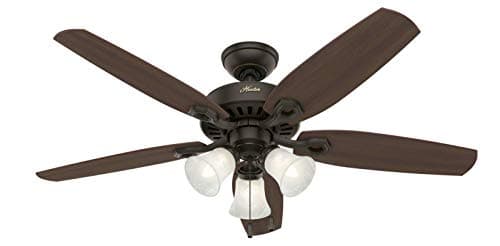 Try this first Hunter Vespucci 52" Ceiling Fan 1.8 W on low and 366.7 CFM per watt — it removes no moisture at all, and often fixes the complaint. | A bedroom that feels clammy rather than one with visible damp | |
| — | Oversized for this room Waykar Dehumidifier, 49 pints/day 49.43 pints a day at 471 kWh a year. An excellent machine, and about twice the bedroom you have. | A basement — not a bedroom |
Almost every recommendation for this room is a size too big, because it was written for a basement and reused.
The load
Where bedroom moisture actually comes from
A basement fights groundwater, which arrives continuously and in volume. A bedroom fights something much smaller and much more predictable.
- The occupants. People release moisture continuously through breathing and perspiration. Two adults over eight hours is the dominant term in most bedrooms.
- An adjoining bathroom. Frequently the real source, especially where extraction is missing or under-powered.
- Drying clothes or towels in the room. Every gram of water in them ends up in the air.
- Cold surfaces. Single glazing, an uninsulated external wall or a knee wall gives moisture somewhere to condense, which makes a modest load look dramatic.
None of that is close to 50 pints a day. A correctly sized bedroom unit is a small one, and the money you save is in running cost rather than purchase price.
First
Check the ventilation before you buy
Persistent bedroom condensation is usually a symptom of air that is not being exchanged, and a dehumidifier treats that symptom indefinitely.
- Does the bathroom extract properly? A certified fan removes moisture at 16.7 CFM per watt — a fraction of a cent an hour, and it takes the water out of the building rather than condensing it back.
- Is anything drying in the room? An airer in a closed bedroom is a moisture source you can simply remove.
- Does the room get any air exchange? Trickle vents, a window opened briefly each morning, or mechanical ventilation.
- Are the cold surfaces fixable? Condensation forms on the coldest thing in the room. Sometimes that is a repair rather than an appliance.
If all four check out and the room is still damp, a dehumidifier is the right tool — and it should be a small one.
The comparison
What each size costs to run
| Capacity | IEF | kWh/yr | A year | Right for a bedroom? |
|---|---|---|---|---|
| 26.87 pt/day | 2.01 | 283 | $52 | Usually, yes |
| 32.46 pt/day | 2.01 | 343 | $63 | Yes, with headroom |
| 35.85 pt/day | 2.01 | 379 | $70 | Only if the room is large |
| 49.43 pt/day | 2.20 | 471 | $86 | No — basement capacity |
The gap between the smallest and the basement unit is $34 a year, every year, for capacity a bedroom cannot use.
Note also that the small units sit at 2.01 L/kWh, the same as most of the field. In this size class efficiency does not vary much, so the sizing decision is the one that moves the number.
This one is not a DIY job
Damp and mold in a sleeping space are a health matter, and this is a buying guide. We can tell you what these machines remove and what they cost to run. We cannot advise on exposure or on what any of it means for a specific condition.
Visible mold growth over a meaningful area, damp that returns within hours, or condensation running down walls are reasons to have the room assessed rather than to keep shopping.
A bedroom with no functioning ventilation is also a building-code question in many jurisdictions. That belongs to a qualified professional.
Practical
Running one in a room you sleep in
- Set a realistic target. Chasing a very low humidity setting means the machine never stops, which is both noisy and expensive.
- Run it by day, not at night. Humidity rebounds far more slowly than temperature, so drying the room while you are out usually holds through the night.
- Consider the landing instead. A unit outside the room with the door open dries a bedroom slowly and is heard by nobody.
- Get it off bare floorboards. A compressor coupled into a timber floor is the loudest version of any of these machines.
- Empty or plumb the tank. A full-tank alarm at 3 a.m. is the noise complaint nobody predicts.
- Remember it warms the room slightly. All the electrical energy becomes heat, plus the latent heat released as water condenses. The room feels better because evaporation works again, not because it got cooler.
Say the unwelcome thing
Do not buy a 50-pint dehumidifier for a bedroom.
It is the standard recommendation and it is sized for a different room entirely.
A bedroom’s moisture load is its occupants and, often, an adjoining bathroom. That is nowhere near 50 pints a day. What you get for the extra capacity is a larger compressor and a larger fan reaching setpoint quickly and then cycling — in a room where you are trying to sleep.
It also costs $34 a year more to run at 18.34¢/kWh, indefinitely, for capacity the room never draws on.
Buy the size that matches the load: 27 pints at 283 kWh a year. And before that, check whether 1.8 W of air movement fixes the complaint for nothing.
In full
Every pick, and what is wrong with it
Published specifications only, each linked to the page it came from. Where a manufacturer publishes nothing, the row says so — we do not fill blanks in.
1. Best overall
Vissani Dehumidifier, 27 pints/day
Vissani · model VAD25S1AWTS
26.87 pints a day at 283 kWh a year — the lowest running cost of any certified unit we hold data for.
The right size for the job, which in this room is the whole decision.
26.87 pints a day comfortably exceeds what occupants and an adjoining bathroom produce in a typical bedroom. Anything larger is capacity you paid for and will not use.
283 kWh a year is about $52 at 18.34¢/kWh — roughly half what a 50-pint unit costs to run, for a room that needs half.
2.01 L/kWh, the category median, and HFC-32 refrigerant. This is not the most sophisticated machine here; it is the correctly sized one, and in a bedroom that saves more than efficiency does.
What’s wrong with it
2.01 L/kWh is exactly the category median, and no noise figure is published.
Running cost — VAD25S1AWTS
| Annual energy use | 283 kWh | ENERGY STAR certified figure |
|---|---|---|
| Annual cost | $52 | 283 × 18.34¢/kWh |
| Per cooling month | $13 | spread over a four-month season |
The annual figure is the certified value from the ENERGY STAR Certified Dehumidifiers dataset, which models a standard cooling season rather than your actual summer. It is more useful than a nameplate wattage here, because a variable-speed compressor spends most of its life well below nameplate.
Rate: 18.34¢/kWh, the US average residential price for June 2026 (EIA Electric Power Monthly, Table 5.3). Yours will differ — swap it in: (watts ÷ 1000) × hours × your rate.
| Water removal | 26.87 pints/day (DOE Appendix X1) |
|---|---|
| Efficiency (IEF) | 2.01 L/kWh |
| Annual energy use | 283 kWh/yr |
| Refrigerant | HFC-32 (GWP 675) |
| Connected | No |
| Noise | Not published in the certified dataset |
| ENERGY STAR | Certified |
Every figure above is from ENERGY STAR Certified Dehumidifiers dataset. Blanks are shown as “not published” rather than filled in.
2. Best if you want to schedule it
Honeywell Smart Dehumidifier, 32 pints/day
Honeywell · model TPFIT32AWK
32.46 pints a day at 343 kWh a year with connected control — 1 of only 35 certified portables that has it.
The best answer to bedroom noise is not a quieter machine, it is a machine that is not running while you sleep — and that requires schedulable control.
Connected capable, which is genuinely uncommon: only 35 of 502 certified portables carry the flag.
32.46 pints a day and 343 kWh a year, about $63 at 18.34¢/kWh, at the 2.01 median.
Schedule it from the unit’s own controls rather than a smart plug — cutting power to a compressor at the socket is the same mistake here as on an air conditioner.
What’s wrong with it
Connectivity adds standby draw that the certified data does not quantify.
Running cost — TPFIT32AWK
| Annual energy use | 343 kWh | ENERGY STAR certified figure |
|---|---|---|
| Annual cost | $63 | 343 × 18.34¢/kWh |
| Per cooling month | $16 | spread over a four-month season |
The annual figure is the certified value from the ENERGY STAR Certified Dehumidifiers dataset, which models a standard cooling season rather than your actual summer. It is more useful than a nameplate wattage here, because a variable-speed compressor spends most of its life well below nameplate.
Rate: 18.34¢/kWh, the US average residential price for June 2026 (EIA Electric Power Monthly, Table 5.3). Yours will differ — swap it in: (watts ÷ 1000) × hours × your rate.
| Water removal | 32.46 pints/day (DOE Appendix X1) |
|---|---|
| Efficiency (IEF) | 2.01 L/kWh |
| Annual energy use | 343 kWh/yr |
| Refrigerant | HFC-32 (GWP 675) |
| Connected | Yes |
| Noise | Not published in the certified dataset |
| ENERGY STAR | Certified |
Every figure above is from ENERGY STAR Certified Dehumidifiers dataset. Blanks are shown as “not published” rather than filled in.
3. Try this first
Hunter Vespucci 52" Ceiling Fan
Hunter · model Vespucci
1.8 W on low and 366.7 CFM per watt — it removes no moisture at all, and often fixes the complaint.
Worth putting third on a dehumidifier page, because a good share of people searching for one have a comfort problem rather than a moisture problem.
Humid air feels worse because it slows the evaporation of sweat. Moving air over skin restores that evaporation directly — the same mechanism, attacked from the other end.
1.8 W on low is 0.3¢ for an eight-hour night. A 27-pint dehumidifier is roughly a hundred times that.
366.7 CFM per watt, certified, with 0.8 W standby. The honest limit is absolute: it does nothing for condensation, damp walls or mold. Those need the moisture actually removed.
What’s wrong with it
It changes nothing about humidity. If you have condensation on the glass, this is not your answer.
Running cost — Vespucci
| Nameplate power | 1.8 W – 13.9 W | manufacturer's published figure |
|---|---|---|
| Energy, 8-hour night | 0.11 kWh | 13.9 ÷ 1000 × 8 |
| Cost per hour | 0.3¢ | at 18.34¢/kWh |
| Cost per 8-hour night | 2.0¢ | on the highest speed |
| Cost per 30 nights | 61¢ | 3.3 kWh |
| Same month, lowest speed | 7.9¢ | at 1.8 W |
Rate: 18.34¢/kWh, the US average residential price for June 2026 (EIA Electric Power Monthly, Table 5.3). Yours will differ — swap it in: (watts ÷ 1000) × hours × your rate.
| Blade span | 52 in |
|---|---|
| Efficiency | 366.7 CFM per watt |
| Power, high speed | 13.9 W |
| Power, low speed | 1.8 W |
| Standby power | 0.8 W |
| Type | Indoor, fan only (no light kit) |
| Warranty | 3 years, components |
| ENERGY STAR | Certified |
Every figure above is from ENERGY STAR Certified Ceiling Fans dataset. Blanks are shown as “not published” rather than filled in.
Skip this one
Waykar Dehumidifier, 49 pints/day
Waykar · model CTH150D
49.43 pints a day at 471 kWh a year. An excellent machine, and about twice the bedroom you have.
Flagged because this class of unit is the default recommendation almost everywhere, including for rooms that do not need it.
49.43 pints a day is basement capacity. In a bedroom it reaches setpoint quickly and then cycles, so you have bought a larger compressor and a larger fan to do a smaller job.
471 kWh a year against 283 for the 27-pint unit — $34 a year more at 18.34¢/kWh, for capacity that goes unused.
It is a genuinely good machine at 2.20 L/kWh and Most Efficient certified. Put it where the water is.
What’s wrong with it
It costs about 66% more a year to run capacity a bedroom cannot use, in a bigger and louder box.
Running cost — CTH150D
| Annual energy use | 471 kWh | ENERGY STAR certified figure |
|---|---|---|
| Annual cost | $86 | 471 × 18.34¢/kWh |
| Per cooling month | $22 | spread over a four-month season |
The annual figure is the certified value from the ENERGY STAR Certified Dehumidifiers dataset, which models a standard cooling season rather than your actual summer. It is more useful than a nameplate wattage here, because a variable-speed compressor spends most of its life well below nameplate.
Rate: 18.34¢/kWh, the US average residential price for June 2026 (EIA Electric Power Monthly, Table 5.3). Yours will differ — swap it in: (watts ÷ 1000) × hours × your rate.
| Water removal | 49.43 pints/day (DOE Appendix X1) |
|---|---|
| Efficiency (IEF) | 2.20 L/kWh |
| Annual energy use | 471 kWh/yr |
| Refrigerant | HFC-32 (GWP 675) |
| Connected | No |
| Noise | Not published in the certified dataset |
| ENERGY STAR | Certified, and on the Most Efficient list |
Every figure above is from ENERGY STAR Certified Dehumidifiers dataset. Blanks are shown as “not published” rather than filled in.
We are not linking a buy button for this one. If you want to look at it anyway, it is easy enough to find — but we would rather send you to something that fits your room.
Questions people actually ask
Frequently asked
What size dehumidifier do I need for a bedroom?
Usually the smallest class — around 25 to 32 pints a day. A bedroom's moisture load is its occupants and any adjoining bathroom, not groundwater, so the 50-pint units most guides default to are sized for a basement.
How much does a bedroom dehumidifier cost to run?
About $52 a year for a 27-pint unit at 18.34¢/kWh, against $86 for a 50-pint one. That is $34 a year of difference for capacity a bedroom cannot use.
Should I run a dehumidifier in the bedroom overnight?
Usually not necessary. Humidity rebounds much more slowly than temperature, so drying the room during the day generally holds through the night — and it avoids running a compressor in a room where someone is sleeping.
Will a fan help instead of a dehumidifier?
If the complaint is that the room feels clammy, often yes — moving air restores the sweat evaporation that humid air blocks, at 1.8 W on low. If you have condensation on the glass or damp walls, no: that needs the moisture actually removed. Why humid air feels worse.
Why does my bedroom get condensation on the windows?
Moisture from occupants and any adjoining bathroom, meeting the coldest surface in the room. It is usually an air-exchange problem first — check that the bathroom extracts properly and that nothing is drying in the room — and a dehumidifier second.
Does a dehumidifier make a bedroom cooler?
It makes the room feel cooler, because your sweat can evaporate again. The thermometer goes slightly the other way: all the electrical energy becomes heat, plus the latent heat released as water condenses.
Sources
Where these numbers came from
Read next
Where to go from here
Back to Dehumidifiers, or read how we pick.