Guide and picks
Smart plugs and scheduling for cooling
Automation is worth having, and the certified data shows exactly what it costs you to leave it listening.
By Sawyer V. · Published
The short answer
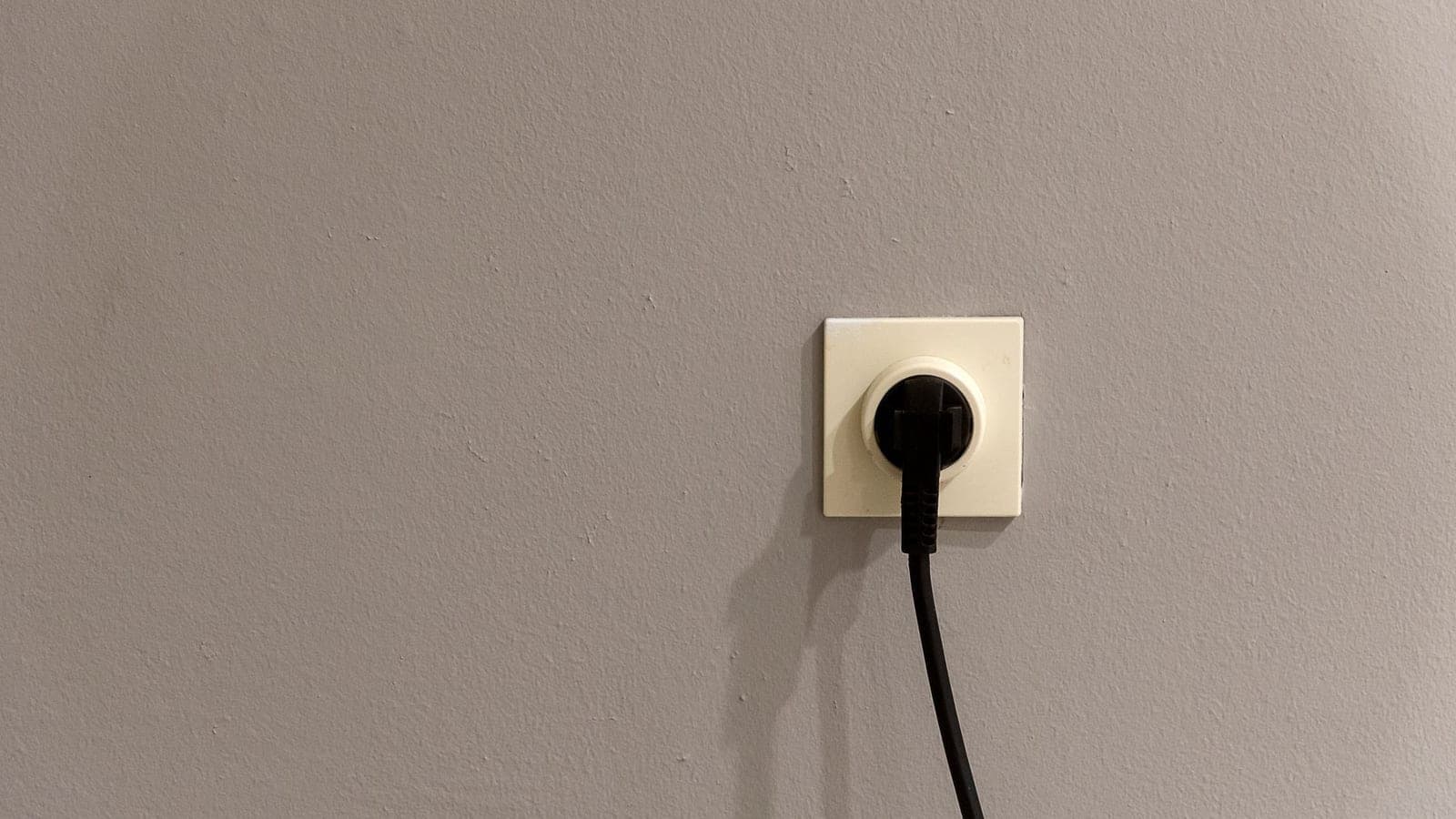
Scheduling is genuinely worth it, but do not put an air conditioner on a smart plug — cutting power mid-cycle can short-cycle the compressor, and most manufacturers prohibit it. Use the unit’s own timer. And know the price of “connected”: 53 of 1,398 certified ceiling fans have it, and they average 1.74 W standby against 0.90 W — roughly double, drawn every hour of the year.
Fan & Frost earns a commission when you buy through our links, at no cost to you. It never changes a ranking, and we say so when the right answer is the cheaper unit or nothing at all. Full disclosure · How we pick.
At a glance
The picks, ranked
Tap any row to jump to the full reasoning. Prices are live from Amazon where we have them, and read “check price” where we don’t — never a number we cannot verify today.
| # | Product | Best for | Price |
|---|---|---|---|
| 1 | Best smart fan Lasko Aria 40" Smart Wi-Fi Tower Fan 460 CFM at 41 to 52 W with an app, Alexa and Google Assistant built in, plus a 9-hour timer. | Scheduling a fan properly, without a plug in the loop | |
| 2 | 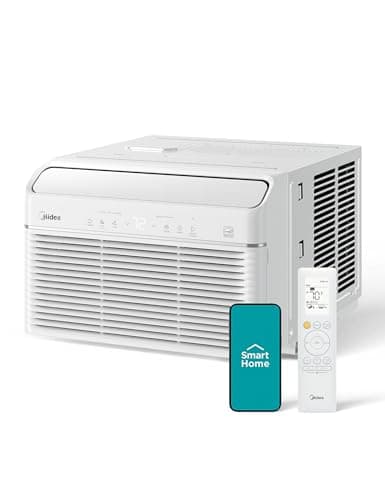 Schedule the machine, not the socket Midea Window Air Conditioner with Heat, 8,000 BTU 397.4 kWh a year at CEER 15.1 with onboard scheduling, and 54% below the federal standard. | Pre-cooling on a timetable without a plug in the loop | |
| 3 | Connected, done efficiently Hunter 60" Smart Ceiling Fan (51883) 0.8 W standby against a 1.74 W average for connected fans — less than half the category norm. | A smart ceiling fan without the usual standby penalty | |
| — | 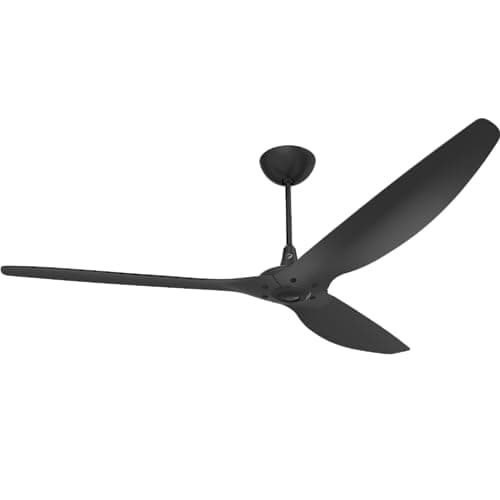 Buy it for the fan, not the app Big Ass Fans Haiku MK-i61 84" Ceiling Fan 418.0 CFM per watt and an excellent machine — with 2.0 W of standby, more than double the non-connected average. | A very large room where 84 inches is the point |
Automation gets sold as free savings. It is not free, and the certified data lets us say exactly what it costs.
The finding
What “connected” costs, measured
The certified ceiling fan dataset records standby power separately from running power, and it flags which models have connected functionality. Across 1,398 certified fans:
- 53 have connected functionality — 3.8% of the field. It is a niche, not the default.
- Connected fans average 1.74 W standby.
- Everything else averages 0.90 W.
Roughly double, and unlike running power, standby is drawn all 8,760 hours of the year. At 18.34¢/kWh the difference is about $1.35 a year per fan.
That is a small number, and stating it plainly is the point: the standby penalty is real and it is not large. What it does not justify is paying an efficiency penalty on top. The best connected fan here manages 0.8 W, below the non-connected average — so the penalty is avoidable if you check the number.
The exception
Never a smart plug on an air conditioner
This is the one hard rule on the page, and it is a hardware constraint rather than a preference.
- Compressors must not be restarted immediately. After shutdown, refrigerant pressures need time to equalise. Restarting against high head pressure stresses the compressor, and short-cycling is a recognized cause of failure.
- A smart plug cuts power without knowing any of that. The unit’s own controls enforce a minimum off-time. A plug simply removes the supply.
- Many units do not resume after a power cut. They come back off, or in a default mode, so the schedule silently does nothing.
- Startup current is high. Compressor inrush is well above running current, and plug ratings are not always sized for it.
- Most manufacturers prohibit it. Manuals commonly require a dedicated outlet and forbid extension cords, plug adapters and timers.
Use the timer built into the unit. Every certified model has one, it understands the compressor’s state, and it does not void anything.
This one is not a DIY job
Read the manual before plugging an air conditioner into anything but a wall outlet. Room air conditioner manuals typically require a dedicated grounded outlet on an appropriately rated circuit and explicitly forbid extension cords, adapters and external timers.
Ignoring that is a fire and electrical safety matter as well as a warranty one, and it applies to a portable and a window unit equally.
Many units also ship with a plug containing a built-in current interrupter that has to be plugged directly into the wall to work. Putting a smart plug in front of it can defeat it.
If you want scheduled cooling and your unit has no usable timer, that is a reason to replace the unit, not to add a plug.
What it is good for
Where scheduling genuinely pays
- Pre-cooling. The largest real saving available from automation, because cooling made in the cooler hours costs less per unit — the timing case in full. Do it with the unit’s own timer.
- Overnight window fans. A thermostat-controlled window fan works the indoor/outdoor crossover for you while you sleep. Fans are safe to switch at the socket.
- Turning things off. The most reliable saving in automation is not running something you forgot about — and a fan running in an empty room is the classic case.
- Time-of-use tariffs. If your rate varies by hour, a schedule that avoids peak hours is worth more than any efficiency difference between two units.
And one place it does not pay: an empty room. Automation that cools a space nobody enters is the scope mistake with a schedule attached.
Practical
If you are automating anyway
- Check the standby figure before buying connected. It ranges from 0.5 W to 2.0 W across the certified connected fans, which is a fourfold spread for the same feature.
- Prefer built-in control to a plug. A plug can only cut power; built-in control can set a speed.
- Check what the device does after a power cut. A fan that comes back off makes the schedule useless.
- Do not automate a pet’s room with fans. A fan switching on unexpectedly in an empty room startles animals — why that matters.
- Nothing here beats shading. Load reduction has no standby draw at all.
Say the unwelcome thing
Do not put your air conditioner on a smart plug.
It is the most common home-automation mistake in cooling, and the consequences fall on the most expensive component in the machine.
A compressor needs time for refrigerant pressures to equalise after shutdown. The unit’s own controls enforce that; a smart plug knows nothing about it and simply removes power. Repeated short-cycling is a recognized cause of compressor failure.
Most manuals also require a dedicated wall outlet and explicitly forbid adapters and external timers — which makes this a warranty and electrical safety question, not just an efficiency one.
Schedule from the machine. A certified unit at 397.4 kWh a year has a timer built in, and a smart fan with control onboard does the same for air movement.
In full
Every pick, and what is wrong with it
Published specifications only, each linked to the page it came from. Where a manufacturer publishes nothing, the row says so — we do not fill blanks in.
1. Best smart fan
Lasko Aria 40" Smart Wi-Fi Tower Fan
Lasko · model T40733
460 CFM at 41 to 52 W with an app, Alexa and Google Assistant built in, plus a 9-hour timer.
The right way to schedule a fan: control built into the machine, rather than a plug that can only cut power at the wall.
The distinction matters. A smart plug can turn a fan on, but the fan comes back at whatever speed it was left at — or, on many models, off, because they need a physical press. Built-in control can set the speed.
460 CFM and 31.5 dBA on low, with five speeds and 90-degree oscillation. The 9-hour timer works with no network at all.
41 to 52 W, or 7.6¢ for eight hours at full output. How the smart fan category compares.
What’s wrong with it
No remote in the box, and 52 W is high for a tower fan.
Running cost — T40733
| Nameplate power | 41 W – 52 W | manufacturer's published figure |
|---|---|---|
| Energy, 8-hour night | 0.42 kWh | 52 ÷ 1000 × 8 |
| Cost per hour | 1.0¢ | at 18.34¢/kWh |
| Cost per 8-hour night | 7.6¢ | on the highest speed |
| Cost per 30 nights | $2.29 | 12.5 kWh |
| Same month, lowest speed | $1.80 | at 41 W |
Rate: 18.34¢/kWh, the US average residential price for June 2026 (EIA Electric Power Monthly, Table 5.3). Yours will differ — swap it in: (watts ÷ 1000) × hours × your rate.
| Power | 41 W - 52 W (0.3-0.44 A at 120 V) |
|---|---|
| Air delivery | 460 CFM |
| Noise | 31.5 dBA low, 48.7 dBA high |
| Speeds | 5 |
| Smart control | Aria for Home app (iOS/Android), Amazon Alexa, Google Assistant |
| Height | 39.58 in |
| Footprint | 11.2 x 11.2 in |
| Weight | 9.5 lb |
| Timer | 9 hours |
| Oscillation | 90 degrees |
| Remote | Not included |
| Warranty | 2 years |
Every figure above is from Lasko product page, T40733. Blanks are shown as “not published” rather than filled in.
2. Schedule the machine, not the socket
Midea Window Air Conditioner with Heat, 8,000 BTU
Midea · model MAW08HV1KWT-A
397.4 kWh a year at CEER 15.1 with onboard scheduling, and 54% below the federal standard.
Every modern certified unit has its own timer, and that is the correct place to schedule an air conditioner from — the controls know the compressor’s state, and a smart plug does not.
397.4 kWh a year, $73 for a season at 18.34¢/kWh, with a variable-speed compressor that suits scheduled pre-cooling because it can run gently for a long time.
54% below the federal standard — the largest margin in the certified set we hold — and on the Most Efficient list.
What the onboard modes actually do is worth reading before automating anything.
What’s wrong with it
8,000 BTU is one room, and the heat mode is only useful if you need it.
Running cost — MAW08HV1KWT-A
| Annual energy use | 397.4 kWh | ENERGY STAR certified figure |
|---|---|---|
| Annual cost | $73 | 397.4 × 18.34¢/kWh |
| Per cooling month | $18 | spread over a four-month season |
The annual figure is the certified value from the ENERGY STAR Certified Room Air Conditioners dataset, which models a standard cooling season rather than your actual summer. It is more useful than a nameplate wattage here, because a variable-speed compressor spends most of its life well below nameplate.
Rate: 18.34¢/kWh, the US average residential price for June 2026 (EIA Electric Power Monthly, Table 5.3). Yours will differ — swap it in: (watts ÷ 1000) × hours × your rate.
| Cooling capacity | 8,000 BTU/h |
|---|---|
| Heating mode | Yes, reverse cycle |
| CEER | 15.1 |
| Annual energy use | 397.4 kWh/yr |
| vs federal standard | 54% less energy |
| Dimensions | 13.9 H x 19.4 W x 22.2 D in |
| Weight | 56.0 lb |
| Installation | Does not straddle the windowsill |
| Support bracket | Not required |
| Compressor | Variable speed |
| Refrigerant | R-32 |
| ENERGY STAR | Certified, and on the Most Efficient list |
Every figure above is from ENERGY STAR Certified Room Air Conditioners dataset. Blanks are shown as “not published” rather than filled in.
3. Connected, done efficiently
Hunter 60" Smart Ceiling Fan (51883)
Hunter · model 51883
0.8 W standby against a 1.74 W average for connected fans — less than half the category norm.
Proof that the standby penalty on connected fans is a design choice rather than a law of physics.
0.8 W standby. Across a full year that is about $1.29 — against $2.80 at the connected average and $1.45 at the non-connected one.
1.7 W on low and 20.0 W on high across a 60-inch span, on the Most Efficient list.
311.7 CFM per watt is the honest cost. The most efficient 60-inch fan certified reaches 483.0, without the radio. The full connected comparison.
What’s wrong with it
311.7 CFM per watt is well below the best certified fans, which is the trade.
Running cost — 51883
| Nameplate power | 1.7 W – 20 W | manufacturer's published figure |
|---|---|---|
| Energy, 8-hour night | 0.16 kWh | 20 ÷ 1000 × 8 |
| Cost per hour | 0.4¢ | at 18.34¢/kWh |
| Cost per 8-hour night | 2.9¢ | on the highest speed |
| Cost per 30 nights | 88¢ | 4.8 kWh |
| Same month, lowest speed | 7.5¢ | at 1.7 W |
Rate: 18.34¢/kWh, the US average residential price for June 2026 (EIA Electric Power Monthly, Table 5.3). Yours will differ — swap it in: (watts ÷ 1000) × hours × your rate.
| Blade span | 60 in |
|---|---|
| Efficiency | 311.7 CFM per watt |
| Power, high speed | 20.0 W |
| Power, low speed | 1.7 W |
| Standby power | 0.8 W |
| Connected functionality | Yes |
| Type | Indoor |
| Warranty | 3 years, components |
| ENERGY STAR | Certified, and on the Most Efficient list |
Every figure above is from ENERGY STAR Certified Ceiling Fans dataset. Blanks are shown as “not published” rather than filled in.
Skip this one
Big Ass Fans Haiku MK-i61 84" Ceiling Fan
Big Ass Fans · model MK-i61-071806
418.0 CFM per watt and an excellent machine — with 2.0 W of standby, more than double the non-connected average.
Flagged not because it is a bad fan — it is one of the best here — but because it makes the standby arithmetic concrete.
2.0 W standby is about 17.5 kWh a year, or $3.21, consumed whether or not you ever use the fan.
Put that against its running figures: 39.8 W on high and 418.0 CFM per watt across an 84-inch span, with a 5-year warranty — the longest in the certified set we hold.
It is a genuinely excellent fan. Just do not pay the standby for an app you will use twice. Large-span fans compared.
What’s wrong with it
2.0 W drawn every hour of the year is roughly 17.5 kWh before the fan turns on.
Running cost — MK-i61-071806
| Nameplate power | 39.8 W | manufacturer's published figure |
|---|---|---|
| Energy, 8-hour night | 0.32 kWh | 39.8 ÷ 1000 × 8 |
| Cost per hour | 0.7¢ | at 18.34¢/kWh |
| Cost per 8-hour night | 5.8¢ | on the highest speed |
| Cost per 30 nights | $1.75 | 9.6 kWh |
Rate: 18.34¢/kWh, the US average residential price for June 2026 (EIA Electric Power Monthly, Table 5.3). Yours will differ — swap it in: (watts ÷ 1000) × hours × your rate.
| Blade span | 84 in |
|---|---|
| Efficiency | 418.0 CFM per watt |
| Power, high speed | 39.8 W |
| Standby power | 2.0 W |
| Connected functionality | Yes |
| Type | Indoor |
| Warranty | 5 years, components |
| ENERGY STAR | Certified, and on the Most Efficient list |
Every figure above is from ENERGY STAR Certified Ceiling Fans dataset. Blanks are shown as “not published” rather than filled in.
We are not linking a buy button for this one. If you want to look at it anyway, it is easy enough to find — but we would rather send you to something that fits your room.
Questions people actually ask
Frequently asked
Can I put an air conditioner on a smart plug?
No. A compressor needs time for refrigerant pressures to equalise after shutdown, and a plug simply cuts power without knowing that — repeated short-cycling is a recognized cause of compressor failure. Most manuals also require a dedicated wall outlet and forbid external timers.
How much standby power does a smart ceiling fan use?
Across 1,398 certified ceiling fans, the 53 with connected functionality average 1.74 W standby against 0.90 W for everything else — roughly double, drawn all 8,760 hours of the year. That is about $1.35 a year of difference.
Is the standby penalty on connected fans avoidable?
Yes. It ranges from 0.5 W to 2.0 W across the certified connected fans — a fourfold spread for the same feature. The best of them draws less standby than the non-connected average, so it is worth checking the number before buying. Connected fans compared.
Are smart plugs safe for fans?
Fans are generally fine to switch at the socket — they have no compressor to protect. The practical catch is that many fans come back off after a power cut, or return at whatever speed they were left at, which can make the schedule useless.
What does scheduling actually save?
The biggest real saving is pre-cooling — running the unit while outdoor air is cooler, so each unit of cooling costs less. Second is simply not running things you forgot about. On a time-of-use tariff, avoiding peak hours can be worth more than any efficiency difference between two units. Timing the day.
Should I schedule cooling in rooms I am not in?
No. Cooling cannot be stored, so automation that cools an empty room is spending with no return — it is the scope mistake with a timer attached.
Sources
Where these numbers came from
- ENERGY STAR Certified Ceiling Fans dataset — standby power and connected functionality flag across 1,398 records
- ENERGY STAR Certified Room Air Conditioners dataset — CEER, annual kWh, Most Efficient flag
- Lasko T40733 Aria product page — 460 CFM, 41-52 W, app and voice control, 9-hour timer
- EIA Electric Power Monthly, Table 5.3 — average residential electricity price
Read next
Where to go from here
Back to Guides & Calculators, or read how we pick.