Head to head
Box fan vs tower fan
One of these draws thirty-five times the power of the other on its lowest setting. It also does something the other cannot do at all.
By Sawyer V. · Published
The short answer
A tower fan is dramatically more efficient — a good DC model runs at 2.9 to 19 W against a box fan’s 73 to 102 W — and it publishes a noise rating, which box fans generally do not. But a box fan fits in a window, and that lets it exchange indoor air for cooler outdoor air, which genuinely lowers the temperature. A tower fan can only move the air already in the room.
Fan & Frost earns a commission when you buy through our links, at no cost to you. It never changes a ranking, and we say so when the right answer is the cheaper unit or nothing at all. Full disclosure · How we pick.

At a glance
The picks, ranked
Tap any row to jump to the full reasoning. Prices are live from Amazon where we have them, and read “check price” where we don’t — never a number we cannot verify today.
| # | Product | Best for | Price |
|---|---|---|---|
| 1 | 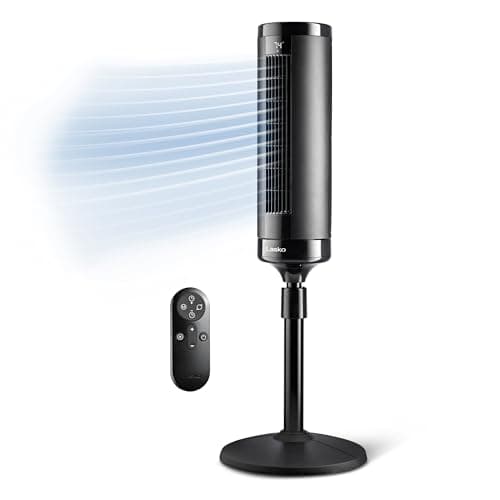 The tower case Lasko EcoQuiet 42" DC Tower Fan 2.9 W on low at 23 dBA, with twelve speeds and a DC motor — a fraction of a box fan's draw for comparable comfort. | A bedroom, an office, or any room with a wall socket | |
| 2 | The window job, done properly Lasko Twin Window Fan with Remote Up to 560 CFM on 22 to 31 W, with independent motors for intake, exhaust or both at once. | Exchanging hot indoor air for cool outdoor air overnight | |
| 3 | 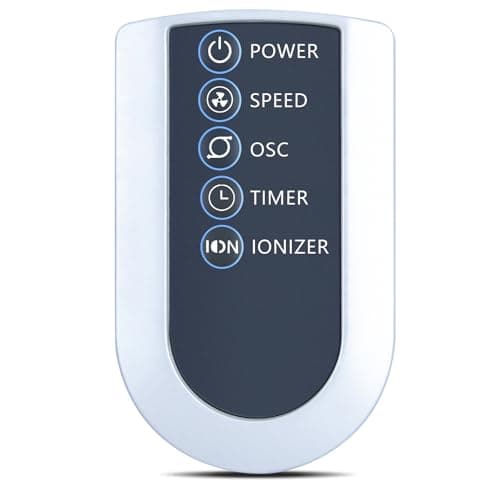 If you want a box fan's airflow without its wattage Lasko Wind Curve 42" Tower Fan 720 CFM published — the most airflow of any fan on this site, at head height rather than floor level. | A large room needing real air movement at a sensible height | |
| — | The box fan itself Lasko Power Plus 20" Box Fan 73 to 102 W with no published CFM and no published dBA — cheap, sturdy, and expensive to run. | A window, a garage, or somewhere you would rather not put a nice fan |
These get compared because they are the two cheapest fans in the shop, and the comparison is usually framed around airflow. The number that actually separates them is power.
The gap
Thirty-five times the wattage
| Fan | Low | High | 8 h on high | dBA |
|---|---|---|---|---|
| Lasko EcoQuiet T42710 tower | 2.9 W | 19 W | 2.8¢ | 23 – 46 |
| Lasko Twin window fan W09550 | 22 W | 31 W | 4.5¢ | not published |
| Lasko Whirlwind A12107 table | 18 W | 32 W | 4.7¢ | 39 – 55 |
| Lasko Aria T40733 tower | 41 W | 52 W | 7.6¢ | 31.5 – 48.7 |
| Lasko Power Plus B20801 box | 73 W | 102 W | 15¢ | not published |
Manufacturer product pages. There is no certification program for portable fans, so nothing here is independently tested.
73 watts is the floor for a box fan and 19 is the ceiling for a good DC tower fan. The two ranges do not overlap at any point.
The reason is motor type. A box fan uses a shaded-pole or PSC induction motor, which is cheap to make and does not vary its speed efficiently — slowing it down mostly means wasting energy as heat rather than drawing less. A DC motor genuinely reduces its consumption as it slows, which is why the low figures are so far apart. The mechanism in full.
Note the honest limit of this comparison: neither fan publishes a CFM figure, so we cannot state an efficiency ratio. What we can state is that they draw wildly different amounts of power for air movement most people find comparable in a normal room.
Where the box fan wins
The window, and only the window
There is one thing a box fan does that a tower fan cannot do at all, and it is not a small thing.
A box fan fits a window sash. That turns it from a device that stirs the air already in your room into one that replaces that air. Once the outdoor temperature drops below the indoor temperature — typically after dark — a fan in the window genuinely lowers the room temperature. Every other fan on this page only makes you feel cooler.
That is a real difference in mechanism, and it is the strongest argument for owning a box fan.
It is also the argument for owning a window fan instead, which does the same job better:
- 22 to 31 W against 73 to 102. A third of the power for a published 560 CFM.
- Two independent motors, so it can pull in and push out simultaneously through one window. A box fan does one direction.
- A thermostat, so it stops when the room is cool enough rather than over-cooling it at 4am.
- It fits the opening properly at 24 to 32 inches wide, instead of leaving gaps around a square box that let the air you just moved come straight back.
This one is not a DIY job
Timing is what makes window ventilation work. The fan is only useful while the outdoor air is cooler than the indoor air. Run it at 3pm and you are actively importing heat.
The pattern that works: close everything and shade the glass during the day, then open up and run the fan once outdoor temperature has dropped below indoor — usually a couple of hours after sunset. Shut it all again before the morning sun arrives.
Two openings beat one. Air needs somewhere to leave as well as somewhere to enter. A fan exhausting from one window with another open on the opposite side of the room moves far more air than a fan pushing into a sealed space.
Choose
Which one
Tower fan if the fan will live in a room and run for long periods — a bedroom, an office, a living room. The wattage difference is decisive over a season, and you get a published noise rating and a slim footprint with it.
Window fan if your goal is to exchange air rather than move it. That is a genuinely different and more powerful mechanism, and a purpose-built window fan does it on a third of a box fan’s power.
Box fan if you need something cheap, sturdy and replaceable for a garage, a workshop or a job where it will get filthy — or if you want one object that can sit in a window some nights and on the floor others, and you accept the running cost for that flexibility.
Say the unwelcome thing
Do not buy a box fan for a bedroom.
It is the default cheap fan and it is the wrong one for a room you sleep in, on two counts.
73 W is its quietest setting, which is more than the highest setting of most fans on this site — 11¢ a night against 0.4¢ for a DC tower fan on low.
And no box fan we hold data for publishes a dBA figure. For a bedroom, noise is the specification that matters most, and it is precisely the one the category declines to state.
Fans that do publish their noise ratings start at 23 dBA and cost a fraction as much to run.
In full
Every pick, and what is wrong with it
Published specifications only, each linked to the page it came from. Where a manufacturer publishes nothing, the row says so — we do not fill blanks in.
1. The tower case
Lasko EcoQuiet 42" DC Tower Fan
Lasko · model T42710
2.9 W on low at 23 dBA, with twelve speeds and a DC motor — a fraction of a box fan's draw for comparable comfort.
2.9 W on low. An eight-hour night costs 0.4¢. The same night on a box fan’s lowest setting — 73 W — costs 11¢.
That is roughly twenty-five times the running cost, for air movement most people would rate as comparable in a normal room.
23 dBA on low is the quietest published figure on this site. Not one box fan we hold data for publishes a dBA rating at all.
The DC motor is the reason for both numbers. AC motors do not run efficiently at low speed, which is why box fans have such high floors.
What’s wrong with it
Lasko publishes no CFM for it, and it cannot be put in a window to bring outdoor air in.
Running cost — T42710
| Nameplate power | 2.9 W – 19 W | manufacturer's published figure |
|---|---|---|
| Energy, 8-hour night | 0.15 kWh | 19 ÷ 1000 × 8 |
| Cost per hour | 0.3¢ | at 18.34¢/kWh |
| Cost per 8-hour night | 2.8¢ | on the highest speed |
| Cost per 30 nights | 84¢ | 4.6 kWh |
| Same month, lowest speed | 13¢ | at 2.9 W |
Rate: 18.34¢/kWh, the US average residential price for June 2026 (EIA Electric Power Monthly, Table 5.3). Yours will differ — swap it in: (watts ÷ 1000) × hours × your rate.
| Power | 2.9 W - 19 W (0.06-0.303 A at 120 V) |
|---|---|
| Noise | 23 dBA low, 46 dBA high |
| Speeds | 12 |
| Height | 41.6 in |
| Footprint | 12.8 x 12.8 in |
| Weight | 7.8 lb |
| Timer | 8 hours |
| Air delivery (CFM) | Not published |
| Warranty | 2 years |
Every figure above is from Lasko product page, T42710. Blanks are shown as “not published” rather than filled in.
2. The window job, done properly
Lasko Twin Window Fan with Remote
Lasko · model W09550
Up to 560 CFM on 22 to 31 W, with independent motors for intake, exhaust or both at once.
If the reason you are considering a box fan is to put it in a window, this is what that job actually calls for.
Two independent motors mean it can run one side as intake and the other as exhaust simultaneously — pulling cool air in and pushing warm air out through the same opening. A box fan can only do one direction at a time.
22 to 31 W for up to 560 CFM, against 73 to 102 W for a box fan with no published CFM at all. About 4.5¢ for an eight-hour night.
An adjustable thermostat shuts it off when the room reaches temperature, which is the feature that makes overnight unattended use practical. Full window fan comparison.
What’s wrong with it
It fits 24 to 32 inch windows and nothing else, and it is useless as a room fan once the window is shut.
Running cost — W09550
| Nameplate power | 22 W – 31 W | manufacturer's published figure |
|---|---|---|
| Energy, 8-hour night | 0.25 kWh | 31 ÷ 1000 × 8 |
| Cost per hour | 0.6¢ | at 18.34¢/kWh |
| Cost per 8-hour night | 4.5¢ | on the highest speed |
| Cost per 30 nights | $1.36 | 7.4 kWh |
| Same month, lowest speed | 97¢ | at 22 W |
Rate: 18.34¢/kWh, the US average residential price for June 2026 (EIA Electric Power Monthly, Table 5.3). Yours will differ — swap it in: (watts ÷ 1000) × hours × your rate.
| Power | 22 W - 31 W at 120 V |
|---|---|
| Air delivery | Up to 560 CFM |
| Window fit | 24 - 32 in wide |
| Modes | Intake, exhaust or exchange (independent motors) |
| Thermostat | Adjustable |
| Speeds | 3 |
| Dimensions | 12.9 H x 24.0 W x 4.9 D in |
| Weight | 8.0 lb |
| Warranty | 1 year |
Every figure above is from Lasko product page, W09550. Blanks are shown as “not published” rather than filled in.
3. If you want a box fan's airflow without its wattage
Lasko Wind Curve 42" Tower Fan
Lasko · model 2554
720 CFM published — the most airflow of any fan on this site, at head height rather than floor level.
The usual reason people reach for a box fan is that it feels like it moves a lot of air. It does — and so does this, at a published 720 CFM, which is more than any box fan we hold figures for is willing to state.
The height difference matters more than it sounds. A box fan sits on the floor and blows across it, where furniture blocks it and where the coolest, densest air already is. A pedestal puts the head at seated or standing height, where the people are.
The honest gaps: Lasko publishes no wattage and no dBA for this model, so it cannot be compared on running cost. Full pedestal comparison.
What’s wrong with it
No published wattage or dBA, and a pedestal takes floor space that a box fan in a window does not.
Running cost — 2554
| Nameplate power | 37 W – 49 W | manufacturer's published figure |
|---|---|---|
| Energy, 8-hour night | 0.39 kWh | 49 ÷ 1000 × 8 |
| Cost per hour | 0.9¢ | at 18.34¢/kWh |
| Cost per 8-hour night | 7.2¢ | on the highest speed |
| Cost per 30 nights | $2.16 | 11.8 kWh |
| Same month, lowest speed | $1.63 | at 37 W |
Rate: 18.34¢/kWh, the US average residential price for June 2026 (EIA Electric Power Monthly, Table 5.3). Yours will differ — swap it in: (watts ÷ 1000) × hours × your rate.
| Power | 37 W - 49 W (0.4 A at 120 V) |
|---|---|
| Air delivery | 720 CFM |
| Speeds | 3 |
| Height | 42.5 in |
| Footprint | 13 x 13 in |
| Weight | 10.62 lb |
| Timer | 7.5-hour auto-off |
| Noise | Not published |
| Warranty | 1 year |
Every figure above is from Lasko product page, 2554. Blanks are shown as “not published” rather than filled in.
Skip this one
Lasko Power Plus 20" Box Fan
Lasko · model B20801
73 to 102 W with no published CFM and no published dBA — cheap, sturdy, and expensive to run.
Listed as a skip on running cost, not on merit. It is a genuinely useful object — 10.1 lb, a weather-resistant motor, and a flat profile that sits in a window sash.
The numbers are the problem. 73 W on low, 102 W on high, which is 15¢ for an eight-hour night. Its lowest setting draws more than the EcoQuiet tower fan’s highest.
And no published CFM and no published dBA, so there is nothing to set against that consumption. You cannot calculate its efficiency because Lasko does not publish the numerator.
Where it earns its place is the window, and there a purpose-built twin window fan does the same job on a third of the power with a thermostat.
What’s wrong with it
It is the least efficient way to move air on this site, and its lowest setting still draws more than most fans' highest.
Running cost — B20801
| Nameplate power | 73 W – 102 W | manufacturer's published figure |
|---|---|---|
| Energy, 8-hour night | 0.82 kWh | 102 ÷ 1000 × 8 |
| Cost per hour | 1.9¢ | at 18.34¢/kWh |
| Cost per 8-hour night | 15¢ | on the highest speed |
| Cost per 30 nights | $4.49 | 24.5 kWh |
| Same month, lowest speed | $3.21 | at 73 W |
Rate: 18.34¢/kWh, the US average residential price for June 2026 (EIA Electric Power Monthly, Table 5.3). Yours will differ — swap it in: (watts ÷ 1000) × hours × your rate.
| Power | 73 W - 102 W (0.6-0.9 A at 120 V) |
|---|---|
| Speeds | 3 |
| Dimensions | 21.25 H x 22.5 x 4.75 in |
| Weight | 10.1 lb |
| Motor | Weather-resistant |
| Air delivery (CFM) | Not published |
| Warranty | 2 years |
Every figure above is from Lasko product page, B20801. Blanks are shown as “not published” rather than filled in.
We are not linking a buy button for this one. If you want to look at it anyway, it is easy enough to find — but we would rather send you to something that fits your room.
Questions people actually ask
Frequently asked
Is a box fan or a tower fan better?
A tower fan for almost any room use — a DC model draws 2.9 to 19 watts against a box fan's 73 to 102, and publishes a noise rating that box fans generally do not. A box fan wins only when it goes in a window, where it can exchange indoor air for cooler outdoor air.
How much more electricity does a box fan use?
A box fan's lowest setting draws 73 watts, more than a good DC tower fan's highest at 19. Over an eight-hour night that is roughly twenty-five times the cost for air movement most people find comparable in a normal room.
Can a tower fan go in a window?
No — the format is wrong, and that is the one real advantage a box fan has. A window-mounted fan replaces indoor air with cooler outdoor air, which genuinely lowers the temperature. A tower fan can only move the air already in the room.
Is a window fan better than a box fan in a window?
Yes, on every axis. A twin window fan uses 22 to 31 watts against 73 to 102, publishes 560 CFM where box fans publish nothing, runs two independent motors so it can intake and exhaust at once, and includes a thermostat. Window fans, ranked.
Why are box fans so inefficient?
The motor type. Box fans use shaded-pole or PSC induction motors, which are cheap but do not reduce consumption much when slowed — the energy largely goes to heat instead. DC motors genuinely draw less as they slow, which is why their low-speed figures are so much lower.
When should I run a fan in a window?
Only once the outdoor air is cooler than the indoor air, typically a couple of hours after sunset. Running it during the afternoon actively imports heat. Two openings work far better than one, since the air needs somewhere to leave.
Sources
Where these numbers came from
Read next
Where to go from here
Back to Fans, or read how we pick.