Head to head
Sensibo Air vs Cielo Breez Max
Both put a Wi-Fi box in front of an air conditioner that has no app. They take opposite positions on what should happen when the router goes down, and on how much their own specification sheet should say.
By Sawyer V. · Published
The short answer
Buy the Cielo Breez Max for a room you actually live in. It is the only one of the two with a backlit display and on-device controls, so a dead router leaves you with a working thermostat rather than a hunt for the original remote. Buy the Sensibo Air if you want to know what you are buying: it is the one that publishes a Wi-Fi band, a physical size and a warranty. Neither publishes what its sensor is accurate to.
Fan & Frost earns a commission when you buy through our links, at no cost to you. It never changes a ranking, and we say so when the right answer is the cheaper unit or nothing at all. Full disclosure · How we pick.
At a glance
The picks, ranked
Tap any row to jump to the full reasoning. Prices are live from Amazon where we have them, and read “check price” where we don’t — never a number we cannot verify today.
| # | Product | Best for | Price |
|---|---|---|---|
| 1 | 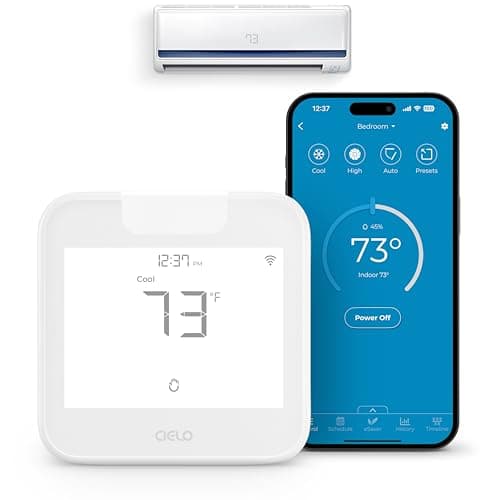 The Cielo case Cielo Breez Max Smart AC Controller The only one here with a backlit screen and buttons on the device, both sensors stated, and a 24 V wiring option instead of a USB brick on the baseboard. | A bedroom or living room where somebody other than you will need to change the temperature | |
| 2 | 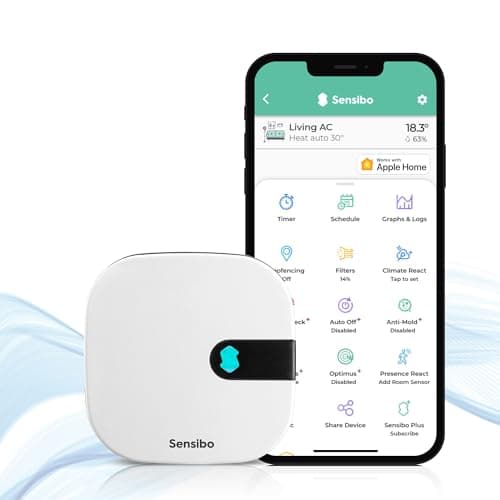 The Sensibo case Sensibo Air Smart AC Controller The only maker here that publishes a Wi-Fi band, physical dimensions and a warranty length — and the only one that learns your remote rather than matching it to a stored profile. | A room where the controller can stay invisible, bought by someone who wants the specification sheet to be complete before it arrives |
These two are the same idea executed twice. A small Wi-Fi box sits in line of sight of an air conditioner, fires the same infrared codes the remote fires, and gives a unit with no app a schedule, geofencing and a target temperature measured in the room rather than inside the machine. For a mini-split or a remote-controlled window unit you already own, a controller is the cheap alternative to replacing the hardware.
They cost within about ten dollars of each other. Almost everything that separates them comes down to two questions.
Head to head
What each maker publishes
| Published spec | Cielo Breez Max | Sensibo Air |
|---|---|---|
| Sensors stated | Temperature + humidity | Temperature + humidity |
| Sensor accuracy | Not published | Not published |
| Display | Backlit LCD | None |
| Works with Wi-Fi down | Yes, on-device controls | No, app only |
| Pairing | Auto-detection | Learns the remote |
| Stated compatibility | 20,000+ models | 10,000+ models |
| Wi-Fi band | Not published | 802.11 b/g/n, 2.4 GHz |
| Dimensions | Not published | 2.56 x 2.56 x 0.67 in |
| Power | 5 V USB or 24 V AC | 5 V micro-USB |
| Warranty | Not published | 1 year limited |
| HomeKit / Matter | Not published | Not published |
Every cell is what the maker publishes on its own product page. Blanks read “Not published” because nothing is stated, not because we could not find it.
Question one
What happens when the router goes down
This is the practical fork and it is not close. The Breez Max keeps a backlit screen and touch controls on the device, and Cielo states plainly that they still adjust the air conditioner when Wi-Fi is unavailable. The Sensibo Air has neither.
Think about who else lives in the room. A controller replaces the remote in practice — the handset gets put away once the app works. If the internet drops during a heat wave, the Cielo degrades into an ordinary wall thermostat, and the Sensibo degrades into nothing until somebody finds the original remote.
That is the whole argument for the Cielo, and for most households it is enough on its own.
Question two
How much the maker will tell you
Here the result reverses. Sensibo publishes the Wi-Fi band (2.4 GHz only — worth knowing before you discover it on a 5 GHz-only mesh network), the physical dimensions, and a one-year limited warranty. Cielo publishes none of those three on its product page.
Neither publishes an infrared range, though both require line of sight to the indoor unit — the one number a buyer would actually use before ordering. And neither publishes HomeKit or Matter: Cielo lists Siri Shortcuts, which is not HomeKit, and Sensibo’s spec table lists “Apple Siri”. An Apple-first household should confirm with the maker rather than assume.
The finding
Neither will say what its sensor is accurate to
Both devices exist to measure a room. Sensibo describes a “high accuracy temperature & humidity sensor” and attaches no number. Cielo publishes no accuracy figure for the Breez Max or for any other model in the range.
It matters because the adjacent category does it properly. A $25 hygrometer states the band it reads within, in percentage points — it is the first thing our hygrometer roundup ranks on, because a humidity reading you cannot bound is not a measurement. These controllers contain the same class of sensor, sell for four to five times as much, and state nothing.
So treat the sensor as a placement advantage rather than a precision one. That is still a real advantage, and it is the next section.
This one is not a DIY job
The mechanism both of these share is sensor placement, and it is the part that genuinely works. A mini-split or window unit measures temperature at its own return-air intake — inside the machine, high on a wall, in the stream of air it just finished conditioning. That is the number it holds when it decides to cycle off. A controller at desk or bedside height measures the air where a person actually is. Same set point, different place, different behavior — which is why rooms that never feel like the number on the remote often improve the day a controller goes in, with no change to the air conditioner at all.
Pairing
Learning a remote against matching one
Both state the same hard prerequisite: your air conditioner must have a working infrared remote. A unit operated only from buttons on its own panel cannot be controlled by either.
Cielo matches. Setup is auto-detection — point the old remote at the Breez Max, press power once, and it identifies the profile from a library it says covers 20,000-plus models and 300-plus brands.
Sensibo learns. Its support documentation describes the device as learning and replicating the remote’s own infrared signals, with support stated for over 10,000 models.
Neither claim is independently verifiable and we are not going to pretend otherwise. What is checkable before you spend anything is your specific model: both makers run a compatibility lookup on their own sites, and checking yours takes a minute and removes the only real risk in the purchase.
Which one
How to choose
- Anyone else in the house will touch it: the Breez Max. A screen and buttons mean the fallback is a thermostat rather than a drawer.
- Replacing a wall thermostat: the Breez Max again, for the 24 V wiring option.
- You want the spec sheet complete before you buy: the Sensibo Air — the band, the size and the warranty are all published.
- Your network is 5 GHz-only: check either way, but note Sensibo publishes 2.4 GHz and Cielo publishes no band at all.
- You want it invisible: the Sensibo, which is designed to disappear and has nothing on it to look at.
Say the unwelcome thing
Do not choose between these on the savings claim.
Cielo prints “save up to 25%” on the Breez Max — and on the Breez Eco, the Breez Lite and the discontinued Breez Plus, with no test method, no baseline and no conditions stated. A figure identical across four products with four different sensor sets is a marketing constant, not a specification.
Sensibo is vaguer and therefore less objectionable: its pages say scheduling, geofencing and filter alerts mean the device pays for itself, with no percentage attached.
Buy either because it will run the air conditioner on a schedule you would never keep by hand, and because it holds a temperature measured where you sit. Those are real. Whatever you save after that is whatever your old habits were costing you, which is a number neither maker can know.
In full
Every pick, and what is wrong with it
Published specifications only, each linked to the page it came from. Where a manufacturer publishes nothing, the row says so — we do not fill blanks in.
1. The Cielo case
Cielo Breez Max Smart AC Controller
Cielo · model Breez Max
The only one here with a backlit screen and buttons on the device, both sensors stated, and a 24 V wiring option instead of a USB brick on the baseboard.
Built-in temperature and humidity sensors, a backlit LCD, and control by app, on-device touch or voice. That list is short but it contains the one thing the Sensibo does not have, and it is the thing that decides most households.
Cielo is unusually direct about the failure mode: a stable Wi-Fi connection is required “to experience smart features”, but “in case your Wi-Fi goes down, you can manually adjust the settings using on-device controls”. A controller sits between a person and the only way to change their own air conditioning. If it has buttons, a router outage is an inconvenience. If it does not, it is a search for a remote somebody put in a drawer in May.
5 V DC USB or 24 V AC. The 24 V option is worth noticing if you are replacing a wall thermostat rather than sticking a puck beside a mini-split head — it wires in, so nothing hangs off a baseboard outlet.
Pairing is auto-detection: point the existing AC remote at it and press power once. Cielo claims the Breez family covers 20,000-plus models across 300-plus brands. One controller runs one indoor unit, with a single stated exception — two units only if they are the same make and model.
What’s wrong with it
Cielo publishes no Wi-Fi band, no dimensions as figures, no infrared range and no warranty length on the product page. A 'Proximity Sensor' appears in its comparison table with no explanation. And the same 'up to 25%' saving is printed on every Cielo model regardless of hardware.
Running cost
Cielo does not publish a wattage for the Breez Max, so we cannot calculate what it costs to run. We are not going to estimate one. If Cielo publishes a nameplate figure, this block will show the arithmetic.
| Sensors | Built-in temperature and humidity |
|---|---|
| Sensor accuracy | Not published |
| Display | LCD, backlit |
| Control | App, on-device touch, voice |
| Without Wi-Fi | On-device controls still adjust the AC |
| Pairing | Auto-detection — point the AC remote at it and press power once |
| Integrations | Alexa, Google Assistant, Siri Shortcuts, SmartThings, IFTTT |
| HomeKit / Matter | Not published |
| Power | 5 V DC USB adapter included, or 24 V AC wiring |
| Wi-Fi band | Not published |
| Dimensions | Not published as figures |
| Weight | 0.35 lb |
| Infrared range | Not published — line of sight required |
| ACs per unit | One, unless both are the same make and model |
| Warranty | Not published on the product page |
Every figure above is from Cielo product page, Breez Max. Blanks are shown as “not published” rather than filled in.
2. The Sensibo case
Sensibo Air Smart AC Controller
Sensibo · model Air
The only maker here that publishes a Wi-Fi band, physical dimensions and a warranty length — and the only one that learns your remote rather than matching it to a stored profile.
2.56 x 2.56 x 0.67 inches. 802.11 b/g/n at 2.4 GHz. One year limited warranty. Three ordinary facts, and Sensibo is the only one of these two makers that publishes any of them. On a site that ranks appliances by what their makers will commit to in writing, that counts for something by itself.
It also pairs differently, and the difference has a real consequence. Sensibo describes the device as “learning and replicating your AC’s infrared remote control signals” rather than matching your handset to a stored profile. Sensibo states support for over 10,000 AC models, and that the Sky, Air and Air Pro all share the same compatibility — so which Sensibo you buy is a hardware decision, not a compatibility one.
The sensor set is temperature and humidity plus a universal IR receiver, and the automation on top is Climate React, with 7-day schedules, timers, geofencing and filter-cleaning alerts.
What you do not get is any way to touch it. No display, no buttons. That is a defensible design — it is meant to disappear behind the head — but it means the app is the only interface, and the app needs the router.
What’s wrong with it
No display and no buttons at all, so a router outage hands you back the original remote. It is micro-USB in 2026, 2.4 GHz only, it costs more than the Breez Max, and its spec table lists Apple Siri rather than HomeKit. It does not publish a sensor accuracy figure either.
Running cost
Sensibo does not publish a wattage for the Air, so we cannot calculate what it costs to run. We are not going to estimate one. If Sensibo publishes a nameplate figure, this block will show the arithmetic.
| Sensors | Temperature and humidity, plus a universal IR receiver |
|---|---|
| Sensor accuracy | Not published — the page says only "high accuracy" |
| Display | None |
| Control | App and voice |
| Pairing | Learns and replicates your AC remote's infrared signals |
| Stated compatibility | Over 10,000 AC models; same across Sky, Air and Air Pro |
| Integrations | Alexa, Google Home, Apple Siri, SmartThings, IFTTT, API |
| HomeKit / Matter | Not published |
| Wi-Fi band | 802.11 b/g/n at 2.4 GHz only |
| Power | 5 V 1 A micro-USB |
| Dimensions | 2.56 x 2.56 x 0.67 in (65 x 65 x 17 mm) |
| Infrared range | Not published |
| ACs per unit | One |
| Warranty | 1 year limited |
Every figure above is from Sensibo product page, Sensibo Air. Blanks are shown as “not published” rather than filled in.
Questions people actually ask
Frequently asked
Sensibo Air or Cielo Breez Max — which is better?
For most rooms the Cielo Breez Max, because it is the only one of the two with a backlit display and on-device controls, and Cielo states those still adjust the air conditioner when Wi-Fi is down. The Sensibo Air is the better buy if you want a complete specification before ordering: it publishes a Wi-Fi band, physical dimensions and a one-year limited warranty, none of which Cielo publishes.
Do smart AC controllers work without internet?
Partly, and the difference between these two is the whole comparison. Cielo says a stable Wi-Fi connection is needed for smart features but that on-device controls still adjust the air conditioner if the network drops. The Sensibo Air has no display and no buttons, so without the app the only interface left is the air conditioner's original remote.
How accurate are the temperature sensors in these controllers?
Neither maker says. Sensibo describes a 'high accuracy temperature and humidity sensor' with no figure attached, and Cielo publishes no accuracy figure for any Breez model. That is unusual for the price: a $25 hygrometer normally states the band it reads within. Treat the sensor as an advantage of placement — it measures the room rather than the machine's return air — rather than of precision. The category that does publish it.
Will either one work with my air conditioner?
Only if your unit has a working infrared remote — both makers state that as a hard requirement, and a machine operated solely from its own panel cannot be controlled this way. Cielo pairs by auto-detection against a library it says covers 20,000-plus models and 300-plus brands; Sensibo learns and replicates your remote's signals and states support for over 10,000 models. Check your specific model on the maker's compatibility lookup first.
Do these controllers support Apple HomeKit?
Not according to either product page. Cielo lists Alexa, Google Assistant, Siri Shortcuts, SmartThings and IFTTT — Siri Shortcuts is not HomeKit — and Sensibo's spec table lists Apple Siri alongside Google Home, Alexa, SmartThings, IFTTT and an API. Neither publishes Matter support. Verify with the maker before buying if the Home app is how your house runs.
Can one controller run two indoor units?
Generally no. Sensibo states you need one unit per air conditioner or heat pump. Cielo says each controller is designed for one mini-split and can run two only if both indoor units are the same make and model. Budget per indoor head rather than per house.
Sources
Where these numbers came from
- Cielo product page, Breez Max — built-in temperature and humidity sensors, backlit LCD, app/touch/voice control, on-device control without Wi-Fi, 5 V DC or 24 V AC, auto-detection pairing, one unit per mini-split, the 'save up to 25%' claim
- Cielo smart AC controllers overview — the 20,000-plus model and 300-plus brand compatibility claim
- Sensibo product page, Sensibo Air — high accuracy temperature and humidity sensor with no figure stated, 802.11 b/g/n at 2.4 GHz, 65 x 65 x 17 mm, 5 V 1 A micro-USB, 1-year limited warranty, Climate React, geofencing, 7-day schedules
- Sensibo support, AC compatibility — learning and replicating the AC's infrared remote signals, over 10,000 models, identical compatibility across Sky, Air and Air Pro, infrared remote required
Read next
Where to go from here
Back to Air Conditioners, or read how we pick.