Head to head
AprilAire E080 vs E080W
Same water removal, same efficiency, same annual energy. The entire difference between these two is a radio and a screen.
By Sawyer V. · Published
The short answer
Buy the E080 unless you will genuinely use the app. Both units certify 65 pints a day, IEF 2.35 L/kWh and 632 kWh a year — identical on every measured figure, both on the ENERGY STAR Most Efficient list. The E080W premium buys Wi-Fi and an onboard display and changes nothing about the dehumidification. Note too that both are marketed as 80 pint while DOE measures 65.
Fan & Frost earns a commission when you buy through our links, at no cost to you. It never changes a ranking, and we say so when the right answer is the cheaper unit or nothing at all. Full disclosure · How we pick.
At a glance
The picks, ranked
Tap any row to jump to the full reasoning. Prices are live from Amazon where we have them, and read “check price” where we don’t — never a number we cannot verify today.
| # | Product | Best for | Price |
|---|---|---|---|
| 1 | 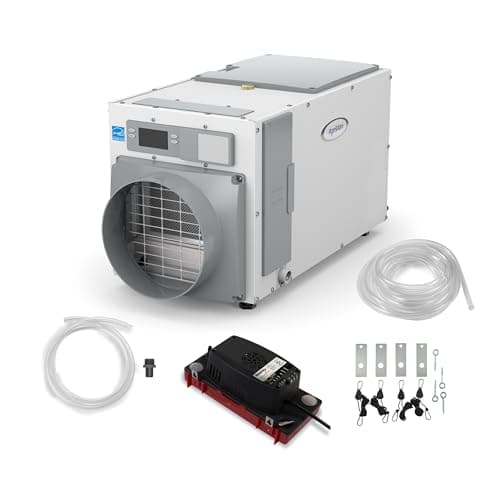 The E080 case Aprilaire E080 Whole-Home Dehumidifier, 65 pints/day 65 pints a day at IEF 2.35 L/kWh and 632 kWh a year, on the Most Efficient list, for less money than the Wi-Fi version. Identical performance. | Almost everyone — a basement, crawl space or whole-house install where the unit is set once and left | |
| 2 | 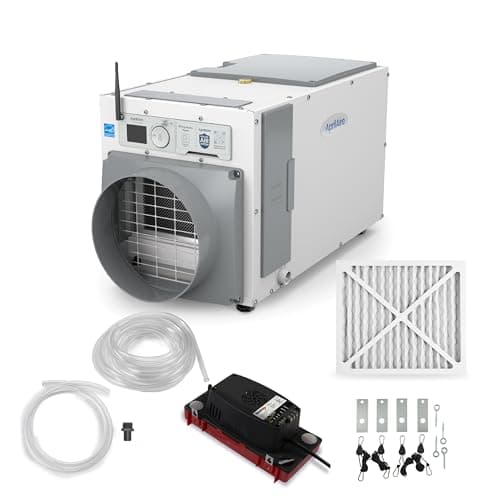 The E080W case AprilAire E080W Wi-Fi Whole-House Dehumidifier The same 65 pints a day and IEF 2.35, plus Wi-Fi, an onboard digital display, a MERV 8 washable filter and published install detail. | An unattended crawl space or second home, where knowing the unit stopped is worth the premium |
This is the cleanest version of a question buyers face constantly: the connected model costs more, so what does it actually add? Here the answer is unusually crisp, because the certification covers both units and the numbers come out the same.
Head to head
Certified figures, side by side
| E080 | E080W | |
|---|---|---|
| Water removal (DOE) | 65.00 pints/day | 65 pints/day |
| Marketed as | 80 pint | 80 pint |
| Efficiency (IEF) | 2.35 L/kWh | 2.35 L/kWh |
| Annual energy use | 632 kWh/yr | 632 kWh/yr |
| Annual running cost | $116 | $116 |
| ENERGY STAR | Certified, Most Efficient | Certified, Most Efficient |
| Install | Ducted or free-standing | 10 in collars, backdraft damper |
| Filter | Not published | MERV 8 washable, 13.5 x 12 in |
| Drain | Not published | Direct drain, barbed, no tray |
| Control | Onboard | Wi-Fi plus digital display |
| Coverage claim | Not published | Up to 4,400 sq ft |
| Noise | Not in the dataset | Not in the dataset |
Water removal, IEF and annual kWh from the ENERGY STAR Certified Dehumidifiers dataset; install detail from AprilAire’s product pages; running cost is our arithmetic at 18.34¢/kWh. Prices checked 11 October 2026: the E080 was $1,913.99 and the E080W $2,136.99. The buttons above carry the live price and the date.
Worth knowing
Both are sold as 80 pint and measured at 65
AprilAire markets this unit as an 80-pint dehumidifier. The DOE Appendix X1 figure in the certification is 65 pints a day. Both numbers are real: the marketing figure comes from a warmer, wetter test condition than the federal procedure uses.
This matters when you size. If you work out that a space needs 80 pints a day of removal and buy a unit labelled 80, you have bought 65 pints of federally-measured capacity. Size against the DOE number. How to size a dehumidifier.
This one is not a DIY job
Whole-home units are more efficient than every portable ever certified. IEF 2.35 here against a portable median of 2.01 and a portable maximum of 2.24. If you are weighing one of these against two large portables, the ducted unit wins on efficiency as well as on coverage — which is the opposite of how capacity behaves in air conditioners.
Which one
How to choose
- A basement you are in regularly: the E080. You will see a problem before an app would tell you about it.
- A crawl space, or a property you are not at: the E080W. Remote visibility on an unattended machine is the one thing worth paying for here.
- You want the published install detail: the E080W, which publishes collar size, damper, drain and filter where the E080 does not.
- Best drying per dollar: the E080. Identical performance, lower price.
- Either way: size on 65 pints a day, not 80.
Say the unwelcome thing
Do not pay the Wi-Fi premium expecting better dehumidification.
The two units certify identically: same 65 pints a day, same IEF 2.35, same 632 kWh a year, both on the Most Efficient list. Nothing about the moisture removal differs, and no part of the price difference buys drying capacity.
The other thing not to do is assume a whole-home unit removes the need to fix the water. A dehumidifier manages humidity; it does not stop a grade problem, a failed damp-proof course or a leaking downpipe, and running one against an active water ingress is a permanent electricity bill.
In full
Every pick, and what is wrong with it
Published specifications only, each linked to the page it came from. Where a manufacturer publishes nothing, the row says so — we do not fill blanks in.
1. The E080 case
Aprilaire E080 Whole-Home Dehumidifier, 65 pints/day
Aprilaire · model E080
65 pints a day at IEF 2.35 L/kWh and 632 kWh a year, on the Most Efficient list, for less money than the Wi-Fi version. Identical performance.
65.00 pints a day on DOE Appendix X1, at IEF 2.35 L/kWh and 632 kWh a year — about $116 at 18.34¢/kWh.
That 2.35 is the point of buying whole-home rather than portable. Across 502 certified portable units IEF runs 1.70 to 2.24 with a median of 2.01; whole-home units median 2.30 and reach 3.26. This unit is above every portable ever certified. The whole-home category.
It installs ducted or free-standing, which is the flexibility that matters in a basement or crawl space where you may not have ductwork to tie into.
What you give up against the W version is visibility. On a machine that lives in a crawl space and runs unattended for months, an app that tells you it has stopped is worth something — just not necessarily the price difference.
What’s wrong with it
No app and no remote visibility, so a failure or a full drain is something you discover rather than something that tells you. AprilAire publishes no noise figure.
Running cost — E080
| Annual energy use | 632 kWh | ENERGY STAR certified figure |
|---|---|---|
| Annual cost | $116 | 632 × 18.34¢/kWh |
| Per cooling month | $29 | spread over a four-month season |
The annual figure is the certified value from the ENERGY STAR Certified Dehumidifiers dataset, which models a standard cooling season rather than your actual summer. It is more useful than a nameplate wattage here, because a variable-speed compressor spends most of its life well below nameplate.
Rate: 18.34¢/kWh, the US average residential price for June 2026 (EIA Electric Power Monthly, Table 5.3). Yours will differ — swap it in: (watts ÷ 1000) × hours × your rate.
| Water removal | 65.00 pints/day (DOE Appendix X1) |
|---|---|
| Efficiency (IEF) | 2.35 L/kWh |
| Annual energy use | 632 kWh/yr |
| Unit type | Whole-home (ducted or free-standing install) |
| Noise | Not published in the certified dataset |
| ENERGY STAR | Certified, and on the Most Efficient list |
Every figure above is from ENERGY STAR Certified Dehumidifiers dataset. Blanks are shown as “not published” rather than filled in.
2. The E080W case
AprilAire E080W Wi-Fi Whole-House Dehumidifier
AprilAire · model E080W
The same 65 pints a day and IEF 2.35, plus Wi-Fi, an onboard digital display, a MERV 8 washable filter and published install detail.
Identical certified performance: 65 pints a day, IEF 2.35 L/kWh, 632 kWh a year, Most Efficient. If you were hoping the newer model dries better, it does not, and that is worth knowing before you pay the difference.
What it does add is Wi-Fi plus an onboard digital display, and a usefully specified install: 10 inch inlet and outlet collars with a backdraft damper, a direct drain on a barbed fitting with no tray, and a MERV 8 washable filter at 13.5 x 12 inches. Coverage is published as up to 4,400 sq ft.
26 D x 14 W x 15 H inches on R-32. The dimensions matter for a crawl space hatch; measure the access before you buy either unit.
The case for it is narrow but real. A dehumidifier in a crawl space that quietly stops working costs you a season of damp before anyone notices. If this is a second home, or an access you hate, the radio earns its money.
The honest gap: no power figure on the product page, and no noise rating — the certified dataset has no acoustic field for any of the 554 models in it.
What’s wrong with it
Costs more for zero measurable gain in drying. AprilAire does not publish a power figure on its product page, and it markets the unit as 80 pint when DOE measures 65.
Running cost — E080W
| Annual energy use | 632 kWh | ENERGY STAR certified figure |
|---|---|---|
| Annual cost | $116 | 632 × 18.34¢/kWh |
| Per cooling month | $29 | spread over a four-month season |
The annual figure is the certified value from the AprilAire product page, E080 — capacity, coverage, ducting, filter and dimensions; certified figures from the ENERGY STAR dehumidifier dataset, which models a standard cooling season rather than your actual summer. It is more useful than a nameplate wattage here, because a variable-speed compressor spends most of its life well below nameplate.
Rate: 18.34¢/kWh, the US average residential price for June 2026 (EIA Electric Power Monthly, Table 5.3). Yours will differ — swap it in: (watts ÷ 1000) × hours × your rate.
| Water removal | 65 pints/day (DOE Appendix X1); AprilAire markets it as 80 |
|---|---|
| Efficiency (IEF) | 2.35 L/kWh |
| Annual energy use | 632 kWh/yr |
| Coverage | Up to 4,400 sq ft |
| Ducting | 10 in inlet and outlet collars, backdraft damper |
| Drain | Direct drain, barbed fitting; no tray |
| Filter | MERV 8, washable, 13.5 x 12 in |
| Refrigerant | R-32 |
| Dimensions | 26 D x 14 W x 15 H in |
| Control | Wi-Fi, onboard digital display |
| ENERGY STAR | Certified, Most Efficient 2025 |
| Power | Not published on the product page |
Every figure above is from AprilAire product page, E080 — capacity, coverage, ducting, filter and dimensions; certified figures from the ENERGY STAR dehumidifier dataset. Blanks are shown as “not published” rather than filled in.
Questions people actually ask
Frequently asked
What is the difference between the AprilAire E080 and E080W?
Wi-Fi and an onboard digital display. Both certify identically — 65 pints a day, IEF 2.35 L/kWh and 632 kWh a year, both on the ENERGY STAR Most Efficient list — so nothing about the dehumidification changes. The E080W also publishes more install detail: 10 inch collars, a backdraft damper, a direct barbed drain and a MERV 8 washable filter.
Is the AprilAire E080 an 80 pint dehumidifier?
AprilAire markets it as 80 pint; the DOE Appendix X1 figure in its certification is 65 pints a day. Both are real measurements taken at different conditions, and you should size against the 65 — otherwise a space needing 80 pints a day gets a unit delivering 65 by the federal procedure. Sizing properly.
Is a whole-home dehumidifier more efficient than portables?
Yes, consistently. These units certify IEF 2.35 L/kWh, where 502 certified portables run 1.70 to 2.24 with a median of 2.01 — so a whole-home unit beats every portable ever certified. Whole-home units median 2.30 and reach 3.26. Whole-house dehumidifiers.
How much does an AprilAire E080 cost to run?
About $116 a year at 18.34¢/kWh, from its certified 632 kWh annual figure. Both the E080 and the E080W certify at the same 632 kWh, so running cost is identical between them. Running costs in full.
Is the Wi-Fi version worth it for a crawl space?
That is the one case where it is arguable. A dehumidifier in a crawl space that stops working quietly can cost a season of damp before anyone notices, and remote visibility prevents that. For a basement you walk through regularly, the plain E080 saves money for no loss. Crawl space dehumidifiers.
How loud is an AprilAire whole-home dehumidifier?
Neither unit publishes a figure. The certified dehumidifier dataset records capacity, IEF, annual kWh, refrigerant and connectivity across all 554 models and contains no acoustic field at all, so any decibel number you see on a listing is the manufacturer's own with no common test behind it.
Sources
Where these numbers came from
Read next
Where to go from here
Back to Dehumidifiers, or read how we pick.