The picks
The best solar attic fans
The one category where running on sunlight is not a compromise, because the thing you are fighting is the sun.
By Sawyer V. · Published
The short answer
Solar suits attic ventilation better than almost any other application, because the load and the supply peak at the same time — the attic is hottest when the sun is strongest. A current unit delivers 1,150 CFM on a 40 W panel with a brushless IP68 motor and a 15-year warranty, against a shaded-pole mains unit with one year. The limits: no output at night, and no certification program exists for the category.
Fan & Frost earns a commission when you buy through our links, at no cost to you. It never changes a ranking, and we say so when the right answer is the cheaper unit or nothing at all. Full disclosure · How we pick.
At a glance
The picks, ranked
Tap any row to jump to the full reasoning. Prices are live from Amazon where we have them, and read “check price” where we don’t — never a number we cannot verify today.
| # | Product | Best for | Price |
|---|---|---|---|
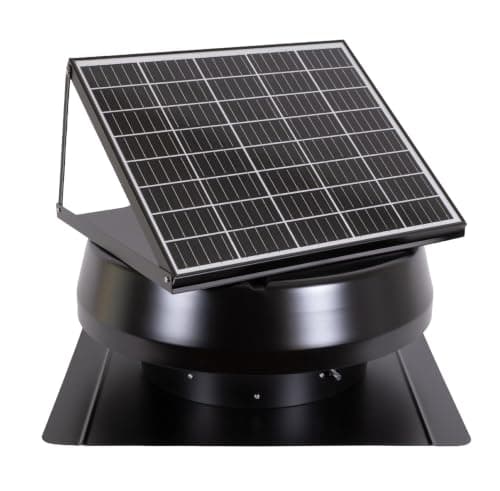
| 1 | Best overall iLIVING 14" Solar Roof Attic Exhaust Fan 1,150 CFM on a 40 W adjustable-tilt panel, brushless IP68 motor, 15-year warranty and a 50 to 122 degree F thermostat. | An attic with no circuit run to it and a sunny roof | |
| 2 | The mains comparison Broan 353 Gable-Mount Powered Attic Ventilator 760 / 1,020 CFM gable-mounted with a thermostat — less airflow than the solar unit, and it runs at night. | An attic that needs ventilation after dark, with a circuit available | |
| 3 | 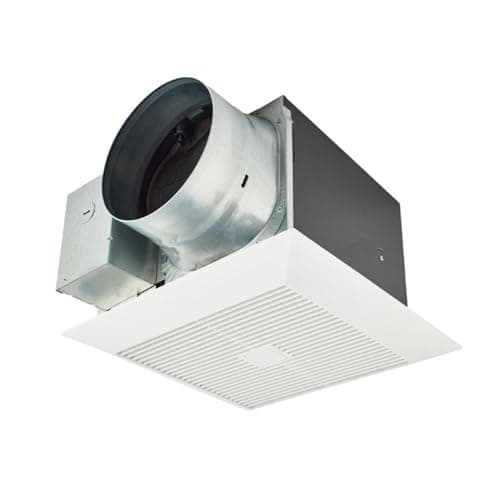 Fix this first Panasonic WhisperGreen Select FV-0511VK3 Ventilation Fan 110 CFM at 0.1 sones and 16.7 CFM per watt — certified, and it removes moisture at the source. | Stopping moisture from reaching the attic in the first place | |
| — | If you want to cool the house, not the attic QuietCool Stealth Pro X Whole House Fan, 4,280 CFM 2,361 CFM on 73.9 W into the attic — a completely different machine doing a completely different job. | Cooling living space on cool evenings |
Solar power is usually a compromise: you take intermittent supply in exchange for free energy. Attic ventilation is the rare case where the intermittency lines up with the need.
The fit
Load and supply peak together
An attic is hot because the sun is on the roof. The hotter the sun, the hotter the attic, and the more ventilation it wants.
A solar panel produces most power when the sun is strongest. So the supply curve and the demand curve are the same curve, which is not true of almost any other solar application.
- Peak sun, peak attic temperature, peak fan output. No battery, no storage, no mismatch to engineer around.
- Night, cool attic, no fan. Which is mostly fine — the attic is cooling passively anyway once the roof stops receiving sun.
- Cloudy day, cooler attic, reduced output. Again the two move together.
- No wiring. Many attics have no circuit, and running one is electrician work in a hot confined space.
This is the strongest argument for the category, and it is a genuine one rather than marketing.
The comparison
Solar against mains, on published figures
| Specification | Solar unit | Mains gable unit |
|---|---|---|
| Airflow | 1,150 CFM | 760 / 1,020 CFM |
| Motor | Brushless, IP68 | Shaded pole |
| Warranty | 15 years | 1 year |
| Running cost | None | Not publishable — no watts stated |
| Thermostat | 50 to 122 degrees F | Built-in, adjustable |
| Runs after dark | No (hybrid adapter available) | Yes |
| Electrical work | None | Circuit required |
The solar unit wins on airflow, motor type, warranty and running cost, and loses on after-dark operation. That is an unusually one-sided comparison, and it is worth being skeptical about it for one reason: none of these figures is independently verified.
The gap
Nothing here is certified
The ENERGY STAR Certified Ventilating Fans dataset holds 1,140 records in four types — 973 bathroom and utility fans, 92 range hoods, 73 single-port in-line fans and 2 multi-port. There is no attic fan type at all, solar or otherwise.
So when we say 1,150 CFM, that is the manufacturer’s number. It has not been measured at a defined static pressure by an independent laboratory the way a bathroom fan’s 110 CFM has.
- CFM claims are not comparable between brands with any confidence.
- Panel wattage is not fan output. A 40 W panel does not deliver 40 W to the motor in most real conditions — tilt, orientation, temperature and cloud all reduce it.
- Coverage claims in square feet have no test procedure behind them.
- No noise rating exists in any form.
We use the published figures because they are what exists, and we flag them as claims rather than presenting them as tested data.
Placement
Getting the panel angle right
A solar attic fan’s output is set by how much power the panel makes, which makes siting more consequential than on a mains unit.
- Use the adjustable tilt. The panel on this unit adjusts, and matching it to your latitude and roof pitch is the single biggest lever on output.
- Face it toward the sun’s path, not simply along the roof plane. A north-facing roof slope in the northern hemisphere is the worst case.
- Check for shade. A tree that shades the panel for three hours in the afternoon removes exactly the hours you most wanted.
- Keep it clean. Dust and pollen on a panel reduce output, and roofs are dusty.
- Confirm the attic can exhaust it. Any powered fan needs make-up air; clear soffit vents are what supply it.
This one is not a DIY job
This is roof work, and a roof penetration done badly costs far more than the fan. Flashing, underlayment and shingle integration all have to be right, and a leak may not show itself for a season.
Combustion safety applies here too. A powered fan depressurizes the attic and, where the ceiling plane is leaky, the house. If there is any atmospherically vented gas appliance, water heater or fireplace, that needs professional assessment first.
Do not block soffit vents while insulating. A powered fan with no intake path pulls its make-up air from inside the house, which is the exact failure mode the category is criticised for.
Working on a roof is itself a risk. If you are not equipped for it, this is a job to hire out.
Say the unwelcome thing
Do not buy a solar attic fan expecting it to cool your house.
It ventilates the attic. Whether that reaches you depends entirely on your ceiling insulation, and if the insulation is good the effect indoors is small by design.
The honest framing is that an attic fan reduces attic temperature and removes attic moisture. Those are worth having — for the roof structure, for stored items, and for the rooms below if the ceiling plane is poor. They are not a cooling system.
Before buying, check the two free things: are the soffit vents clear rather than buried under insulation, and is the attic floor properly insulated? Both do more, permanently, for less.
If you want cooler living space, that is a different machine: 2,361 CFM on 73.9 W of whole-house fan. If you want a ventilated attic with no wiring, 1,150 CFM on a 40 W panel is the pick.
In full
Every pick, and what is wrong with it
Published specifications only, each linked to the page it came from. Where a manufacturer publishes nothing, the row says so — we do not fill blanks in.
1. Best overall
iLIVING 14" Solar Roof Attic Exhaust Fan
iLIVING · model ILG8SF301
1,150 CFM on a 40 W adjustable-tilt panel, brushless IP68 motor, 15-year warranty and a 50 to 122 degree F thermostat.
More airflow than the mains gable unit we recommend, no electrician involved, and a warranty fifteen times longer.
1,150 CFM from a 14 inch fan on a 40 W adjustable-tilt solar panel — the tilt matters, because panel output depends heavily on the angle to the sun and roof pitches vary.
Brushless motor, IP68 rated, with a 15-year warranty. Compare that to the shaded-pole motor and 1-year warranty on the mains alternative: brushless motors have no wearing brushes, and IP68 is a serious ingress rating for something that lives in a roof.
Adjustable thermostat, 50 to 122°F, so it is not simply running whenever the sun is out. 32 lb, 23.5 by 23.5 by 10.5 inches, and hybrid-ready with an AC/DC adapter if you later want it running after dark.
What’s wrong with it
Output tracks sunlight, and the CFM figure is a manufacturer claim like everything in this category.
Running cost
iLIVING does not publish a wattage for the ILG8SF301, so we cannot calculate what it costs to run. We are not going to estimate one. If iLIVING publishes a nameplate figure, this block will show the arithmetic.
| Air delivery | 1,150 CFM |
|---|---|
| Fan diameter | 14 in |
| Solar panel | 40 W, adjustable tilt |
| Motor | Brushless, IP68 rated |
| Thermostat | Adjustable, 50 - 122 degrees F |
| Coverage claim | Up to 2,900 sq ft |
| Dimensions | 23.5 x 23.5 x 10.5 in |
| Weight | 32 lb |
| Warranty | 15 years |
| Noise | Not published |
| ENERGY STAR | No program exists for attic ventilators |
Every figure above is from iLiving USA product page, ILG8SF301. Blanks are shown as “not published” rather than filled in.
2. The mains comparison
Broan 353 Gable-Mount Powered Attic Ventilator
Broan · model 353
760 / 1,020 CFM gable-mounted with a thermostat — less airflow than the solar unit, and it runs at night.
The honest comparison, and the case for mains is narrower than you would expect.
760 / 1,020 CFM against 1,150 for the solar unit. The mains fan moves less air, which is not the usual direction for this comparison.
No watts published. A solar fan’s running cost is zero and knowable; this one’s is neither.
Shaded-pole motor, 1-year warranty. Shaded pole is the least efficient common motor type, and on an appliance mounted in a roof, one year against fifteen is a meaningful difference.
Its genuine advantage is running when the sun is not on the panel — after dark, or under heavy cloud.
What’s wrong with it
No wattage published, a shaded-pole motor, and a 1-year warranty.
Running cost
Broan does not publish a wattage for the 353, so we cannot calculate what it costs to run. We are not going to estimate one. If Broan publishes a nameplate figure, this block will show the arithmetic.
| Air delivery | 760 / 1,020 CFM |
|---|---|
| Mount | Gable |
| Motor | Shaded pole, 1,030 RPM |
| Blade | 4-blade steel |
| Housing | 15 in diameter x 8 in |
| Thermostat | Built-in, adjustable |
| Power | 120 VAC; watts not published |
| Noise | Filed as 0 sones, which is a placeholder rather than a rating |
| Warranty | 1 year |
| ENERGY STAR | No program exists for attic ventilators |
Every figure above is from Broan-NuTone product page, model 353. Blanks are shown as “not published” rather than filled in.
3. Fix this first
Panasonic WhisperGreen Select FV-0511VK3 Ventilation Fan
Panasonic · model FV-0511VK3
110 CFM at 0.1 sones and 16.7 CFM per watt — certified, and it removes moisture at the source.
A large share of attic ventilation problems are moisture problems, and moisture in an attic usually arrives from the rooms below.
A bathroom fan ducted into the attic instead of outdoors is one of the most common building faults there is, and no attic fan solves it — it just runs against it.
16.7 CFM per watt at 0.1 sones, tested and certified, on the Most Efficient list. Everything the attic fan category does not publish.
Running cost is a fraction of a cent an hour. The certified field and why it needs cleaning.
What’s wrong with it
It ventilates a bathroom, not an attic. It does nothing about attic temperature.
Running cost
Panasonic does not publish a wattage for the FV-0511VK3, so we cannot calculate what it costs to run. We are not going to estimate one. If Panasonic publishes a nameplate figure, this block will show the arithmetic.
| Noise | 0.1 sones |
|---|---|
| Air delivery, high | 110 CFM at 0.25 in w.g. |
| Air delivery, medium | 80 CFM |
| Air delivery, low | 50 CFM |
| Efficacy, high | 16.7 CFM per watt |
| Efficacy, medium | 18.4 CFM per watt |
| Efficacy, low | 14.7 CFM per watt |
| Duct size | 6 in diameter |
| Speeds | 3 or more |
| Lighting | None |
| Power | Not published in the certified dataset |
| ENERGY STAR | Certified, and on the Most Efficient list |
Every figure above is from ENERGY STAR Certified Ventilating Fans dataset. Blanks are shown as “not published” rather than filled in.
Skip this one
QuietCool Stealth Pro X Whole House Fan, 4,280 CFM
QuietCool · model QC STL PRO-4.8X
2,361 CFM on 73.9 W into the attic — a completely different machine doing a completely different job.
Flagged because people arrive at solar attic fans hoping to cool the house, and that is not what these do.
A solar attic fan exhausts the attic to outdoors. It lowers attic temperature and removes attic moisture. The effect on your living space is indirect and depends entirely on your ceiling insulation.
A whole-house fan moves the air you are living in. 2,361 CFM on 73.9 W on low — 11¢ for an eight-hour night — drawing cool outdoor air through open windows.
If the goal is a cooler house on a cool evening, that is the machine. Whole-house fans, ranked.
What’s wrong with it
It is not an attic fan. It cools people by exchanging house air, and needs open windows.
Running cost — QC STL PRO-4.8X
| Nameplate power | 73.9 W – 408 W | manufacturer's published figure |
|---|---|---|
| Energy, 8-hour night | 3.26 kWh | 408 ÷ 1000 × 8 |
| Cost per hour | 7.5¢ | at 18.34¢/kWh |
| Cost per 8-hour night | 60¢ | on the highest speed |
| Cost per 30 nights | $18 | 97.9 kWh |
| Same month, lowest speed | $3.25 | at 73.9 W |
Rate: 18.34¢/kWh, the US average residential price for June 2026 (EIA Electric Power Monthly, Table 5.3). Yours will differ — swap it in: (watts ÷ 1000) × hours × your rate.
| Air delivery, high | 4,280 CFM |
|---|---|
| Air delivery, medium | 3,500 CFM |
| Air delivery, low | 2,361 CFM |
| Power, high | 408 W |
| Power, medium | 225 W |
| Power, low | 73.9 W |
| Coverage claim | 1,427 - 2,140 sq ft |
| Motor | ECM |
| Warranty | 15 years |
| Noise | Not published as sones or dBA |
| ENERGY STAR | No program exists for whole-house fans |
Every figure above is from QuietCool Stealth Pro X specification sheet, QC STL PRO-4.8. Blanks are shown as “not published” rather than filled in.
We are not linking a buy button for this one. If you want to look at it anyway, it is easy enough to find — but we would rather send you to something that fits your room.
Questions people actually ask
Frequently asked
Are solar attic fans worth it?
For attic ventilation specifically, the fit is unusually good — the attic is hottest when the sun is strongest, so supply and demand peak together with no battery needed. The current unit also beats the mains alternative on airflow, motor type and warranty, at zero running cost.
How many CFM does a solar attic fan move?
The unit here claims 1,150 CFM from a 14 inch fan on a 40 W panel. Treat that as a manufacturer figure — there is no certification program for attic fans, so it has not been measured at a defined static pressure by an independent laboratory.
Do solar attic fans work at night?
No, not on solar alone — output tracks sunlight. That is mostly fine, because the attic cools passively once the sun leaves the roof. Some units are hybrid-ready with an AC/DC adapter if you want after-dark operation.
Solar or mains attic fan?
On published figures the solar unit wins on airflow (1,150 vs 1,020 CFM), motor (brushless IP68 vs shaded pole), warranty (15 years vs 1) and running cost (zero vs unpublishable). Mains wins on running after dark. Note none of these figures is independently certified. Powered attic fans in full.
Will a solar attic fan cool my house?
Only indirectly, and less than the marketing implies. It lowers attic temperature; whether that reaches you depends on your ceiling insulation — and if the insulation is good, the indoor effect is small by design.
Where should the solar panel face?
Toward the sun's path, using the adjustable tilt to match your latitude and roof pitch. Check for afternoon shade from trees, because that removes exactly the hours the attic is hottest, and keep the panel clean — roofs are dusty.
Sources
Where these numbers came from
- iLiving USA product page, ILG8SF301 — 1,150 CFM, 40 W adjustable panel, brushless IP68 motor, 50-122F thermostat, 15-year warranty
- Broan-NuTone product page, model 353 — 760/1,020 CFM, shaded pole motor, 1-year warranty
- ENERGY STAR Certified Ventilating Fans dataset — the four certified unit types, none of which is an attic fan
- EIA Electric Power Monthly, Table 5.3 — average residential electricity price
Read next
Where to go from here
Back to Whole-House Airflow, or read how we pick.