The picks
The quietest fans for sleeping, by published decibels
Almost nothing in this category publishes a decibel figure, which makes 'whisper quiet' unfalsifiable. These are the fans that give you a number.
By Sawyer V. · Published
The short answer
The Lasko EcoQuiet T42710 at 23 dBA on low — published, and the lowest figure we found. It draws 2.9 W there, about 13¢ for a month of eight-hour nights. A certified ceiling fan on low is quieter still and uses 1.8 W, if you have somewhere to mount one.
Fan & Frost earns a commission when you buy through our links, at no cost to you. It never changes a ranking, and we say so when the right answer is the cheaper unit or nothing at all. Full disclosure · How we pick.
At a glance
The picks, ranked
Tap any row to jump to the full reasoning. Prices are live from Amazon where we have them, and read “check price” where we don’t — never a number we cannot verify today.
| # | Product | Best for | Price |
|---|---|---|---|
| 1 | 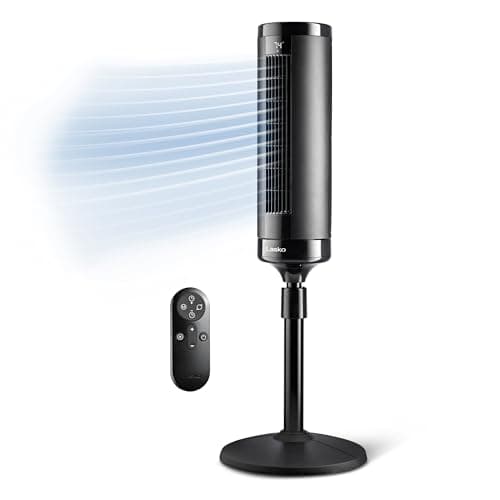 Quietest published figure Lasko EcoQuiet 42" DC Tower Fan 23 dBA on low, published, with twelve speeds so you can actually find the quiet-enough setting. | A bedside tower fan you run all night | |
| 2 | 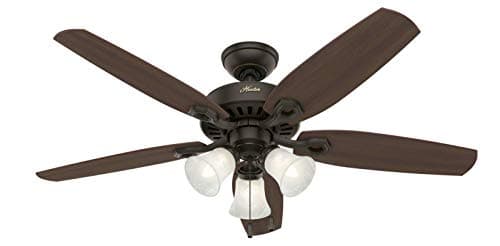 Quietest if you can mount it Hunter Vespucci 52" Ceiling Fan 1.8 W on low at a certified 366.7 CFM per watt — a big blade turning slowly is inherently quiet. | A bedroom you own, with a ceiling that takes a downrod | |
| 3 | 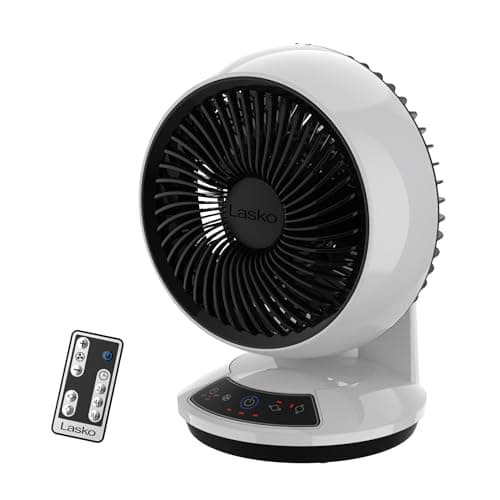 Quietest small fan Lasko Whirlwind Tilt 12" Table Fan 39 dBA on low from a 12-inch table fan, published, at 18 W and under three pounds. | A bedside table or a small room, where a tower is too much | |
| — | The one to skip beside a bed Lasko Power Plus 20" Box Fan 102 W of box fan with no published noise figure, which is the classic white-noise purchase and a poor one. | Moving a lot of air in a room you are not sleeping in |
Search for a quiet fan and you get a wall of adjectives: whisper quiet, ultra silent, library quiet, sleep mode. Very few numbers. That is not a stylistic quirk — most fan manufacturers simply do not publish a decibel figure, and no certification program measures portable fan noise the way ENERGY STAR measures ceiling fan efficiency.
So this page is short on candidates by design. These are the fans that give you a number you can check.
The numbers
Everything we could find a published figure for
| Fan | Published noise | Watts | 30 nights, low |
|---|---|---|---|
| Lasko EcoQuiet T42710 | 23 / 46 dBA | 2.9 – 19 W | 13¢ |
| Lasko A12107 table fan | 39 / 55 dBA | 18 – 32 W | 79¢ |
| Lasko 2554 Wind Curve | Not published | 37 – 49 W | $1.63 |
| Lasko B20801 box fan | Not published | 73 – 102 W | $3.21 |
| Lasko S18931 pedestal | Not published | Not published | — |
| Vornado 630 / 683DC | Not published | Not published | — |
| Hunter Vespucci ceiling fan | Not published | 1.8 – 13.9 W | 7.9¢ |
Figures from manufacturer product pages and the ENERGY STAR certified ceiling fan dataset. Costs are our arithmetic at 18.34¢/kWh.
Five of the seven rows have a “not published” in them. That is the honest state of the information in this category, and it is why we are not able to give you a ranked list of twelve fans by decibel.
Reading dBA
What the numbers mean beside a bed
Decibels are logarithmic. A 10 dB increase is roughly a doubling of perceived loudness, so the gap between 23 and 39 dBA is far larger than the arithmetic difference suggests.
- 20–25 dBA — a quiet rural bedroom. Below the threshold at which most people notice anything.
- 30–40 dBA — a library. Audible if you listen for it, easy to sleep through.
- 45–55 dBA — a quiet office to a normal conversation. Most people can sleep through it once used to it, but it is a presence in the room.
- 60+ dBA — conversation level. Not a bedroom fan.
The thing dBA misses
Steady beats quiet
This is the most useful thing on the page and it is not a number.
A constant 40 dBA is easier to sleep through than an intermittent 30 dBA. Your hearing habituates to steady sound within minutes and stops reporting it. It does not habituate to change — every start, stop or shift in pitch is a fresh event that pulls you toward waking.
Which means, practically:
- Avoid oscillation for sleeping. A fan sweeping back and forth produces a rising and falling sound and a rising and falling draft. Both are changes. Point it and leave it.
- Avoid auto or eco modes overnight. Anything that varies the speed in response to temperature is generating exactly the transitions you want to avoid.
- This is also why a fan beats an air conditioner for sleep, noise-wise. A compressor cycling between silence and 45 dBA every twenty minutes is more disruptive than a fan holding a steady 40 — more on that here.
Say the unwelcome thing
A rattle is not fixable by buying a quieter fan.
If a fan you already own has developed a click, a rattle or a wobble, the decibel figure is not the problem. Mechanical noise is intermittent and tonal, which is precisely the kind your brain refuses to ignore.
Usually it is one of three things: dust on the blades making them unbalanced, a loose grille or housing screw, or a fan that is not sitting level. All three are five-minute fixes, and all three do more for your sleep than 6 dB on a spec sheet.
Placement
Four free things that make any fan quieter
- Move it closer and turn it down. A fan at three feet on its lowest speed delivers the same airflow to you as a fan at ten feet on medium, at a fraction of the noise. This is the single biggest lever.
- Get it off a hard floor. A hard surface reflects and can resonate. A rug under a floor-standing fan measurably helps.
- Keep it away from corners. Corners reflect sound back into the room and add turbulence noise on the intake side.
- Clean the blades. Dust builds unevenly, and an unbalanced blade is a vibration source. This is the most common cause of a fan getting louder over a season.
And if the room is hot rather than merely warm, quiet is the wrong problem to be solving. Above roughly 95°F moving air stops helping at all, and the bedroom page works through what actually helps, in order.
In full
Every pick, and what is wrong with it
Published specifications only, each linked to the page it came from. Where a manufacturer publishes nothing, the row says so — we do not fill blanks in.
1. Quietest published figure
Lasko EcoQuiet 42" DC Tower Fan
Lasko · model T42710
23 dBA on low, published, with twelve speeds so you can actually find the quiet-enough setting.
23 dBA on low, 46 dBA on high, both published by Lasko. 23 dBA is below a whispered conversation and around the level of a quiet rural bedroom at night. In practice it disappears within a minute of lying down.
Twelve speeds is the specification that actually makes a fan sleepable, and it is consistently underrated. A three-speed fan often has nothing usable between not enough air and too much noise. Twelve steps lets you sit exactly on the boundary, and on a DC motor each step down is a genuine reduction in both noise and power rather than a token change.
2.9 W at that lowest setting — about 13¢ for a month of eight-hour nights at 18.34¢/kWh. Effectively free.
The 8-hour timer is well matched to a night, and at 7.8 lb it is easy to reposition. 2-year warranty.
What’s wrong with it
No published CFM, so we cannot tell you how much air it moves at that 23 dBA — quiet is easy if you move no air, and Lasko has not given us the number to rule that out.
Running cost — T42710
| Nameplate power | 2.9 W – 19 W | manufacturer's published figure |
|---|---|---|
| Energy, 8-hour night | 0.15 kWh | 19 ÷ 1000 × 8 |
| Cost per hour | 0.3¢ | at 18.34¢/kWh |
| Cost per 8-hour night | 2.8¢ | on the highest speed |
| Cost per 30 nights | 84¢ | 4.6 kWh |
| Same month, lowest speed | 13¢ | at 2.9 W |
Rate: 18.34¢/kWh, the US average residential price for June 2026 (EIA Electric Power Monthly, Table 5.3). Yours will differ — swap it in: (watts ÷ 1000) × hours × your rate.
| Power | 2.9 W - 19 W (0.06-0.303 A at 120 V) |
|---|---|
| Noise | 23 dBA low, 46 dBA high |
| Speeds | 12 |
| Height | 41.6 in |
| Footprint | 12.8 x 12.8 in |
| Weight | 7.8 lb |
| Timer | 8 hours |
| Air delivery (CFM) | Not published |
| Warranty | 2 years |
Every figure above is from Lasko product page, T42710. Blanks are shown as “not published” rather than filled in.
2. Quietest if you can mount it
Hunter Vespucci 52" Ceiling Fan
Hunter · model Vespucci
1.8 W on low at a certified 366.7 CFM per watt — a big blade turning slowly is inherently quiet.
The physics is on its side. Fan noise comes overwhelmingly from blade tip speed and from air turbulence, and a 52-inch blade moving a large volume of air slowly generates far less of both than a small impeller spinning fast to move the same air.
1.8 W on low, at a certified 366.7 CFM per watt. That is about 7.9¢ for a month of nights, and a fan drawing under two watts is not doing anything violent enough to be loud.
We should be straight that this is an inference, not a measured claim. The ENERGY STAR certified ceiling fan dataset publishes CFM/W and per-speed wattage but no acoustic figure, and Hunter does not publish one either. We are recommending it on mechanism and on the wattage, and saying so.
One practical note: a wobbling ceiling fan is far more disturbing than a humming one. If yours rattles, it needs balancing, and that is a five-minute job with a balancing kit.
What’s wrong with it
No published dBA figure — the ENERGY STAR ceiling fan dataset records efficiency and wattage but not noise, so we are inferring quietness from the physics rather than reading it off a spec sheet.
Running cost — Vespucci
| Nameplate power | 1.8 W – 13.9 W | manufacturer's published figure |
|---|---|---|
| Energy, 8-hour night | 0.11 kWh | 13.9 ÷ 1000 × 8 |
| Cost per hour | 0.3¢ | at 18.34¢/kWh |
| Cost per 8-hour night | 2.0¢ | on the highest speed |
| Cost per 30 nights | 61¢ | 3.3 kWh |
| Same month, lowest speed | 7.9¢ | at 1.8 W |
Rate: 18.34¢/kWh, the US average residential price for June 2026 (EIA Electric Power Monthly, Table 5.3). Yours will differ — swap it in: (watts ÷ 1000) × hours × your rate.
| Blade span | 52 in |
|---|---|
| Efficiency | 366.7 CFM per watt |
| Power, high speed | 13.9 W |
| Power, low speed | 1.8 W |
| Standby power | 0.8 W |
| Type | Indoor, fan only (no light kit) |
| Warranty | 3 years, components |
| ENERGY STAR | Certified |
Every figure above is from ENERGY STAR Certified Ceiling Fans dataset. Blanks are shown as “not published” rather than filled in.
3. Quietest small fan
Lasko Whirlwind Tilt 12" Table Fan
Lasko · model A12107
39 dBA on low from a 12-inch table fan, published, at 18 W and under three pounds.
39 dBA low, 55 dBA high, published. Worth knowing because small fans are commonly assumed to be quieter than large ones, and the opposite is usually true: a small blade has to spin fast to move any useful air, and speed is what makes noise.
39 dBA is roughly a quiet library. It is not silent, and against the EcoQuiet’s 23 dBA it is a considerable step — decibels are logarithmic, so 16 dB is much more than it looks.
What it buys you is placement. 2.78 lb and 11 inches tall means it sits on a nightstand and aims directly at you from three feet away, which lets you run it at a lower speed than a floor-standing fan across the room. Sometimes proximity beats absolute quietness.
18–32 W, so $1.41 for a month of nights at full power. It also wall-mounts, though the hardware is not included.
What’s wrong with it
39 dBA on low is 16 dB above the EcoQuiet — a substantial difference given the logarithmic scale — and 55 dBA on high is too loud to sleep through.
Running cost — A12107
| Nameplate power | 18 W – 32 W | manufacturer's published figure |
|---|---|---|
| Energy, 8-hour night | 0.26 kWh | 32 ÷ 1000 × 8 |
| Cost per hour | 0.6¢ | at 18.34¢/kWh |
| Cost per 8-hour night | 4.7¢ | on the highest speed |
| Cost per 30 nights | $1.41 | 7.7 kWh |
| Same month, lowest speed | 79¢ | at 18 W |
Rate: 18.34¢/kWh, the US average residential price for June 2026 (EIA Electric Power Monthly, Table 5.3). Yours will differ — swap it in: (watts ÷ 1000) × hours × your rate.
| Power | 18 W - 32 W (0.24-0.5 A at 120 V) |
|---|---|
| Noise | 39 dBA low, 55 dBA high |
| Air distance | 50 ft |
| Speeds | 3 |
| Dimensions | 11.19 H x 11.4 W x 6.2 D in |
| Weight | 2.78 lb |
| Mounting | Wall-mountable (hardware not included) |
| Air delivery (CFM) | Not published |
| Warranty | 1 year |
Every figure above is from Lasko product page, A12107. Blanks are shown as “not published” rather than filled in.
Skip this one
Lasko Power Plus 20" Box Fan
Lasko · model B20801
102 W of box fan with no published noise figure, which is the classic white-noise purchase and a poor one.
The box fan is the traditional bedroom white-noise machine, and it is the wrong tool for the job on both counts.
Lasko publishes no noise figure for it, which for a fan bought largely for its sound is a striking omission. And a 20-inch blade in a bare open frame produces broadband turbulent noise — the kind with a rattly edge to it rather than the smooth hiss people actually find soothing.
73–102 W is the other issue. That is $4.49 for a month of eight-hour nights against 13¢ for the EcoQuiet on low. Roughly 35 times the running cost, for worse sound.
If it is the noise you want rather than the air, a white-noise app costs nothing and gives you a smoother spectrum. If it is the air, the fans above do it better and more cheaply. The box fan earns its place in a window or a workshop, not beside a pillow.
What’s wrong with it
No published dBA at all, 73-102 W, and a 20-inch blade in an open frame is inherently a turbulent, broadband noise source.
Running cost — B20801
| Nameplate power | 73 W – 102 W | manufacturer's published figure |
|---|---|---|
| Energy, 8-hour night | 0.82 kWh | 102 ÷ 1000 × 8 |
| Cost per hour | 1.9¢ | at 18.34¢/kWh |
| Cost per 8-hour night | 15¢ | on the highest speed |
| Cost per 30 nights | $4.49 | 24.5 kWh |
| Same month, lowest speed | $3.21 | at 73 W |
Rate: 18.34¢/kWh, the US average residential price for June 2026 (EIA Electric Power Monthly, Table 5.3). Yours will differ — swap it in: (watts ÷ 1000) × hours × your rate.
| Power | 73 W - 102 W (0.6-0.9 A at 120 V) |
|---|---|
| Speeds | 3 |
| Dimensions | 21.25 H x 22.5 x 4.75 in |
| Weight | 10.1 lb |
| Motor | Weather-resistant |
| Air delivery (CFM) | Not published |
| Warranty | 2 years |
Every figure above is from Lasko product page, B20801. Blanks are shown as “not published” rather than filled in.
We are not linking a buy button for this one. If you want to look at it anyway, it is easy enough to find — but we would rather send you to something that fits your room.
Questions people actually ask
Frequently asked
What is the quietest fan for sleeping?
The Lasko EcoQuiet T42710 at 23 dBA on its lowest speed, which is the lowest published figure we found. It draws 2.9 W there and has twelve speeds, so you can sit exactly on the boundary between enough airflow and too much noise.
How many decibels is a quiet fan?
Under about 30 dBA is genuinely quiet — below a whispered conversation. 30 to 40 dBA is library level and easy to sleep through. Above 50 dBA you are at conversation level, which is a presence in the room rather than background.
Why do most fans not list decibel ratings?
There is no certification program measuring portable fan noise, unlike ENERGY STAR's efficiency testing for ceiling fans, and no requirement to publish one. Of the fans we looked at, five of seven published no noise figure at all — which is why 'whisper quiet' is usually unfalsifiable.
Is a box fan good for white noise?
Not especially. A 20-inch blade in an open frame produces broadband turbulent noise with a rattly edge rather than the smooth hiss people find soothing, and it draws 73 to 102 W. If you want the sound, a white noise app is free and smoother; if you want the air, a DC tower fan does it better.
Should I use oscillation while sleeping?
No. Your hearing habituates to steady sound within minutes but not to change, and an oscillating fan produces a rising and falling sound plus a rising and falling draft. A constant 40 dBA is easier to sleep through than an intermittent 30. Point it and leave it.
Are ceiling fans quieter than tower fans?
Almost certainly, though nobody publishes the figures to prove it. Fan noise comes mainly from blade tip speed and turbulence, and a 52-inch blade moving slowly generates far less of both than a small impeller spinning fast. A certified ceiling fan drawing 1.8 W on low is not doing anything violent enough to be loud.
Sources
Where these numbers came from
- Lasko EcoQuiet T42710 specifications — 23 dBA low, 46 dBA high
- Lasko A12107 specifications — 39 dBA low, 55 dBA high
- Lasko 2554 Wind Curve specifications — no noise figure published
- Lasko B20801 box fan specifications — no noise figure published
- ENERGY STAR Certified Ceiling Fans dataset — wattage, no acoustic field
Read next
Where to go from here
Back to Fans, or read how we pick.