The picks
The best mini-splits for a garage
Most people price a garage mini-split for July. The number that will actually decide whether you like it is measured at five degrees Fahrenheit.
By Sawyer V. · Published
The short answer
Filter on cold climate certification and COP at 5°F, because a garage is used year-round and the winter half is the harder one. The best figures available are COP 2.89 at 18,000 BTU and COP 2.48 at 9,000 BTU. But insulate the garage door first — it is the largest thermal weak point in most homes, and a mini-split fighting it is an expensive way to lose.
Fan & Frost earns a commission when you buy through our links, at no cost to you. It never changes a ranking, and we say so when the right answer is the cheaper unit or nothing at all. Full disclosure · How we pick.

At a glance
The picks, ranked
Tap any row to jump to the full reasoning. Prices are live from Amazon where we have them, and read “check price” where we don’t — never a number we cannot verify today.
| # | Product | Best for | Price |
|---|---|---|---|
| 1 | Best overall Carrier Mini-Split Heat Pump, 18,000 BTU 18,000 BTU with COP 2.89 at 5 degrees F — the highest cold-weather heating figure in the 9,000 to 18,000 BTU cold-climate field. | A two-car garage, insulated, used year-round | |
| 2 | Best for a single-car garage Fujitsu Mini-Split Heat Pump, 9,000 BTU 9,000 BTU at EER2 19.1, HSPF2 14.00 and COP 2.48 at 5 degrees F — the highest EER2 we hold data for. | A smaller, well-sealed garage or workshop | |
| 3 | Best refrigerant choice Mitsubishi Electric Mini-Split Heat Pump, 9,000 BTU SEER2 33.1 and EER2 18.35 on R-454B at GWP 470 — a fifth of R-410A's warming potential. | A new installation where you get to pick the refrigerant | |
| — | 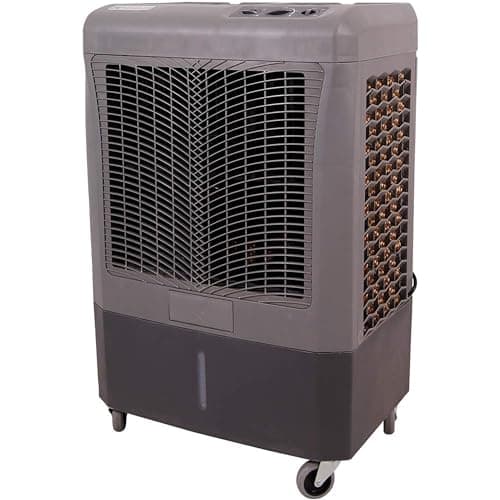 The cheaper answer in a dry climate Hessaire MC37M Mobile Evaporative Cooler 3,100 CFM on 250 W — no installation, no refrigerant, and roughly a tenth of the running cost. | A garage in a dry region, worked in with the door open |
A garage mini-split is one of the better uses of the technology, and the specification people shop on is the wrong one.
The filter
Cold climate certification first
A garage is not a bedroom. It is used for projects, storage, a gym or a workshop — year round, including the months when a bedroom just needs a blanket.
So the heating half of a mini-split matters more here than almost anywhere, and the certified data gives you two figures for it:
- HSPF2 is the seasonal heating efficiency, averaged across a modeled heating season. Useful, and it can hide poor cold-weather behavior.
- COP at 5°F is heat delivered per unit of electricity on a genuinely cold day. This is the one that decides whether the garage is usable in January.
Across the certified field, cooling efficiency barely predicts heating — a high SEER2 tells you almost nothing about COP at 5°F. The full analysis. So filter on the cold-climate flag and then compare COP directly.
Brand helps here in a way it does not elsewhere: cold-climate share varies from 54% to 99% across the large brands, so some ranges are aimed at winter and some are not.
First
The envelope work comes before the equipment
This is the same warning as on the garage air conditioner page, and it matters more with a mini-split because the installation is permanent and expensive.
- Insulate the garage door. It is the largest exterior surface and usually an uninsulated steel panel facing the sun. Highest impact per dollar in the whole project.
- Seal the perimeter. Bottom, sides and top. A door that has to move seals badly by design.
- Insulate walls and ceiling where they are bare, particularly under a room above, where it pays twice.
- Then size the mini-split, from a proper load calculation on the sealed space.
Sizing before sealing means paying for capacity permanently to fight a problem that a weekend and some insulation would have removed.
The comparison
Mini-split against the alternatives
| Option | Heats? | Install | Note |
|---|---|---|---|
| Mini-split heat pump | Yes, well | Licensed | Best year-round answer |
| Through-the-wall AC | Some models | Sleeve required | 425.5 kWh/yr certified |
| Window AC | Some models | Needs a window | Garages rarely have one |
| Evaporative cooler | No | None | Dry climates, door open |
| Exhaust fan | No | Wall opening | Removes heat, makes no cold |
| Electric heater | Heat only | None | No cooling, high running cost |
The mini-split’s case is genuinely strong here, and it is not primarily about cooling efficiency. It is that a garage needs both heating and cooling, it has no usable window, and a heat pump is far cheaper to run for heat than resistance heating.
Against a through-the-wall unit — $78 a season for 8,000 BTU — the mini-split wins on heating and on indoor noise, and loses heavily on installed cost.
This one is not a DIY job
Never run a vehicle in an enclosed garage. Carbon monoxide is lethal and a mini-split does not remove it — it recirculates indoor air rather than exchanging it, exactly like a room air conditioner. Ventilation and CO detection are separate requirements.
If the garage is attached to living space, the wall and ceiling between them is usually a fire separation required by code. Routing a line set through it has rules; that is a contractor’s job.
Mini-split installation is licensed work. Charging, evacuating and brazing a line set is regulated, and a poor installation is the most common reason one underperforms its published figures.
A garage circuit is often shared with door openers and outlets. Confirm the electrical supply before planning the installation.
Practical
Getting a garage install right
- Ask for COP at 5°F, not just SEER2. Both are published for every certified model, and a quote that only mentions SEER2 is quoting the flattering one.
- Confirm the cold-climate certification if you have real winters. It is a flag in the certified data, not a marketing term.
- Site the outdoor unit with clearance and drainage. Recirculating its own exhaust costs efficiency you paid for.
- Mount the indoor head high and away from dust. A workshop is a dusty environment and the filter will load faster than in a house.
- Plan for condensate. The indoor unit produces water in cooling mode and it has to drain somewhere sensible.
- Check the model number against the certified list. Many identical machines carry different badges at different prices.
Say the unwelcome thing
Do not install a mini-split in an uninsulated garage.
It is the most expensive way to discover that an uninsulated garage door is the largest thermal weak point in most homes.
A garage door is a thin steel panel facing the weather, with gaps at the sides and bottom by design because it has to move. Walls and ceilings are frequently bare. Cooling or heating that space is conditioning the driveway.
Worse, a mini-split is a permanent licensed installation sized to the load you had on the day. Size it against an unsealed envelope and you have bought that capacity, and its running cost, indefinitely.
Insulate and seal the door first — it is a weekend and a fraction of the equipment cost. Then size properly and buy on COP at 5°F: COP 2.89 at 18,000 BTU or EER2 19.1 at 9,000 BTU.
In full
Every pick, and what is wrong with it
Published specifications only, each linked to the page it came from. Where a manufacturer publishes nothing, the row says so — we do not fill blanks in.
1. Best overall
Carrier Mini-Split Heat Pump, 18,000 BTU
Carrier · model 38MPRBQ18AA3
18,000 BTU with COP 2.89 at 5 degrees F — the highest cold-weather heating figure in the 9,000 to 18,000 BTU cold-climate field.
The capacity most detached and two-car garages actually want, with the best winter figure the size class offers.
COP 2.89 at 5°F means 2.89 units of heat per unit of electricity on a genuinely cold day. In a garage that is the number that decides whether the space is usable in January.
SEER2 26.3, EER2 15.3, HSPF2 11.00, cold climate and Most Efficient certified.
Two honest caveats. R-410A at GWP 2,088 is the highest-warming refrigerant still common here. And this exact model appears under at least ten brand names — which is worth knowing before you pay a premium for a badge.
What’s wrong with it
R-410A at GWP 2,088, and 18,000 BTU is more than a small garage needs.
Running cost
Carrier does not publish a wattage for the 38MPRBQ18AA3, so we cannot calculate what it costs to run. We are not going to estimate one. If Carrier publishes a nameplate figure, this block will show the arithmetic.
| Cooling capacity | 18,000 BTU/h |
|---|---|
| SEER2 | 26.3 |
| EER2 | 15.3 |
| HSPF2 | 11.00 |
| COP at 5 degrees F | 2.89 |
| Cold climate | Yes |
| Refrigerant | R-410A (GWP 2,088) |
| ENERGY STAR | Certified, and on the Most Efficient list |
| Noise | Not published in the certified dataset |
Every figure above is from ENERGY STAR Certified Mini-Split Heat Pumps dataset. Blanks are shown as “not published” rather than filled in.
2. Best for a single-car garage
Fujitsu Mini-Split Heat Pump, 9,000 BTU
Fujitsu · model AOUH09KTAP1
9,000 BTU at EER2 19.1, HSPF2 14.00 and COP 2.48 at 5 degrees F — the highest EER2 we hold data for.
The efficiency leader on the cooling side, and strong enough on heating for a garage that has had the envelope work done.
EER2 19.1 is the highest of any 9,000 to 24,000 BTU unit in the certified data, and HSPF2 14.00 is the best seasonal heating figure among our picks.
COP 2.48 at 5°F and SEER2 33.5, cold climate and Most Efficient certified, on R-32 at GWP 675.
Size honestly. 9,000 BTU suits a single-car garage that is insulated and sealed; in an uninsulated two-car space it will run flat out and lose.
What’s wrong with it
9,000 BTU will not hold a large or uninsulated garage, and COP 2.48 trails the 18,000 BTU unit.
Running cost
Fujitsu does not publish a wattage for the AOUH09KTAP1, so we cannot calculate what it costs to run. We are not going to estimate one. If Fujitsu publishes a nameplate figure, this block will show the arithmetic.
| Cooling capacity | 9,000 BTU/h |
|---|---|
| SEER2 | 33.5 |
| EER2 | 19.1 |
| HSPF2 | 14.00 |
| COP at 5 degrees F | 2.48 |
| Cold climate | Yes |
| Refrigerant | R-32 (GWP 675) |
| ENERGY STAR | Certified, and on the Most Efficient list |
| Noise | Not published in the certified dataset |
Every figure above is from ENERGY STAR Certified Mini-Split Heat Pumps dataset. Blanks are shown as “not published” rather than filled in.
3. Best refrigerant choice
Mitsubishi Electric Mini-Split Heat Pump, 9,000 BTU
Mitsubishi Electric · model MUZ-FX09NLHZ
SEER2 33.1 and EER2 18.35 on R-454B at GWP 470 — a fifth of R-410A's warming potential.
The refrigerant decision is one you make once and live with for the life of the equipment, and a garage install is a good moment to make it deliberately.
R-454B at GWP 470 against R-32 at 675 and R-410A at 2,088. Across the certified mini-split field the split is roughly 46% R-454B, 38% R-410A and 16% R-32.
SEER2 33.1, EER2 18.35, HSPF2 13.30, cold climate and Most Efficient certified.
COP 2.20 at 5°F is the honest cost — about 24% less heat per unit of electricity than the 18,000 BTU unit above on the coldest days, which is exactly when a garage needs it.
What’s wrong with it
COP 2.20 at 5 degrees F is the lowest of these three, which matters most in a cold garage.
Running cost
Mitsubishi Electric does not publish a wattage for the MUZ-FX09NLHZ, so we cannot calculate what it costs to run. We are not going to estimate one. If Mitsubishi Electric publishes a nameplate figure, this block will show the arithmetic.
| Cooling capacity | 9,000 BTU/h |
|---|---|
| SEER2 | 33.1 |
| EER2 | 18.35 |
| HSPF2 | 13.30 |
| COP at 5 degrees F | 2.20 |
| Cold climate | Yes |
| Refrigerant | R-454B (GWP 470) |
| ENERGY STAR | Certified, and on the Most Efficient list |
| Noise | Not published in the certified dataset |
Every figure above is from ENERGY STAR Certified Mini-Split Heat Pumps dataset. Blanks are shown as “not published” rather than filled in.
Skip this one
Hessaire MC37M Mobile Evaporative Cooler
Hessaire · model MC37M
3,100 CFM on 250 W — no installation, no refrigerant, and roughly a tenth of the running cost.
Marked skip because it is not a mini-split, and included because a lot of people pricing one should price this first.
250 W is about 18¢ for a four-hour session. A mini-split installation is a licensed job with a line set, an outdoor unit and an electrical circuit.
If the garage is used a few hours at weekends in a dry climate, that difference is very hard to justify away. The evaporative case for garages.
Its limits are real: above roughly 60% relative humidity it does very little, it needs the door open, and it has no heating mode at all. A genuine year-round workshop is the mini-split case.
What’s wrong with it
It only works in dry air with the door open, and it does nothing in winter.
Running cost — MC37M
| Nameplate power | 250 W | manufacturer's published figure |
|---|---|---|
| Energy, 8-hour night | 2.00 kWh | 250 ÷ 1000 × 8 |
| Cost per hour | 4.6¢ | at 18.34¢/kWh |
| Cost per 8-hour night | 37¢ | on the highest speed |
| Cost per 30 nights | $11 | 60.0 kWh |
Rate: 18.34¢/kWh, the US average residential price for June 2026 (EIA Electric Power Monthly, Table 5.3). Yours will differ — swap it in: (watts ÷ 1000) × hours × your rate.
| Air delivery | 3,100 CFM |
|---|---|
| Power | 250 W / 2.4 A |
| Water tank | 10.3 gallons, continuous hookup capable |
| Dimensions | 24 L x 16 W x 38 H in |
| Weight | 40 lb |
| Pads | Industrial-grade cooling pads |
| Coverage claim | Not published on the product page |
Every figure above is from Hessaire product page, MC37M. Blanks are shown as “not published” rather than filled in.
We are not linking a buy button for this one. If you want to look at it anyway, it is easy enough to find — but we would rather send you to something that fits your room.
Questions people actually ask
Frequently asked
What size mini-split do I need for a garage?
9,000 BTU suits a single-car garage that is insulated and sealed; 18,000 BTU is the usual answer for a two-car space. But size after the envelope work, from a proper load calculation — sizing against an uninsulated door buys permanent capacity to fight a fixable problem.
Which specification matters most for a garage mini-split?
COP at 5 degrees F, because a garage is used year-round and the winter half is the harder one. The best figures available are 2.89 at 18,000 BTU and 2.48 at 9,000. Cooling efficiency barely predicts heating, so do not shop on SEER2 alone. Why SEER2 does not predict heating.
Do I need a cold-climate mini-split for a garage?
If you have real winters, yes — and it is a flag in the certified data rather than a marketing term. Cold-climate share varies from 54% to 99% across the large brands, so some ranges are aimed at winter heating and some are not.
Is a mini-split worth it for a garage?
If you use the space year-round, yes — it heats and cools, needs no window, and a heat pump is far cheaper to run for heat than resistance heating. For a few hours at weekends in a dry climate, an evaporative cooler at 250 W is very hard to argue against.
Can I install a garage mini-split myself?
No. Charging, evacuating and brazing a refrigerant line set is licensed work, and a poor installation is the most common reason a mini-split underperforms its published figures. Routing a line set through an attached garage's fire separation also has code rules.
Is it safe to run a mini-split with a car in the garage?
Never run a vehicle in an enclosed garage. Carbon monoxide is lethal and a mini-split does not remove it — it recirculates indoor air rather than exchanging it. Ventilation and CO detection are separate requirements from conditioning.
Sources
Where these numbers came from
- ENERGY STAR Certified Mini-Split Heat Pumps dataset — SEER2, EER2, HSPF2, COP at 5F, cold climate and Most Efficient flags across 14,328 US records
- ENERGY STAR Certified Room Air Conditioners dataset — annual kWh for the through-the-wall comparison
- Hessaire MC37M product page — 3,100 CFM, 250 W
- EIA Electric Power Monthly, Table 5.3 — average residential electricity price
Read next
Where to go from here
Back to Air Conditioners, or read how we pick.