Head to head
Midea Cube 20 vs 50 pint dehumidifier
In dehumidifiers, bigger is more efficient — the opposite of room air conditioners. These two from the same line show the gap at its widest.
By Sawyer V. · Published
The short answer
Buy the 50-pint. It removes 2.5 times the water (49.67 against 20.16 pints a day) at 22 per cent better efficiency — IEF 2.08 L/kWh against 1.70, where 2.08 is among the best figures certified for any portable and 1.70 is the floor of the entire certified dataset. The 20-pint only makes sense where the 50 physically will not fit or 249 kWh a year is the ceiling.
Fan & Frost earns a commission when you buy through our links, at no cost to you. It never changes a ranking, and we say so when the right answer is the cheaper unit or nothing at all. Full disclosure · How we pick.

At a glance
The picks, ranked
Tap any row to jump to the full reasoning. Prices are live from Amazon where we have them, and read “check price” where we don’t — never a number we cannot verify today.
| # | Product | Best for | Price |
|---|---|---|---|
| 1 | 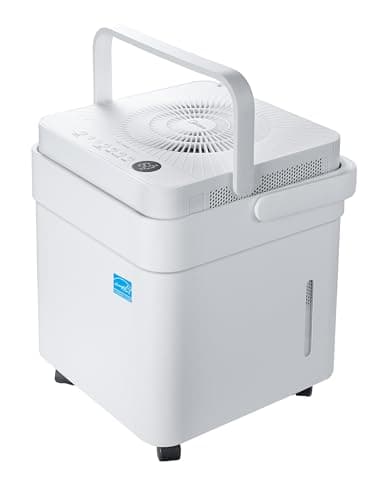 The 50-pint case Midea Dehumidifier, 50 pints/day 49.67 pints a day at IEF 2.08 L/kWh — more water removed per kilowatt-hour than almost any certified portable, and 2.5 times the capacity of the small one. | A basement, a damp ground floor, or anywhere you want the job finished rather than managed | |
| 2 | 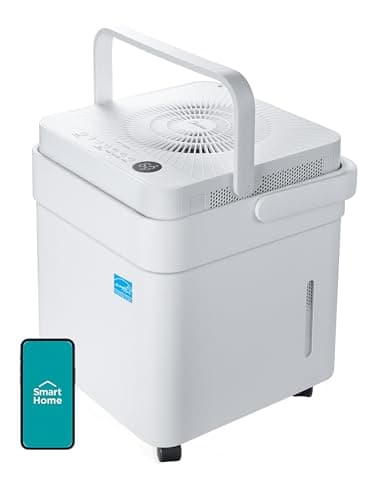 The 20-pint case Midea Dehumidifier, 20 pints/day 20.16 pints a day at 249 kWh a year, the lower total consumption of the two and the smaller footprint. | A single small room, a closet or a boat — somewhere the larger unit physically will not go |
Dehumidifiers are shopped on the pint number and rated on something else. The pint figure is capacity; the number that decides your bill is IEF — integrated energy factor, litres of water removed per kilowatt-hour. These two units come from the same line and the gap between their IEF figures is unusually large.
Head to head
Certified figures, side by side
| Cube 20 pint | Cube 50 pint | |
|---|---|---|
| Water removal | 20.16 pints/day | 49.67 pints/day |
| Efficiency (IEF) | 1.70 L/kWh | 2.08 L/kWh |
| Annual energy use | 249 kWh/yr | 515 kWh/yr |
| Annual running cost | $46 | $94 |
| Refrigerant | HFC-32 (GWP 675) | HFC-32 (GWP 675) |
| Connected | No | No |
| Noise | Not in the dataset | Not in the dataset |
| ENERGY STAR | Certified | Certified |
| Where IEF sits | Floor of the field | Above all but two brands |
Water removal, IEF and annual kWh from the ENERGY STAR Certified Dehumidifiers dataset; running cost is our arithmetic at 18.34¢/kWh. Prices checked 11 October 2026: the 20-pint was $179.99 and the 50-pint $241.59. The buttons above carry the live price and the date.
The finding
Bigger is more efficient here, unlike air conditioners
This is the opposite of the pattern in room air conditioners, where certified efficiency holds at CEER 16.0 up to 14,000 BTU and then falls to 12.7 at 24,000. In dehumidifiers, capacity and efficiency move together: a bigger compressor and a bigger coil condense water more cheaply per litre.
The pattern holds right up the range. Whole-home dehumidifiers median 2.30 L/kWh against 2.01 for portables, with a maximum of 3.26 against 2.24. Bigger is better all the way.
So the usual appliance instinct — buy the smallest unit that will cope, to save energy — is wrong in this category. Buy the capacity that comfortably covers the space and it will cost you less per litre removed and hold a steadier humidity.
This one is not a DIY job
Work out the cost per litre, not the cost per year. The 20-pint uses less electricity annually only because it removes far less water. At IEF 1.70 against 2.08, every litre the small unit takes out of the air costs about 22 per cent more than the same litre through the bigger machine.
Which one
How to choose
- A basement or a damp whole floor: the 50-pint, without hesitation. The 20-pint will run continuously and still lose.
- One small room with a real but modest damp problem: the 50-pint still, if it fits. Capacity is not a penalty here.
- A closet, a boat, a space the 50 cannot occupy: the 20-pint. That is the case it exists for.
- Lowest annual electricity: the 20-pint, at $46 against $94 — but it is removing a fraction of the water.
- Lowest cost per litre removed: the 50-pint, by 22 per cent.
Say the unwelcome thing
Do not buy a small dehumidifier for a cold garage or crawl space.
The certified dataset records no minimum operating temperature, which is the one specification that decides whether a refrigerant dehumidifier works in an unheated space. Below roughly 65°F a compressor unit ices its coil and spends its time defrosting rather than drying.
For an unheated garage or crawl space the answer is a desiccant unit or a purpose-built crawl space machine, not a smaller portable. Desiccant versus compressor.
In full
Every pick, and what is wrong with it
Published specifications only, each linked to the page it came from. Where a manufacturer publishes nothing, the row says so — we do not fill blanks in.
1. The 50-pint case
Midea Dehumidifier, 50 pints/day
Midea · model MDUDMB-50AEN8-BB0F
49.67 pints a day at IEF 2.08 L/kWh — more water removed per kilowatt-hour than almost any certified portable, and 2.5 times the capacity of the small one.
49.67 pints a day measured on DOE Appendix X1, at IEF 2.08 L/kWh. That efficiency figure is the interesting one: across 502 certified portable units, IEF runs from 1.70 to 2.24 with a median of 2.01, and eleven household-name brands all top out at exactly 2.01. Only Midea and two online-native brands exceed it. This is one of them.
515 kWh a year, or about $94 at 18.34¢/kWh. That is more total electricity than the 20-pint, and it should be — it is doing two and a half times the work. Per litre of water removed it is the cheaper machine by a wide margin.
HFC-32 refrigerant (GWP 675) and no connected functionality. Midea publishes no noise rating, and neither does anyone else: the certified dehumidifier dataset has no acoustic field at all across all 554 models, so any decibel figure on a listing is the manufacturer's own with no common test behind it.
The practical argument for capacity is duty cycle. A unit that can keep up runs less of the time and holds a stable humidity; an undersized one runs continuously and never gets there. How to size one properly.
What’s wrong with it
515 kWh a year is roughly double the small unit's total consumption, and it is a physically larger object to find room for.
Running cost — MDUDMB-50AEN8-BB0F
| Annual energy use | 515 kWh | ENERGY STAR certified figure |
|---|---|---|
| Annual cost | $94 | 515 × 18.34¢/kWh |
| Per cooling month | $24 | spread over a four-month season |
The annual figure is the certified value from the ENERGY STAR Certified Dehumidifiers dataset, which models a standard cooling season rather than your actual summer. It is more useful than a nameplate wattage here, because a variable-speed compressor spends most of its life well below nameplate.
Rate: 18.34¢/kWh, the US average residential price for June 2026 (EIA Electric Power Monthly, Table 5.3). Yours will differ — swap it in: (watts ÷ 1000) × hours × your rate.
| Water removal | 49.67 pints/day (DOE Appendix X1) |
|---|---|
| Efficiency (IEF) | 2.08 L/kWh |
| Annual energy use | 515 kWh/yr |
| Refrigerant | HFC-32 (GWP 675) |
| Connected | No |
| Noise | Not published in the certified dataset |
| ENERGY STAR | Certified |
Every figure above is from ENERGY STAR Certified Dehumidifiers dataset. Blanks are shown as “not published” rather than filled in.
2. The 20-pint case
Midea Dehumidifier, 20 pints/day
Midea · model MAD20S1QWT
20.16 pints a day at 249 kWh a year, the lower total consumption of the two and the smaller footprint.
20.16 pints a day at IEF 1.70 L/kWh and 249 kWh a year — about $46 annually.
Be clear about that 1.70. It is not merely below average; it is the floor of the certified field. And it is not a Midea failing — six household brands all bottom out at exactly 1.70 in the sub-25-pint class, because that is what the physics of a small compressor and a small coil delivers.
There is a second trap at this size worth naming. The sub-25-pint class holds 88 of the 111 Most Efficient badges in the whole portable field and simultaneously has the worst median efficiency of any capacity band at 1.79 L/kWh. The criteria are scored relative to capacity class, so a badge here means "good for its size" rather than good. How the label actually works.
Where this unit is genuinely right: a space the 50-pint cannot occupy, or a room whose moisture load is genuinely small. Buying it for a basement because it is cheaper is the classic mistake.
What’s wrong with it
IEF 1.70 L/kWh is the lowest figure in the entire certified dehumidifier dataset at any capacity. It is the least efficient way to remove water that carries a certification.
Running cost — MAD20S1QWT
| Annual energy use | 249 kWh | ENERGY STAR certified figure |
|---|---|---|
| Annual cost | $46 | 249 × 18.34¢/kWh |
| Per cooling month | $11 | spread over a four-month season |
The annual figure is the certified value from the ENERGY STAR Certified Dehumidifiers dataset, which models a standard cooling season rather than your actual summer. It is more useful than a nameplate wattage here, because a variable-speed compressor spends most of its life well below nameplate.
Rate: 18.34¢/kWh, the US average residential price for June 2026 (EIA Electric Power Monthly, Table 5.3). Yours will differ — swap it in: (watts ÷ 1000) × hours × your rate.
| Water removal | 20.16 pints/day (DOE Appendix X1) |
|---|---|
| Efficiency (IEF) | 1.70 L/kWh |
| Annual energy use | 249 kWh/yr |
| Refrigerant | HFC-32 (GWP 675) |
| Connected | No |
| Noise | Not published in the certified dataset |
| ENERGY STAR | Certified |
Every figure above is from ENERGY STAR Certified Dehumidifiers dataset. Blanks are shown as “not published” rather than filled in.
Questions people actually ask
Frequently asked
Should I buy the 20 pint or 50 pint Midea Cube?
The 50-pint in almost every case. It removes 49.67 pints a day against 20.16 and certifies IEF 2.08 L/kWh against 1.70, so it is both higher capacity and 22 per cent more efficient per litre of water removed. The 20-pint makes sense only where the larger unit physically will not fit.
Are bigger dehumidifiers more efficient?
Yes, and this is the opposite of room air conditioners. Across the certified field portables median 2.01 L/kWh and whole-home units median 2.30, with the maximum rising from 2.24 to 3.26. A larger compressor and coil condense water more cheaply per litre, so capacity and efficiency move together.
What is IEF on a dehumidifier?
Integrated energy factor — litres of water removed per kilowatt-hour. It is the figure dehumidifiers are actually rated on, as opposed to the pint number everyone shops by, which is capacity. Across 502 certified portables IEF runs 1.70 to 2.24 with a median of 2.01. Sizing and IEF explained.
How much does a dehumidifier cost to run?
About $46 a year for the 20-pint and $94 for the 50-pint at 18.34¢/kWh, from certified annual figures of 249 and 515 kWh. The bigger unit uses more electricity in total and less per litre of water removed. Running cost in full.
Is a small dehumidifier with an ENERGY STAR Most Efficient badge a good buy?
Treat it carefully. The sub-25-pint class holds 88 of the 111 Most Efficient badges among portables and simultaneously has the worst median efficiency of any capacity band, at 1.79 L/kWh. The criteria are scored relative to capacity class, so the badge means good for its size, not good outright. How the label is scored.
How loud are these dehumidifiers?
Neither publishes a figure, and nor does any competitor. The certified dehumidifier dataset records capacity, IEF, annual kWh, refrigerant and connectivity across all 554 models and has no acoustic field at all, so any decibel number on a listing is the manufacturer's own with no common test procedure behind it.
Sources
Where these numbers came from
Read next
Where to go from here
Back to Dehumidifiers, or read how we pick.